Harvey AI and CoCounsel are the two names that come up in almost every legal AI purchasing conversation we hear about in 2026, and the comparison content out there is nearly useless. Most of the pages ranking for this query are written by rival legal AI vendors, and their verdict is always the same: consider us instead.
We have no product in this race. We reviewed both platforms separately, and this page is the decision matrix: who each one actually fits by firm size, how the pricing models differ, how each grounds its citations, what the agent architectures look like after the biggest announcement of the year, and where the lock-in lives. For feature deep-dives, start with our full Harvey AI review and CoCounsel review. This page is for the moment after you have read those and need to pick.
The timing matters. On May 12, 2026, Thomson Reuters announced that the next generation of CoCounsel Legal is being rebuilt on Anthropic’s Claude Agent SDK, with US general availability planned for August 2026. That reframes the whole comparison: this is no longer a research tool vs a workflow tool. It is a custom-model standalone agent platform (Harvey) vs a Claude-powered, Westlaw-grounded agent platform (CoCounsel).
Harvey AI vs CoCounsel at a glance
| Decision factor | Harvey AI | CoCounsel (Thomson Reuters) |
|---|---|---|
| Best-fit firm size | AmLaw / BigLaw, large in-house teams | Solo through mid-size, plus Westlaw-committed large firms |
| Pricing model | Quote-only, no published pricing at all | Gated, but self-serve configurator for firms up to 10 attorneys |
| Reported cost (unofficial) | ~$1,200/seat/mo base; ~$100 to $300/seat/mo at 200+ seats (third-party reported) | ~$104 to $639/user/mo configuration-dependent (costbench, June 2026) |
| Seat minimums | Reported 20 to 25+ seats on 12-month contracts | None; configurator goes down to 1 attorney |
| Model approach | Custom models tuned for legal work | Historically GPT-4 based via Casetext; next generation built on Anthropic Claude Agent SDK |
| Citation grounding | Your firm’s documents and knowledge; verification is on you | 1.9B Westlaw/Practical Law docs, 1.4B KeyCite signals, citation ledger |
| Agent capability | Harvey Agents; 25K firm-built agents (Harvey-claimed) | Claude Agent SDK agents, US GA August 2026; MCP connects Claude to CoCounsel |
| Ecosystem lock-in | Standalone platform, contract-length lock | Westlaw content bundle; leaving means leaving your research stack |
| Contract terms | Reported 12-month minimum | 1/2/3-year terms; 3-year saves ~18%, 2-year ~12% (third-party derived) |
| Buying process | Demo request, sales cycle | Self-serve up to 10 attorneys, sales beyond that |
Every dollar figure in that table is unofficial. Neither vendor publishes prices, which is itself a decision factor we will get to.
What each platform is in 2026
Harvey AI
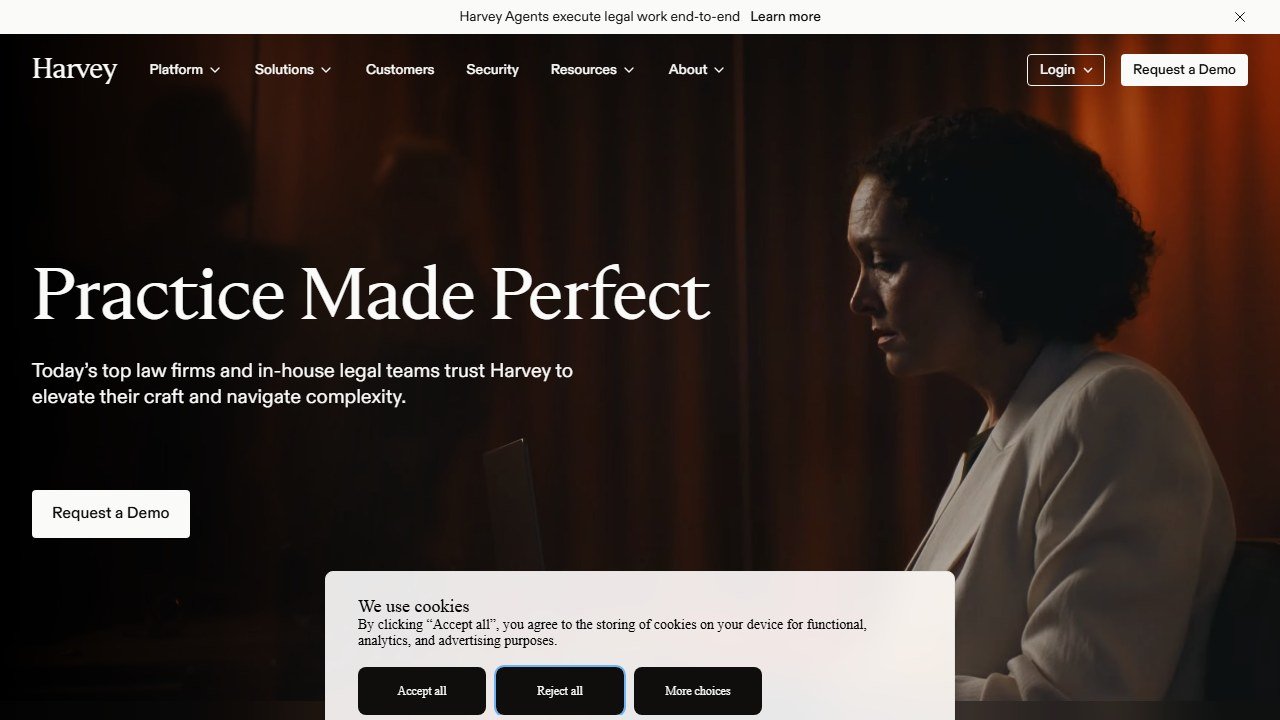
Harvey is the standalone enterprise legal AI platform, and in 2026 it is the most heavily capitalized company in the category. A $200M growth round co-led by GIC and Sequoia closed in March 2026 at an $11B valuation, up from $8B just three months earlier. The current module lineup is Assistant, Vault, Knowledge, Agents, and Contract Intelligence, plus Command Center for admins, Shared Spaces, and a mobile app. If you see “Workflows” presented as a Harvey module, you are reading an outdated page: that is not a current module name.
In practice, for the full review, Harvey’s strength was breadth on top of your own material: multi-document analysis in Vault, research and drafting through Assistant, and firm-specific agents that encode your playbooks. Harvey claims more than 700K daily tasks and 25K firm-built agents on the platform. Those are Harvey’s own numbers, not independently audited, so treat them as vendor-claimed scale signals rather than verified facts.
Who it is for: large firms and in-house departments with the seats, budget, and internal appetite to build custom workflows. The honest limitation: you cannot meaningfully evaluate it without entering a sales cycle, and reported entry costs put it out of reach for most firms under roughly 20 attorneys.
CoCounsel

CoCounsel is Thomson Reuters’ legal AI, born from the $650M Casetext acquisition in 2023 and now sold in four plans (verified on the TR site in July 2026): CoCounsel Essentials, Westlaw Advantage with CoCounsel Essentials, Practical Law Dynamic Tool Set with CoCounsel Essentials, and the flagship CoCounsel Legal, which includes full Westlaw Advantage and the Practical Law Dynamic Tool Set with no exclusions. If a comparison page talks about “CoCounsel Core,” it is describing a plan structure TR no longer uses.
The big 2026 story is the Anthropic partnership. Announced May 12, 2026: the next-generation CoCounsel Legal is built on the Claude Agent SDK, grounded in 1.9 billion Westlaw and Practical Law documents plus 1.4 billion KeyCite citation signals, with an MCP integration that connects Claude itself to CoCounsel Legal. US general availability is planned for August 2026. Frame the model history accurately: historically GPT-4 based via Casetext, next generation built on Claude Agent SDK.
Who it is for: any firm already paying for Westlaw or Practical Law, and any small firm that wants a real buying path. TR claims roughly 1 million professionals across 107 countries use CoCounsel; that is TR’s own figure. The honest limitation: as of 2026, getting the full research experience means buying into Westlaw content tiers, so CoCounsel is less a standalone product than the AI layer of the TR ecosystem.
Who it fits, by firm size
This is the cleanest way to cut the decision, because the two vendors have essentially chosen different markets.
Solo and small firms (1 to 10 attorneys). CoCounsel, and it is not close. TR runs a self-serve online configurator for firms up to 10 attorneys, meaning a solo can price and buy without talking to sales. Harvey’s reported seat minimums of 20 to 25 seats on 12-month contracts translate to a reported entry floor near $288K per year, which is not a small-firm number under any negotiation. If you are in this bracket, also see our best AI tools for small law firms roundup for the wider budget-first field.
Mid-size firms (roughly 10 to 100 attorneys). Genuinely contested. CoCounsel routes firms above 10 attorneys to sales, so both products now involve a sales cycle. The deciding questions become: are you already a Westlaw shop (CoCounsel gets dramatically easier to justify because the research grounding rides on content you already pay for), and do you have the legal ops capacity to build custom agents (Harvey’s differentiator is wasted if nobody at the firm will configure it)? Reported Harvey mid-market pricing runs roughly $1,000 to $2,000 per seat per month, which is a real budget conversation at 50 seats.
AmLaw / BigLaw and large in-house. Harvey’s home turf. The platform is built around firm-specific agents, large-scale document work in Vault, and per-seat economics that reportedly improve sharply at volume: AmLaw 100 firms buying 200+ seats reportedly negotiate down to roughly $100 to $300 per seat per month. Those figures come from third-party sources, not Harvey, but the shape of the curve is consistent across sources. Note that plenty of AmLaw firms run both: Harvey for bespoke workflows, CoCounsel for Westlaw-grounded research. This is not always an either/or.
Pricing models: quote-only vs configurator
Neither company puts a price on its website, but the buying experiences are very different.
Harvey is quote-only in the strictest sense: harvey.ai has demo requests and ROI calculators and nothing else (we verified in July 2026). Every number in circulation is third-party reported: roughly $1,200 per seat per month base, about $2,400 with a LexisNexis bundle, a smaller-firm tier reported around $399, and median contracts reported near $175K per year, with one source framing $50K to $200K as typical. The sources conflict, and Harvey confirms none of it. Reported seat minimums also vary between 20 and 25+ depending on who you ask.
CoCounsel is gated but partially self-discoverable. The official plans page shows no prices, and quotes depend on sector, attorney count, jurisdiction, and term. But because the configurator is open to firms up to 10 attorneys, third parties have derived real numbers from it: a range of roughly $104 to $639 per user per month depending on configuration (costbench, verified June 2026), with a worked example of Westlaw Advantage plus Essentials for a solo, all states and federal, at $639.20 per user per month on a 1-year term, dropping to $519.35 on a 3-year term. Multi-year commitments matter: roughly 18% off for 3 years, 12% for 2.
Two practical consequences. First, you can sanity-check a CoCounsel quote against configurator-derived figures before your sales call; with Harvey you are negotiating blind. Second, CoCounsel’s real total cost hides in the Westlaw dependency: if your firm already spends heavily on Westlaw firm-wide, CoCounsel stacks on top of it.
We keep the full fee math out of this page on purpose. For the line-item budgeting, see our Harvey AI pricing breakdown and CoCounsel pricing breakdown, which carry the source tables and TCO scenarios.
Citation grounding: Westlaw ledger vs custom models
If hallucinated citations are your board-level fear, this section is your decision.
CoCounsel’s anti-hallucination pitch is structural, not just promised. The next-generation system is grounded in 1.9 billion Westlaw and Practical Law documents with 1.4 billion KeyCite citation signals, and it produces a citation ledger: answers trace back to identifiable, KeyCite-flagged sources in a corpus your firm already trusts. You still verify (nothing removes that duty), but you are verifying against Westlaw, with the citator signals attached. It is the strongest grounding story in legal AI, because no other vendor owns that corpus.
Harvey’s grounding is your own material. Its custom models work over the documents, precedents, and knowledge your firm loads into Vault and Knowledge, which is exactly right for diligence, contract analysis, and firm-playbook work where your documents are the authority. For case law research, Harvey does not own a Westlaw-scale primary-law corpus with a citator, so citation verification leans more heavily on your lawyers’ workflow. Large firms mitigate this with review protocols; small firms often cannot.
The practical split: for research memos where every cite gets checked by opposing counsel, CoCounsel’s ledger is the safer default. For high-volume work over your own document sets, Harvey’s approach is not a weakness at all, because the source of truth is the deal room, not the reporter. If research tooling is your main axis, our best AI legal research tools ranking covers the field beyond these two.
Agent architecture: Claude Agent SDK rebuild vs Harvey Agents
Both platforms are now selling agents, and the architectures diverge in an interesting way.
Harvey Agents shipped first and are firm-built: Harvey claims 25K agents created by customer firms, encoding tasks like diligence checklists, clause extraction runs, and drafting sequences. The pitch is customization depth: your firm’s agents, on Harvey’s custom models, tuned to your playbooks. The dependency is internal: someone at the firm has to build and maintain them, which is why this lands best where legal ops or innovation teams exist.
CoCounsel’s agent story is the Claude Agent SDK rebuild. Rather than bolting agent features onto the old Casetext-era architecture, TR is rebuilding CoCounsel Legal as an agentic system on Anthropic’s SDK, with MCP integration meaning Claude itself can connect to CoCounsel Legal as a tool. US GA is planned for August 2026, then Canada, UK, and Australia. The pitch is grounded autonomy: agents that plan multi-step research and drafting while staying anchored to the Westlaw corpus and citation ledger.
The honest caveat cuts both ways. Harvey’s agents are shipped and battle-tested at large firms today; the claimed numbers are vendor-sourced but the capability is real and current. CoCounsel’s next-gen agents are, at the time of writing, weeks from US general availability: the architecture is announced, the at-scale performance is not yet publicly proven. If you are signing a 3-year CoCounsel term partly for the agentic future, you are buying a roadmap with a very credible builder behind it, but a roadmap nonetheless.
Lock-in and switching costs
Harvey’s lock-in is contractual and operational. Reported 12-month minimums with 20 to 25+ seats mean a meaningful committed spend, and the deeper hook is the agents: every firm-built agent, every Vault project structure, every embedded workflow is Harvey-specific. Two years in, the switching cost is not the license fee, it is rebuilding your automation layer somewhere else.
CoCounsel’s lock-in is the ecosystem, and it is heavier. As of 2026, the research-capable tiers bundle Westlaw content, so CoCounsel is effectively an extension of your Westlaw relationship. Leaving CoCounsel while keeping Westlaw is easy; leaving the TR ecosystem entirely means replacing your primary research platform, which most firms will simply never do. Multi-year terms (the ones with the 12 to 18% discounts) deepen this. The flip side: if you were never leaving Westlaw anyway, this lock-in costs you nothing you had not already spent.
Neither vendor is a stability risk in the way the 2025 to 2026 legal AI shakeout made some competitors: Harvey at $11B with ~$1.2B raised, TR being TR. The lock-in question is about flexibility, not survival.
Data handling and deployment
Both vendors lead with enterprise-grade security postures, and both clear the bar that big-firm security teams set. The differences are in the details.
TR states plainly that customer data is not used to train third-party models, a commitment made explicitly in the Anthropic partnership announcement. Deployment rides on TR’s existing enterprise infrastructure, and for firms that have already run security review on Westlaw and Practical Law, CoCounsel mostly inherits an approved vendor relationship: procurement tends to be faster for that reason alone.
Harvey’s positioning is enterprise-first isolation: firm data stays within the firm’s environment on the platform, and its custom-model approach means the sensitive work product driving your agents is not feeding a shared consumer model. Large-firm security teams have approved Harvey at scale across AmLaw and Magic Circle firms, which is a meaningful signal in itself. As always, the specific commitments live in the contract, not the marketing page: get training-use, retention, and residency terms in writing from either vendor.
Verdict: which one fits your firm
Choose CoCounsel if you are a solo, small, or mid-size firm, or any firm already committed to Westlaw. You get a real buying path (self-serve up to 10 attorneys), configurator-visible price anchors, and the strongest citation grounding in the category, backed by the Claude Agent SDK rebuild landing in August 2026. The catch is the bundle: budget for the Westlaw dependency, not just the CoCounsel line.
Choose Harvey if you are an AmLaw-scale firm or large in-house department with the seats to clear reported minimums and the internal capacity to build custom agents. It is the deeper platform for bespoke, high-volume work over your own documents, and the per-seat economics reportedly improve dramatically at volume. The catch is opacity: no published pricing, conflicting reported figures, and a sales cycle you cannot shortcut.
If you are torn in the middle, the tiebreaker is grounding: pick CoCounsel when the work product is research that lives or dies on citations, pick Harvey when it is document-heavy transactional work where your own files are the source of truth. And if the budget for either makes you wince, that is a signal too: the wider market has credible options at a fraction of these numbers, starting with our full map of the best AI tools for lawyers.

Written by
FazFaz is the founder of AIToolsBakery. Some tools here are tested hands on. Others are assessed from vendor documentation and pricing verified on the live page, and every review says which one it is. Sponsors can buy a position in a guide. They cannot buy the score, the criticism, or silence about a better option.
How we test and how we make money →