Try to budget for Spellbook and you hit a wall fast. The vendor publishes no prices, and the third-party estimates that fill the vacuum disagree by a factor of 25: we found figures from roughly $20 per seat per month all the way to roughly $500. Most pricing pages online quietly pick one number and present it as settled. It is not.
We did it the slow way instead. We pulled every credible third-party estimate we could find, dated them, labeled each one by source, and triangulated the range that actually holds up. This page is the result: the divergence table, the reported seat minimums and commitment terms, the late-2025 enterprise price increase, and per-team cost scenarios for a solo lawyer, a 5-seat firm, and a 15-seat in-house team.
One scope note up front: this is a cost page only. We have not published a full Spellbook review, so you will not find a feature verdict here. For how Spellbook stacks up against the category, see our best AI contract review software roundup, and for the platform-vs-add-in decision, our Spellbook vs Harvey comparison.
The divergence table: every reported figure, labeled by source
This is the table Spellbook’s own site will not give you. Every figure below is a third-party estimate. None of them is official, and we label each by who reported it and when, because the source and the date change how much weight a number deserves.
| Figure | Tier it supposedly covers | Source | Reported when | Official? |
|---|---|---|---|---|
| ~$20/user/mo | Entry tier | HyperStart | May 2026 | No, third-party estimate |
| ~$40/user/mo | Mid tier | HyperStart | May 2026 | No, third-party estimate |
| ~$99/user/mo | Professional entry | Multiple aggregators | 2025 into 2026 | No, reported range |
| ~$149/user/mo | Professional, annual billing | Multiple aggregators | 2025 into 2026 | No, reported range |
| ~$179/user/mo | Enterprise, pre-increase | Aggregator reporting on the late-2025 change | Before late 2025 | No, reported legacy figure |
| ~$199 to $350/user/mo | Enterprise, current | Multiple aggregators | Late 2025 into 2026 | No, reported range |
| ~$350/user/mo | Enterprise | HyperStart | May 2026 | No, third-party estimate |
| ~$500/user/mo | Per seat, unspecified tier | Vaquill | July 2026 | No, third-party estimate |
| 7-day free trial | All new users, self-serve | spellbook.com pricing page | Verified July 2026 | Yes, official |
| 10-seat minimum, 6-month commitment | Enterprise agreements | Third-party reporting | 2025 into 2026 | No, reported |
| Monthly billing ~20% above annual | All paid tiers | Aggregators | 2025 into 2026 | No, reported |
Read that table honestly and one thing jumps out: the only official number in the entire Spellbook pricing conversation is the length of the free trial.
What Spellbook actually sells
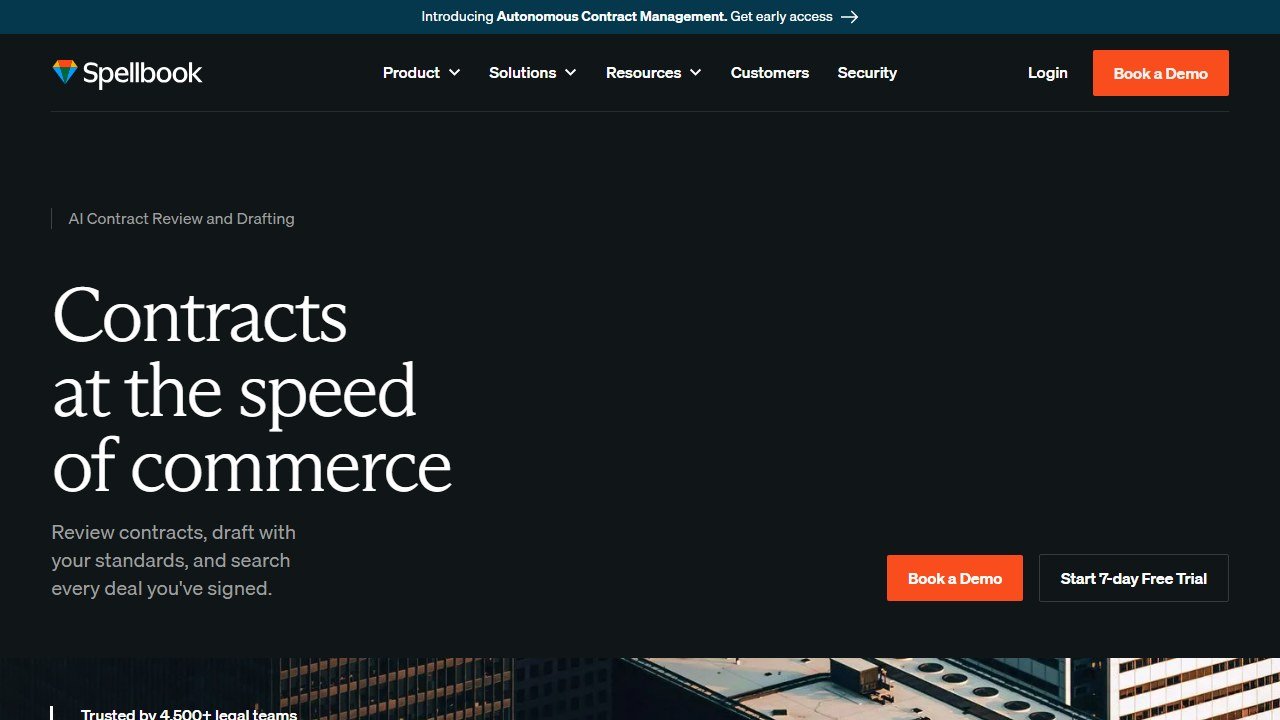
Spellbook, the product behind the quote
Before the cost math, a quick map of what your quote is actually pricing, because module scope is one of the levers that moves it.
Spellbook is a contract drafting and review tool that lives inside Microsoft Word. The official lineup is the Spellbook Suite: the Word Add-In plus Associate, its multi-document agent. Feature-wise the suite covers Review (redline suggestions and issue spotting), Draft (clause and full-document generation), Ask (questions against your uploaded contracts), Benchmarks (market-standard comparisons), and Playbooks (your firm’s positions applied automatically).
Two buying-process facts are verified on the official site as of July 2026. First, spellbook.com/pricing says exactly this: “Custom pricing for modern legal teams,” with a demo request as the only path to a number. Second, the 7-day free trial starts self-serve, no sales call required, which is genuinely rare in legal AI and matters for how you evaluate it. Also worth knowing: spellbook.com is now the primary domain, and the old spellbook.legal address is a legacy redirect.
So the honest answer to “how much does Spellbook cost” is: whatever your quote says, and the rest of this page is about walking into that quote conversation knowing the reported bands.
Why the estimates diverge 25x
A 25x spread between the lowest and highest reported figures is not normal, even for quote-only software. Three things explain it.
The estimates describe different tiers without saying so. HyperStart’s ~$20 and ~$40 figures, if they were ever real, would describe a stripped-down entry tier. Vaquill’s ~$500 figure reads like an enterprise seat with everything switched on. Aggregators flatten “Spellbook pricing” into a single number and skip the tier context, so a reader comparing two sources thinks they contradict when they may just describe different products.
The price moved underneath them. Third-party reporting describes an enterprise increase from roughly $179 to roughly $350 per seat per month in late 2025. Any estimate collected before that repricing is stale, and most aggregator pages do not date their data. A “Spellbook costs $179” claim and a “Spellbook costs $350” claim can both have been accurate, twelve months apart.
Most sources are competitors. HyperStart and Vaquill both sell contract AI. Their Spellbook pricing pages exist to catch your search and route you to their own demo. That does not automatically make the numbers wrong, but it means nobody in the SERP has an incentive to publish a careful, dated, tier-labeled range. Which is why we built the table above.
The credible range, triangulated
Strip out the outliers and here is where the weight of reporting lands.
The ~$20 and ~$40 figures sit alone at the bottom, contradicted by every other source, and would be strange economics for a tool reportedly on a $100M ARR trajectory. We discount them heavily. The ~$500 figure sits alone at the top, from a single competitor page in July 2026; it is plausible as a fully loaded enterprise seat but not as a baseline.
That leaves the cluster most sources agree on:
- Professional and team tiers: roughly $99 to $149 per user per month, with the higher end typically tied to annual billing on the fuller feature set.
- Enterprise: roughly $199 to $350 per user per month, post the late-2025 increase, with a reported 10-seat minimum and a 6-month commitment.
- Monthly billing: reportedly about 20% above the annual rate, consistent with how most legal SaaS penalizes month-to-month flexibility.
Every one of those is a reported figure. But when independent-ish sources converge on a band across 2025 and 2026, and the outliers each come from a single competitor, the band is the best available planning number.
What actually drives your quote
Since the price is custom, it helps to know the variables the quote is built from. Based on the reported structure, four things move the number:
- Seat count. Per-seat licensing is the reported backbone. More seats, lower per-seat rate, and the 10-seat enterprise threshold is reportedly where the pricing model itself changes.
- Modules. A quote covering the Word Add-In alone should land differently than one including Associate, the multi-document agent. Ask for the line-item split; bundled quotes hide where the money goes.
- Commitment length. Annual reportedly saves about 20% versus monthly, and enterprise deals reportedly carry a 6-month floor. Longer terms are your main discount lever.
- Timing. The late-2025 enterprise repricing shows Spellbook adjusts list pricing as it grows. A quote from early 2025 is not evidence of what you will pay now.
Cost scenarios: what three real teams would budget
Using the credible reported bands, here is the planning math. These are estimates built on estimates, so use them for budgeting, not for holding a sales rep to a number.
Solo attorney. One seat at the reported professional band of $99 to $149 per month, annual billing, is roughly $1,200 to $1,800 per year. On monthly billing with the reported ~20% premium, closer to $1,430 to $2,150. The 7-day trial means you can validate against your own contracts before spending anything.
5-seat firm. Five professional seats at the same band run roughly $5,900 to $8,900 per year on annual billing. You are reportedly below the 10-seat enterprise threshold, so expect per-seat pricing without the enterprise minimum mechanics, and less negotiating room.
15-seat in-house team. This lands in reported enterprise territory: 15 seats at $199 to $350 per month is roughly $35,800 to $63,000 per year, with the reported 6-month minimum commitment. At this size you have leverage: multi-year terms, module scope, and rollout phasing are all negotiable, and the spread between the bottom and top of that band is exactly why you get competing quotes. Our in-house counsel tools roundup covers what else that budget buys.
When the math pays off
The sanity check for any of these numbers is drafting time. Take a mid-band professional seat at roughly $125 per month, reported. If a lawyer bills at $300 per hour, the seat costs about 25 minutes of billed time per month. If Spellbook saves even one hour of first-pass contract review or clause drafting per month per user, the reported price clears easily; most teams evaluating tools in this class report saving multiples of that per week, though you should verify against your own matter mix during the trial.
The math gets harder at the reported enterprise band. At $350 per seat, you need roughly 70 minutes of saved billable time per user per month just to break even at $300 per hour, and in-house teams without billable rates should benchmark against loaded salary cost instead. That is the calculation to run before the demo, not after. If the enterprise number does not clear for your workflow, the market has in-Word alternatives at published prices; our Spellbook alternatives guide maps them by job.
The consolidator context: what the funding means for your contract
Two money facts are verified and worth weighing as a buyer, because they speak to vendor stability, the thing pricing pages never cover.
Spellbook raised a $50M Series B in October 2025, led by Khosla Ventures at a $350M post-money valuation, taking total equity raised past $80M (Businesswire, October 9, 2025). Then in March 2026 it took on $40M in debt from RBCx, earmarked for roughly five acquisitions totaling around $60M over two years. BetaKit’s reporting from the same period describes a roughly $100M ARR trajectory and a Canadian Bar Association partnership.
The buyer translation: you are pricing a consolidator, not a startup. That cuts both ways. On the plus side, vendor-collapse risk, the thing that burned buyers of other legal AI tools in the 2025 shakeout, looks low here. On the minus side, a company that just repriced enterprise upward and is buying competitors has pricing power and knows it. Lock your rate for as long as you can tolerate: a reported 6-month enterprise minimum is a floor, but a 12- or 24-month price hold is the thing worth trading commitment for, especially with the late-2025 increase as precedent.
What to ask for on the sales call
Walk in with the divergence table and ask for these specifically:
- The line-item split between the Word Add-In and Associate, so you know what dropping a module saves.
- A written price hold of 12 months or more, citing the late-2025 repricing as your reason.
- The actual seat minimum and commitment term in writing, since both are reported-only.
- The annual-vs-monthly delta for your quote, to confirm whether the reported ~20% gap holds.
- Growth pricing: what seat 11 costs when you cross the reported enterprise threshold, before you are already locked in.
Verdict: budget the band, negotiate the term
Spellbook’s real 2026 price, per the weight of third-party reporting, is roughly $99 to $149 per user per month for professional teams and $199 to $350 at enterprise scale with a reported 10-seat minimum. Nothing outside the 7-day trial is official, the outlier estimates of ~$20 and ~$500 do not survive triangulation, and the late-2025 enterprise increase means old quotes and old blog posts are stale.
Budget the top of your band, run the trial against real contracts first, and spend your negotiating capital on a price hold rather than a discount. And if the quote comes back above the band here, that is your signal to get competing numbers: start with our best AI tools for lawyers market map or the job-by-job Spellbook alternatives breakdown before you sign.

Written by
FazFaz is the founder of AIToolsBakery. Some tools here are tested hands on. Others are assessed from vendor documentation and pricing verified on the live page, and every review says which one it is. Sponsors can buy a position in a guide. They cannot buy the score, the criticism, or silence about a better option.
How we test and how we make money →