
Search for “Spellbook vs Harvey” and here is what page one gives you: Spellbook’s own comparison page ranking itself first, and a stack of rival legal AI vendors reviewing both companies with a verdict that always lands on “consider us instead.” There is not a single neutral answer in the results, so we wrote one.
Here is the thing the vendor pages will not say plainly: this is not really a feature war. It is a buyer qualification question. Spellbook is a Microsoft Word add-in with a 7-day self-serve trial that a solo transactional lawyer can start this afternoon. Harvey is a quote-only enterprise platform with reported seat minimums of 20 to 25 seats and contracts that reportedly land around $175K per year. Before you compare a single feature, ask which one you can actually buy. For most readers, that question ends the comparison. For the rest, we break down the buying process, the reported price gap, and the functional split below. Harvey’s full feature verdict lives in our Harvey AI review; this page is the decision framework.
Spellbook vs Harvey at a glance
| Decision factor | Spellbook | Harvey AI |
|---|---|---|
| What it is | Microsoft Word add-in for contract review, redlining, and drafting | Standalone enterprise platform for research, diligence, and multi-document analysis |
| How you buy it | Self-serve 7-day free trial, then a quote | Demo request, then an enterprise sales cycle. No trial, no self-serve |
| Official published pricing | None. “Custom pricing for modern legal teams” | None. Demo request and ROI calculators only |
| Reported pricing (unofficial) | ~$99/user/mo entry, ~$149 professional annual, ~$199 to $350 enterprise | ~$1,200/seat/mo base mid-market, ~$100 to $200/seat/mo at 200+ seats, median contract ~$175K/yr |
| Reported minimums | 10-seat minimum and 6-month commitment on enterprise tier only | 20 to 25 seats on 12-month contracts (sources vary) |
| Core buyer | Solo, small firm, and in-house transactional lawyers | AmLaw, Magic Circle, and large in-house legal departments |
| Works inside Word | Yes, that is the whole product | No native in-Word redlining |
| Custom agents | Associate multi-document agent | Full custom agent building on firm workflows |
| Company scale | $50M Series B (Oct 2025), ~$100M ARR trajectory (reported) | $11B valuation (Mar 2026), 100,000+ lawyers reported across 1,300+ orgs |
Every dollar figure in that table is a third-party estimate. Neither vendor publishes a price, which tells you something about how each expects to sell. We label all of it as reported throughout, because the divergence between sources is real and worth knowing before a sales call.
The question that decides this comparison: which one can you actually buy?
Most versus pages jump straight to features. That is the wrong order here, because the two products have completely different front doors.
Spellbook: swipe a card, start today
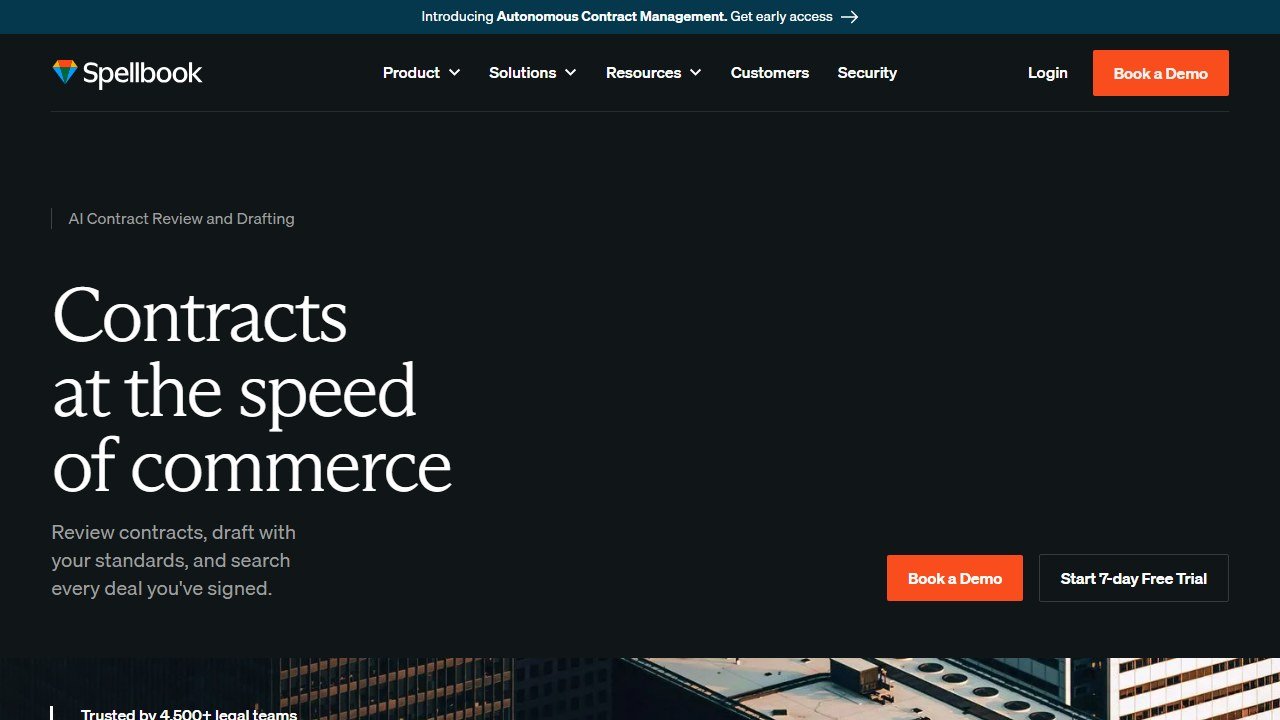
Spellbook offers a 7-day free trial you start yourself from spellbook.com. No demo call, no procurement review, no NDA before you see the product. You install the Word add-in, point it at a real contract, and know within an hour whether it fits your practice. We verified the self-serve trial flow on the official pricing page in July 2026.
That single fact defines Spellbook’s buyer. A solo transactional lawyer, a three-attorney firm, or a two-person in-house team can evaluate and adopt it without anyone’s permission. The pricing page itself says only “Custom pricing for modern legal teams,” so the final quote still involves a conversation, but the evaluation does not.
What you are evaluating: the Spellbook Suite pairs the Word add-in with Associate, its multi-document agent. The named features are Review (clause-level contract analysis against your positions), Draft (generating clauses and full agreements), Ask (questions answered against uploaded contracts), Benchmarks (comparing terms to market standards), and Playbooks (encoding your firm’s standard positions so review runs against your rules, not generic ones). Note the scope on Ask: it answers from the contracts you upload, not from a legal research corpus. Spellbook is a drafting and review tool, not a research platform.
One honest limitation: Spellbook does not publish pricing, and the third-party estimates diverge widely, from roughly $99 per user per month at entry to $350 on enterprise tiers, with a reported enterprise repricing from around $179 to around $350 in late 2025. If you are quoted a number, you have almost no public benchmark to negotiate against. We built the full triangulation, including the 25x divergence across sources, in our Spellbook pricing breakdown.
Harvey: book a demo, bring a committee
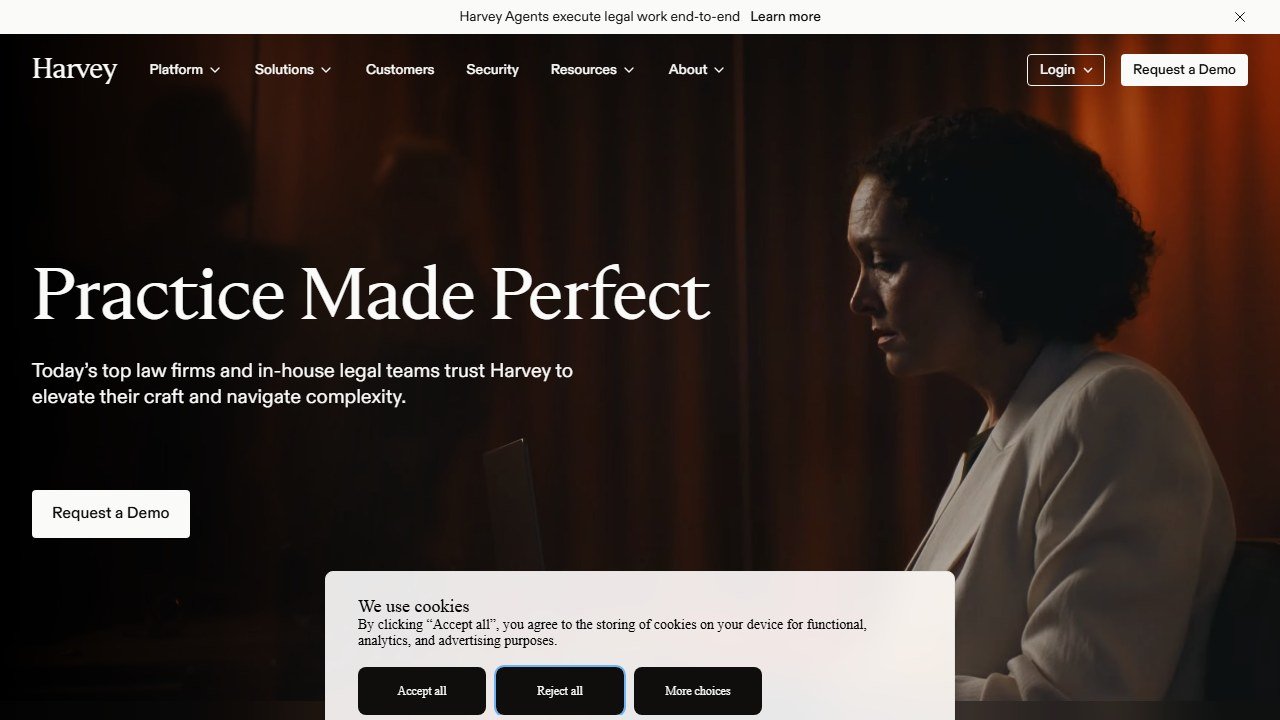
Harvey has no trial, no self-serve path, and no published pricing. The website offers a demo request and ROI calculators, and that is the entire public buying surface (verified July 2026). Everything else happens inside an enterprise sales cycle: security review, procurement, contract negotiation, deployment planning.
That is not a criticism, it is a design choice that matches the product. Harvey is a platform, not an add-in. Its modules span Assistant (general legal AI work), Vault (secure multi-document analysis and diligence workspaces), Knowledge (research), Agents (custom automations built on firm workflows), and Contract Intelligence. Deploying it well means training teams, connecting document repositories, and building firm-specific agents. Harvey claims over 700,000 daily tasks run on the platform, a figure we attribute to Harvey rather than verify, and secondary coverage reports 100,000+ lawyers across 1,300+ organizations.
The company operates at a different altitude than Spellbook too. Harvey closed a $200 million round at an $11 billion valuation in March 2026, co-led by GIC and Sequoia, up from $8 billion just three months earlier. When a vendor is capitalized like that and sells only through sales teams, the product roadmap follows enterprise money. That is great news if you are an AmLaw firm and irrelevant news if you are not.
One honest limitation: you cannot meaningfully evaluate Harvey without committing to the sales process, and the reported entry costs are steep. Third-party sources put the base price around $1,200 per seat per month with minimums of 20 to 25 seats on 12-month contracts, which pencils out to a reported entry floor near $288K per year. Other sources frame typical contracts at $50K to $200K per year with a median around $175K. The band is wide and every number in it is unofficial. We unpack the full reported range, the seat-minimum math, and the negotiation levers in our Harvey AI pricing guide.
The price gap, with the honesty labels attached
Neither company publishes pricing, so treat this section as reconnaissance for a sales call, not a rate card.
Reported Spellbook figures (third-party estimates, not official): roughly $99 per user per month at entry, around $149 for professional tiers on annual billing, and $199 to $350 per user per month for enterprise with a reported 10-seat minimum and 6-month commitment. Monthly billing reportedly runs about 20 percent above annual. A 5-lawyer team at the reported mid-tier lands somewhere around $9,000 per year.
Reported Harvey figures (also unofficial, and they conflict): approximately $1,200 per seat per month as a base, $1,000 to $2,000 per seat per month for mid-market firms of 50 to 200 attorneys, and a reported discount curve down to $100 to $200 per seat per month for the largest buyers taking 200+ seats. Median contract value is reported around $175K per year.
So the honest comparison at equal seat counts is roughly an order of magnitude, but the more useful point is that equal seat counts barely exist. Spellbook’s reported floor is one seat on a trial. Harvey’s reported floor is 20 to 25 seats on an annual contract. The overlap zone, teams of roughly 10 to 25 lawyers who could plausibly buy either, is narrow, and even there the budget conversation is $15K to $40K per year versus a reported $250K and up.
The functional split: in-Word redlining vs platform research and diligence
Once you clear the buying question, the products genuinely do different jobs, and this is where older comparison pages get sloppy.
Spellbook’s job is transactional work inside Word. You are reviewing a supplier agreement, redlining an NDA against your playbook, drafting an indemnification clause, benchmarking a non-compete against market terms. The add-in lives where that work already happens, and Associate extends it across multiple documents when a deal involves a stack of related agreements. If your week is contracts, Spellbook is shaped like your week.
Harvey’s job is platform-scale legal work: research memos, due diligence across data rooms, multi-document analysis in Vault, and custom agents that encode a firm’s own workflows. Its Contract Intelligence module does handle contract analysis, so the categories are not perfectly disjoint, but Harvey does not offer native in-Word redlining, and nobody deploys a 20-seat-minimum platform to redline NDAs.
One framing error to avoid: some comparison pages describe Harvey as a litigation tool. That is wrong, or at least far too narrow. Harvey’s diligence and contract intelligence work is heavily transactional; the accurate description is an enterprise research and diligence platform that spans practice areas, not a litigation product. If you catch a comparison page making that claim, be skeptical of its other claims too.
The practical test: open your calendar from last week. If most of the legal work happened inside a Word document, you are a Spellbook-shaped buyer. If it happened across research databases, data rooms, and internal knowledge systems, you are in Harvey territory, assuming you have the seats to qualify.
Who should pick which
Pick Spellbook if:
- You are a solo, small firm, or in-house team doing primarily transactional and contract work
- You want to evaluate the tool this week, on your own real documents, without a sales cycle
- Your budget conversation is thousands per year, not hundreds of thousands
- Your team lives in Microsoft Word and wants AI to come to them, not the other way around
Pick Harvey if:
- You are an AmLaw or Magic Circle firm, or a large in-house department, with 25+ lawyers who will actually use it
- Research, diligence, and multi-document analysis matter as much as or more than contract redlining
- You want custom agents built on your firm’s own workflows and precedents
- You have the procurement muscle for an enterprise sales cycle and a six-figure annual contract
Pick neither if your core need is a broad comparison of contract review tools rather than these two specifically. Spellbook has real competition in its own lane, and our roundup of the best AI contract review software maps that market properly. And if your Harvey question is really “Harvey or the Thomson Reuters ecosystem,” that is a different decision with different trade-offs, which we cover in Harvey vs CoCounsel.
A note on vendor stability, both directions
Legal AI went through a real shakeout in 2025 and 2026, so stability is a fair question for any tool you are about to build workflows on.
Spellbook looks like a consolidator, not a casualty. It raised a $50 million Series B in October 2025 led by Khosla Ventures, then took on $40 million in debt from RBCx in March 2026 specifically earmarked for acquisitions, with reporting pointing to a roughly $100 million ARR trajectory. Buying Spellbook in 2026 means buying from a company that is absorbing competitors, which cuts both ways: the vendor is durable, but the product may change as acquisitions get folded in, and the reported late-2025 enterprise price increase suggests pricing power is being exercised.
Harvey’s stability signal is blunter: an $11 billion valuation and roughly $1.2 billion in total funding. The risk with Harvey is not survival, it is that a company priced for hypergrowth builds for its largest customers first. If you are at the small end of Harvey’s reported seat range, expect the roadmap to be set by firms much larger than yours.
Verdict
This comparison resolves on buyer identity, not features. Spellbook and Harvey barely compete for the same customer, whatever the versus-page traffic implies.
If you are under roughly 25 lawyers and your work is contracts, Spellbook is not just the better fit, it is the only one of the two you can realistically buy. Start the 7-day trial on your own documents and let the product make its case; just walk into the quote conversation with the reported pricing bands in hand, because you will not find an official rate card.
If you are a large firm or legal department weighing Harvey, the real comparison set is not Spellbook at all. It is other enterprise platforms, your existing research stack, and the build-vs-buy question for custom agents. Our Harvey AI review covers the platform in depth, and the Harvey pricing guide gives you the reported numbers to negotiate against.
And if you land in the narrow overlap, a 15 to 25 lawyer transactional team that could stretch to either: run the Spellbook trial first. It costs you a week. Harvey costs you a sales cycle just to find out the price.

Written by
FazFaz is the founder of AIToolsBakery. Some tools here are tested hands on. Others are assessed from vendor documentation and pricing verified on the live page, and every review says which one it is. Sponsors can buy a position in a guide. They cannot buy the score, the criticism, or silence about a better option.
How we test and how we make money →