
Hevy and Strong are the two best workout-logging apps in 2026, but they are not interchangeable. Pick Hevy if you want a social feed, full Android parity, a $74.99 lifetime license, and a polished free tier. Pick Strong if you live on Apple Watch, want a private logbook, and prefer paying $29.99 per year for a simpler, faster-feeling interface. For most lifters in 2026, Hevy wins on value and feature breadth.
Quick answer: Hevy wins on social features, free-plan breadth and the cheaper one-time price, $74.99 lifetime on the US App Store. Strong wins on a simple, private logbook, with Pro listed at $29.99 a year and a free plan limited to 3 custom routines. Pick Hevy for community and value, Strong for clean, distraction-free logging.Hevy vs Strong pricing: what the App Store lists
Both apps sell Pro inside the app stores rather than on the web. The US App Store listings, read on 17 September 2026, show the in-app purchases below. Some products appear at more than one price, which usually reflects older or promotional offers, so check the price shown in the app on your own device before you buy.
Hevy Pro: $2.99 or $3.99 a month, $23.99 a year, or $74.99 lifetime (one-time). Hevy is free to download and use; its App Store description says Pro adds unlimited routines and unlimited graph history. For the full picture of one app, see our Hevy review and Strong app review.
Strong PRO: $3.99 or $4.99 a month, $19.99 for six months, $23.99 or $29.99 a year, or a one-time Strong PRO Forever at $79.99 or $99.99. Its App Store description says the free version saves unlimited workouts but is limited to 3 custom routines.
On those figures, Hevy's lifetime licence pays for itself after a little over three years against Hevy's own $23.99 yearly plan, and Strong Forever at $99.99 after about three and a third years against $29.99 a year. If you want to pay once, Hevy's $74.99 is the cheaper one-time price of the two. These are our calculations on the listed prices.
10-year cost projection
Year Hevy lifetime ($74.99 once) Hevy yearly ($23.99) Strong yearly ($29.99) Strong Forever ($99.99 once) 1 $74.99 $23.99 $29.99 $99.99 2 $74.99 $47.98 $59.98 $99.99 3 $74.99 $71.97 $89.97 $99.99 5 $74.99 $119.95 $149.95 $99.99 7 $74.99 $167.93 $209.93 $99.99 10 $74.99 $239.90 $299.90 $99.99
Prices last checked: 17 September 2026, US App Store.
Search "hevy vs strong app" on Google and the top five results are written by people who sell workout apps. Setgraph, GymGod, and SensAI all rank in the top five, and each one quietly recommends a different "better alternative" by the bottom of the article. It is a SERP full of conflicted comparisons.
We do not sell a workout app. We read the Hevy and Strong public docs, the App Store reviews, the threads on r/fitness and r/homegym, and we made a call. This post is the version of "hevy vs strong" we wish we had found when we were trying to choose. It includes a 15-row feature matrix, a 10-year cost projection with break-even math, and a decision tree by lifter type at the end.
The 30-second verdict: who each app is for
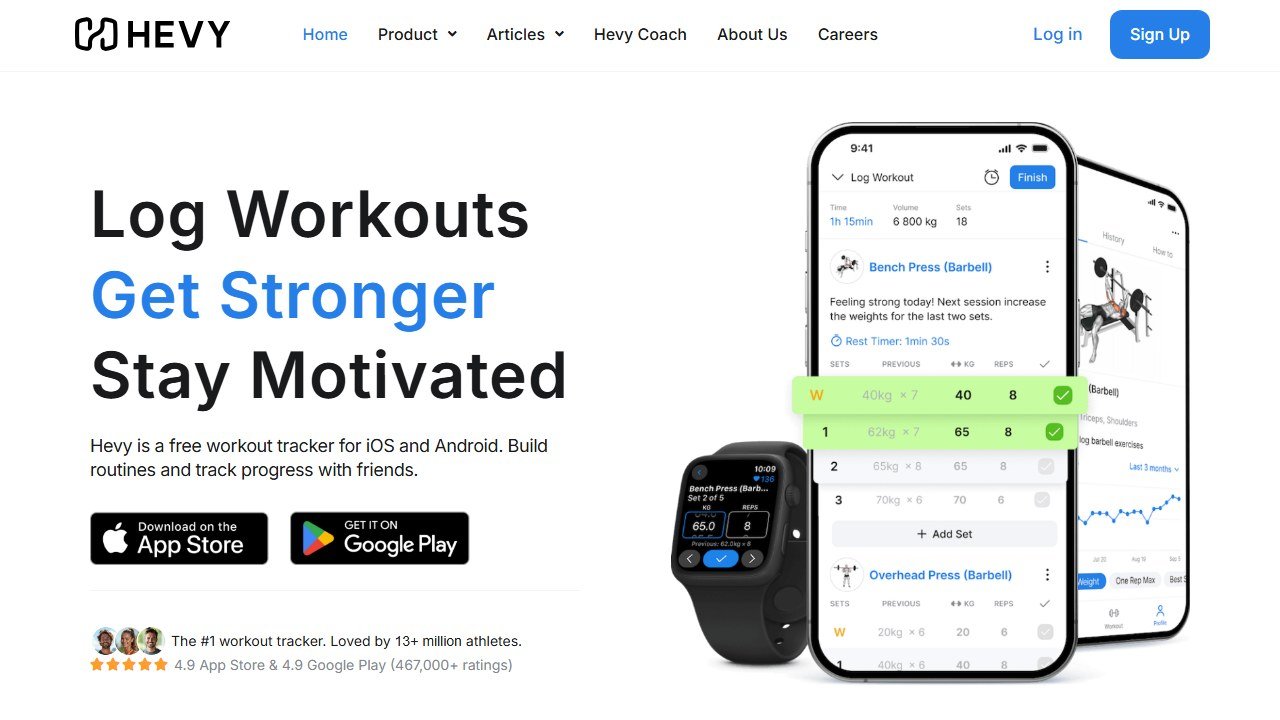
Hevy is the app you pick if you want the modern package: clean UI, full Android parity, a social feed if you want one (ignorable if you do not), advanced features like RIR tracking and supersets handled cleanly, and a one-time $74.99 lifetime licence that pays for itself in a little over three years against Hevy's own yearly plan, and costs less than Strong's one-time Forever price. The free tier is also genuinely useful, not a crippled demo.
Strong is the app you pick if you have been using it since 2015 and your muscle memory does not want to move, if you log workouts primarily from an Apple Watch (where Strong has a documented edge), or if you actively dislike social features and want a quiet, private logbook. Strong is simpler. That is its strength and, depending on what you want, also its ceiling.
How we compared these (no fake bench testing)
We did not run a stopwatch in a gym. We are not pretending to. What this post is based on:
- The Hevy and Strong App Store listings and feature docs; prices re-read on 17 September 2026.
- App Store and Google Play review samples (most-helpful + most-recent, both stars, both apps).
- r/fitness, r/homegym, r/weightroom, and r/xxfitness threads from the last 18 months where users compared the two by name.
- AITB editorial judgment on workout-app UX, having reviewed eight fitness logging apps for the best AI workout app post and the best fitness apps for strength training roundup.
Where we say "users report" or "reviewers consistently note," that is what those public sources say, not our own bench test.
Over 10 years, Hevy lifetime is $74.99 in total, against $299.90 for Strong at $29.99 a year, or $99.99 for Strong Forever. If you are sure you will keep logging, a one-time purchase beats either yearly plan, and Hevy's is the cheaper one.
The counter-argument: if you are not sure you will stick with lifting past a year or two, a yearly plan costs less than any lifetime price, and Hevy's $23.99 listing undercuts Strong's $29.99. For people who have been training for 5+ years already and intend to keep going, a one-time purchase is the better maths.
Free tier: what you actually get without paying
This is underrated. Most people will use the free tier first.
Hevy free: unlimited workouts, but Hevy’s Free vs Pro table caps free accounts at 4 routines, 7 custom exercises and 3 months of stats history, and free body measurements are limited to body weight and waist. Supersets, RPE, the plate calculator, the Apple Watch and Wear OS apps and Strava sync are not listed as Pro. Hevy’s App Store feature list says “Create an unlimited amount of routines”, but the help centre is the more specific source.
Strong free: unlimited workouts, capped at 3 templates (Strong’s new name for routines). Its PRO list adds unlimited templates, body part measurements, all charts, the plate and warm-up calculators, and custom icons and themes. Apple Watch, supersets, RPE, custom exercises, Apple Health and CSV export are not on that list. Strong also promises you will “ALWAYS be able to use the free version”.
If your plan is "free until I am sure I will stick with it," both work: Hevy gives you one more routine and more platforms, Strong limits you to 3 templates but does not limit custom exercises or history on its PRO list.
Logging speed: taps per set
The number-one thing a workout app has to be good at is logging a set without breaking your rest pace. Both apps do this well, but in different ways.
Hevy: tap exercise > previous weight and reps prefilled > tap to confirm or edit > tick. App Store reviews consistently call it "fast" and "clean." The previous-set prefill is the time-saver.
Strong: similar flow, slightly fewer animations, which some Strong loyalists explicitly say they prefer ("Hevy has too much going on, Strong just gets out of the way"). Strong has had the prefill behavior longer and it is rock-solid.
Both are fast enough that the speed difference is a matter of preference. If you have used Strong for years, Hevy will feel slightly busier. If you start fresh with Hevy, Strong will feel slightly sparse.
Android parity: the gap
This is one of the most cited differences in r/homegym and r/Android threads.
Hevy supports iPhone, Android, web, Apple Watch and Wear OS, all on its free plan. On 21 September 2026 it held 4.9 on Google Play from about 268,000 ratings, the same as its App Store score.
Strong’s own help centre documents differences between its Android and iPhone apps: the superset flow differs and will be unified “in a future update”, the plate calculator has “minor differences in functionality”, and Health Connect support is described as part of a Strong 6.0 public beta. We found no Wear OS app. On 21 September 2026 Strong held 4.3 on Google Play from about 43,000 ratings, against 4.9 on the App Store.
If you are on Android, Hevy is the lower-risk choice in 2026. If you are on iOS, the gap closes considerably and other factors matter more.
Apple Watch logging: Strong's documented strength
Strong’s Apple Watch app is its long-standing strength. Its help centre describes live sync with the iPhone and Handoff, needs watchOS 10 or later, and notes that “Not all features of Strong are available on Apple Watch” and that live sync “does increase Apple Watch battery consumption”.
Hevy also has an Apple Watch app, which live-syncs with the phone and tracks heart rate according to its App Store listing, plus a Wear OS app that Strong lacks. For Apple Watch users who want a long-established watch app and no social features, Strong remains a reasonable pick.
If you do not own an Apple Watch, this section does not apply to you, and the rest of the comparison favors Hevy.
Supersets, drop sets, RIR/RPE workflows
Advanced programming features matter for intermediate-to-advanced lifters.
Hevy: supersets are first-class (tap to link exercises into a circuit, the app handles the rest timer accordingly). Drop sets are supported. RIR (Reps in Reserve) and RPE (Rate of Perceived Exertion) can be logged per set. Custom rest timers per exercise.
Strong: supersets, drop sets, failure sets and RPE on a 6 to 10 scale are all documented in its help centre, and none is on its PRO list. Strong notes that its superset flow still differs between iPhone and Android.
For someone running a structured hypertrophy or strength program (5/3/1, RP, GZCL, Push-Pull-Legs with RIR targets), Hevy's modern handling of these features will feel less friction. For someone doing simple linear progression and just wanting a logbook, Strong's simpler approach is fine.
Social feed (Hevy) vs private logging (Strong)
This is the most visible philosophical difference between the two apps.
Hevy has a social feed. You can follow friends, see their workouts, like and comment. You can also turn it off entirely and use Hevy as a pure logbook. The social side is opt-in by behavior; you do not have to engage with it.
Strong has no social feed. It is private by design. Your workouts are yours alone unless you screenshot and share them.
Reading reviews, this splits cleanly:
- Lifters who want accountability, community, or to share PRs love the Hevy feed.
- Lifters who think workout apps should be solo tools find the feed irritating or unnecessary.
If you fall into the second camp, Strong is the more comfortable choice. If you are in the first camp or are indifferent, Hevy gives you the option without forcing it.
One limit is worth knowing: Hevy’s own privacy settings article says you can make your profile and workouts private, but “The Discover feed will remain on the Home screen. As of right now, there is no way to remove this feature.”
Data, charts, PR tracking, CSV export
Both apps track personal records and offer progress charts. Differences:
Hevy: 1RM estimates per lift, volume charts, frequency heatmap, muscle-group distribution, body measurement charts. Hevy’s export of workouts and measurements is not listed as a Pro feature, and Hevy can import CSV files exported from Strong.
Strong: 1RM estimates, volume and intensity charts, PR tracking, body measurements. Its CSV export is not on the PRO list, but Strong says “exported files cannot be imported back into Strong”. The charts are functional but less visually polished than Hevy's, per common review feedback.
For data exporters who want to pull workouts into Google Sheets or a spreadsheet (we have written about this in our AI fitness coaching guide), both apps deliver the CSV. Hevy's export schema is slightly cleaner and easier to pivot, per developer comments on r/fitness.
15-row feature matrix
| Feature | Hevy | Strong |
|---|---|---|
| Free tier (workouts) | Unlimited | Unlimited |
| Free tier (custom routines) | 4 (unlimited on Pro) | 3 (unlimited on PRO) |
| Monthly Pro | $2.99 or $3.99 | $3.99 or $4.99 |
| Annual Pro | $23.99 | $23.99 or $29.99 |
| Lifetime license | $74.99 one-time | Forever, $79.99 or $99.99 one-time |
| iOS app rating (21 Sep 2026) | 4.9 | 4.9 |
| Android app rating (21 Sep 2026) | 4.9 | 4.3 |
| Apple Watch app | Yes (good) | Yes (excellent) |
| Supersets | Polished UI | Supported, older UI |
| Drop sets | Yes | Yes |
| RIR / RPE logging | Yes (per set) | Yes (6 to 10 scale) |
| Social feed | Yes (ignorable) | No |
| Custom exercises | 7 on free, unlimited on Pro | Yes |
| CSV export | Yes; imports Strong CSVs | Yes; cannot be re-imported into Strong |
| Cross-platform sync | iOS + Android + Web | iOS + Android (iOS-first) |
Where each one falls short (honest section)
Where Hevy falls short:
- The social feed, even if ignorable, is something a chunk of lifters fundamentally do not want in their gym app. If that is you, Hevy will always feel slightly cluttered.
- Apple Watch experience is good but not as refined as Strong's.
- No Garmin integration: Hevy says Garmin rejected its application for API access.
- A 150-set limit per workout, even on Pro, and no Apple Family Sharing.
Where Strong falls short:
- Its Android app still differs from iPhone, by Strong’s own help centre, and we found no Wear OS app.
- Its one-time Strong PRO Forever price, $79.99 or $99.99 on the App Store, is higher than Hevy's $74.99 lifetime.
- The advanced-programming UI (supersets, drop sets) is functional but feels dated next to Hevy's.
- A slower release cadence than Hevy: its last iPhone release before 21 September 2026 was on 12 August, while Hevy says it updates every one to two weeks.
Neither app has a fatal flaw. They have personalities, and the right pick depends on which personality fits yours.
Decision tree by lifter type
You are on Android -> Hevy. The parity gap is the dealbreaker. This is the strongest single recommendation in this post.
You live on Apple Watch and log primarily from your wrist -> Strong. The Watch app is the best in the category, full stop.
You want a social/accountability feed -> Hevy. Strong does not have one and is not adding one.
You actively do not want a social feed and consider it bloat -> Strong. Or Hevy with the feed tab ignored, but if the existence of the feed bothers you, pick Strong.
You plan to log workouts for 3+ years and want to stop paying -> Hevy lifetime ($74.99). Math is decisive.
You are trying a workout app for the first time and not sure you will stick -> Hevy free tier. It is the more honest free experience.
You are a long-time Strong user with years of data and no specific complaint -> Stay on Strong. Migration to Hevy is possible, because Hevy imports Strong’s CSV export once, but Strong cannot import anything back, and if Strong is working for you, the upgrade pressure is small.
You run structured hypertrophy programs with RIR/RPE per set -> Hevy. The advanced-logging UI is smoother.
You want the simplest possible logbook with no extra surface area -> Strong. Its simplicity is a feature.
More from AIToolsBakery: best AI workout apps, Fitbod vs JuggernautAI comparison, best AI workout apps for beginners.
The five year roadmap and ecosystem question
Both Hevy and Strong are growing in 2026, but the trajectory differs. Hevy is the higher-velocity product, shipping new features quarterly and aggressively expanding its social community. Its biggest 2026 addition, Hevy Trainer, is a Pro feature that builds a programme from your goals, and Hevy says its programmes “are generated using an algorithm and do not rely on AI”. Strong is the more conservative product, focused on refining the core logging experience and the Apple Watch app rather than building entirely new feature surfaces.
For lifters who want the app to evolve alongside their training, Hevy is the better bet. For lifters who want a stable tool that does exactly the same job in five years, Strong is the safer bet. Most beginners benefit from Hevy’s social features; most intermediate-and-up lifters appreciate Strong’s stability and clean logging.
The 2026 verdict
Hevy is the right pick for lifters who want social features, faster product evolution, and a modern UX. Strong is the right pick for lifters who want a stable, simple, reliable logger and the strongest Apple Watch experience in the category. Both are credible 2026 choices at their respective price points, and the right one depends on whether you want a community alongside your training or just a clean place to log it.
How to tell whether the tool was worth it
Fitness software is easy to evaluate honestly because the numbers are countable and small. The reason most coaches cannot say whether a platform helped is that nobody wrote down where they started.
Pick the metric the tool is supposed to move
For a coaching platform it is clients per coach and hours spent on programming and admin per client per week. For a consumer app it is sessions completed per week and adherence over eight weeks. For form checking it is whether you are still filming in month three. Each of those is countable and each needs a figure from before.
Record the time cost this month, before anything changes
Ask yourself or your coaches to log how long programming, check-ins and admin take across one normal week. It takes minutes and it is the only way the time saving is ever provable. Most of the honest value in this category is hours rather than revenue, and hours are measurable in advance and unprovable afterwards.
Give it two client cycles
Retention and adherence move slowly and seasonally. A four week read tells you about novelty rather than value. Judge a coaching platform over at least two full client cycles, and say so at the outset so an unremarkable first month is understood as expected.
Name the result that would end it
Write down before you subscribe what twelve months would have to look like for you not to renew. It converts renewal from a default into a decision, which matters more in a category where the monthly figure is small enough to stop noticing.

Written by
FazFaz is the founder of AIToolsBakery. Some tools here are tested hands on. Others are assessed from vendor documentation and pricing verified on the live page, and every review says which one it is. Sponsors can buy a position in a guide. They cannot buy the score, the criticism, or silence about a better option.
How we test and how we make money →