Search for school fundraising software and most of what comes back is for the PTA: wrapping paper sales, fun runs, lunch money and auction apps. That is a real market, but it is not what an advancement office needs. An independent school’s development team is running an annual fund, a parent giving programme, alumni relations, major gifts and often a capital campaign, on a donor file that changes every June when a class graduates.
This guide is for that office. It separates the four kinds of software involved, publishes the prices the vendors actually show, maps the AI each one names, and starts from the number that explains most of what follows.
Disclosure: Zilwaris, the consultancy run by AI Tools Bakery’s founder, does paid advisory work for Gratefully, which did not pay for any placement on this page and is assessed on the same criteria as everything else on this site.
How we put this together. We have not used these platforms ourselves; this is a research-based comparison. Prices and features come from each vendor’s own website, read on 4 October 2026, and are linked throughout. Benchmarks come from NAIS Facts at a Glance 2024 to 2025, covering 1,331 member schools, and the CASE Insights on Philanthropy in Independent Schools 2024 key findings, published with NAIS.
The number that shapes school fundraising
In the NAIS data, the median participation rate among parents of current students is 66.2%. Among alumni it is 7.1%. Among parents and grandparents of alumni it is 7.6%. Employees, at 72.0%, are the only group that gives more reliably than current families.
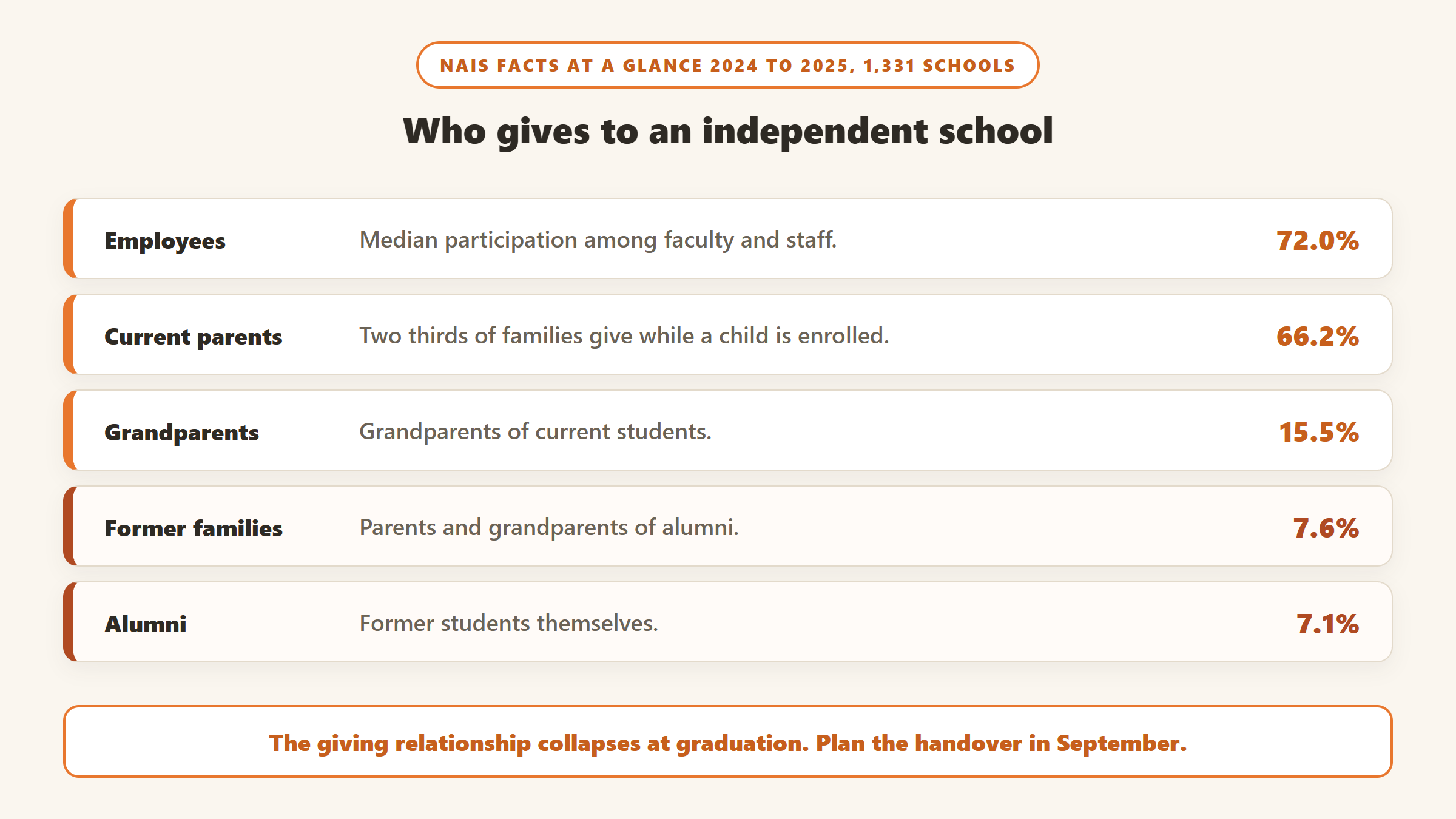
Put plainly, two thirds of families give while their child is enrolled, and fewer than one in ten keep giving once the child has left. The CASE 2024 findings show the same shape in dollars: parents of current students are the largest median source of funds at 25.0%, rising to 30.5% at day schools and 42.3% at elementary schools, while alumni provide a median 10.6%.
Two other CASE figures matter for software. Among the 383 schools reporting every year from 2022 to 2024, the number of donors fell 3.5% while funds received held roughly level, so schools are raising similar amounts from fewer people. And the largest single donor accounts for a median 25.6% of funds raised, so losing track of one relationship can move the whole year. Nearly half the schools, 44.7%, were in a comprehensive campaign.
The software question that follows is simple: does your system know who is a current parent, who is about to become a former parent, and who has not been thanked? Most of the cost and complexity in this market is about answering that.
Four kinds of software, and how schools combine them
The school system with a development module
Veracross and Blackbaud’s school suite keep students, families, billing and development in one place, so a donor record already knows which children are enrolled and when they graduate. That is the strongest answer to the parent problem above. Both are quote only.
A standalone donor CRM
Raiser’s Edge NXT, Bloomerang, Little Green Light, DonorPerfect and Salesforce hold gifts, pledges, campaigns and relationships, and connect to the school system for family data. Smaller schools often run one of these without a full school suite.
A giving and engagement platform
GiveCampus, Givebutter and OneCause run the giving day, the online forms, the volunteer ambassadors and the auction. They feed gifts into the CRM rather than replacing it.
An intelligence layer
The newest layer reads the CRM and the notes around it and tells a small team who to contact next and why. It replaces nothing, and it is most useful where the advancement office is two or three people covering everything.
What the platforms cost
| Platform | Type | Published price, 4 October 2026 |
|---|---|---|
| Little Green Light | Donor CRM | $45 a month to 2,500 records, $135 at 50,000; 10% off annually |
| Bloomerang | Donor CRM | CRM from $125 a month, billed annually |
| DonorPerfect | Donor CRM | “Plans start at $119 per month”; tiers by quote |
| Salesforce Nonprofit Cloud | CRM platform | $70 to $285 per user per month, billed annually; 10 free Core licences for eligible nonprofits |
| Givebutter | Giving platform | Free with optional donor tips, or a 3% platform fee with tips off; Plus from $29 a month |
| Raiser’s Edge NXT | Donor CRM | Quote only |
| Veracross | School system with development | Not published |
| GiveCampus | Giving and engagement | Quote only, priced on dollars raised, volunteers, users and guests |
The pattern is familiar from the wider nonprofit market: the products built specifically for schools publish nothing, and the general nonprofit CRMs publish everything. If predictable budgeting matters to your business office, that is worth weighing on its own.
The platforms compared
Blackbaud Raiser’s Edge NXT
Raiser’s Edge NXT is the fundraising CRM inside Blackbaud’s school offering, which it calls the Total School Solution. One detail that confuses buyers: the Blackbaud Education Management pages list enrolment, the student information system, learning management, tuition, financial aid and websites, but not fundraising, so a school buys Raiser’s Edge NXT for that. Its product page names Prospect Insights for finding donors likely to give more, Chat for Blackbaud AI for donor summaries and talking points, and connectors for Claude and Microsoft Copilot, with AI off until an administrator opts in. The Development Agent, which runs email and text outreach to mid level donors, is currently for US Raiser’s Edge NXT customers. Pricing is customised.
Veracross
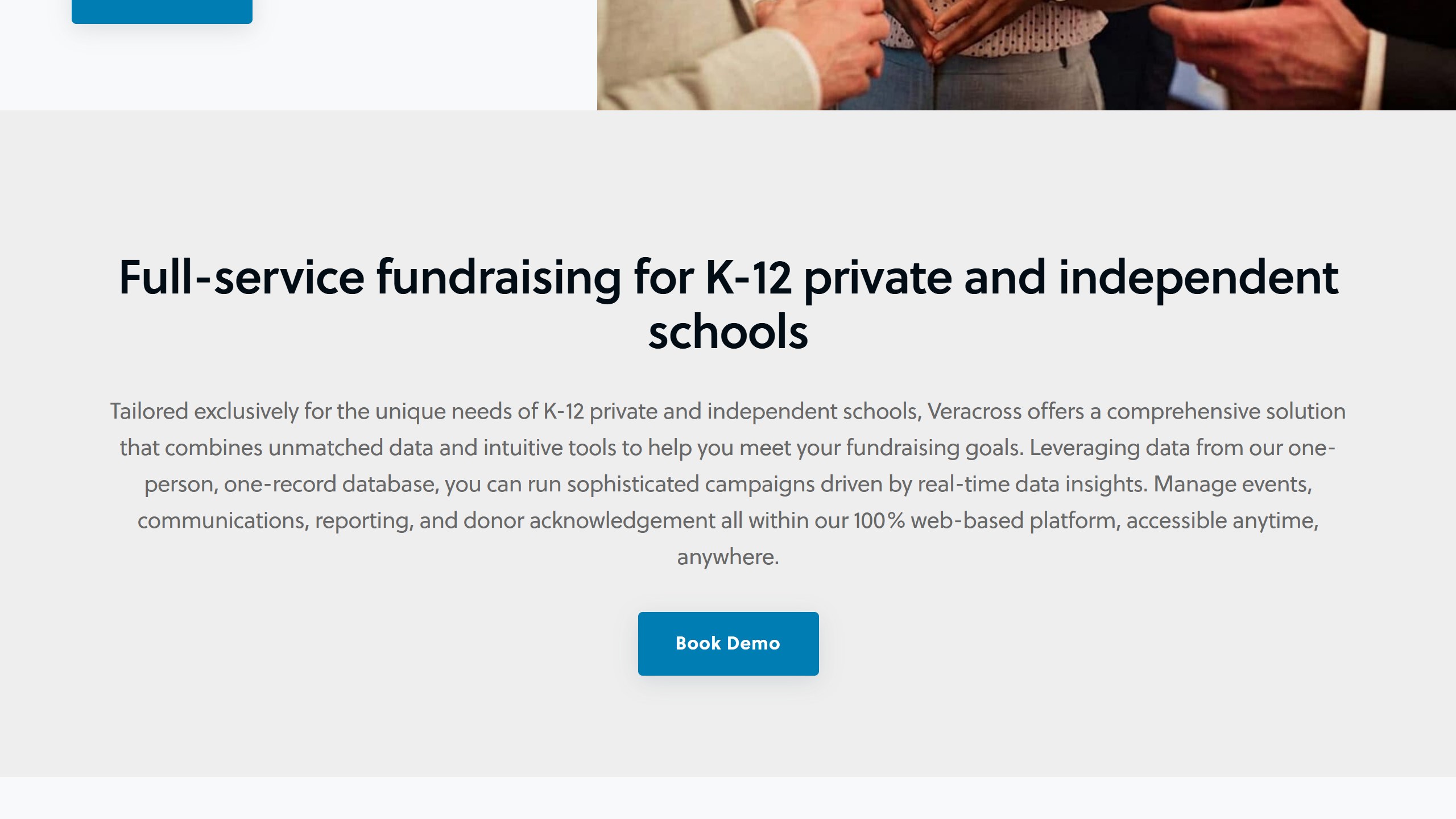
Veracross describes its development module as built “exclusively” for K to 12 private and independent schools, on a one person, one record database shared with admissions, academics and billing. It covers gifts, pledges, soft credits, campaigns, moves management, tribute gifts, a volunteer solicitor portal and reconciliation with the business office. Its AI page describes natural language reporting and donor engagement analytics. No price is published.
Little Green Light
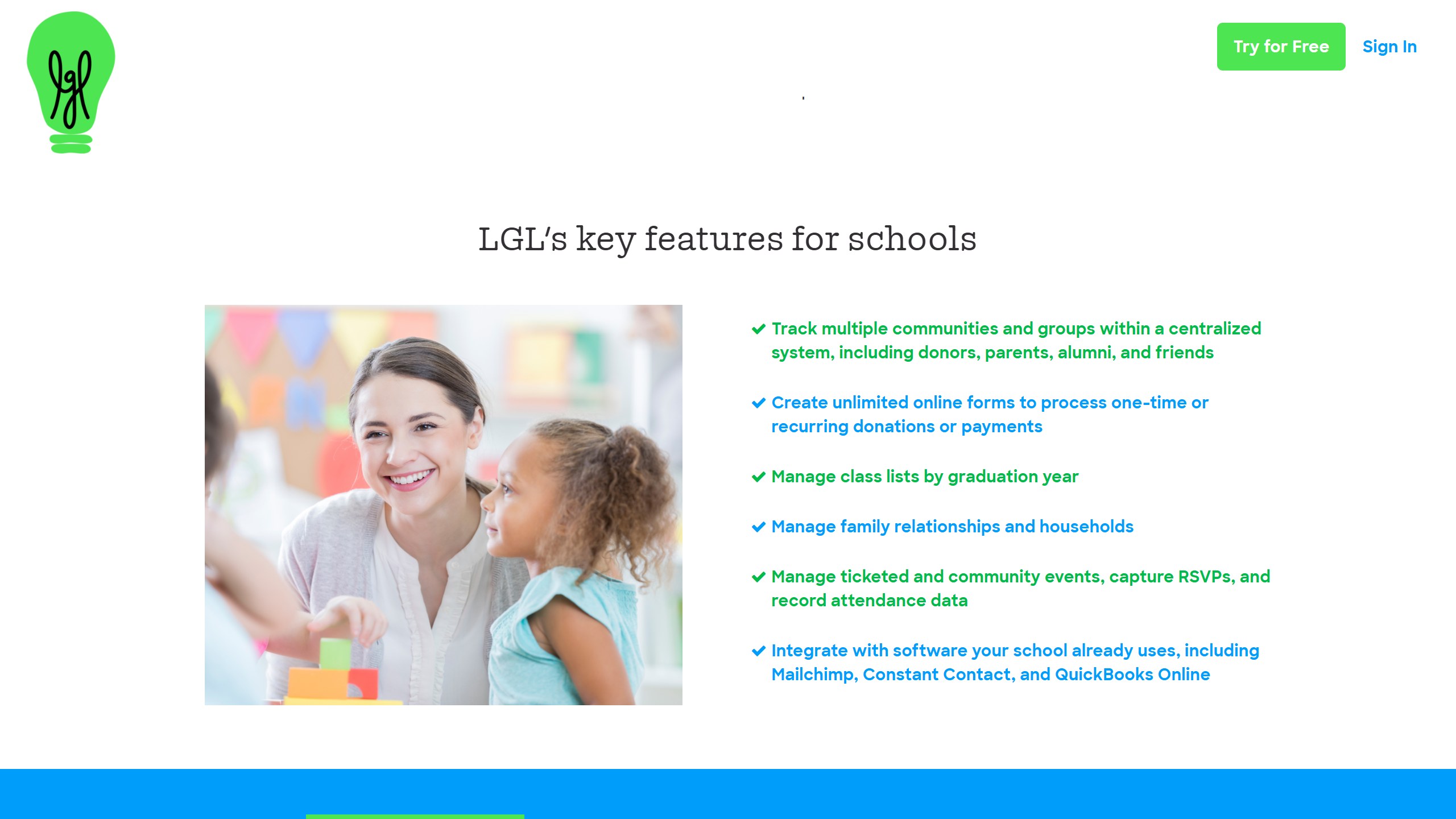
Little Green Light is the cheapest full donor CRM here and has a page for schools: track donors, parents, alumni and friends, manage class lists by graduation year, and group households. Its pricing runs from $45 a month for 2,500 records to $135 for 50,000, with every feature and unlimited users, 10% off when billed annually, and a 30 day trial. We found no AI features on its site. Class lists by graduation year are a simple, practical answer to the parent problem for a school too small for a full suite.
Bloomerang
Bloomerang is not school specific, but it suits a small school that wants retention tools. The CRM starts at $125 a month billed annually, with fundraising forms from $40 when bought with the CRM. Its AI page names Penny, an assistant, and predictive insights for who is ready to give more or likely to lapse, built with Dataro, on select plans. Its pricing FAQ says “You own your data” with easy exports.
DonorPerfect and Salesforce
DonorPerfect targets education nonprofits and alumni giving, with plans from $119 a month and a free AI writing tool. Salesforce for K to 12 covers enrolment, student success and fundraising for schools that want one customisable platform and have the administrator time to run it. Nonprofit Cloud lists $70 to $285 per user per month on its pricing page; Education Cloud is priced separately, so get a quote for the edition you would actually use.
GiveCampus
GiveCampus is built “specifically and exclusively for schools” and says more than 1,500 schools raised over $10 billion on it in 2025. It runs online giving, giving days, volunteer ambassadors, events and gift officer tools. Its pricing is by quote, with editions called Essentials, Professional and Enterprise and a note to ask about plans for independent schools. Its AI includes content generation, smart segments and smart ask amounts in every edition, with two AI agents sold separately. It has a direct integration with Raiser’s Edge NXT; schools on Veracross import gifts through a GiveCampus report file instead.
Givebutter and OneCause
Givebutter is free if you let donors add a tip, or charges a flat 3% platform fee if you turn tips off, plus card processing; its AI features are free. It leans towards PTA and booster fundraising but works for a small school’s online appeal. OneCause is the specialist for galas and auctions and quotes its prices.
Where donor intelligence fits in a school
The school market’s biggest gap is not features, it is time. CASE reports a median of 7.0 advancement staff across all functions, but elementary schools in the same data have a median of 4.0, and many smaller schools run development with two or three people who also handle events, communications and the auction.
That is the office our top pick is built for. Its page for independent schools describes a ranked daily list of who to contact and why, stewardship moments such as unacknowledged gifts, plain English answers with the source record cited, drafted outreach in the school’s voice, lapsed recurring gifts flagged, and handover files for each relationship when a staff member leaves. That last point matters in a sector where a major donor can be a quarter of the year’s total.
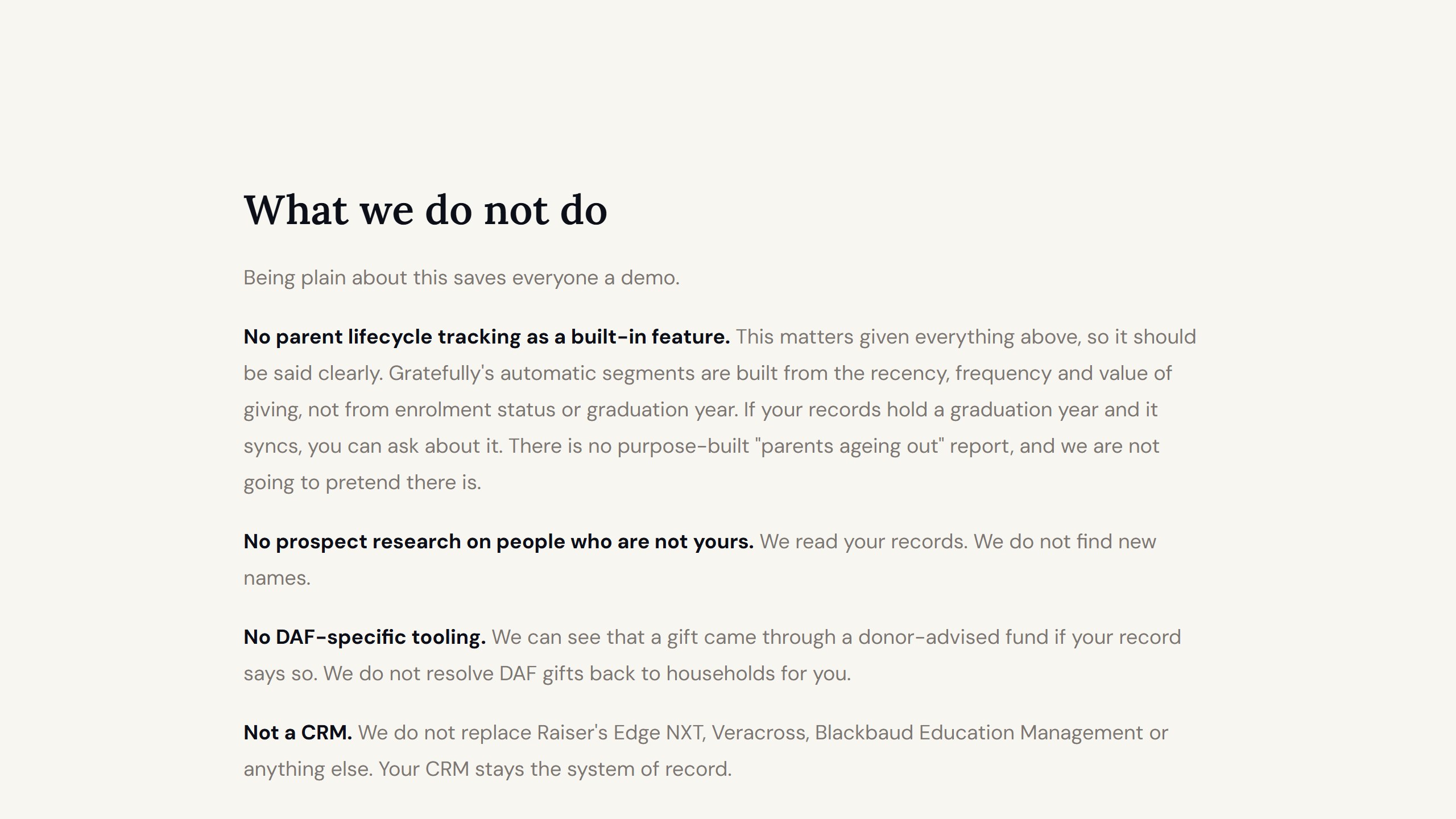
Be clear about the limits, because its own page is. It syncs directly with Salesforce Nonprofit Cloud and NPSP, Bloomerang and Little Green Light; if you run Raiser’s Edge NXT, Veracross or Blackbaud Education Management, you work from a CSV export and document upload. It has “no parent lifecycle tracking as a built-in feature”: its segments come from giving recency, frequency and value, not enrolment status or graduation year, so your CRM still has to know who is a current parent. And it does no wealth screening. Pricing on 4 October 2026 was a free plan for one person, then $79, $399 and $799 a month billed yearly.
The combination we would look at first for a small school is Little Green Light or Bloomerang as the CRM, with class years recorded, and an intelligence layer on top. Both connect natively, and the total is a fraction of a school suite.
Setting up the graduation handover in any CRM
No software fixes the drop at graduation on its own, but the right fields make it a routine rather than a scramble. This works in any of the CRMs above.
Record the expected graduation year on every family. Not just on the student. A family with two children has two dates, and the later one is when the giving relationship is most at risk. Little Green Light’s class lists by graduation year do this out of the box; in other systems a custom field or group does the same job.
Build a “leaving next June” segment in September. That gives you a full school year to thank, involve and ask those families before they become former parents. Most schools start in May, when it is too late to do more than a farewell letter.
Give each leaving family a reason to stay. A named fund linked to their child’s activity, a seat on a class committee, an invitation to a parents of alumni event. The goal is a relationship with the school, not only with the child’s year group.
Change the record type on the day, not at year end. When the family becomes a former parent, the record should move to its new segment immediately, so appeals and reports stop treating them as current parents.
The arithmetic shows why this is worth an afternoon. Take a graduating class of 60 families. At the NAIS median for current parents, about 40 of them give. At the median NAIS rate for parents and grandparents of alumni, about 5 of them would be giving once their children have left. Keeping even ten more of those families giving, year after year, is a bigger annual fund gain than most schools get from any new tool, and it costs a few fields and a calendar reminder.
This is also where the different kinds of software meet. The school system or CRM holds the graduation date. The giving platform makes the ask easy. An intelligence layer, if you have one, notices which leaving families have gone quiet. But the date has to be in the record first, because none of the AI in this guide can infer it.
How to choose
Small schools with one or two development staff
Little Green Light from $45 a month or Bloomerang from $125, with graduation year on every family record, Givebutter for online appeals, and an intelligence layer if nobody has time to work the list.
Schools already on Veracross or Blackbaud
Use the development module you have before buying anything else: the family data is already there. Add GiveCampus for giving days. Any outside AI layer will work from exports, so ask how often you can refresh the file.
Schools in a capital campaign
Prioritise moves management, pledge tracking and prospect research. Raiser’s Edge NXT, Salesforce or Veracross, with a wealth screening service, carry campaign work better than a lightweight CRM.
Boarding schools
The CASE data shows alumni are the largest median source of funds at boarding schools, at 25.1%, which flips the priority from parents to alumni engagement. Weight alumni tools, class agents and reunion giving more heavily.
Questions to ask on a demo
How does the system know who is a current parent? If enrolment data does not reach the donor record automatically, someone will update it by hand, and it will drift.
What happens to a family record at graduation? Ask to see it. The NAIS figures make this the most expensive moment in the school year.
Which giving tools sync directly, and which use a file? GiveCampus syncs directly with Raiser’s Edge NXT and uses a report file for Veracross. Ask the same of every pairing.
Which AI features are included, and which cost extra? Blackbaud’s Development Agent is currently US only, GiveCampus sells its AI agents separately, and Bloomerang’s predictions are on select plans. Get it in writing.
What happens to our data in the AI features? Ask whether student and family records are used to train models, and whether AI can be switched off. Our guide to donor data privacy and AI lists the follow ups, and our page on adding AI without migrating shows which tools connect to which CRM.
Sources
- Research: NAIS Facts at a Glance 2024 to 2025 (1,331 member schools); CASE Insights on Philanthropy in Independent Schools 2024 key findings, with NAIS.
- Vendor pages read 4 October 2026: Blackbaud K to 12, Raiser’s Edge NXT, Development Agent and pricing; Veracross development and AI; Little Green Light pricing and schools; Bloomerang pricing and AI; DonorPerfect; Salesforce Nonprofit Cloud pricing and K to 12; GiveCampus pricing, AI and integrations; Givebutter pricing; OneCause; Gratefully for independent schools.

Written by
FazFaz is the founder of AIToolsBakery. Some tools here are tested hands on. Others are assessed from vendor documentation and pricing verified on the live page, and every review says which one it is. Sponsors can buy a position in a guide. They cannot buy the score, the criticism, or silence about a better option.
How we test and how we make money →