Alumni fundraising software is four different products sold under one name. An advancement CRM holds the records. A giving platform runs the giving day. An alumni community platform runs the directory, mentoring and events. And a growing set of AI tools sits on top of all three, telling gift officers who to contact next. The lists that rank for this search mostly put them side by side as if they were alternatives. They are not, and most institutions run three or four of them at once.
The other lists also share a second problem: two of the most visible are written by vendors that appear in them, one still lists a company whose advancement products were sold off in 2025, and none publishes a price. This guide sorts the market by job, publishes the prices vendors actually show, names the AI each one ships, and says which tools fit which size of institution.
Disclosure: Zilwaris, the consultancy run by AI Tools Bakery’s founder, does paid advisory work for Gratefully, which did not pay for any placement on this page and is assessed on the same criteria as everything else on this site.
How we put this together. We have not used these platforms ourselves; this is a research-based comparison. Every price and feature comes from the vendor’s own website, read on 4 October 2026, and we link to each source. Statistics come from Giving USA 2026, the Lilly Family School of Philanthropy and RNL’s 2025 alumni survey, each identified below.
The state of alumni giving in 2026
Money is not the problem. Giving USA 2026 reports that giving to education reached $92.01 billion in 2025, up 11.7%, or 8.9% after inflation, an all time high and about 14.9% of all US giving. That figure covers all education, not only colleges, but the direction is clear.
The problem is people. Gifts are increasingly concentrated among a small number of large donors, which makes each relationship worth more and each lost relationship more expensive. Two pieces of research show where the losses come from.
The first is staff turnover. A Lilly Family School of Philanthropy study of 1,663 US fundraisers found a mean tenure in their current job of 3.6 years and a median of 2 years, with 20% intending to leave their organisation. The survey is about ten years old, but it is still the best peer reviewed figure, and every departing gift officer takes relationships with them unless the institution has written them down.
The second is donors who drift. RNL’s 2025 National Alumni Survey, covering more than 50,000 alumni at 21 institutions, found that 83% of lapsed alumni donors actively support other causes. RNL sells fundraising services and the sample is self selected, so treat it as directional, but the point stands: lapsed alumni have not stopped giving. They have stopped giving to you.
The four jobs, and which tools do each
Advancement CRM: the system of record
Constituents, gifts, pledges, campaigns, prospect management and reporting. Raiser’s Edge NXT, Salesforce Education Cloud, Ellucian CRM Advance and Kindsight’s Ascend sit here. This is the expensive, sticky decision, usually made for a decade.
Giving platform: the giving day and online gifts
Forms, crowdfunding, giving days, peer to peer ambassadors and events. GiveCampus dominates in higher education. These feed gifts into the CRM.
Alumni community: directory, mentoring and events
Almabase, Gravyty’s Graduway and Hivebrite run the alumni network itself. They drive engagement, which drives giving, but they are not where gifts are managed.
AI engagement and intelligence
Tools that read the CRM and tell a fundraiser who to contact, why and what to say: Gravyty Raise, EverTrue Signal, iWave from Kindsight, Blackbaud’s own agents, Salesforce’s Agentforce, and smaller intelligence layers for lean teams.
The Anthology break-up, which most lists have missed
Anthology’s advancement products were sold off in its 2025 restructuring. According to the sale announcement, a bankruptcy court approved the transactions on 24 November 2025: Encoura acquired the Lifecycle Engagement business, “including Anthology Encompass, Reach, Engage, Advance”, Ellucian acquired the enterprise operations business, and teaching and learning became Blackboard. If you run Encompass or Raise from Anthology, ask Encoura for its roadmap and contract terms before your next renewal. Note too that Anthology’s Raise is a different product from Gravyty’s Raise.
Advancement CRMs compared
Blackbaud Raiser’s Edge NXT
The most widely used fundraising CRM in this market. Its product page names Prospect Insights, which “identifies donors most likely to give more”, Chat for Blackbaud AI for donor summaries and outreach drafts, intelligent assistants, and Agents for Good. The Development Agent runs personalised email and text outreach to mid tier and unassigned donors and logs it to the CRM; it is currently for US Raiser’s Edge NXT customers, with international and Enterprise CRM expansion “anticipated later in 2026”. Pricing is by quote.
Salesforce Education Cloud
Salesforce’s advancement software covers alumni engagement, prospect research dashboards, gift processing, gift planning and alumni portals on Education Cloud. Its named AI is Agentforce Philanthropic Research, which analyses wealth indicators and donor milestones, and Alumni Engagement Insights. Salesforce publishes Education Cloud edition prices, but whether the advancement features and AI are included is not stated, so get a quote for the configuration you need. It is a different product from Nonprofit Cloud, which matters for which outside tools connect to it.
Ellucian CRM Advance
Ellucian CRM Advance is a higher education advancement CRM with engagement scoring, events, online giving and Power BI dashboards, used by institutions such as the University of Denver and Oregon State University’s foundation. Its AI includes predictive insights and a Microsoft Copilot integration. Ellucian’s AI pricing page says AI is “included in your core subscription” with no tokens or credits, but that page describes its student products and does not name CRM Advance, so confirm it for advancement. No CRM price is published.
Kindsight Ascend
Kindsight sells Ascend, a Salesforce based advancement CRM, formerly UC Innovation’s ascend, alongside iWave prospect research and Engage, an AI writing tool. Ascend is by demo only.
Giving, community and AI tools compared
GiveCampus
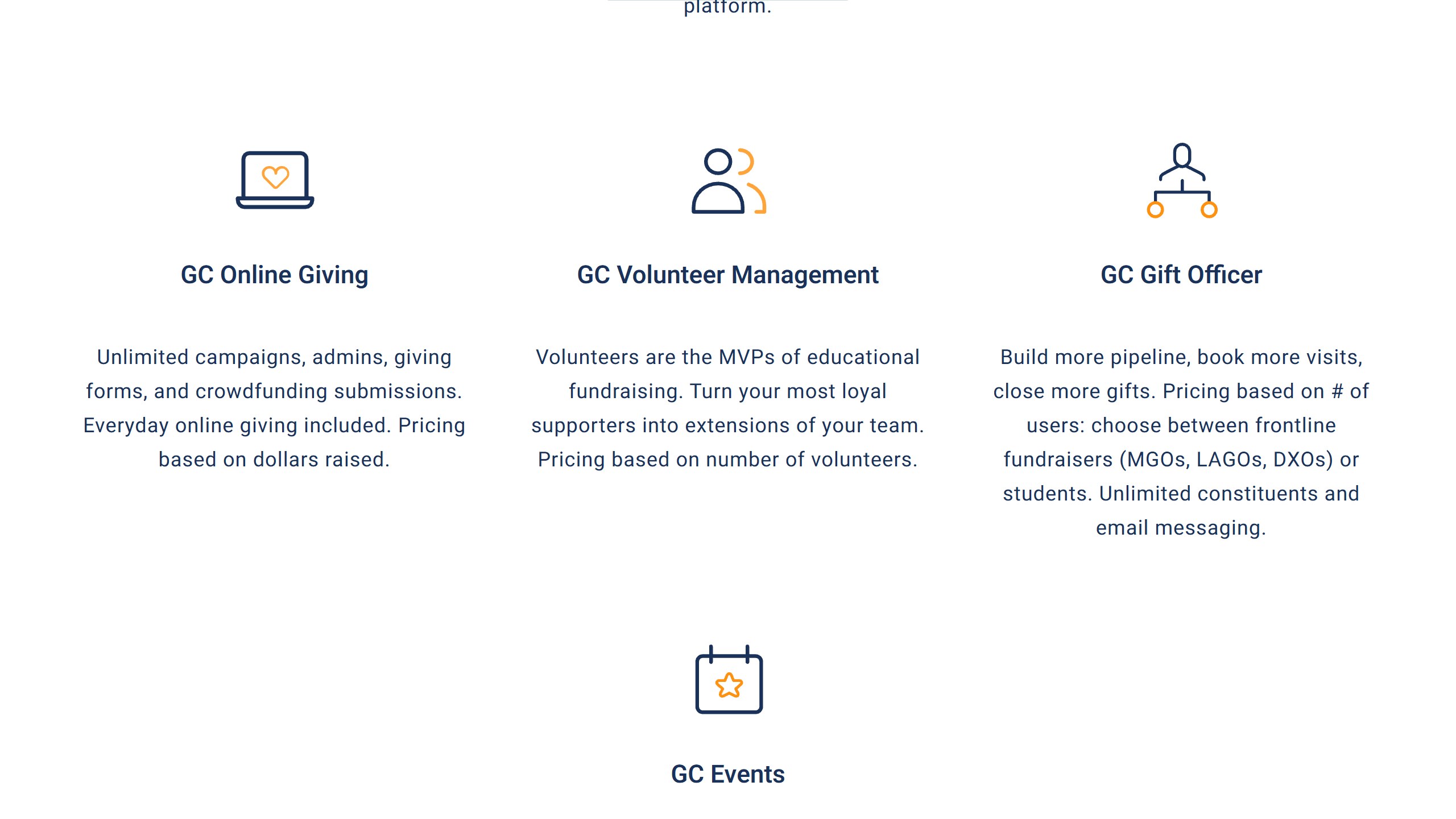
Built only for schools, GiveCampus says more than 1,500 institutions use it and that over $10 billion has been donated. Its pricing page publishes how each module is metered rather than prices: online giving by dollars raised, volunteers by headcount, the gift officer tool by users, events by guests, across Essentials, Professional and Enterprise editions. AI content, smart segments and smart ask amounts are included; two AI agents, Research Riley and Events Evan, are sold separately on every edition.
Almabase
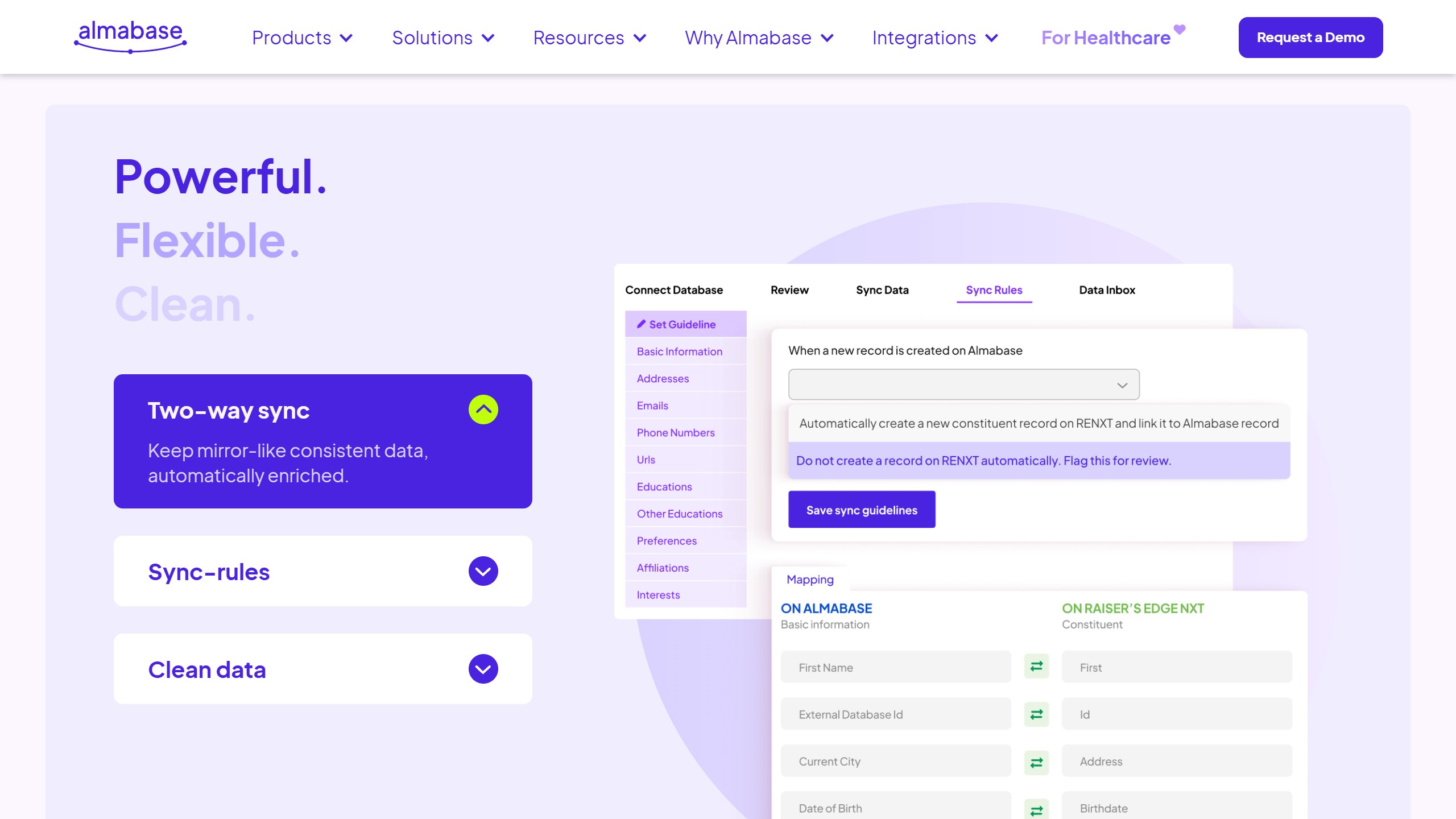
Almabase describes itself as an AI powered platform that works on top of your CRM for directories, mentoring, events, giving days and marketing. The detail most buyers miss is in its integration page: its TrueSync for Raiser’s Edge NXT is an “instant two-way profile sync”, but for other CRMs including Blackbaud CRM, Ellucian and Kindsight, data flows one way from Almabase to your CRM by scheduled file drop. No pricing page was found. Almabase also publishes the listicle that ranks first for this search, so read its comparisons with that in mind.
Gravyty: Raise and Graduway
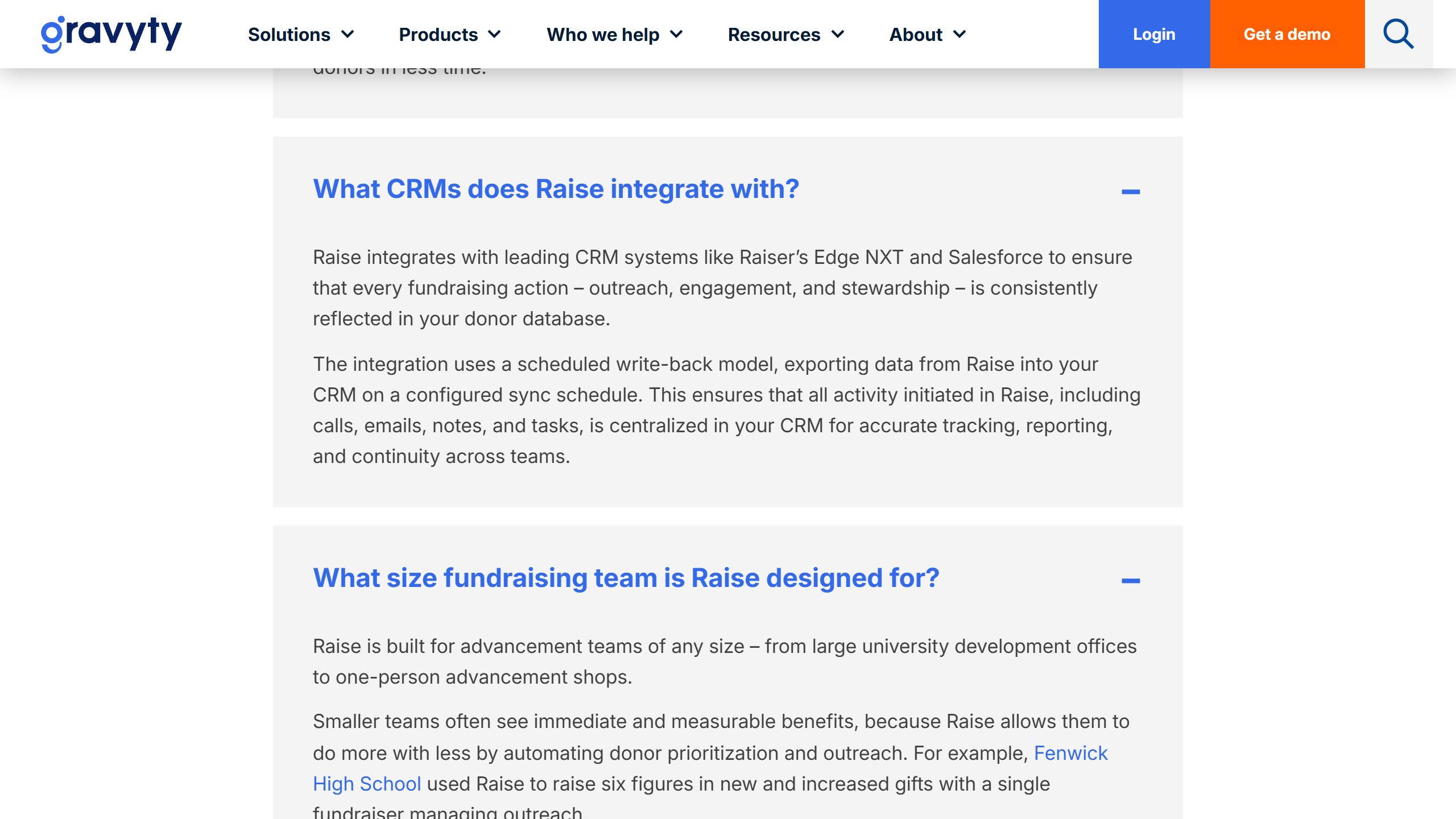
Gravyty says it serves more than 2,750 institutions. Raise drafts outreach, prioritises portfolios and surfaces prospects for gift officers, and works with Raiser’s Edge NXT and Salesforce through “a scheduled write-back model” rather than in real time. Graduway is its alumni community platform, with “customized pricing based on your institution’s specific needs and size of alumni community”.
EverTrue Signal and DonorSearch
EverTrue now owns DonorSearch and ThankView. Signal adds AI donor summaries, suggested follow ups and drafted messages alongside the CRM; DonorSearch AI builds custom predictive models on your data and draws on “more than 200 million charitable gift records”. No prices are published.
iWave
iWave is the only prospect research tool here with published prices: Starter “starting at $4,500” for one user and 1,500 screens, Professional “starting at $5,800” for three users and 5,000 screens, and Premium by quote; the page does not state the billing period. Kindsight’s Engage writing tool is $545, $1,095 or $3,295 a year.
Hivebrite
Hivebrite is an alumni community platform with AI matching, AI search, AI workflows and a connector for AI assistants. Prices are not on its homepage.
The fit for small colleges and lean advancement offices
Almost everything above is built for institutions with a prospect research team, a dozen gift officers and an integration specialist. A small college, a community college foundation or an educational nonprofit often has two or three people doing everything, and the turnover figures above hit them hardest.
That is where our top pick for lean teams fits. Its page for educational institutions describes a priority list of who needs attention and why, segments such as at risk and lapsed, handover files when a colleague leaves, plain language answers grounded in your own records with the source cited, and drafted re engagement letters. It notes that “a two or three person advancement office feels the loss of a departing colleague harder than a large shop does”. Pricing on 4 October 2026 was a free plan for one person, then $79, $399 and $799 a month billed yearly.
It is the wrong tool for a large university, and its own page explains why. Its direct connectors are Salesforce Nonprofit Cloud and NPSP, Bloomerang and Little Green Light; it states that Salesforce Advancement on Education Cloud “is not covered by that connector”, and that institutions on Raiser’s Edge NXT, Ellucian or Jenzabar work through CSV and document upload. It does no wealth screening or capacity ratings, and it has no alumni community, giving day or event features. A university already paying for Blackbaud’s agents, Agentforce or EverTrue would be duplicating what it has.
Sync direction: the question that sorts this market
Every vendor here says it integrates with your CRM. What differs is which way the data flows and how often, and it decides how much manual work your advancement services team takes on.
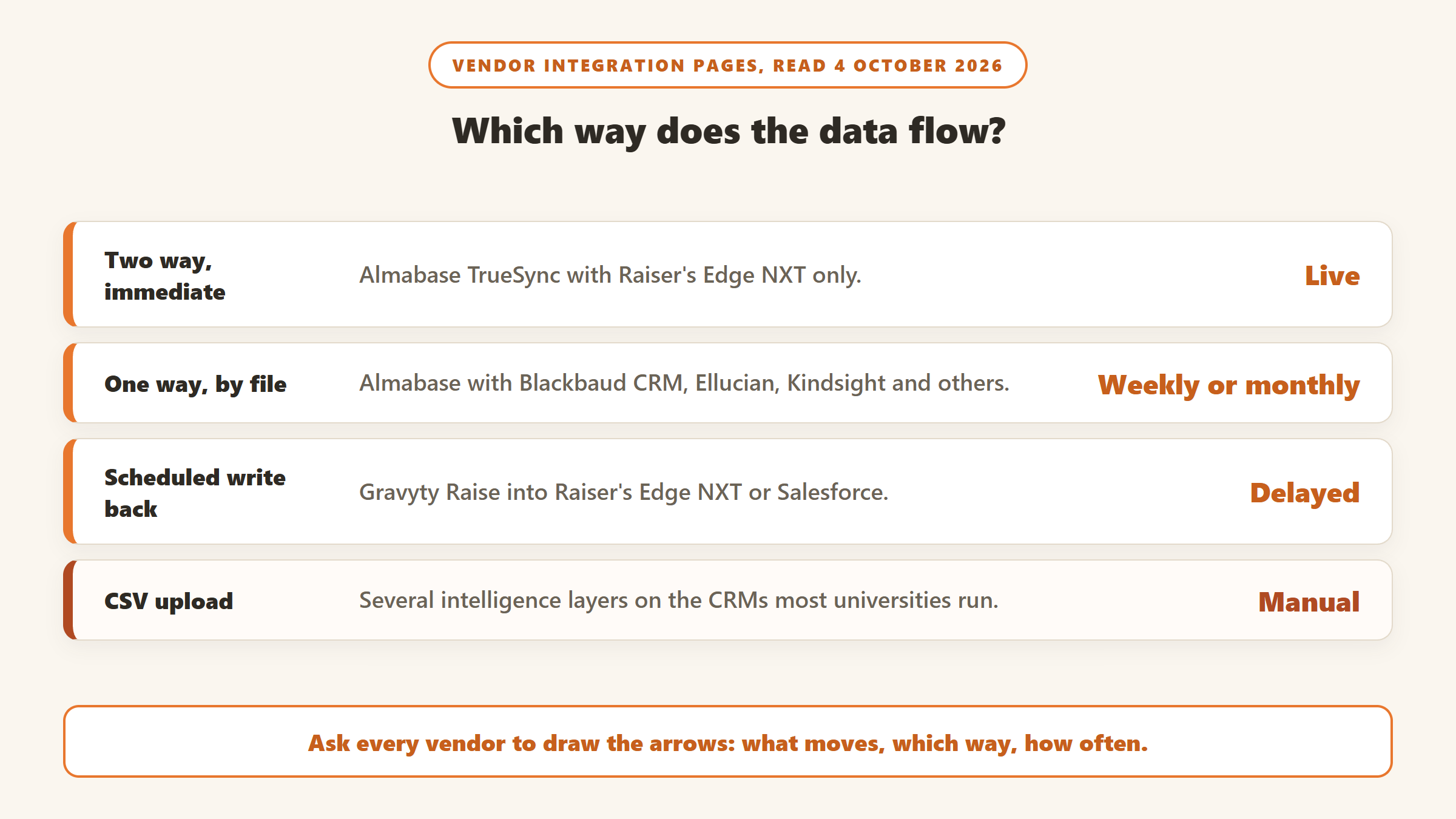
Two way and immediate. Almabase’s TrueSync for Raiser’s Edge NXT is the clearest example: profile changes in either system appear in the other.
One way, on a schedule. Almabase for other CRMs sends data from Almabase into your CRM weekly, monthly or on events, by file. Nothing comes back automatically.
Scheduled write back. Gravyty Raise works in its own app and writes activity back to Raiser’s Edge NXT or Salesforce on a schedule.
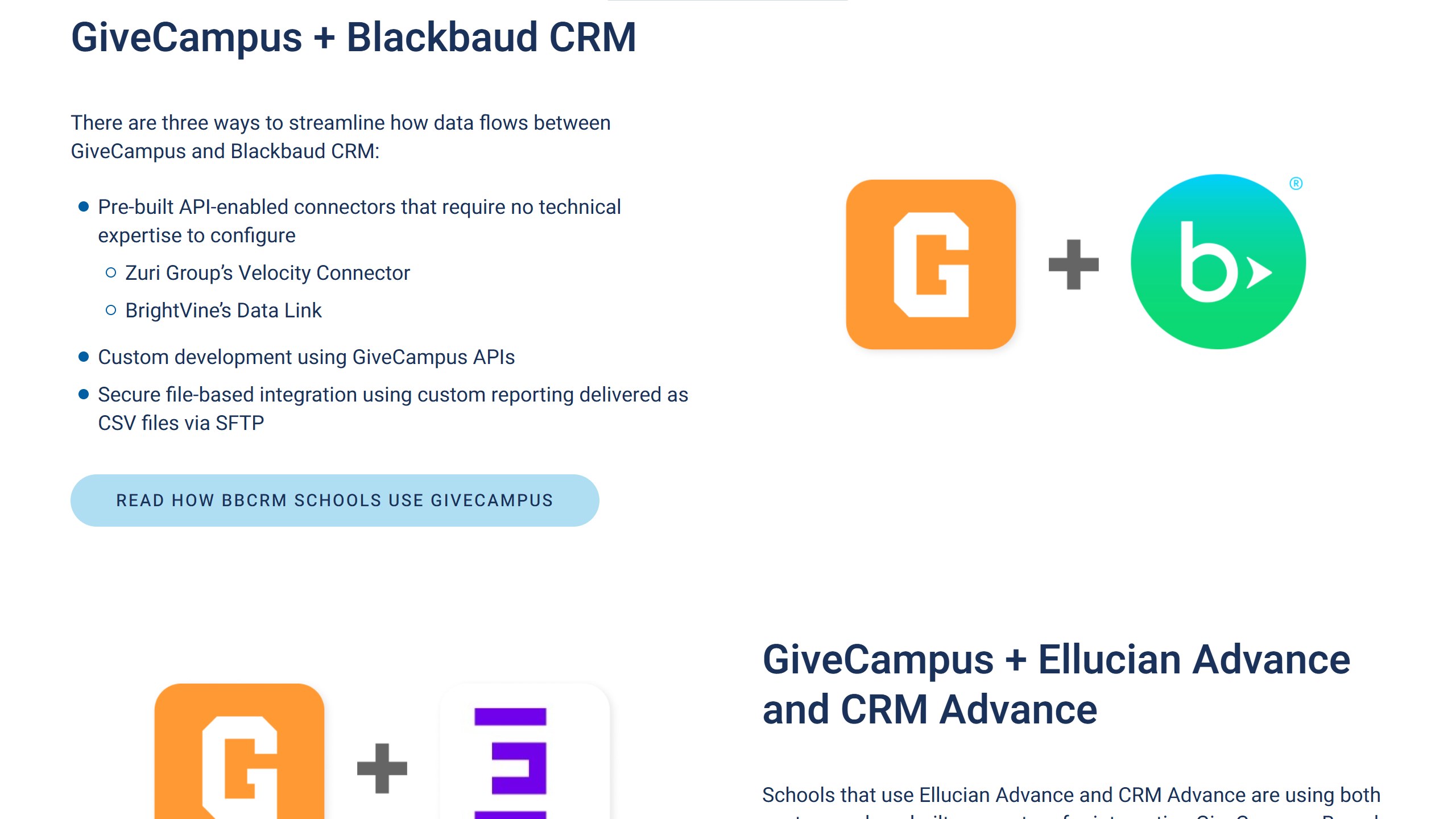
File upload. Several intelligence tools, including our pick for lean teams, work from a CSV export on the CRMs most universities run. That is workable for a small office refreshing monthly, and a real burden for a large one.
Ask every vendor to draw the arrows on a whiteboard: what moves, in which direction, how often, and who fixes it when a sync fails. Our guide to adding AI without migrating your CRM maps this for the main nonprofit CRMs.
Which AI is included, and which costs extra
AI pricing in this market is inconsistent enough that it deserves its own table. This is what each vendor’s own pages said on 4 October 2026.
| Vendor | Named AI | Included or extra, as stated |
|---|---|---|
| Blackbaud Raiser’s Edge NXT | Prospect Insights, Chat for Blackbaud AI, Development Agent | Not stated; Development Agent US only for now |
| Salesforce Education Cloud | Agentforce Philanthropic Research, Alumni Engagement Insights | Not stated on the edition prices; quote needed |
| Ellucian | Predictive insights, Copilot integration | “Included in your core subscription”, on a page about its student products |
| GiveCampus | AI content, Smart Segments, Smart Ask Amounts; Research Riley and Events Evan agents | Core AI included; agents sold separately |
| Kindsight | iWave scores and profiles; Engage writing tool | Engage priced separately, $545 to $3,295 a year |
| Gravyty, EverTrue, Almabase | Raise drafts and prioritisation; Signal summaries; DonorSearch AI models | Not published |
The practical point: ask every vendor for a line item. “AI powered” on a product page tells you nothing about whether the feature is in your edition, metered by usage, or a separate contract.
Questions to ask before you sign
What exactly is in our edition? Get the AI features listed by name on the order form, not described in a sales deck.
Which way does data sync, and how often? Ask for the direction, the frequency and what happens when a record conflicts between systems.
Who owns the models trained on our data? Several vendors build custom models on your gift history. Ask whether they are deleted if you leave, and whether your data trains anything used for other customers.
What happens to a departing gift officer’s knowledge? Contact reports and notes are where relationships live. Ask how the system captures them and how a successor finds them.
What is the exit cost? Ask how you export everything, in what format, and how long access continues after the contract ends. Advancement CRMs are rarely replaced, which is exactly why this question matters before you sign.
Who else at a similar institution can we call? A reference from an institution of your size and CRM is worth more than any case study.
How to choose
Large universities
Your CRM decision is Raiser’s Edge NXT, Salesforce Education Cloud or Ellucian CRM Advance. Add GiveCampus for giving days, a community platform if alumni engagement is a priority, and use the AI that comes with your CRM before buying another layer.
Mid sized institutions
Compare Gravyty Raise and EverTrue Signal for gift officer productivity, and iWave or DonorSearch for prospect research. Ask each for its sync direction with your CRM in writing.
Small colleges and educational nonprofits
A nonprofit CRM such as Bloomerang or Little Green Light, or Salesforce Nonprofit Cloud, can be enough. Add a giving tool and a lean intelligence layer that connects to it natively. See our best CRM for nonprofits guide and our page on handing over a donor portfolio when a gift officer leaves.
Sources
- Research: Giving USA 2026 via the Lilly Family School of Philanthropy; Turnover Intention and Job Tenure of US Fundraisers (Shaker, Rooney, Nathan, Bergdoll and Tempel, n=1,663); RNL 2025 National Alumni Survey; Anthology sale approval, 24 November 2025.
- Vendor pages read 4 October 2026: Blackbaud Raiser’s Edge NXT and Development Agent; Salesforce advancement; Ellucian CRM Advance and AI pricing; GiveCampus pricing; Almabase integrations and Raiser’s Edge; Gravyty Raise and Graduway; EverTrue Signal and DonorSearch; Kindsight pricing and education; Hivebrite; Gratefully for educational institutions.

Written by
FazFaz is the founder of AIToolsBakery. Some tools here are tested hands on. Others are assessed from vendor documentation and pricing verified on the live page, and every review says which one it is. Sponsors can buy a position in a guide. They cannot buy the score, the criticism, or silence about a better option.
How we test and how we make money →