Instrumentl is a genuinely good grant platform. That is not the problem. The problem is the invoice: as of July 2026, Instrumentl starts at $299 per month billed annually. That is $3,588 a year before you touch the AI drafting features, which live on the $499/mo Pre-Award tier, and the full post-award suite runs $999/mo. If you found an article telling you Instrumentl costs around $179 a month, it is stale. The floor has moved, and for a lot of small and mid-size nonprofits it has moved out of reach.
We went looking for what actually replaces it. Not “10 grant tools that exist,” but a mapping exercise: Instrumentl really does four jobs (grant discovery, pipeline tracking, AI drafting, and post-award management), and almost every alternative only does one or two of them well. So this guide matches each tool to the specific Instrumentl job it replaces, with pricing we verified in July 2026 and plain labels on anything we could not confirm.
Instrumentl alternatives compared: verified July 2026 pricing
| Tool | Instrumentl job it replaces | Verified pricing (July 2026) | Free option |
|---|---|---|---|
| Instrumentl (baseline) | All four: discovery, pipeline, AI drafting, post-award | Discover $299/mo annual ($349 monthly), Pre-Award $499/mo, Full Lifecycle $999/mo, Enterprise custom | 14-day trial |
| Grantable | AI drafting | Starter $50/mo, Pro $150/mo; nonprofit discount cuts to $25/mo and $75/mo for one year | Yes, free tier |
| GrantStation | Discovery | $199/yr via TechSoup ($150 with TechSoup Plus); $699/yr direct list price | No |
| Candid Foundation Directory | Discovery + funder research | Roughly $449 to $1,699/yr by tier (partially unverified, confirm with Candid) | Free Essential year via Go for the Gold (orgs under $500K with Gold Seal) |
| GrantWatch | Discovery | $249/yr annual; also $22 weekly, $49 monthly, $100 quarterly | No (browse-only without details) |
| OpenGrants | Discovery (government grants) | Free tier; paid pricing unverified | Yes |
| Grant Assistant by FreeWill | AI drafting (full document workflow) | Quote-based, no published figure | No |
| Grant Gopher | Discovery (small nonprofits) | Unverified, no published figure we could confirm | Limited free search |
All Instrumentl figures come from instrumentl.com/pricing as of July 2026. Anything marked unverified is exactly that: do not budget around it until the vendor confirms.
Why the price jumped (and why old articles mislead you)
A quick word on the cost-cliff itself, because half the search results for “instrumentl pricing” will quote you numbers that no longer exist. Instrumentl restructured its plans around lifecycle stages: Discover ($299/mo annual, $349 month to month, 3 users) covers matching and tracking, Pre-Award ($499/mo annual) adds the AI-assisted drafting, and Full Lifecycle ($999/mo annual) adds post-award management, with a custom Enterprise tier above that. Every figure here is from instrumentl.com/pricing as of July 2026.
The practical consequence: features that used to feel like one product are now three price points, and the AI drafting that most 2026 buyers actually want sits at $5,988/yr, not $3,588. If a comparison article quotes Instrumentl “from $179/mo,” it predates the current structure and its conclusions about relative value are unreliable. That stale-content problem is most of why we wrote this page.
The four jobs Instrumentl actually does
Before you pick a replacement, be honest about which parts of Instrumentl you actually use. In our experience most teams paying $299/mo are heavily using one job and lightly touching the rest.
- Discovery. Matching your programs to active funders and open opportunities, with saved searches and alerts. This is the job most people mean when they say “Instrumentl.”
- Pipeline tracking. Deadlines, stages, assignments, and a calendar view across every application in flight.
- AI drafting. AI-assisted proposal writing, which Instrumentl gates behind the $499/mo Pre-Award tier.
- Post-award management. Reporting deadlines, award tracking, and compliance, gated behind the $999/mo Full Lifecycle tier.
The cheap-stack insight: discovery tools are commodities now ($199 to $249 a year gets you a credible database), AI drafting has a strong low-cost specialist, and pipeline tracking is the one job you may end up doing in a spreadsheet or your CRM. If you want the deeper feature walkthrough of what you would be giving up, our Instrumentl review covers the platform itself.
1. Grantable: replaces the AI drafting job
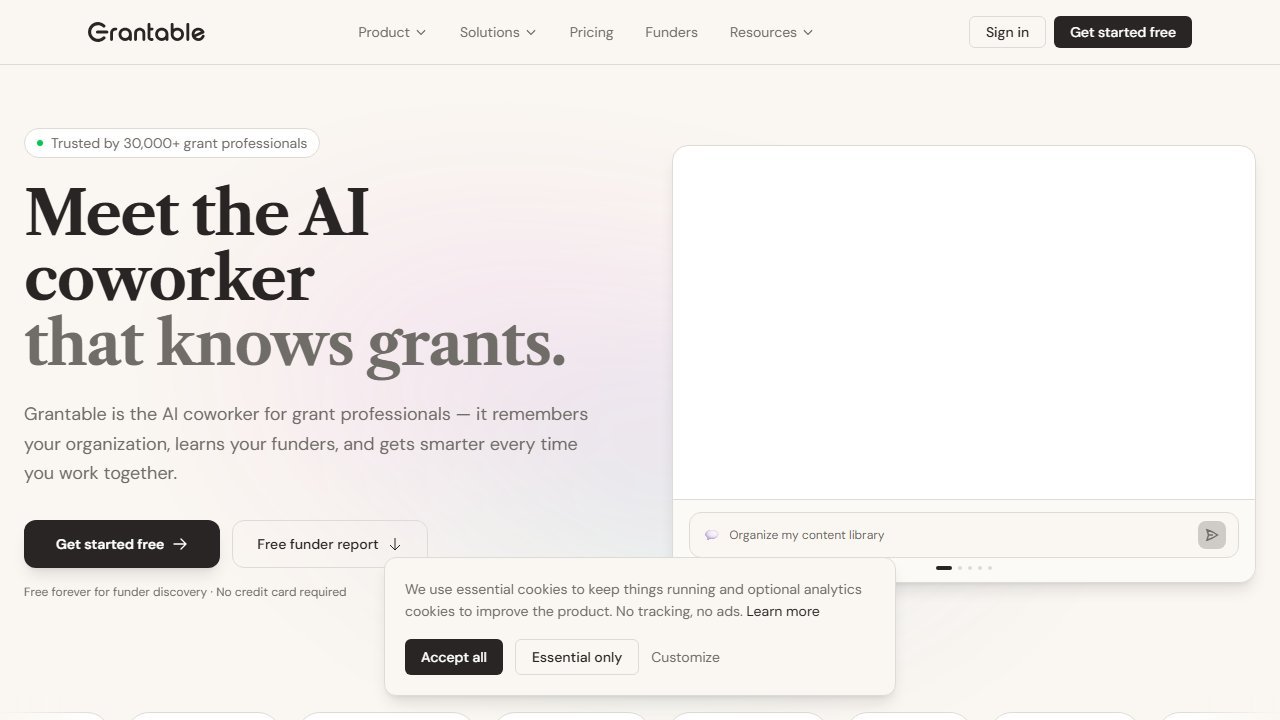
Grantable is the tool we point to first when someone says “I mostly wanted Instrumentl for the AI writing.” It is an AI grant writing assistant that learns from your past proposals and drafts responses to funder questions in your organization’s voice. There is a free tier to start, Starter is $50/mo, Pro is $150/mo, and a one year nonprofit discount cuts those to $25/mo and $75/mo. Compare that to the $499/mo Instrumentl tier where AI drafting lives and the value case makes itself.
We have already published a full hands-on breakdown in our Grantable review, and a direct head-to-head in Grantable vs Instrumentl, so we will keep this short: Grantable does not do discovery or post-award tracking, and it is not trying to. It replaces exactly one Instrumentl job, the drafting one, at roughly a tenth of the price.
Who it’s for: teams whose bottleneck is writing, not finding.
Honest limitation: you still need a discovery source; Grantable will not tell you which funders to approach.
2. GrantStation: the budget discovery workhorse
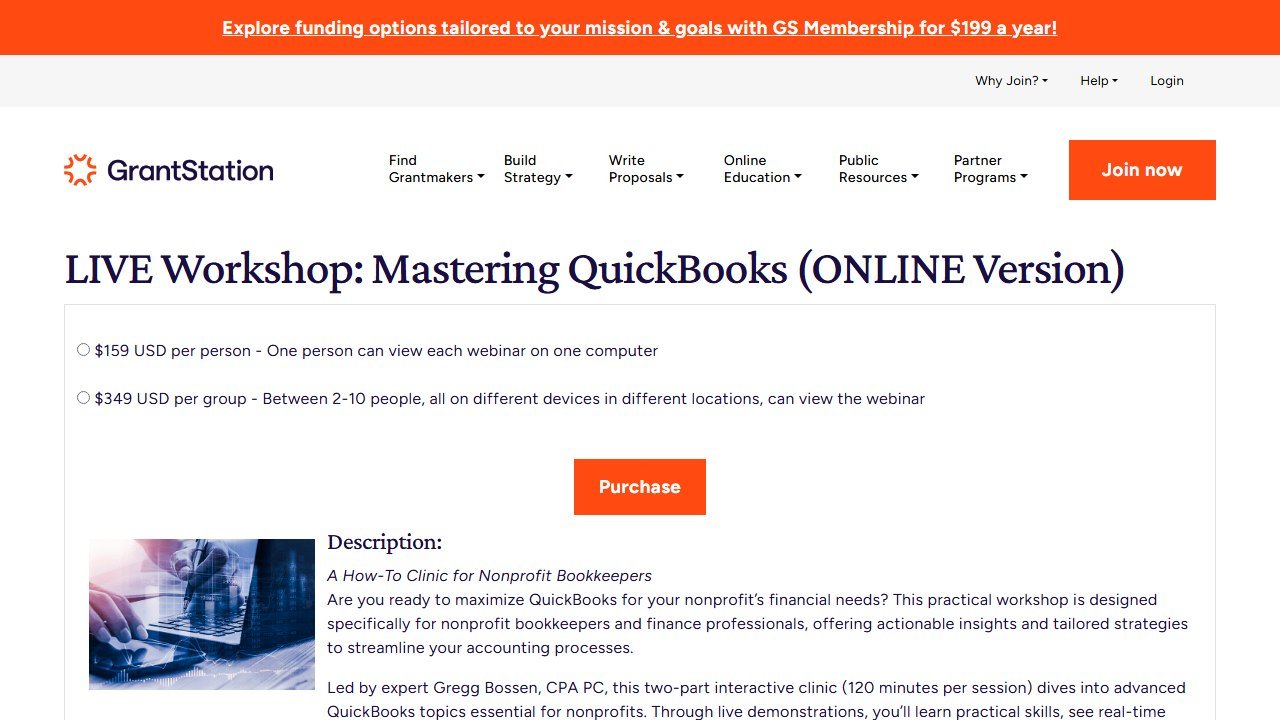
GrantStation is the sleeper deal in this entire category, but only if you buy it the right way. The direct list price is $699/yr. Through TechSoup, eligible nonprofits pay $199/yr, and TechSoup Plus members pay $150/yr. Same product, 71 to 79 percent off, and in practice the TechSoup checkout took under ten minutes for a verified org.
GrantStation gives you a searchable database of grantmakers (private funders plus federal and state listings), weekly funding alerts, and basic tutorials on approach strategy. The interface feels a generation older than Instrumentl’s, and search facets are coarser: you will do more manual reading of funder profiles to judge fit, where Instrumentl’s matching does more of that triage for you. In practice we budget about an hour a week of manual review with GrantStation to get the shortlist quality Instrumentl’s alerts hand you automatically. Whether that hour is worth $3,389 a year in savings is the whole decision, and for most small teams we think it clearly is.
Who it’s for: small nonprofits that need a legitimate funder database at the price of a nice office chair.
Honest limitation: no pipeline tracking, no AI, and match quality depends on you writing good searches rather than the tool learning your programs.
3. Candid Foundation Directory: the research depth play
Candid Foundation Directory (the merged Foundation Center and GuideStar operation) is less an Instrumentl clone and more the primary source Instrumentl-style tools draw from. Its strength is depth on funders: 990-derived giving histories, board names, actual grant sizes to organizations like yours, and recipient patterns you can use to qualify a funder before you spend a week on a proposal.
Pricing is the catch, and we will be straight about it: tiers run roughly $449 to $1,699 per year, but we could not fully verify the current tier breakdown, so treat that range as approximate and confirm with Candid directly. The genuinely useful loophole is Go for the Gold: organizations under $500K in revenue that earn a Gold Seal of Transparency on their Candid profile get a free year of Foundation Directory Essential. For an eligible small nonprofit, that is real research firepower for the cost of an afternoon updating your profile.
Who it’s for: development teams that qualify funders seriously before writing, and small orgs that can claim the free Essential year.
Honest limitation: it is a research library, not a workflow tool. No deadlines pipeline, no drafting, and the top paid tiers cost as much as some full platforms.
4. GrantWatch: cheapest paid discovery, with caveats
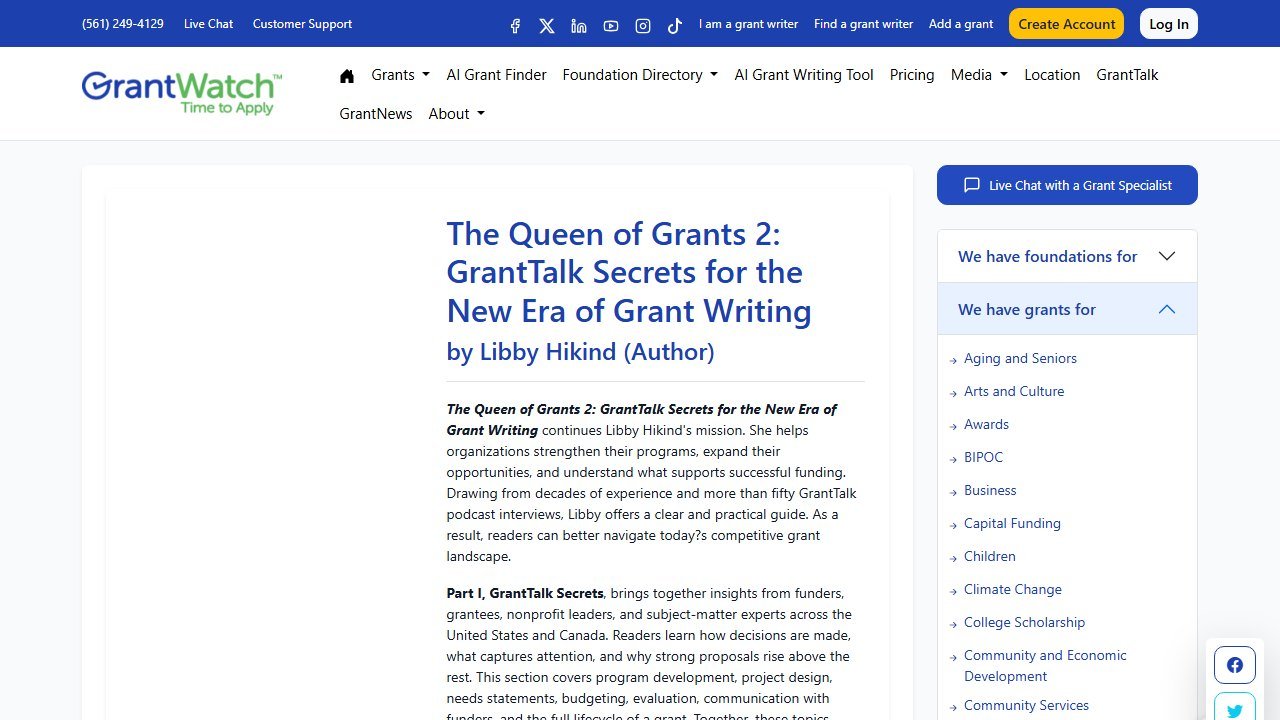
GrantWatch is the volume listings play: a large, frequently updated feed of open grants for nonprofits and small businesses, sorted by state and category. The pricing structure is unusual and honestly a bit of a signal: $22 weekly, $49 monthly, $100 quarterly, or $249 for a year. That weekly option tells you who this is built for, which is people who want to check listings around a specific funding push rather than live in the tool. One transparency note: GrantWatch’s site was intermittently unreachable when we rechecked pricing at draft time, so confirm current figures on their pricing page before subscribing.
Quality is the trade-off. GrantWatch lists opportunities; it does not qualify them. In practice, we found the signal-to-noise ratio demands discipline: expect to filter out listings that are geographically wrong, closed sooner than the interface suggests, or too small to justify the writing effort. Our working method: use the category and state filters aggressively, skim titles only on the first pass, and open a listing’s full details just for the handful that survive. Treat it like a classifieds section, not a matching engine, and the $249 annual price is fair for what it is.
Who it’s for: grant seekers who want cheap, broad awareness of what is open right now, on a short commitment.
Honest limitation: listings-first design means you do the qualification work Instrumentl’s matching would do for you.
5. OpenGrants: the free government-grant matcher
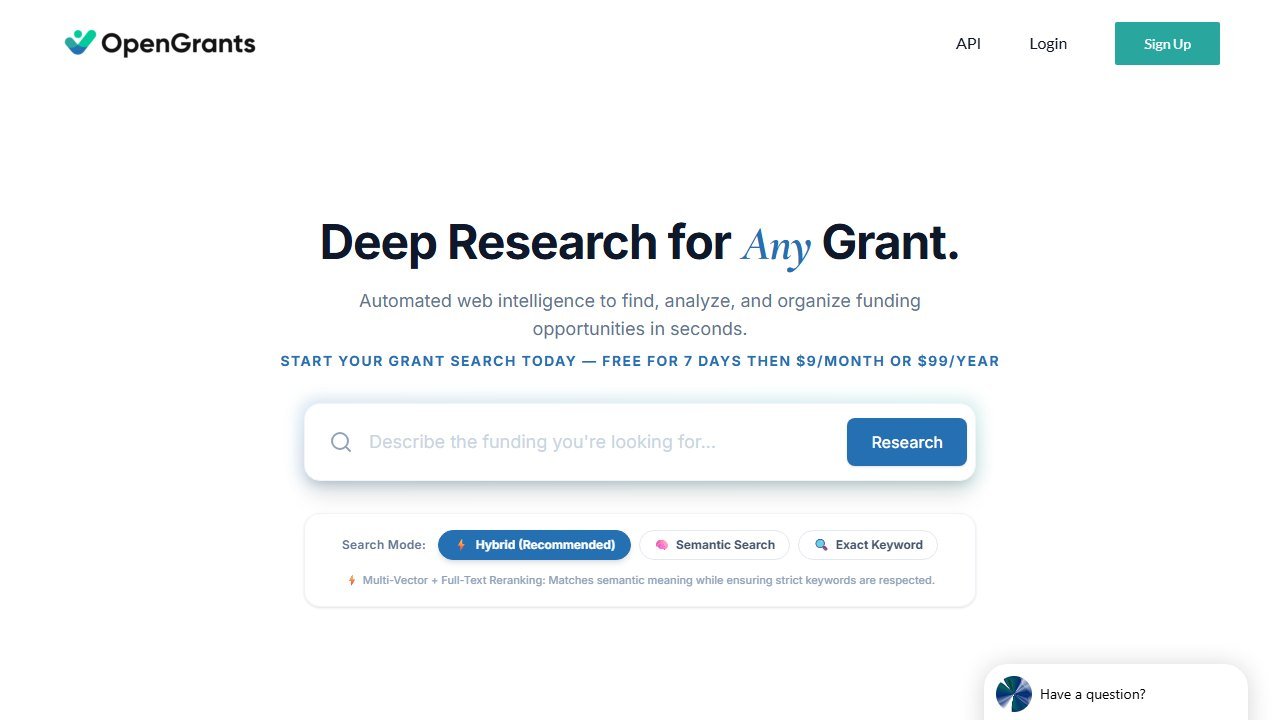
OpenGrants attacks the piece of discovery Instrumentl users often overpay for: government funding. Its free tier includes government-grant matching, and the platform also connects you with vetted grant consultants if you want hired help on a specific application. If your funding mix leans federal or state rather than private foundations, starting here costs you nothing but an account signup.
Paid pricing is unverified: OpenGrants has paid offerings, but we could not confirm published figures, so we will not print a number. Budget for the free tier and treat anything beyond it as a sales conversation.
Who it’s for: orgs chasing government funding who want free matching before spending anything.
Honest limitation: foundation coverage is not the strength, so most teams pair it with GrantStation or Candid rather than using it alone.
6. Grant Assistant by FreeWill: quote-based AI drafting at scale
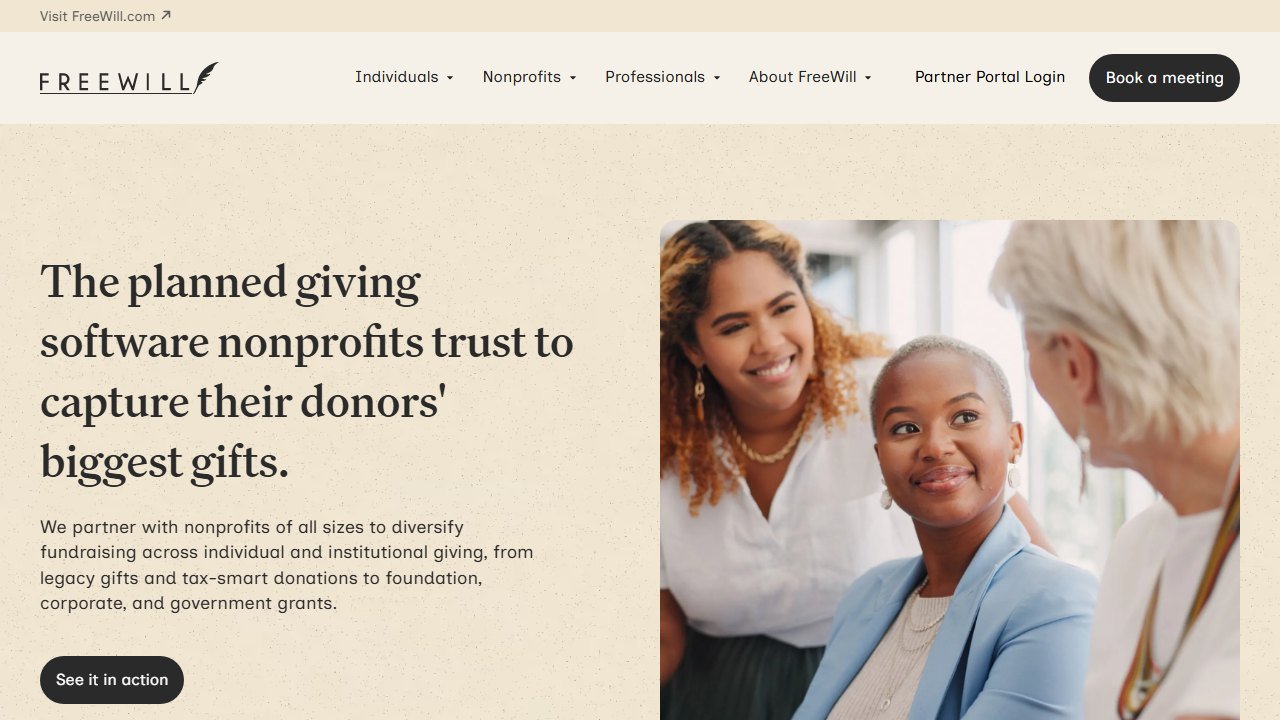
Grant Assistant by FreeWill is the enterprise-flavored answer to the AI drafting job. Where Grantable is a self-serve writing assistant, Grant Assistant positions itself as a fuller AI drafting workflow for grant teams, and FreeWill claims more than 2,200 organizational customers (their figure, not ours). Pricing is quote-based with no published number, which usually means it is priced for organizations with a real grants function rather than a solo development director.
In our evaluation the pitch makes sense for teams submitting at volume who want structured drafting across multiple writers. If that is you, get the quote and compare it directly against Instrumentl’s $499/mo Pre-Award tier, because that is the real head-to-head.
Who it’s for: multi-writer grant teams evaluating AI drafting at the enterprise end.
Honest limitation: no public pricing means no quick budget math, and you are committing to a sales process just to find out if it is affordable.
7. Grant Gopher: small-nonprofit discovery on a shoestring
Grant Gopher is the most modest tool on this list, and that is its role: grant discovery scoped for genuinely small nonprofits, with a simple search and email alerts. There is a limited free search, and paid pricing is unverified; we could not confirm a published figure, so we are not going to invent one. If a tool at this end of the market is your speed, our roundup of the best AI tools for small nonprofits covers what else fits a sub-$1K software budget.
Who it’s for: volunteer-run and sub-$500K orgs that need a starting point, not a platform.
Honest limitation: database breadth and freshness cannot match Candid or GrantStation, so treat it as a first filter rather than your only source.
How to actually replace Instrumentl: three stacks
Because no single alternative covers all four jobs, here is how we would rebuild Instrumentl’s coverage at three budget levels. These stacks come out of the same testing behind our best AI grant writing tools roundup.
The free stack (about $0/yr). OpenGrants free tier for government discovery, Candid Foundation Directory Essential via Go for the Gold if you qualify (under $500K revenue plus a Gold Seal), Grantable’s free tier for drafting, and a spreadsheet for pipeline. Real coverage, real manual effort.
The lean stack (roughly $450 to $550/yr). GrantStation at $199/yr via TechSoup for discovery, plus Grantable Starter at $25/mo with the nonprofit discount ($300 for the first year) for AI drafting. Total: around $499 for year one, which is what Instrumentl charges for one month of Pre-Award.
The research-heavy stack (roughly $700 to $2,000/yr). Candid Foundation Directory for deep funder qualification, GrantWatch annual at $249 for breadth of open listings, and Grantable Pro at $75/mo nonprofit rate for drafting. You are still thousands under Instrumentl’s Full Lifecycle tier, though you give up its integrated post-award tracking.
If grants are one piece of a broader fundraising program, it is also worth checking whether your CRM already handles the pipeline job before buying anything; our guide to the best AI fundraising tools for nonprofits maps that wider landscape.
What grant tooling actually costs, and what each type is for
Grant software is three products wearing one label, and buying the wrong one is the usual reason a subscription goes unused by month four. Here is where Instrumentl sits and what the alternatives do.
Prospect databases, which answer “who might fund this”
These are search products over foundation filings and past awards. You are buying coverage and freshness, and the honest test is whether the database surfaces funders your team did not already know. Ask during the trial for the ten most relevant funders to one specific programme, then ask your grants lead how many were new. If the answer is one or two, the database is confirming rather than discovering, and that is worth much less than the price implies.
Writing assistants, which answer “how do I get this drafted”
These help produce narrative from material you already hold. Their value is real and it is time rather than money: a first draft in an hour rather than a day. Their limit is equally real. A model cannot know your programme outcomes, your budget assumptions or your board’s appetite for risk, so the draft is a scaffold and a human still writes the parts a funder actually reads. Treat any vendor claiming otherwise with suspicion.
Submission and workflow systems, which answer “how do we not miss the deadline”
Submittable and its peers manage applications, reviewers and deadlines rather than finding money or writing prose. Note that Submittable publishes no price at all, so any figure you see quoted for it, including figures we ourselves once carried and have since withdrawn, cannot be traced to the vendor. Ask for the quote in writing and ask what drives it: submissions, reviewers, programmes or seats.
What the surrounding stack costs, for scale
Grant tooling is rarely the whole budget, so keep the CRM figures in view. Verified 4 September 2026: Little Green Light from $45 a month, Salesforce Nonprofit Cloud at $70 per user (as of 4 October 2026) with ten free under Power of Us, Bloomerang from $125, Keela from $164. If a grants tool costs more than your database, it needs to be winning grants you would otherwise have missed, and you should be able to name them.
The question that decides the purchase
Are you short of prospects, short of writing time, or short of process? Most teams answer instinctively and are wrong, because the visible pain is usually the deadline crunch while the actual constraint is a thin pipeline. Look at last year: how many applications did you submit, how many were to funders you had not approached before, and how many were late. Those three numbers pick the product.
Where AI helps in a grant cycle, and where it must not
The useful division is not by task but by who is accountable for the sentence. Anything a funder will hold you to needs a human author.
Genuinely useful: the first pass on structure
Turning a set of programme notes into a coherent outline against a specific funder’s question set is real work and models do it well. So is reformatting the same content for the fourth application this quarter, which is where most grants teams lose hours to no benefit. Start here, because the time saving is immediate and nothing is at risk.
Genuinely useful: reading the guidelines properly
Long funder guidelines hide eligibility rules, word limits and required attachments in the middle of paragraphs. Extracting those into a checklist is a task with a right answer, which is exactly the kind of task to automate. Verify the checklist against the source once, and you have saved the read on every future application to the same funder.
Where it must not go: outcomes, budgets and beneficiary stories
A model does not know what your programme achieved. If it writes an outcome, it is inventing one, and an invented outcome in a funded application is a serious problem rather than an embarrassing one. The same applies to budget assumptions and to anything describing a real person you serve. Those sentences are yours, and the review step that catches them is not optional.
The workflow that survives an audit
Draft with the tool, edit as a human, and keep the record of which is which. Practically: never paste a generated paragraph into a final document without reading it against a source you can point to, keep the funder guidelines and your evidence in the same folder as the draft, and have a second person read anything containing a number before it is submitted. None of this is exotic and all of it is what a funder assumes you already do.
What to tell your board
Say plainly which parts of the process are assisted and which are not. Boards react badly to discovering it after the fact and reasonably well to being told in advance, and the distinction that reassures them is exactly the one above: structure and reading are assisted, claims and outcomes are not.
Verdict: who should switch, and who should stay
Switch if you are paying $299/mo primarily for discovery. GrantStation at $199/yr or GrantWatch at $249/yr does that job at 5 to 7 percent of the cost, and the quality gap, while real, is not a 15x gap. Switch to Grantable if AI drafting was your reason for eyeing the $499/mo tier; at $25 to $75/mo with the nonprofit discount it is the clearest value swap in this entire comparison.
Stay with Instrumentl if you run a high-volume grants operation that genuinely uses all four jobs, especially post-award tracking. The $999/mo Full Lifecycle tier is expensive, but replacing integrated post-award compliance with duct tape has a failure mode (missed report deadlines, jeopardized renewals) that costs more than software. Use the 14-day trial math honestly: if Instrumentl’s matching surfaces even one funded opportunity a year that your cheaper stack would have missed, it may still pay for itself. For everyone else, the lean stack at about $500 a year covers the jobs that matter and leaves $3,000 in your program budget.

Written by
FazFaz is the founder of AIToolsBakery. Some tools here are tested hands on. Others are assessed from vendor documentation and pricing verified on the live page, and every review says which one it is. Sponsors can buy a position in a guide. They cannot buy the score, the criticism, or silence about a better option.
How we test and how we make money →