Generative engines now answer questions that used to send a click to your website. When someone asks ChatGPT for the best project management tool, or asks Perplexity which CRM fits a nonprofit, the model names a handful of brands and cites a handful of sources. If your brand is not in that shortlist, you are invisible in a channel that barely existed two years ago. A new category of software, AI visibility tracking (also called GEO or generative engine optimization analytics), exists to tell you whether you show up, how often, and next to whom.
Peec AI is one of the loudest names in that category, and for a specific reason: price. While the headline enterprise platforms quote four and five figure monthly contracts, Peec starts an order of magnitude lower and throws in unlimited seats. That positioning has made it the single most-named affordable alternative whenever someone asks how to track AI search visibility without an enterprise budget. The company has the growth numbers to match the hype, having reportedly crossed 10 million dollars in annual recurring revenue roughly 16 months after launch and raised around 29 million dollars in funding across a seed and a Series A.
We spent time inside the product, cross-checked the vendor claims against the live site and a stack of independent reviews, and put it through our standard scoring rubric. The short version: Peec is genuinely good at one half of the job and noticeably thinner at the other. It is excellent at description and weaker at prescription. This review explains exactly what that means, who should buy it, and who should look at Profound or Otterly instead.
A note on independence. AIToolsBakery is an independent review site. We do not sell Peec AI, we are not part of any reseller or affiliate arrangement with the company, and we earn nothing if you sign up. When a post is sponsored we label it clearly at the top, and a sponsorship never changes a score or a verdict. This review is not sponsored. Every figure below was checked against the vendor and independent sources in June 2026.
The verdict in 30 seconds: Peec AI scores 4.3 out of 5. It is the value pick of the AI visibility category: clean analytics, daily refreshes, unlimited seats, and a starting price near 89 euros per month. It tells you precisely where you stand in AI answers. It is weaker at telling you what to fix. Ideal for SMBs and agencies, less so for enterprises needing deep prescriptive workflows.
What Peec AI is
Website: Peec AI
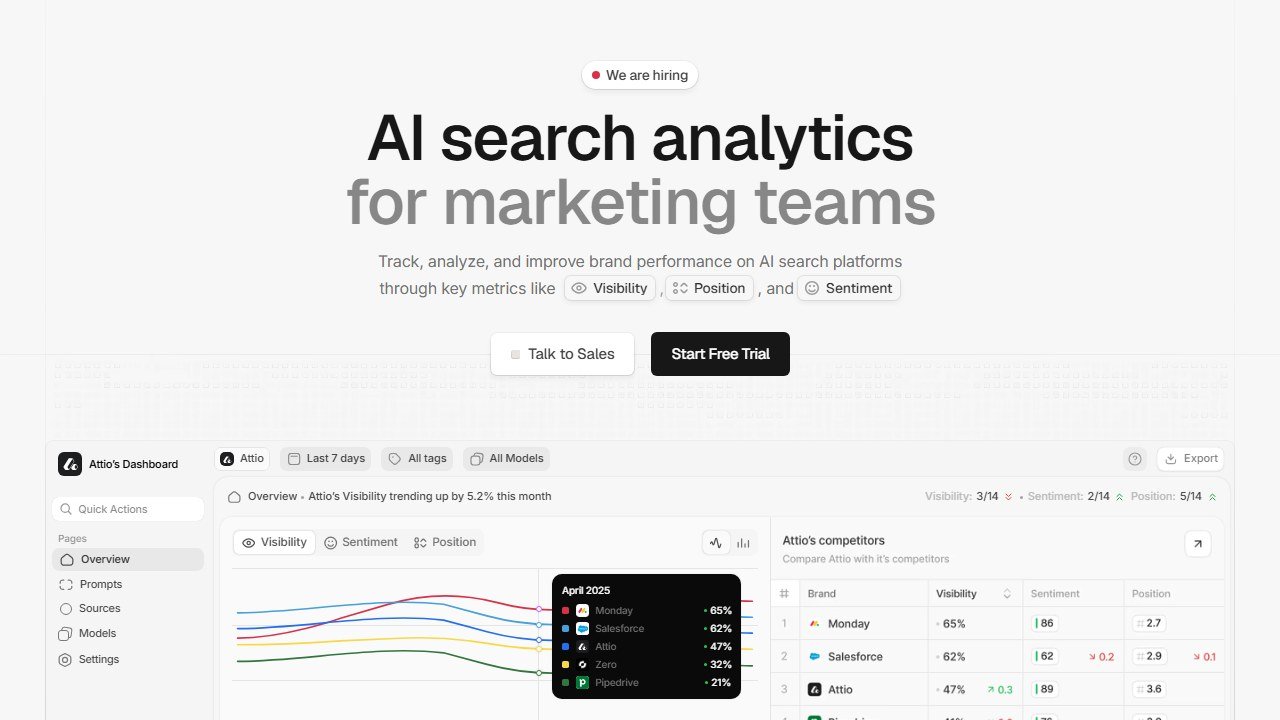
Peec AI is an AI search analytics platform. You feed it a set of prompts, the kind of questions your buyers actually type into a chatbot, and it runs those prompts across the major generative engines on a recurring schedule. It then records whether your brand was mentioned, how prominently, in what tone, and which web sources the model cited to build its answer. Over time you get trend lines, competitor comparisons, and a sense of which topics you own and which you are losing.
The company was founded in early 2025 and grew fast. By mid 2026 it reported more than 2,500 customers, a New York office to chase US demand, and the funding and revenue milestones noted above. That trajectory matters for two reasons. It signals the product is real and improving quickly, and it signals the product is still young relative to enterprise incumbents that have been building crawler infrastructure and prompt datasets for longer.
Positioning wise, Peec sells itself as a workflow and analytics layer rather than a static dashboard, helped by a recently shipped MCP (Model Context Protocol) integration that lets you pull Peec data into other tools and automate reporting. That is a smart, modern move and we cover it below.
What it tracks
Peec monitors brand visibility across the engines that drive most AI answer traffic today. On the standard plans that means ChatGPT, Perplexity, and Google AI Overviews, with Gemini also in the mix. Coverage of additional engines such as Claude and Grok is available, but several independent reviews note these sit behind add-on fees rather than being bundled into the base price, so check the current plan sheet before assuming full coverage.
The metrics it captures fall into a few buckets:
- Visibility and share of voice. A percentage-style score for how often your brand surfaces across your tracked prompts, and how that compares to rivals.
- Ranking and prominence. Whether you are named first, buried mid-answer, or absent.
- Sentiment. Whether the answer frames your brand positively, neutrally, or negatively.
- Source and citation analytics. Which specific domains the models cite when they build answers in your space. This is the most actionable signal in the product, because it tells you which third party pages (G2, Reddit, LinkedIn, editorial sites) are shaping how AI describes your category.
- Competitor benchmarking. Add rival brands and watch the same prompts to see who the models prefer.
Crucially, prompts refresh daily, so you are watching a living picture rather than a one off snapshot. Multi country and multi language tracking is supported with unlimited countries on the plans, which is unusual at this price and a genuine selling point for brands operating across regions.
The analytics (what it does well)
This is where Peec earns its reputation. The analytics are clean, fast to read, and pitched at marketers rather than data engineers. Setup is light. You add prompts (or accept AI suggested ones based on search demand), add your competitors, and within a short window you have dashboards that any marketing lead can interpret without a training session.
The citation analytics deserve a specific callout. Knowing that ChatGPT cites a particular comparison article or a specific Reddit thread when it describes your category turns a vanity metric into a to-do list. You can go earn a mention on the sources the models actually trust. Combined with sentiment and competitor overlays, you get a coherent story: here is where you stand, here is who is beating you, here is what the models are reading.
The MCP integration extends this. Because Peec exposes its data through MCP, teams can wire visibility metrics into their own reporting stacks, automate client recaps, and pull numbers into adjacent workflows instead of living inside one more dashboard. For agencies juggling many clients, that programmatic access is a meaningful time saver.
Pricing and value (the hook)
Pricing is the whole story with Peec, so let us be precise about the model rather than treating any single figure as permanent. Peec uses tiered subscription pricing aimed squarely at the value and mid-market segment, and the standout structural choice is unlimited seats on every plan. There is no per user surcharge, which is the opposite of how most enterprise analytics tools bill.
As of June 2026 the public structure looks like this. Always confirm current numbers on the Peec pricing page, because fast-growing tools in a hot category revise plans often, and engine coverage can shift between bundled and add-on.
| Plan | Approx. monthly price | Roughly who it suits | Notable limits |
|---|---|---|---|
| Starter | From around 89 euros | Startups and small brands beginning AI visibility tracking | Smaller prompt allowance, core engines, email support |
| Pro | Around 199 euros | SMBs and lean teams wanting deeper coverage | Larger prompt allowance, email and Slack support |
| Enterprise | From around 499 euros, with annual discounts | Larger teams and agencies needing scale | Higher volume, expanded support |
Two value notes. First, the prompt allowance, not the seat count, is what you actually budget against. More prompts mean more questions tracked and more AI answers analyzed per month, so map your prompt list to a tier before you pick. Second, the headline price assumes the bundled engines. If tracking Claude, Gemini variants, or Grok matters to you, factor the add-ons in, because they can move the real monthly cost up.
Set against the category, the value case is clear. Premium platforms routinely start in the high hundreds to thousands per month. Peec gets a capable team monitoring AI visibility for a fraction of that, with no seat tax. For most SMBs and agencies, that is the most defensible budget line in the category right now.
Description vs prescription (the honest gap)
Here is the one thing every buyer needs to internalize. Peec is excellent at description and weaker at prescription.
Description means answering “what is happening.” Where do I appear? How often? Next to whom? With what sentiment? Citing which sources? Peec answers all of that cleanly and keeps it current. If your question is “what is my position in AI search,” Peec is one of the best value answers available.
Prescription means answering “what should I do about it, step by step.” Which exact page do I write or update? Which paragraph wording is more likely to be pulled into an answer? Which technical or structural fix moves the needle? This is where Peec is thinner. It surfaces the signals you need to form a plan, the cited sources especially, but it stops short of the deep, opinionated, do-this-next remediation workflows that the most expensive enterprise tools are building. The MCP integration partly bridges this, since you can route Peec data into tools that do the doing, but out of the box Peec is more diagnosis than prescription.
This is not a flaw so much as a design choice that matches the price. Just go in knowing it. If you expect the tool to hand you a finished content brief and a ranked fix list, you will feel the gap. If you have a marketer or agency who can read signals and act, the gap closes.
Peec vs the alternatives (Profound, Otterly, Scrunch)
The category splits roughly into three price bands. Profound sits at the premium, enterprise end with the deepest data and the most prescriptive ambitions. Otterly anchors the entry end with the lowest starting price for solo marketers. Peec occupies the value to mid-market middle, and that middle is precisely why it gets named so often. Scrunch competes nearby with an agency and enterprise lean.
For a full breakdown of the premium option, see our Profound review, and for a head to head read our Profound vs Peec AI comparison. The wider field is covered in our roundup of the best AI search monitoring tools for 2026.
| Tool | Tier | Starting price (approx.) | Best for | Trade-off |
|---|---|---|---|---|
| Peec AI | Value / mid-market | From around 89 euros, unlimited seats | SMBs and agencies wanting clean analytics on a budget | Strong description, lighter prescription |
| Profound | Premium / enterprise | High hundreds to thousands per month | Large brands needing deep data and real user prompt datasets | Priced out of startup reach |
| Otterly | Entry | From around 29 dollars | Solo marketers testing AI visibility for the first time | Costs climb fast with engines and prompt volume |
| Scrunch | Mid to enterprise | Custom, agency oriented | Agencies and enterprises wanting managed depth | Less transparent entry pricing |
The contrast that matters most is Peec against Profound. Profound brings far more data depth, a large library of real user prompts, and a more enterprise-ready remediation story, but it asks for an enterprise budget. Peec brings most of the everyday answer at a fraction of the cost, with unlimited seats and a friendlier setup. Against Otterly, Peec costs more at the door but tends to feel more capable and team-ready once you scale past a handful of prompts, where Otterly’s add-ons start stacking up.
Pros and cons
Pros
- Genuinely affordable entry into AI visibility tracking, starting near 89 euros per month.
- Unlimited seats on every plan, no per user tax, excellent for teams and agencies.
- Clean, marketer-friendly analytics that need almost no training to read.
- Standout citation and source analytics that translate directly into action.
- Daily prompt refreshes and unlimited country tracking.
- Modern MCP integration for automation and pulling data into other tools.
- Fast-moving company shipping improvements quickly, with founder-level responsiveness often praised.
Cons
- Strong at describing visibility, weaker at prescribing specific fixes.
- Some engines (Claude, Grok, certain Gemini coverage) sit behind add-on fees.
- Younger and leaner than enterprise incumbents, with a shorter data history.
- Prompt allowances on lower tiers can feel tight for broad keyword universes.
- Not the right pick if you need deep, configurable, enterprise-grade remediation workflows out of the box.
Who it’s for
Buy Peec AI if you are an SMB, a startup, or an agency that needs to know, accurately and continuously, how your brand appears in AI answers, and you want that without an enterprise contract or a per seat bill. It is especially strong for agencies because unlimited seats and MCP-driven automation let you serve many clients efficiently. If you have someone who can read a citation report and turn it into content and digital PR, Peec gives that person the exact signals they need.
Think twice if you are a large enterprise that needs the deepest possible dataset, real user prompt volumes at scale, and prescriptive, configurable remediation built into the platform. In that case Profound’s depth is likely worth its premium. And if you are a solo marketer just dipping a toe in to see whether AI visibility matters for your niche at all, Otterly’s lower entry point may be the cheaper first step before you graduate to Peec.
Our verdict
Peec AI is the value pick of the AI visibility category, and it earns that title cleanly. It does the hard measurement work well: clean dashboards, daily refreshes, sharp competitor and citation analytics, unlimited seats, and a price most teams can actually approve. The MCP integration shows a company thinking about workflows, not just charts. The honest limit is that it describes better than it prescribes, and a couple of important engines cost extra. Neither breaks the value case for the audience it is built for.
We score Peec AI 4.3 out of 5. The deductions are for the description-over-prescription gap and the add-on engine pricing, not for the core product, which is excellent for the money. If you are an SMB or an agency choosing one AI visibility tool this year and you are not sitting on an enterprise budget, Peec belongs at the top of your shortlist. Confirm the current plan details and engine bundling on the vendor pricing page before you commit, then buy with confidence that you are getting the best measurement value in the category.

Written by
FazFaz is the founder of AIToolsBakery. Some tools here are tested hands on. Others are assessed from vendor documentation and pricing verified on the live page, and every review says which one it is. Sponsors can buy a position in a guide. They cannot buy the score, the criticism, or silence about a better option.
How we test and how we make money →Frequently Asked Questions