If you searched for “Otterly.ai review,” you almost certainly hit a wall of “Otterly alternatives” pages first. That is not an accident, and it tells you something important before you read a single feature list. People discover Otterly.ai, use it happily for a few months, then start shopping. The question is whether that pattern means the tool is weak, or simply that it does one job well and a lot of buyers eventually need a second job done too.
This is a category that barely existed two years ago. AI search monitoring (sometimes called AI visibility, GEO, or AEO tracking) measures how often ChatGPT, Perplexity, Google AI Overviews, and Copilot mention your brand when people ask questions in your space. Otterly was one of the first tools to ship a real product here. Being early earns it credit. It also means newer rivals have had time to study its gaps and build around them.
We spent time inside the product, cross-checked the vendor’s own pricing page against independent reviews, and mapped where Otterly sits against the tools people switch to. The short version is that Otterly is a genuinely good entry point that struggles to become a long-term home for fast-growing teams. The rest of this review is about exactly when that distinction matters to you.
A note on independence: AIToolsBakery is an independent AI-tools review site. We do not sell Otterly.ai, we are not partnered with it, and we earn nothing if you sign up. This review is not sponsored. When a post is sponsored we label it clearly at the top, and even then a payment never changes a score or a verdict. What follows is our honest read, scored on a 0 to 5 scale.
The verdict in 30 seconds: Otterly.ai scores 4.1 / 5. It is the most accessible AI search monitoring tool on the market, with a low self-serve entry price, a clean dashboard, and solid mention, citation, and sentiment tracking. It is excellent at telling you what is happening and lighter on telling you what to do about it. Best first AI-visibility tool. Plan to graduate later.
What Otterly.ai Is
Website: Otterly.ai
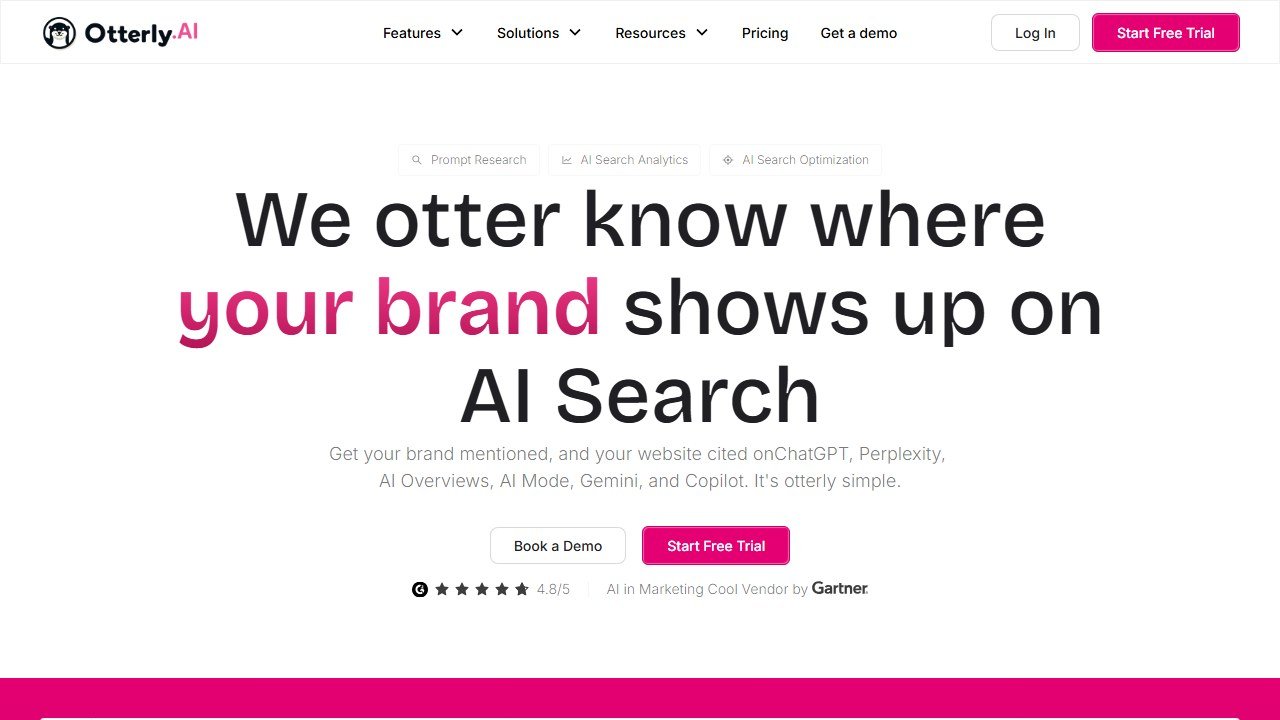
Otterly.ai is an AI search monitoring platform. You give it a set of prompts (the questions your customers might ask an AI assistant), pick the markets and languages you care about, and Otterly runs those prompts on a schedule across the major AI engines. It then reports whether your brand showed up, where it ranked in the answer, whether your site was cited as a source, and how positive or negative the mention was.
The company is one of the originals in this space. It launched in 2024 out of Austria, and it has been recognised by Gartner as a Cool Vendor in the emerging generative-search category, which is a useful signal that analysts take it seriously rather than a guarantee of fit for you. In practice Otterly’s identity is “the easy one.” You can sign up, connect nothing complicated, and have a working dashboard the same afternoon. No sales call, no procurement dance, no onboarding fee on the entry tier.
That positioning is the whole story. Otterly is built so a solo marketer, a small in-house team, or an agency managing a handful of clients can start measuring AI visibility this week, not next quarter.
What It Tracks
Otterly’s core job is monitoring, and it covers the metrics that matter for AI search:
- Brand mentions. How often each AI engine names your brand in answers to your tracked prompts.
- Citations and links. Which of your pages (and which competitor or third-party pages) the engines cite as sources. This is more useful than raw mention counts because it shows what content is actually feeding the answers.
- Average brand position. Where you land inside an answer, not just whether you appear.
- Sentiment. Whether the mention frames you positively, neutrally, or negatively.
- Share of voice. Your visibility versus named competitors across the same prompt set.
- Competitor tracking. Side-by-side coverage so you can see who the engines favour in your category.
- GEO content audits. URL-level checks that score how likely a page is to be picked up and cited by AI engines, with predictive scoring before you publish.
On engine coverage, read the fine print. Otterly’s base plans track four core engines: ChatGPT, Google AI Overviews, Perplexity, and Microsoft Copilot. The marketing sometimes implies a wider “six engine” reach, but Google AI Mode, Gemini, and Claude are paid add-ons rather than included. For a brand whose customers live mostly in ChatGPT and Google AI Overviews, the four core engines are exactly where the attention is, so this is not a dealbreaker. It is just not the all-in coverage the headline suggests.
What It Does Well (Entry-Level Monitoring)
Three things make Otterly the easiest tool to recommend to a first-time buyer.
The entry price is genuinely low. The Lite tier sits around the $29 a month mark on monthly billing, which is the cheapest serious option in the category by a wide margin. Most rivals start two to three times higher, and the enterprise leaders do not publish a self-serve price at all. If your job is to prove that AI visibility is worth measuring before anyone hands you a budget, this is the tool that lets you do it.
Self-serve setup is fast and painless. You can trial it, configure prompts, and read your first dashboard without talking to a human. For small teams and agencies that is a real advantage, because the alternative at the high end is a demo, a quote, and a multi-week rollout.
The dashboard is clean and the data is trustworthy. Otterly does not drown you in vanity charts. Mentions, position, citations, sentiment, and share of voice are laid out so a non-specialist can read them. Agency-friendly touches help too: unlimited team members and workspaces on the paid tiers, plus a Looker Studio connector for client reporting on the higher plans.
For the core use case of “show me whether AI engines know my brand exists, and whether that is getting better or worse,” Otterly does the job cleanly and affordably. That is not faint praise in a category full of half-finished products.
Where It Falls Short (Optimization and Action)
Otterly is strong at measurement and noticeably lighter on what to do next. This is the recurring theme in independent reviews and the real reason the “alternatives” searches run so hot.
It tells you what, not how. You will see that a competitor outranks you in Perplexity for a key prompt. Otterly is thinner on a prioritised, do-this-next plan to close that gap. The GEO audit and predictive scoring help at the page level, but the strategic layer (which content to build, which pages to fix first, what the engines reward in your specific category) is where enterprise tools pull ahead.
Prompt allowances are tight. Fifteen prompts on Lite and one hundred on Standard fill up fast once you track multiple products, markets, or languages. Serious multi-market tracking pushes you up the plans, or into add-ons, quicker than the entry price suggests.
Coverage gaps for deeper research. There is no Reddit or forum monitoring and no AI-crawler analytics (which bot fetched which page, how often). Teams running a real GEO program eventually want that visibility, and Otterly does not provide it.
Add-on creep. Wanting Gemini, Google AI Mode, or Claude, or simply more prompts, means stacking paid add-ons. The headline $29 is honest, but a realistic working configuration for a growing brand lands well above it.
None of this makes Otterly bad. It makes Otterly a monitoring tool rather than a full visibility operating system. Know which one you are buying.
Pricing
Otterly is fully self-serve with transparent, published pricing, which is refreshing in a category that loves “contact sales.” Always confirm current numbers on the Otterly.ai pricing page, because tiers and add-ons in this market move quickly. As of this review the structure looks like this:
- Lite (around $29 a month): roughly 15 prompts, the 4 core engines, daily tracking, unlimited team members, and a GEO URL audit allowance. The “prove it works” tier.
- Standard (around $189 a month, the popular pick): roughly 100 prompts, API and MCP access, unlimited workspaces, a larger GEO audit allowance, and the Looker Studio connector. The realistic working tier for an in-house team or agency.
- Premium (around $489 a month): roughly 400 prompts, the largest GEO audit allowance, more API requests, and personal onboarding. For heavier multi-market programs.
- Enterprise (custom): single sign-on, quarterly health checks, and tailored terms.
Billing notes worth knowing: annual plans carry a discount (around 15 percent), and a free trial lets you test before paying. Add-ons (extra prompts, Claude, Gemini, Google AI Mode) are priced separately, so budget for a configuration above the sticker if you need wider engine coverage. The pricing model is the main reason to start here. Few rivals let you begin this cheaply with this little friction.
When to Stay vs Switch (the Honest Part)
This is the question most “Otterly review” searchers are really asking. Here is our straight answer.
Stay with Otterly if:
- You are new to AI search monitoring and need affordable, credible proof that it matters.
- Your customers concentrate in ChatGPT, Google AI Overviews, Perplexity, and Copilot (the four core engines).
- You are a small team or an agency that values self-serve setup and clean client reporting over deep strategy.
- Budget sensitivity is real and a sub-$30 entry point is the difference between starting and not starting.
Switch (or add a second tool) when:
- You have the proof and leadership now wants a plan, not just a scoreboard. You need optimization and action guidance, not only measurement.
- You are tracking many products, markets, or languages and Otterly’s prompt limits keep forcing upgrades or add-ons.
- You need Reddit and forum monitoring, AI-crawler analytics, or all major engines included rather than bolted on.
- Enterprise procurement enters the picture and you need SOC 2, single sign-on, and security review as standard.
Where do people go? The usual graduation path runs to Peec AI for deeper mid-market analytics, to Profound for enterprise-grade strategy and the widest answer coverage, and to Scrunch for teams that want GEO content guidance plus enterprise compliance. The point is not that Otterly loses. It is that Otterly is the on-ramp, and these are where the road leads once you scale.
Otterly vs the Alternatives
| Tool | Best for | Entry price (self-serve) | Strength | Trade-off |
|---|---|---|---|---|
| Otterly.ai | First AI-visibility tool, startups, agencies | Lowest (around $29/mo) | Accessible, fast self-serve, clean monitoring | Lighter on optimization and action; add-ons for wider engines |
| Peec AI | Mid-market analytics teams | Mid (around €85/mo) | Deeper analytics, strong competitor insight | Pricier entry; still analytics-led |
| Profound | Enterprise, category leaders | Custom (sales-led) | Widest answer coverage, deepest strategy, enterprise scale | No cheap self-serve; heaviest spend |
| Scrunch AI | GEO content + enterprise compliance | Mid to high | Action guidance plus SOC 2 for procurement | More than entry teams need |
Read the table as a ladder, not a fight. Otterly is rung one. Most teams should start there and climb only when a real limit forces it.
Pros and Cons
Pros:
- Cheapest serious entry point in the category (self-serve, no sales call).
- Fast, painless setup with a clean, readable dashboard.
- Solid core monitoring: mentions, position, citations, sentiment, share of voice.
- Genuinely agency-friendly (unlimited team members and workspaces, Looker Studio export on paid tiers).
- Transparent published pricing with a free trial and an annual discount.
- Early mover with Gartner Cool Vendor recognition.
Cons:
- Lighter on optimization and action guidance than enterprise rivals.
- Tight prompt allowances that push multi-market teams up the plans fast.
- Only four core engines included; Gemini, Google AI Mode, and Claude cost extra.
- No Reddit or forum monitoring and no AI-crawler analytics.
- Add-on stacking can push the real cost well above the headline price.
- Better as a monitoring layer than a complete visibility strategy platform.
Who It’s For
Otterly.ai is for the team taking its first serious step into AI search visibility. If you are a startup, a small in-house marketing team, or an agency that needs to start measuring brand presence across AI answers this week, on a budget, with no procurement overhead, Otterly is the easiest yes in the category. It is also a smart sandbox for proving the value of AI-visibility work before you pitch for a bigger tool and a bigger budget.
It is a weaker fit if you are already past the proof stage and need a platform that prescribes strategy, covers every engine and channel out of the box, and clears enterprise security review. Those buyers should look at the deeper tools in our best AI search monitoring tools guide and our broader best AI visibility tools roundup, and compare directly against our Peec AI review for the most common next step up.
Our Verdict
Otterly.ai earns a 4.1 out of 5. It is the best entry-level AI search monitoring tool on the market and the one we would put in front of almost anyone starting out. The low self-serve price, the fast setup, and the clean, trustworthy monitoring data make it the obvious first purchase in a category that otherwise pushes you straight into enterprise sales calls. Being early shows in the polish of the core experience.
It loses points where the “alternatives” searches predict it would: optimization and action guidance are thin, prompt limits bite as you scale, and a complete engine lineup costs extra. That keeps it from being a five and makes it a tool many teams eventually outgrow. But outgrowing a tool is a sign it did its job. Buy Otterly to learn the category cheaply and prove the value. When monitoring alone stops being enough and you need a plan, that is your cue to graduate to Peec, Profound, or Scrunch. As the entry-level pick, Otterly is hard to beat.

Written by
FazFaz is the founder of AIToolsBakery. Some tools here are tested hands on. Others are assessed from vendor documentation and pricing verified on the live page, and every review says which one it is. Sponsors can buy a position in a guide. They cannot buy the score, the criticism, or silence about a better option.
How we test and how we make money →Frequently Asked Questions