Profound is the name that comes up first whenever marketers talk about AI search visibility, and for good reason. While most of us were still arguing about whether anyone would actually replace Google with ChatGPT, Profound built the deepest dataset in the category and signed Fortune 500 logos faster than anyone else. Backed by a Sequoia-led Series B in August 2025 and a reported $96M Series C in February 2026 at a $1B valuation, it is now the most-benchmarked, most-imitated platform in generative engine optimization (GEO). When a rival tool publishes a comparison page, Profound is almost always the one they are measuring themselves against.
That market position is exactly why an honest review is hard to find. The search results for “Profound review” are stuffed with vendor-biased pages: competitors reviewing Profound to sell you their cheaper alternative, and Profound reviewing competitors to sell you itself. Everyone in this niche is selling something, so every “comparison” tilts toward whoever paid for the page. The questions that actually matter get buried: Is the price floor justified? Does it tell you what to fix, or just what is broken? And who, realistically, should write a five-figure annual check for it?
We bought into the GEO category as analysts, not resellers, and we wanted a verdict we could trust ourselves. So here it is, scored on our usual 0 to 5 scale, with the price and the diagnosis-versus-execution gap treated as first-class concerns rather than footnotes.
A note on our independence. We are AIToolsBakery, an independent AI-tools review site. We do not sell Profound, we are not a Profound partner or reseller, and we earn nothing if you buy it. We have no affiliate deal with any tool in this category. When a post on this site is sponsored, it is labelled as sponsored at the top, and a sponsorship never changes a score or a recommendation. This review is not sponsored. Nobody paid for it, nobody reviewed it before publication, and the only agenda here is helping you decide where to spend a real budget.
The verdict in 30 seconds: Profound (4.5/5) is the best AI search visibility platform money can buy, with the deepest real-scrape data across ChatGPT, Perplexity, AI Overviews, Copilot and more. The catch: the $99 Starter tracks ChatGPT only, the tier that matches the reputation is $399 a month, and it is a product that diagnoses brilliantly but only recently started helping you execute. Built for large brands, overkill for solo operators.
What Profound is
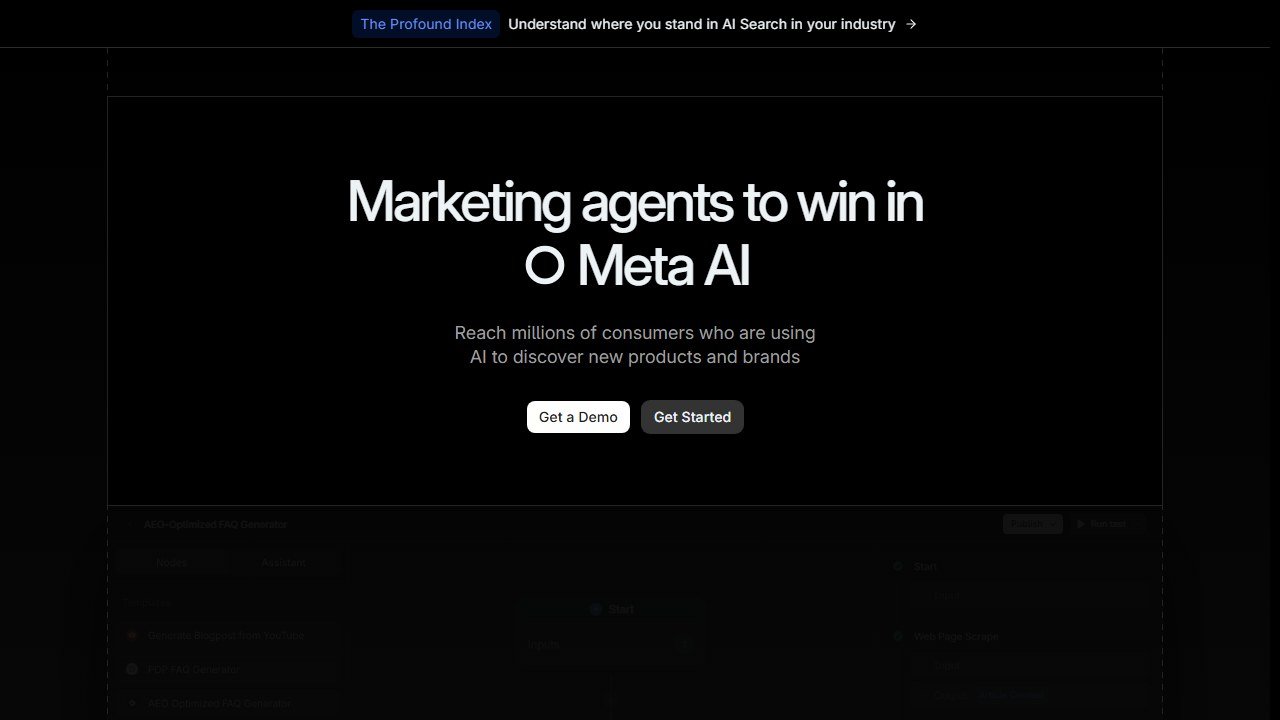
Website: Profound
Profound is an enterprise AI visibility platform. Its job is to tell you how your brand shows up when real people ask AI assistants questions, and how that compares to your competitors. Where a traditional rank tracker tells you where you sit on a page of blue links, Profound tells you whether ChatGPT recommends you, whether Perplexity cites your page, and whether Google’s AI Overviews mention you by name when someone asks “what is the best tool for X.”
The company frames the platform around four verbs: understand, analyze, build, and measure. In practice the core that made Profound famous is the measurement and analysis side. It captures front-end, user-facing AI responses at scale, then turns them into share-of-voice metrics, citation analytics, sentiment tracking, and competitive benchmarks. Profound launched in 2024, and by 2026 its publicly named customers include Ramp, DocuSign, Figma, MongoDB, Indeed, Chime, U.S. Bank, and a string of Fortune 500 retailers. That client list is part of the product: enterprise buyers trust enterprise references.
If you want the broader landscape before committing to any single vendor, our roundup of the best AI search monitoring tools for 2026 maps the whole field, and our guide to the best AI visibility tools for 2026 ranks the top contenders head to head.
For how Profound stacks up against the rest of the category, see our full AI Mode SEO checking tools comparison.
What Profound tracks
Profound monitors a wider set of answer engines than almost anyone else in the category. As of mid-2026 it covers ChatGPT, Perplexity, Google AI Overviews, Google AI Mode, Microsoft Copilot, Gemini, Claude, Grok, Meta AI, and DeepSeek. That breadth matters because your audience is not all using the same assistant, and visibility in ChatGPT does not guarantee visibility in Perplexity or AI Overviews.
The feature set breaks down into a few pillars:
- Answer Engine Insights. The flagship view. It shows how AI represents your brand across thousands of real conversations, with your name highlighted in the actual response text. This is the “are we even in the answer” dashboard, sliced by topic, competitor, and engine.
- Conversation Explorer. Lets you read the actual AI answers, in context, with brand mentions surfaced. This is the feature reviewers consistently single out, because seeing the verbatim text is far more convincing than a score.
- Prompt Volumes. An estimate of what millions of people are actually asking AI, by topic. This is genuinely close to unique. It is the AI-search equivalent of keyword volume data, and it is the thing competitors struggle to replicate.
- Citation analytics. Which sources the AI engines pull from when they answer questions in your category, so you can see which pages and domains are winning the citations you want.
- Agent Analytics. Tracks how AI crawlers (the bots behind ChatGPT, Gemini, Claude, Perplexity, and others) crawl and interpret your own site, which is the supply side of the same problem.
- Agents / Actions. The newer execution layer. Autonomous workers that generate AI-optimized content and push it to systems like WordPress, Sanity, Contentful, and Slack. More on this below, because it is also where the honest caveat lives.
How good is the data
This is where Profound earns its reputation, and where the score mostly comes from. The differentiator is methodology. Profound captures real, front-end AI responses, the same surface a human user would see, rather than relying purely on API calls that can behave differently from the consumer-facing product. AI assistants personalize, change over time, and answer the same prompt differently depending on context, so a tool that scrapes the real UI at scale gets closer to ground truth than one that only queries an API.
The result is the deepest, most defensible dataset in the category. Prompt Volumes in particular has no real equivalent: it is the only widely available source that estimates actual AI-search demand by topic, which lets you prioritize the questions worth winning instead of guessing. Combined with verbatim conversation data and multi-engine coverage, this is the most complete picture of AI visibility on the market. It is the reason rivals benchmark against Profound rather than the other way around.
The honest qualifier: no tool in this space is perfect. AI engines are moving targets, sampling is sampling, and Profound’s G2 reviews include real complaints about occasional bugs, slow interface performance, and support response times that can stretch out. None of that undermines the core data advantage, but a five-figure tool should be held to a high bar on reliability, and a handful of users say it has missed that bar at times.
The pricing question
Here is the part most Profound coverage has wrong. It used to be opaque and sales-led, and nearly every review still says so. It now publishes tiered prices, and the gap between the cheapest tier and the useful one is the single biggest reason it is still not for everyone.
This changed, and most coverage has not caught up. Profound used to be sales-led and opaque, and third-party reviews through 2026 still quote a floor around $499 a month for an entry tier that no longer exists. It now publishes its prices. We loaded the pricing page on 1 September 2026 and read the figures from the page markup, because they render as animated components that a plain text scrape returns empty.
| Plan | Price | Answer engines | Prompts tracked | Agent credits |
|---|---|---|---|---|
| Starter | $99/month, billed yearly | ChatGPT only | 50 | 100/month |
| Growth (Popular) | $399/month, billed yearly | 3 | 100 | 400/month |
| Enterprise | Custom | Up to 9 | Tailored | Tailored |
Both paid tiers advertise two months free on annual billing, and Growth carries a “Try for free” route rather than the demo-only wall the older coverage describes. Enterprise adds SSO and SAML, SOC 2 compliance, multiple tracked companies and dedicated Slack support.
What that means in practice has changed with it. The entry point is now $99 a month rather than five times that, which puts Profound inside reach of teams it used to exclude outright. Read the Starter row carefully before celebrating though: it tracks ChatGPT only and 50 prompts, so it is a monitoring toehold rather than the platform the reviews are describing. The product people mean when they call Profound best-in-class is Growth and above. The honest read is that the floor came down a long way and the price of the actual thing did not.
The free AEO Report on Profound’s site is the one no-commitment way to get a taste. Enter a brand, get a snapshot. It is a lead magnet, not the product, but it is a reasonable way to see the kind of insight the platform produces before you book a call.
Diagnosis versus execution
This is the most important honest caveat in the review, so we are giving it its own section.
For most of its life, Profound has been a diagnosis tool. It is exceptional at telling you what is happening: where you are losing share of voice, which competitor owns a topic, which pages get cited, how sentiment trends. What it has historically been lighter on is execution, the part where it actually fixes the problem for you. Several independent reviewers have made the same point in blunter terms: you get dashboards, not next steps. The insight is world-class; the “now do this” has been thinner.
Profound is clearly aware of the gap and is closing it. The 2026 Agents / Actions layer is the execution play: autonomous workers that generate AI-optimized content and publish it into your stack, plus a stated ambition to move into the broader marketing-automation market. That is a genuine expansion, and if it matures it changes the value equation considerably. But as of mid-2026 it is the newer, less proven part of the platform, and the thing Profound is unambiguously best in the world at remains measurement. Buy it today for the diagnosis. Treat the execution layer as promising upside, not the reason you sign.
If you want a contender that leans harder into the “what should I change” workflow at a lower price, that is exactly where the alternatives come in.
Profound versus the alternatives
The three names you will weigh against Profound are Peec AI, Otterly, and Scrunch. Here is the honest shape of the market.
| Tool | Best for | Pricing model | Free trial / self-serve | Standout strength | Main trade-off |
|---|---|---|---|---|---|
| Profound | Large brands and enterprises | Published tiers, $99 and $399/mo, Enterprise custom | Free route into Growth, self-serve signup | Deepest real-scrape data, Prompt Volumes, most engines | Price floor, diagnosis-heavy, must talk to sales |
| Peec AI | Mid-market teams and brand managers | Mid-market, more accessible | More self-serve friendly | Actionable recommendations, fast-growing, near real-time | Less data depth and engine breadth than Profound |
| Otterly | SMBs and first-time GEO buyers | Lowest entry point | Self-serve, low-cost entry | Easiest on-ramp, affordable monitoring | Lighter analytics, slower refresh cycles |
| Scrunch | Brands wanting agent-side and execution focus | Mid-market to enterprise | Demo-led | Agent experience and optimization angle | Smaller, less benchmarked dataset |
The pattern is clear. Profound wins on data depth and trust and loses on price and access. Peec AI is the natural step down for teams that want strong analytics plus actual recommendations without the enterprise commitment, which is why it is the most common head-to-head. We break that exact matchup down in our Profound vs Peec AI comparison, and if Peec is on your shortlist, read our full Peec AI review before you decide. Otterly is the budget on-ramp for anyone testing the waters, and Scrunch is worth a look if your priority is the agent and execution side rather than the deepest measurement.
Pros and cons
Pros
- The deepest, most defensible dataset in the category, built on real front-end scraping rather than API-only sampling.
- Broadest engine coverage we have seen: ChatGPT, Perplexity, AI Overviews, AI Mode, Copilot, Gemini, Claude, Grok, Meta AI, DeepSeek.
- Prompt Volumes is close to unique: actual AI-search demand by topic, not guesswork.
- Conversation Explorer shows verbatim AI answers with your brand highlighted, which is far more persuasive than a bare score.
- Enterprise-grade trust: Fortune 500 client roster, strong funding, G2 Leader status, security and reporting that pass procurement.
- An emerging execution layer (Agents / Actions) that, if it matures, closes the one real product gap.
Cons
- The capable tier is still $399/mo. Starter at $99 tracks ChatGPT only and 50 prompts, so the entry price and the useful price are far apart.
- No open free tier. Growth advertises a free route in, but Starter and Enterprise still route through signup or sales.
- Historically diagnosis-heavy: excellent at telling you what is wrong, lighter on fixing it (improving, but newer).
- Some G2 reviewers report bugs, slow interface performance, and slow support, which stings at this price.
- Overkill for anyone who just needs lightweight monitoring of a single brand.
Who should (and should not) buy it
Buy Profound if you are a large brand or enterprise where AI search is a real revenue channel and being misrepresented (or absent) in AI answers costs you measurable money. If you have multiple competitors, multiple markets, and a marketing team that needs procurement-grade data to justify a GEO program to leadership, Profound is the most defensible choice on the market. The price stops being the headline when AI visibility is worth six or seven figures to you.
Do not buy Profound if you are a solo creator, freelancer, agency on a tight margin, or small business with one brand to watch. The floor is too high, the lack of a trial makes evaluation painful, and you will pay for depth you cannot fully use. Start with Otterly to learn the category cheaply, or step up to Peec AI when you want serious analytics plus recommendations without the enterprise commitment. You can always graduate to Profound later, when the budget and the stakes both justify it.
Our verdict
Profound is the best AI visibility platform you can buy in 2026, and it is not especially close on the dimension that matters most: data. The real-scrape methodology, the engine breadth, the Prompt Volumes demand data, and the verbatim Conversation Explorer add up to a picture of AI search that no competitor matches today. The enterprise trust is earned, the funding is real, and the category benchmarks itself against this product for a reason.
The drag is access, not quality, though less so than it was. Published tiers from $99 and a free route into Growth have removed the sales-only wall, but the tier that matches the reputation is $399 a month, and a product that until recently diagnosed far better than it executed means that for much of the market the value is still theoretical. You are paying for the best instrument in the world, and only large brands have a problem big enough to need it. The execution layer is promising and could lift the score over time, but we grade what ships, and today the honest position is: best-in-class data, priced and gated for enterprises.
That nets out to a strong score with a clear-eyed caveat. Profound earns a 4.5 out of 5: a near-perfect tool for the buyers it is built for, held back half a point by a price floor and access model that put it out of reach for everyone else.

Written by
FazFaz is the founder of AIToolsBakery. Some tools here are tested hands on. Others are assessed from vendor documentation and pricing verified on the live page, and every review says which one it is. Sponsors can buy a position in a guide. They cannot buy the score, the criticism, or silence about a better option.
How we test and how we make money →Frequently Asked Questions