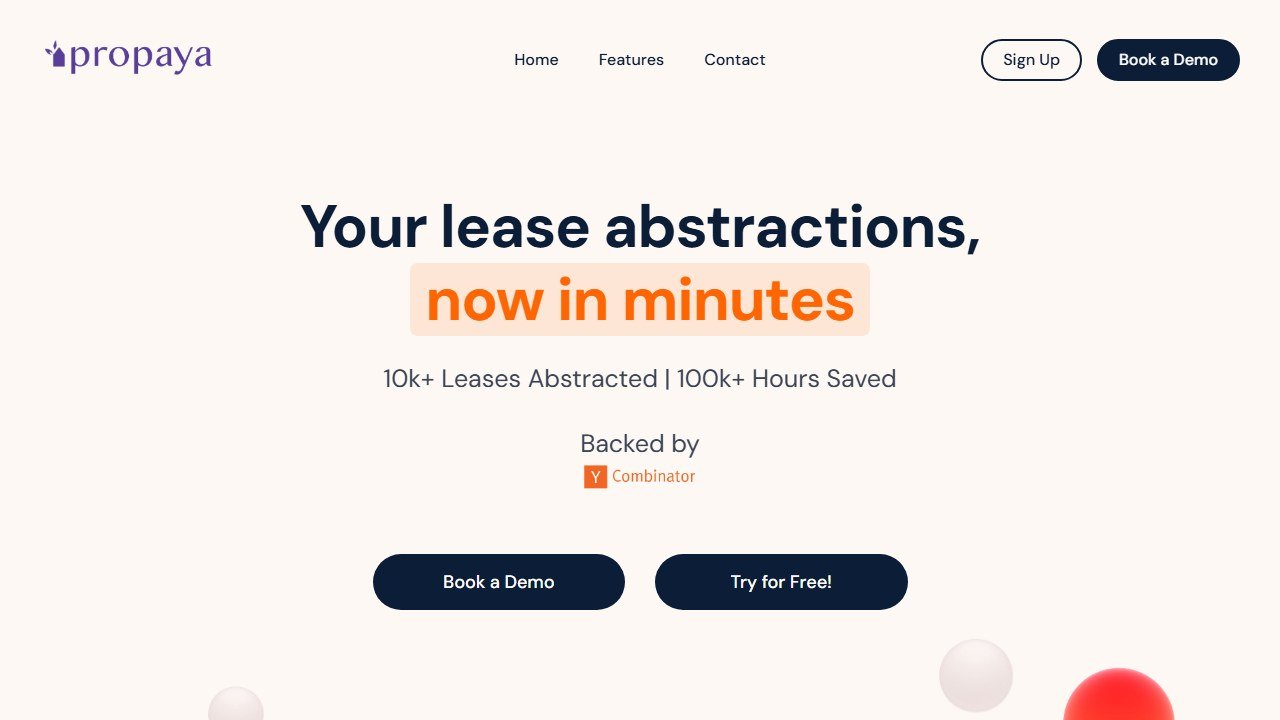
Commercial lease abstraction is the kind of work that quietly eats a career. A single lease can run sixty pages of dense legal language, and a broker, analyst, or asset manager may need to pull the key terms from dozens of them before a deal closes or a portfolio gets valued. Done by hand it takes hours per lease and invites costly mistakes. Propaya is a Y Combinator-backed startup built to make that job take minutes instead, and it is one of the more credible new names in commercial real estate AI.
Verdict: Propaya is a strong, early-stage AI lease abstraction tool for commercial real estate, extracting 188 or more lease terms in minutes with optional human review for near-perfect accuracy. Best for brokers, attorneys, and asset managers who abstract leases regularly. Fast-moving but young, so verify on your own documents first.
What Propaya does
Propaya uses AI to abstract and analyze commercial leases. You upload a lease PDF, and the system extracts the key terms, delivering clause-cited insights, linked schedules, and export-ready data in a fraction of the time a manual abstraction takes. The company says it pulls more than 188 key terms from a lease, and that customers save roughly ninety percent of the time and cost they used to spend on lease review.
The detail that matters most is the citation. Propaya links each extracted term back to the source clause in the document, so you are not asked to trust a summary blindly. You can click through to the exact language the AI read, which is the difference between a tool you can rely on for a real deal and a tool that produces a plausible summary you still have to verify from scratch. For high-stakes commercial work, that clause-level traceability is not a nice extra. It is the whole point.
Beyond raw abstraction, Propaya positions itself as a deal tool, giving brokers, heads of real estate, and attorneys market benchmarks and evaluation features to negotiate more effectively. That moves it from a document-processing utility toward something closer to a workflow platform, though the core value today is the abstraction engine.
Who is behind it
Propaya was founded by Reader Wang and Jake Golas, who met as students at Phillips Academy Andover and stayed close friends. Wang, the CEO, is a former SpaceX engineer who worked on the Starship program and holds a masters from Stanford. Golas, the CTO, studied computer science and worked as a software engineer at Epic Systems, the healthcare software giant known for demanding engineering standards. The company is part of Y Combinator, which places it firmly in the early-stage, founder-led category rather than among established incumbents.
That background cuts both ways for a buyer. The founding team is technically serious, which shows in the product’s accuracy focus. But the company is young, so you are betting partly on a startup’s trajectory, and you should weigh that the way you would with any early tool: strong upside, less of a track record than a decade-old vendor.
Key features
Fast, clause-cited abstraction
The headline capability is extracting 188 or more terms from a lease PDF in minutes, each linked to its source clause. This is the feature that saves the ninety percent of time Propaya advertises, and the citation is what makes the output safe to act on.
Optional human quality assurance
Propaya offers an optional human QA layer that the company says lifts accuracy to around ninety-nine percent. This hybrid model is smart for commercial real estate, where a single missed clause can carry real financial consequences. You get AI speed on the bulk of the work and a human check where it counts.
Deal and negotiation tooling
The platform layers market benchmarks and deal-evaluation features on top of abstraction, aimed at helping brokers and attorneys negotiate from a stronger, data-backed position rather than just filing away a summary.
Pricing
Propaya has not published a standard public price list at the time of writing, which is common for early-stage commercial real estate tools that quote by volume and use case. If you abstract leases regularly, the relevant comparison is not the subscription figure but the loaded cost of the hours your team currently spends doing it by hand. Ask for a quote tied to your actual lease volume, and ask specifically how the optional human QA is priced, since that is where the accuracy guarantee lives.
| What to confirm on a demo | Why it matters |
|---|---|
| Price per lease vs subscription | Your real cost depends on volume; model both |
| Human QA cost and turnaround | This is what backs the 99% accuracy claim |
| Export formats and integrations | Abstracted data is only useful if it flows into your systems |
| Data handling and security | Leases are sensitive; confirm how documents are stored and used |
Pros and cons
What we like: genuinely fast abstraction on a task that is painfully slow by hand; clause-level citations that make the output verifiable; an optional human QA layer for near-perfect accuracy; a technically strong founding team focused on correctness; and a clear, large problem that AI is genuinely well-suited to solve.
What to weigh: it is an early-stage company, so the track record is short and the roadmap is still forming; pricing is quote-based rather than transparent; and as with any AI on legal documents, you should run it on your own leases and confirm the accuracy before you trust it at scale. Treat the first batch as a supervised trial, not a set-and-forget switch.
Who should use Propaya
Propaya fits commercial brokers, real estate attorneys, asset managers, and acquisition teams who abstract leases often enough that the hours add up. If lease review is a recurring bottleneck in your deals or your portfolio work, the time savings are real and the citations make the output usable rather than just fast. It is a weaker fit for someone who touches a lease abstraction once or twice a year, where the setup and learning are not worth it, and for teams that require a long, proven vendor track record before adopting any tool on legal-critical work.
How Propaya compares
Propaya sits in the commercial real estate slice of the AI landscape, alongside tools that apply computer vision to property capture and appraisal and platforms that handle owner finance. Within lease abstraction specifically, it competes with established players, and its differentiators are the clause-level citation and the optional human QA. For the broader picture of where lease tools fit among AI for agents and brokers, see our guide to the best AI tools for real estate agents, and for the commercial angle specifically, our roundup of AI tools for commercial real estate.
How these purchases go wrong, and the early warning signs
Four patterns cover most of what we hear a year after a real estate software purchase, and all four are visible in the first month.
The migration that never finishes
The new system goes live, the old one stays open “for historical records”, and eighteen months later half the team still works in both. This is the most common and most expensive failure in property management software. Before signing, agree a cutover date, a named owner, and what specifically will not be migrated. Running two systems is worse than either.
Tenant-facing features nobody told the tenants about
Online payments, maintenance portals and application flows only save time when residents actually use them, and adoption depends entirely on how the change is communicated. A portal with 20% adoption creates more work than paper did, because you now run two processes. Plan the resident communication before go-live and measure adoption at thirty days.
The tool one person runs
One capable person builds the workflows and produces every report. They leave and it stops the same week. The warning sign is that nobody else has ever done a full month-end in the system. Have a second person do it once a quarter from written steps.
The fees that arrive after the subscription
Payment processing, screening, e-signatures, bank account setup and inspections are all charged separately by most vendors in this category and all of them are published. A business case built on the subscription alone will be wrong in year one, usually by a four figure sum. Build the model from the fee schedule, not the plan cards.
What it costs to leave, which no pricing page mentions
Switching cost is why landlords and managers stay on systems they have outgrown. In this category it is unusually concrete, which means you can ask about it precisely.
Recurring payment authorisations rarely transfer
This is the big one. Tenant records, leases and ledgers export from almost any platform. Live recurring payment authorisations and the stored bank or card details behind them generally do not, which means every resident on autopay has to re-enrol. A share will not, and you will chase rent you were previously collecting automatically. Ask about this in writing during procurement, when you still have leverage.
Ask exactly what a full export contains
Standard fields usually come out cleanly. What often does not is the maintenance history with its photographs and correspondence, the document store of signed leases and addenda, the accounting history in a form your accountant can actually use, and the audit trail of who changed what. Ask for a sample export file during the trial rather than a description of one.
The accounting cutover has a right time and many wrong ones
Move at a period boundary, ideally the start of a financial year, and never mid-month with rent in flight. Plan to run a parallel reconciliation for one full cycle, and budget the hours for it. Migrations that go badly almost always went live at a convenient calendar date rather than a sensible accounting one.
Count the integrations before you sign, not when you leave
Listing syndication, accounting, screening providers, e-signature, banking, insurance and any owner portal are each work to disconnect and reconnect elsewhere. The count is always higher than anyone remembers, and it is the part that turns a two week migration into a six month one.
Where the figures on this page come from
Every price here was read from the vendor’s own pricing page on 4 September 2026, not from an aggregator or a review site. Each figure carries that date, because pricing in this market moves and a claim without a date is not checkable.
The pages we read
Buildium publishes $62, $192 and $400 a month plus a detailed fee schedule. DoorLoop publishes $69, $149 and $209 a month billed yearly with per unit equivalents. TurboTenant publishes a free tier plus $12.42 and $16.48. TenantCloud publishes $15 to $50 a month on annual billing. RentRedi publishes $12 a month on the annual plan. Hemlane, Rentec Direct and Landlord Studio all publish in full, as do Follow Up Boss at $69 per user, Wise Agent at $49, and Placester from $59.
The ones we could not read
AppFolio, Innago, Top Producer and Hostaway did not yield a figure to the same method that read every vendor above, and Lofty’s pricing page carried no plan rates. We are not presenting that as proof they publish nothing, because a failed read is not evidence of absence. Treat any figure for those five from elsewhere as unverified.
What we do not do
We do not carry a figure we cannot source to the vendor. Where a number circulates and cannot be traced, we say so and withdraw it rather than repeating it with a hedge, and we have withdrawn our own published figures on that basis more than once.
What agent CRMs and lead platforms actually charge
This half of the market divides into CRMs you fill with your own leads and platforms that sell you the leads as well, and the second is several times the price of the first. Here is each alternative to propaya review, read on 4 September 2026.
Follow Up Boss, $69 per user per month, published plainly
Follow Up Boss publishes $69 per user per month plus tax, with a yearly option giving two months free and calling as a $39 per user add-on. It is a CRM rather than a lead source, which is the important distinction: you are buying the system that works leads you already have. At five agents that is $4,140 a year before the calling add-on, so price it at your real headcount rather than at one seat.
Wise Agent, $49 a month, and the cheapest published option here
Wise Agent publishes $49 a month, falling to $42 billed annually at $499 a year, with a higher tier at $69 and $59. Its annual toggle is marked as saving 15% and the saving holds. For a solo agent or a small team this is the published floor of the category, and the gap to a lead platform is an order of magnitude rather than a percentage.
Placester, from $59 a month, sold around the website
Placester publishes $59, $79 and $129 a month with a 20% annual discount, positioned around IDX websites and marketing rather than lead generation. If your gap is presence rather than pipeline, that is a materially cheaper problem to solve than buying leads, and it is worth being honest with yourself about which one you actually have.
The lead platforms, where almost nobody publishes
The platforms that sell leads alongside software, Lofty, CINC, Ylopo, Zurple, Sierra Interactive, Real Geeks, Market Leader and BoldTrail among them, largely quote rather than publish. We could not read a plan figure from Lofty’s own pricing page on 4 September 2026. That is normal in this corner of the market and it means your only real leverage is a published CRM priced at your team size, plus a clear view of what you currently pay per closed transaction.
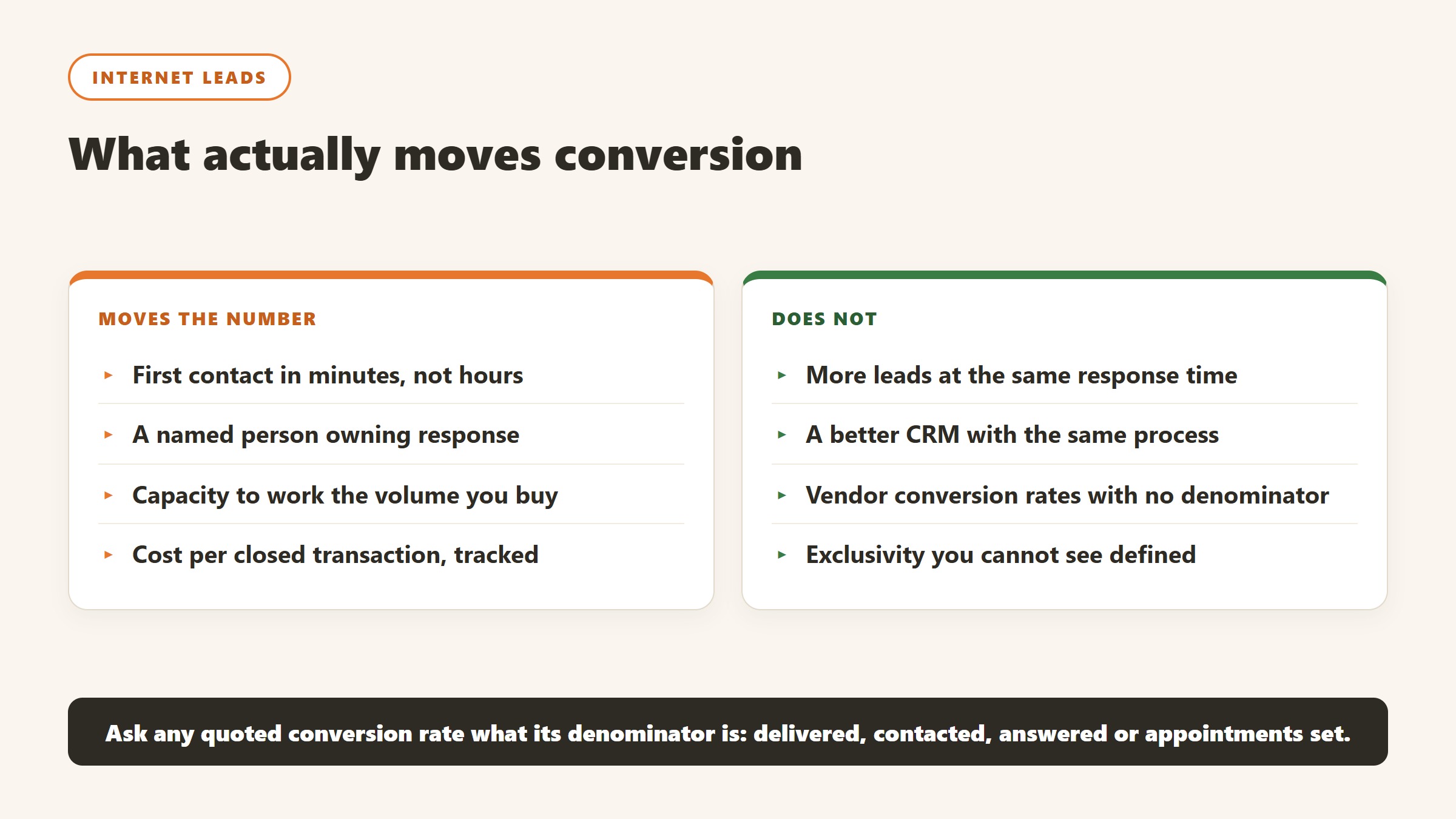
Work out your cost per closing before any demo
Take last year: total spend on leads and CRM, divided by transactions closed from those leads. That single number is the benchmark every quote has to beat, and most agents have never calculated it. Without it you are comparing monthly figures against each other rather than against the thing that pays for them, which is how a $2,000 a month platform gets renewed for three years on the strength of a feeling.
The verdict
Propaya is one of the more convincing new entrants in commercial real estate AI, precisely because it does not try to do everything. It takes the single most tedious, error-prone task in the sector and makes it fast and verifiable, with a founding team that clearly cares about getting the details right. The early-stage caveats are real: quote-based pricing, a short track record, and the standard need to validate AI output on legal documents. But for a team that lives in leases, Propaya is well worth a trial, and it earns its place as a tool to watch as commercial real estate catches up to the AI wave that residential has already ridden.

Written by
FazFaz is the founder of AIToolsBakery. Some tools here are tested hands on. Others are assessed from vendor documentation and pricing verified on the live page, and every review says which one it is. Sponsors can buy a position in a guide. They cannot buy the score, the criticism, or silence about a better option.
How we test and how we make money →