Commercial real estate runs on documents and math: sixty-page leases, offering memoranda, rent rolls, and models that decide whether a deal pencils. It is the corner of real estate where AI delivers the clearest returns, because the work is dense, repetitive, and expensive to get wrong. The tools have matured fast, and the 2026 field splits cleanly by job: abstract the leases, underwrite the deal, model the cash flow, and read the market. This guide ranks the best AI tools for commercial real estate by the job each one does.
Short answer: The best AI tools for commercial real estate in 2026 are Propaya and Prophia for lease abstraction, Blooma for lender underwriting, Dealpath for acquisition due diligence, Argus Enterprise for institutional modeling, and Cherre and CompStak for data and market comps. Match the tool to the job, and verify AI output on the numbers that matter.
Commercial listings increasingly ship with a rendered walkthrough rather than photographs, and that is a different tool category from the ones above. Our Enscape review and Twinmotion review both cover architectural visualisation tools, with current pricing and what each one needs from your existing CAD or BIM setup.
How we ranked these tools
We judged each tool on the job it actually does, how well it fits firms of different sizes, accuracy on the documents and numbers that carry real money, integration with the systems CRE teams already run, and price. We are a review site and take no payment for placement. One caution runs through the whole category: AI on legal and financial documents is fast, not infallible, so every tool here should be validated on your own leases and deals before you trust it at scale, and the ones with human review in the loop earn their premium in a sector where a missed clause is expensive.
Quick comparison
| Tool | Best for | Pricing |
|---|---|---|
| Propaya | AI lease abstraction for lean teams | Custom |
| Prophia | Ongoing lease and portfolio management | Custom |
| LeaseLens | Cheap per-lease abstraction | ~$25/lease |
| Blooma | Lender and credit underwriting | Custom |
| Dealpath | Acquisition due diligence and deal pipeline | Custom |
| Argus Enterprise | Institutional cash-flow modeling | Enterprise |
| Cherre | Real estate data integration | Enterprise |
| CompStak | Lease and sale comps, market rent | Custom |
Lease abstraction: turning leases into data
Abstracting a lease by hand takes hours and invites mistakes, and a portfolio can hold hundreds of them. This is the single clearest AI win in commercial real estate, and the tools now pull two hundred or more terms from a lease in minutes.
Propaya: best for lean teams and deal-time abstraction
Propaya is a Y Combinator-backed tool that extracts 188 or more terms from a lease PDF in minutes, each linked back to its source clause, with an optional human quality-assurance layer the company says lifts accuracy to around ninety-nine percent. The clause-level citation is the detail that matters: you can click straight to the language the AI read rather than trust a summary blindly, which is what makes the output safe to act on in a live deal. For brokers, attorneys, and lean acquisition teams who abstract leases often, it is a fast, verifiable pick. Read our full Propaya review.
Prophia: best for ongoing lease and portfolio management
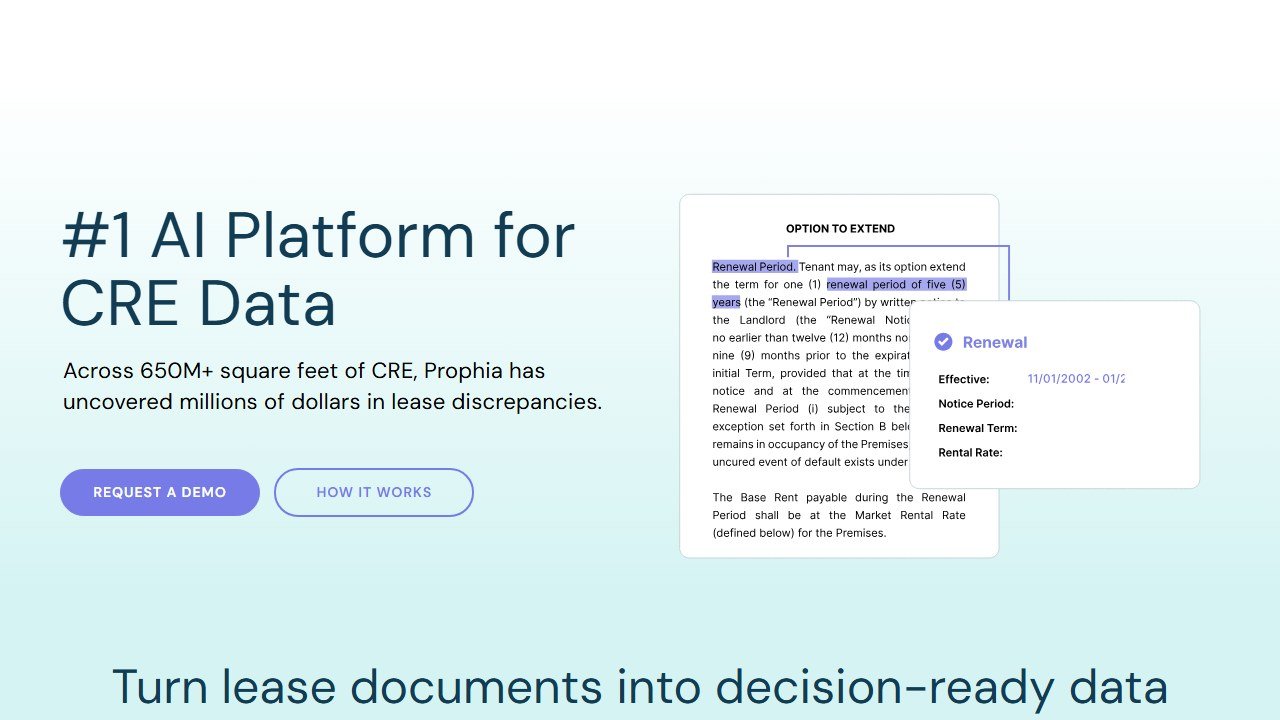
Prophia extracts more than two hundred CRE data terms with roughly ninety-nine percent accuracy using AI plus human review, and it is built for ongoing lease management rather than one-time abstraction. It handles the rent schedules, escalation clauses, renewal options, and tenant obligations that asset managers live in, and it is notably good with legacy or poorly scanned leases that trip up purely automated tools. For an owner or manager who needs a living, searchable record of a portfolio rather than a one-off export, Prophia is the stronger fit.
LeaseLens: best cheap, per-lease option
LeaseLens abstracts a commercial lease and exports it for around twenty-five dollars per lease, with no platform commitment. For a firm that only needs to abstract a handful of leases occasionally, its pay-per-lease pricing is the most sensible entry point, though it does not give you the ongoing management layer of a full platform.
Underwriting and deal analysis
Once the leases are data, the next job is deciding whether the deal works. AI underwriting tools ingest financials and documents, run the models, and produce lender-ready or investor-ready outputs in a fraction of the time.
Blooma: best for lender and credit underwriting
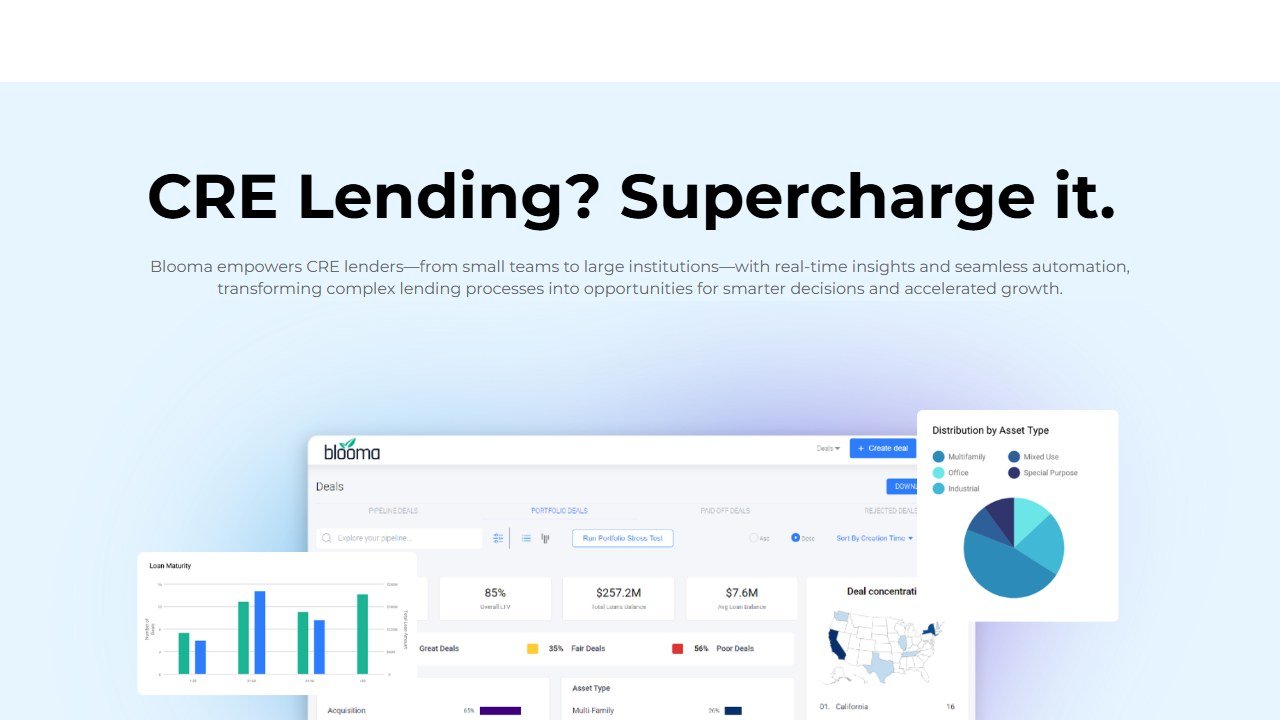
Blooma targets CRE lenders and credit teams, automating loan sizing, DSCR calculation, property valuation, and credit-memo generation. It ingests borrower financials and property documents, runs risk scoring against property records and market comps, and produces lender-ready outputs, with the company claiming a large increase in deal-processing capacity per underwriter. For a lending or credit shop drowning in memos, it is the category pick.
Dealpath: best for acquisition due diligence
Dealpath is a deal-management platform whose AI Extract module abstracts offering-memorandum and lease data in under a minute at a stated accuracy near ninety-five percent, then feeds it straight into the deal pipeline and auto-populates underwriting fields. For an acquisitions team that wants extraction and pipeline management in one system rather than stitched-together tools, Dealpath is the natural home.
Financial modeling: the institutional standard
Argus Enterprise: the common language of CRE finance
Argus Enterprise, owned by Altus Group, is the institutional standard for commercial real estate cash-flow modeling and valuation, used by most large owners, lenders, and appraisers for discounted-cash-flow analysis, lease-by-lease modeling, and portfolio reporting. It is not a new AI-native startup and it carries enterprise pricing and a learning curve, but it is the common language of CRE finance, and increasingly the AI-native tools above are built to feed data into it rather than replace it. If you work at institutional scale, you already speak Argus.
Data and market intelligence
The last job is reading the market: what comparable space is renting for, and what the data across your portfolio and the wider world is telling you.
Cherre: best for real estate data integration
Cherre connects a firm’s internal systems, property management, accounting, and CRM, with external sources like demographics, permits, satellite imagery, and foot traffic, through a single unified data layer built on billions of address records. For a data-mature firm that wants one clean source of truth to run analytics and AI on, Cherre is the infrastructure play rather than a point tool.
CompStak: best for lease and sale comps
CompStak runs a crowdsourced database of commercial lease and sale comparables, verified and standardized by an analyst team, across office, retail, and industrial in major markets, with AI focused on comparable selection and market-rent estimation. When your underwriting hinges on defensible comps, CompStak is where the market data lives.
Property capture and appraisal
For the physical side, tools like Automax apply LiDAR and computer vision to capture property details automatically and generate appraisal-ready reports, cutting the manual site-measurement and write-up work that appraisers and asset teams still do by hand. The sector here is early, so treat these as promising rather than proven, and verify the output.
Buying residential rather than commercial? Our guide to the best AI tools for real estate investors covers the flip, rental, and wholesaling stack, from off-market lead gen to underwriting.
Which one should you choose?
- Lean broker, attorney, or acquisitions team abstracting leases: Propaya.
- Owner or manager needing a living portfolio record: Prophia.
- Occasional, cheap lease abstraction: LeaseLens.
- Lender or credit team: Blooma.
- Acquisitions team wanting extraction plus pipeline: Dealpath.
- Institutional modeling: Argus Enterprise.
- Data infrastructure and market comps: Cherre and CompStak.
If you run a residential brokerage rather than a CRE shop, the operational stack is different: our guide to the best AI tools for real estate brokerages and teams covers recruiting, transaction compliance, and back office.
A note on accuracy and trust
Commercial real estate is unforgiving of errors, so treat AI output as a fast first pass, not a final answer. Favor tools that cite their source, offer human review, and let you verify a number against the document it came from. Run any tool on a set of leases or deals you already know cold before you rely on it, and keep a human on the terms that carry real money. Used that way, these tools genuinely compress timelines and lift throughput. Used blindly, they simply make mistakes faster.
Where the figures on this page come from
Every price here was read from the vendor’s own pricing page on 4 September 2026, not from an aggregator or a review site. Each figure carries that date, because pricing in this market moves and a claim without a date is not checkable.
The pages we read
Buildium publishes $62, $192 and $400 a month plus a detailed fee schedule. DoorLoop publishes $69, $149 and $209 a month billed yearly with per unit equivalents. TurboTenant publishes a free tier plus $12.42 and $16.48. TenantCloud publishes $15 to $50 a month on annual billing. RentRedi publishes $12 a month on the annual plan. Hemlane, Rentec Direct and Landlord Studio all publish in full, as do Follow Up Boss at $69 per user, Wise Agent at $49, and Placester from $59.
The ones we could not read
AppFolio, Innago, Top Producer and Hostaway did not yield a figure to the same method that read every vendor above, and Lofty’s pricing page carried no plan rates. We are not presenting that as proof they publish nothing, because a failed read is not evidence of absence. Treat any figure for those five from elsewhere as unverified.
What we do not do
We do not carry a figure we cannot source to the vendor. Where a number circulates and cannot be traced, we say so and withdraw it rather than repeating it with a hedge, and we have withdrawn our own published figures on that basis more than once.
What agent CRMs and lead platforms actually charge
This half of the market divides into CRMs you fill with your own leads and platforms that sell you the leads as well, and the second is several times the price of the first. Here is each alternative to best ai, read on 4 September 2026.
Follow Up Boss, $69 per user per month, published plainly
Follow Up Boss publishes $69 per user per month plus tax, with a yearly option giving two months free and calling as a $39 per user add-on. It is a CRM rather than a lead source, which is the important distinction: you are buying the system that works leads you already have. At five agents that is $4,140 a year before the calling add-on, so price it at your real headcount rather than at one seat.
Wise Agent, $49 a month, and the cheapest published option here
Wise Agent publishes $49 a month, falling to $42 billed annually at $499 a year, with a higher tier at $69 and $59. Its annual toggle is marked as saving 15% and the saving holds. For a solo agent or a small team this is the published floor of the category, and the gap to a lead platform is an order of magnitude rather than a percentage.
Placester, from $59 a month, sold around the website
Placester publishes $59, $79 and $129 a month with a 20% annual discount, positioned around IDX websites and marketing rather than lead generation. If your gap is presence rather than pipeline, that is a materially cheaper problem to solve than buying leads, and it is worth being honest with yourself about which one you actually have.
The lead platforms, where almost nobody publishes
The platforms that sell leads alongside software, Lofty, CINC, Ylopo, Zurple, Sierra Interactive, Real Geeks, Market Leader and BoldTrail among them, largely quote rather than publish. We could not read a plan figure from Lofty’s own pricing page on 4 September 2026. That is normal in this corner of the market and it means your only real leverage is a published CRM priced at your team size, plus a clear view of what you currently pay per closed transaction.
Work out your cost per closing before any demo
Take last year: total spend on leads and CRM, divided by transactions closed from those leads. That single number is the benchmark every quote has to beat, and most agents have never calculated it. Without it you are comparing monthly figures against each other rather than against the thing that pays for them, which is how a $2,000 a month platform gets renewed for three years on the strength of a feeling.
Buying leads honestly: what the conversion numbers actually mean
Every platform in this category quotes conversion figures. Almost none of them mean what a reader assumes, and the differences are large enough to reverse a purchase decision.
Ask what the denominator is
A conversion rate can be measured against leads delivered, leads contacted, leads that answered, or appointments set. Those four produce wildly different percentages from the same underlying performance. When a vendor quotes a rate, ask which one it is, and ask for the number of days over which it was measured. A rate with no denominator and no window is a marketing figure rather than a metric.
Speed to lead is the variable that actually moves conversion
The single largest controllable factor in internet lead conversion is how fast the first contact happens, and it is measured in minutes rather than hours. That is a staffing and process question, not a software one. A platform that routes leads instantly to an agent who checks their phone twice a day will underperform a spreadsheet worked by someone answering in five minutes. Fix the response process before buying anything that increases lead volume.
More leads at the same conversion is not obviously good
Doubling lead volume doubles the work and, unless response times hold, usually reduces conversion. Teams that buy volume without adding capacity get a lower conversion rate on a bigger number and conclude the leads were bad. Before increasing volume, work out how many new leads your current team can genuinely contact within the window that matters.
The contract term is where the risk sits
Lead platforms frequently ask for six or twelve month commitments, sometimes with a territory or exclusivity element. That is defensible, because a pipeline takes time to season. It is also a lock-in on performance you have not seen. Ask for a defined review point in writing, agree in advance what result would end the arrangement, and be sceptical of any exclusivity you are paying a premium for without a written definition of the area it covers.
The bottom line
Commercial real estate is where AI has moved from novelty to daily workflow fastest, because the work is exactly what machines do well: dense documents and repeatable math. Abstract leases with Propaya or Prophia, underwrite with Blooma or Dealpath, model in Argus, and read the market with Cherre and CompStak. Buy by the bottleneck that is costing you the most time, verify on a real deal, and expand from there. For the full real estate toolkit beyond the commercial side, see our guide to the best AI tools for real estate agents.
More AI tool guides worth reading: Best AI Property Management Software, Best AI Answering Services for Realtors and Perspective AI Review.

Written by
FazFaz is the founder of AIToolsBakery. Some tools here are tested hands on. Others are assessed from vendor documentation and pricing verified on the live page, and every review says which one it is. Sponsors can buy a position in a guide. They cannot buy the score, the criticism, or silence about a better option.
How we test and how we make money →