In November 2024, a competitor newsletter published a piece literally titled “A Eulogy to Propertyware.” Days later it was retracted, after RealPage refuted the shutdown claim. The correction traveled about a tenth as far as the obituary did, and the rumor kept circulating through 2025 and into 2026. Which puts us in a strange spot for a review: before we can tell you whether Propertyware is any good, we have to tell you that it exists.
It does. Propertyware is alive, selling, and shipping features in 2026. It is also a 2010-era product with exactly one AI feature, a pricing page seemingly designed to confuse scrapers, and minimum fees that quietly multiply the advertised rate for smaller portfolios. We spent time in the product, ran the fee math nobody else runs, and traced the death rumor back to its origin. Here is the honest picture.
| Plan | Advertised rate | Monthly minimum | Effective cost at 100 units | Breakeven point |
|---|---|---|---|---|
| Basic | $1.00/unit/mo | $250 | $2.50/unit | 250 units |
| Plus | $1.50/unit/mo | $350 | $3.50/unit | ~233 units |
| Premium | $2.00/unit/mo | $450 | $4.50/unit | 225 units |
| Verdict at a glance | ||||
| AITB score | 3.9/5 | |||
| Best for | Single-family operators with 250 to 1,000 doors who want accounting depth and customization | |||
| Owner | RealPage (which also owns Buildium) | |||
| AI | One feature: AI Screening for Single Family | |||
| Skip it if | You manage under 150 units, need a modern UI, or want a serious AI roadmap | |||
Pricing verified on the live Propertyware pricing page, July 21, 2026. Implementation fee (2x monthly subscription) and add-ons not included.
The eulogy that wasn’t: what actually happened in November 2024
The rumor has a specific origin story, and it is worth telling because it explains why half the internet still thinks this product is gone.
On November 15, 2024, Sina Shekou’s Aptly newsletter published “A Eulogy to Propertyware,” declaring the platform finished. The retraction followed after RealPage publicly refuted the shutdown claim. So where did the idea come from? RealPage had emailed a subset of small Propertyware accounts suggesting they consider Buildium, which RealPage also owns. The industry read a migration nudge aimed at small accounts as a sunset notice for the whole platform. That is an understandable misread, but it was a misread.
The timeline matters. The eulogy and the retraction both happened in November 2024. The rumor started in late 2024 and kept circulating through 2025 and 2026, resurfacing in forums, sales calls, and at least a few competitor pitch decks. If a salesperson tells you Propertyware is sunsetting, they are repeating a claim that was retracted the same month it was published.
And the evidence of life is not subtle. The pricing page is live with a 2026 copyright footer and an active demo CTA. Landbase counts roughly 1,738 verified companies using it in 2026. The What’s New page lists shipped features that, as of mid-2026, include AI Screening for Single Family, a new Application Portal, SimpleBills utility billing via SimpleBills, and a redesigned Money In workflow. Products in hospice do not redesign their payments module.
What Propertyware actually is in 2026
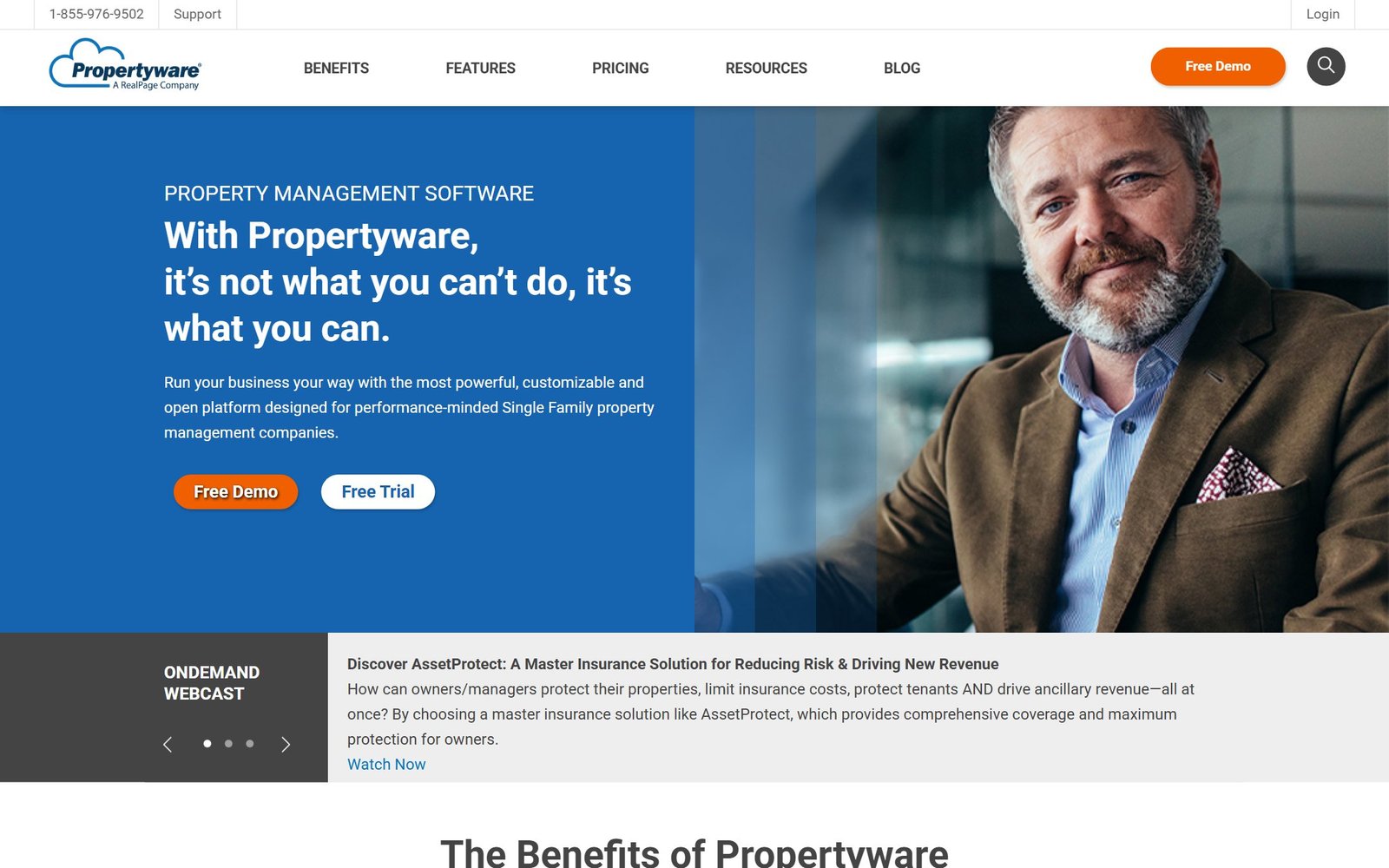
Propertyware is single-family property management software, and it does not pretend otherwise. Where AppFolio and Buildium chase every asset class, Propertyware has spent nearly two decades optimizing for the scattered-site SFR operator: hundreds of individual houses across a metro, each with its own owner, its own quirks, and its own accounting trail.
That focus shows up in three places we found genuinely strong in practice:
Accounting depth. Full general ledger, owner statements that owners can actually read, custom reporting, and the kind of trust accounting rigor that keeps a state auditor calm. This is the reason 250-door shops stay for a decade.
Customization. Custom fields, custom reports, and configurable workflows go further than most rivals allow. If your operation has a weird process, Propertyware will usually bend to it rather than forcing you into its shape.
Open API. For $1.00 per unit per month extra, you get an open API, which is rare at this price tier. Operators building their own owner portals, BI dashboards, or maintenance integrations get a real integration surface, not a webhook and a prayer.
The trade-off is the interface. The UI is dated, and we mean 2010 dated: dense tables, small click targets, page reloads where competitors have moved to live-updating views. It works, and long-time users are fast in it, but training a new hire takes noticeably longer than on modern rivals. In practice, common tasks like posting a payment or pulling an owner statement took more clicks than they would in a modern platform, though every one of those clicks landed somewhere sensible once we learned the map. Review scores reflect the mixed experience: 3.7 on G2 and 3.9 on Capterra across 325 reviews, with reliability and support responsiveness the recurring complaint themes.
The 2026 release cadence deserves a mention here too, because it directly contradicts the abandonment narrative. The What’s New page, current as of mid-2026, lists a rebuilt Application Portal that modernizes the applicant experience, SimpleBills integration for utility billing, and a full redesign of the Money In payments workflow. None of these are moonshots, but they are exactly the unglamorous plumbing improvements a maintained product ships, and the payments redesign in particular touches the workflow operators use most.
Scale limits are real too. The platform is comfortable in the hundreds of doors. Above roughly 1,000 units, users report performance strain and reporting slowdowns. The sweet spot is 250 to 1,000 SFR doors, and we would take that range seriously at both ends.
Pricing: the superscript trap and the minimum-fee math
Propertyware’s pricing is public, which we credit, because half this category hides behind quote forms. But the page has two traps, one typographic and one mathematical.
The typographic trap. The pricing page renders cents as superscript. To a human, Basic reads as one dollar per unit. To a scraper or a rushed AI summarizer, the superscript gets flattened and $1.00 becomes $100. We have seen third-party sites print Propertyware at $100, $150, and $200 per unit, which is off by a factor of one hundred. The real numbers, verified on the live page July 21, 2026: Basic $1.00 per unit per month, Plus $1.50, Premium $2.00.
The mathematical trap. Each plan carries a monthly minimum: $250 on Basic, $350 on Plus, $450 on Premium. Until your portfolio clears the breakeven, the minimum is your price, and the per-unit rate is decoration. On Basic, breakeven is 250 units. Run a 100-door portfolio and you pay the $250 minimum, which is $2.50 per unit effective, two and a half times the advertised rate. This is the same minimum-fee shape AppFolio uses, and we broke that version down in our AppFolio pricing guide. It is becoming the standard way this industry advertises one price and charges another.
Three more line items belong in your budget before you sign:
- Implementation is 2x your monthly subscription. One-time, but real money on day one.
- Units bill in 50-unit increments. A 260-unit portfolio bills as 300 units. Round up when you model costs.
- Add-ons stack. Maintenance Contact Center runs $1.10 per unit plus a $300 setup fee. Leasing Contact Center is $2.85 per unit plus $300 setup. Websites cost $99 per month. AssetProtect is $12 per policy. A Plus-plan shop using both contact centers is really paying $5.45 per unit before minimums, not $1.50.
Model your actual door count against the minimums and increments before comparing Propertyware to anything else. The advertised per-unit rate is the least informative number on the page.
The one AI feature (and the honest read on it)
Here is where the 2026 story gets uncomfortable. Propertyware has exactly one AI feature: AI Screening for Single Family. It scores applicants using AI-driven risk models, and RealPage claims it reduces bad debt by about $31 per unit per year. That is a vendor claim, not an independent benchmark, but screening is a sensible place to apply machine learning, and it is a real shipped feature, current as of mid-2026.
The problem is everything that is not there. No AI leasing agent answering inquiries at 2 a.m. No AI maintenance intake triaging photos of a leaking water heater. No natural-language reporting assistant. In 2026, those are table stakes moves that competitors have already made, and the roundup of what leading platforms now ship is in our best AI tools for property managers guide.
The sharpest version of the critique: RealPage is not slow at AI. It is sprinting on AI elsewhere in its portfolio while Propertyware receives one screening feature. That tells you something about where Propertyware sits in its owner’s investment priorities. Not sunsetting, clearly, since features are still shipping. But not the favored child either.
The ownership question: RealPage, Buildium, and the DOJ
RealPage owns Propertyware. RealPage also owns Buildium. If you are a small operator comparing the two, understand that this is a choice between two products with the same parent, and the migration emails that sparked the eulogy rumor show RealPage is willing to steer small accounts between them. Our full Buildium review covers that platform’s own fee stack, and our AppFolio vs Buildium comparison is the head-to-head if you are weighing the two biggest names.
One clarification we want on the record, because RealPage’s name attracts it: the Department of Justice consent decree with RealPage covers its AIRM, YieldStar, and LRO revenue management products only, per the Federal Register notices of January 21 and May 8, 2026. Propertyware is not named in any filing. If someone conflates the DOJ matter with Propertyware in a sales conversation, that is FUD, and you can say so.
What we liked
- Public pricing. Rates and minimums on a live page, in a category full of quote gates. We will always credit that, traps and all.
- SFR-native accounting. Owner statements, trust accounting, and custom reporting built for scattered-site portfolios rather than adapted from multifamily.
- Customization and the open API. The $1.00 per unit API add-on is a genuine differentiator for operators with in-house tech ambitions.
- It survived its own obituary. Shipping an application portal, utility billing, a payments redesign, and an AI screening feature in the window when the internet said you were gone is a quiet flex.
- Contact center add-ons. Outsourced maintenance and leasing call handling at published per-unit prices, for shops that want to buy back their phone hours.
What holds it back
- The interface. Dated is the polite word. New staff onboard slowly, and the daily experience trails every modern rival we have reviewed.
- Support and reliability complaints. The 3.7 G2 score is not an accident; slow support responses and intermittent reliability issues are the dominant negative themes across review platforms.
- Minimum-fee inflation. Below 250 units on Basic, you are paying above list. Below about 150, the effective rate gets hard to defend against competitors without minimums.
- A one-feature AI roster. Real, but thin, and the gap versus the category widens every quarter.
- The 1,000-unit ceiling. Growth-stage operators planning to triple should ask hard questions about performance at their target size.
Propertyware is not the only PM platform whose public prices went missing: our Rent Manager review covers the founder-owned platform that quietly went quote-only while page one still prints its dead per-unit grid.
Who should buy Propertyware in 2026
Buy it if you run 250 to 1,000 single-family doors, your accounting and owner-reporting requirements are heavier than average, and you value customization or API access over interface polish. In that lane, the per-unit math works, the feature set fits, and the platform’s SFR focus is a genuine advantage.
Skip it if you manage under 150 units (the minimums punish you), you are betting your operations on AI automation (one feature is not a strategy), or your team will revolt at a 2010-era interface. Smaller landlords will find better fits in our best AI tools for property managers roundup, and buyers deciding between the big general-purpose platforms should start with the AppFolio pricing breakdown to see how the minimum-fee pattern plays out at the top of the market.
What it costs to leave, which no pricing page mentions
Switching cost is why landlords and managers stay on systems they have outgrown. In this category it is unusually concrete, which means you can ask about it precisely.
Recurring payment authorisations rarely transfer
This is the big one. Tenant records, leases and ledgers export from almost any platform. Live recurring payment authorisations and the stored bank or card details behind them generally do not, which means every resident on autopay has to re-enrol. A share will not, and you will chase rent you were previously collecting automatically. Ask about this in writing during procurement, when you still have leverage.
Ask exactly what a full export contains
Standard fields usually come out cleanly. What often does not is the maintenance history with its photographs and correspondence, the document store of signed leases and addenda, the accounting history in a form your accountant can actually use, and the audit trail of who changed what. Ask for a sample export file during the trial rather than a description of one.
The accounting cutover has a right time and many wrong ones
Move at a period boundary, ideally the start of a financial year, and never mid-month with rent in flight. Plan to run a parallel reconciliation for one full cycle, and budget the hours for it. Migrations that go badly almost always went live at a convenient calendar date rather than a sensible accounting one.
Count the integrations before you sign, not when you leave
Listing syndication, accounting, screening providers, e-signature, banking, insurance and any owner portal are each work to disconnect and reconnect elsewhere. The count is always higher than anyone remembers, and it is the part that turns a two week migration into a six month one.
Verdict: alive, specific, and priced in fine print
Propertyware earns its 3.9. It is not the platform the eulogy described, and it is not the platform its own advertised rates describe either. It is a living, narrowly excellent SFR system with real accounting depth, honest-enough public pricing once you do the minimum-fee math, one AI feature where the market now expects five, and an owner whose attention is visibly elsewhere. For the 250 to 1,000 door single-family operator, it remains a rational choice in 2026. For everyone else, the math, the interface, or the AI gap will send you elsewhere, and the rest of our property management coverage will help you figure out where.

Written by
FazFaz is the founder of AIToolsBakery. Some tools here are tested hands on. Others are assessed from vendor documentation and pricing verified on the live page, and every review says which one it is. Sponsors can buy a position in a guide. They cannot buy the score, the criticism, or silence about a better option.
How we test and how we make money →