Rentvine’s pricing page says you can get the platform for “as low as $1.50 per unit.” Rentvine’s own FAQ, on the same website, says the standard rate is $2.50 per unit per month with a $199 monthly minimum. Both numbers are official. Only one of them is the price you will actually pay, and the gap between them is the single most useful thing to understand before you book a demo.
We spent time inside Rentvine, ran the fee math the marketing page skips, and dug into what the platform’s quiet AI acquisition spree actually shipped. Here is the full picture.
| Rentvine at a glance | The details |
|---|---|
| Plan structure | One all-inclusive plan, no feature tiers |
| Advertised price | “As low as $1.50/unit” (at-scale floor) |
| Standard price (per FAQ) | $2.50/unit/mo + $199/mo minimum |
| Setup fee | One-time, amount undisclosed (quote-only) |
| Other costs | Transaction and screening fees apply |
| Effective cost at 40 units | ~$4.98/unit (the $199 minimum governs) |
| Breakeven for the $2.50 rate | ~80 units |
| AI features | Fixie maintenance agent, AI Assistant, RentFinder comps, all included |
| Ownership | Independent, founder-led (Dave Borden); $74M growth equity from Mainsail Partners, Aug 2024 |
| G2 rating | 4.7/5 (~41 reviews) |
| Our score | 4.3/5 |
| Best for | Professional PM companies, roughly 80 to 2,000 doors |
What is Rentvine?
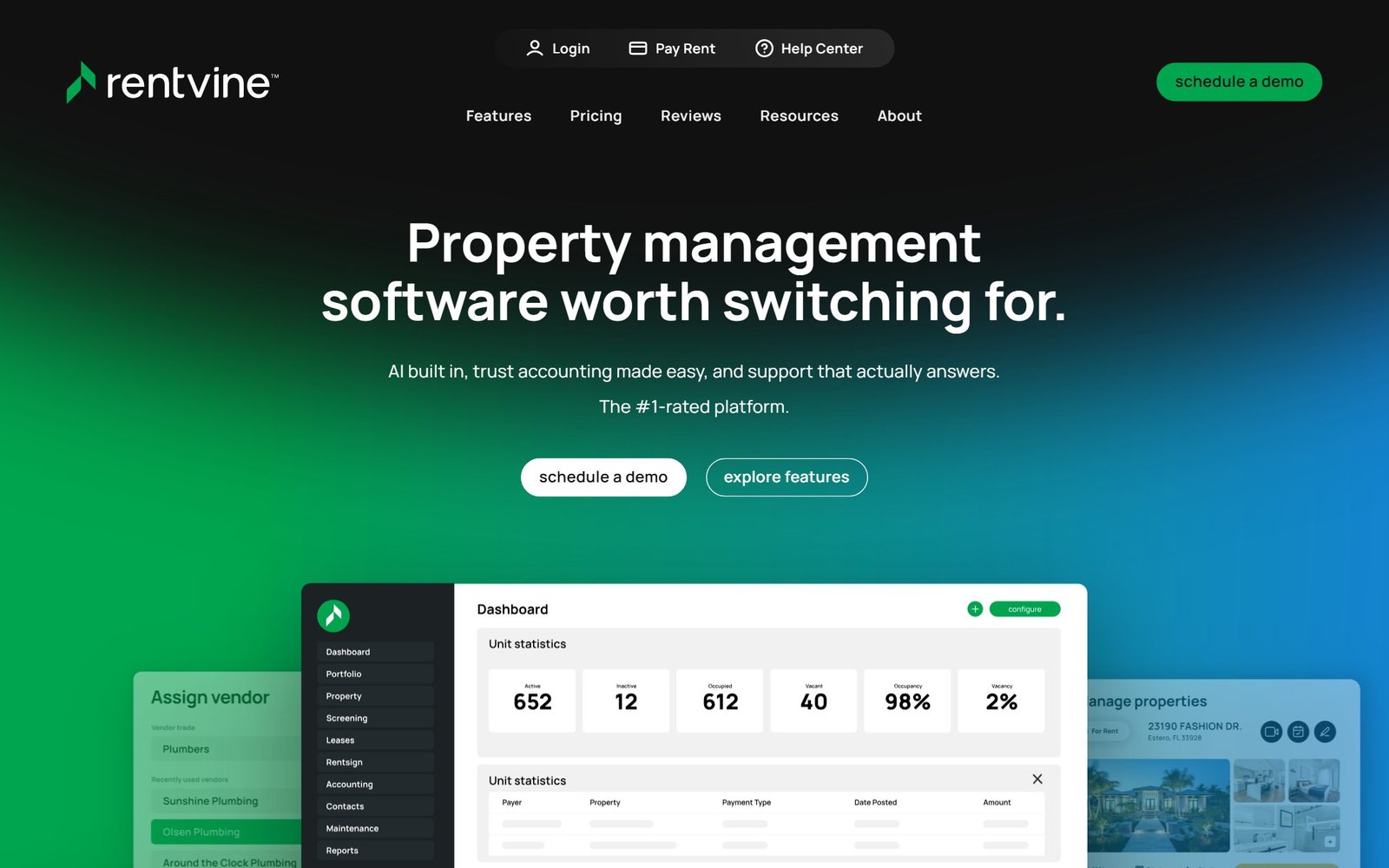
Rentvine is a property management platform built for professional management companies: full trust accounting, leasing, maintenance, owner and tenant portals, inspections, and an open API. It positions itself squarely as the anti-AppFolio: one plan instead of tiers, published per-unit pricing instead of a quote wall, and a founder who answers to customers rather than to a public market.
That founder story is unusually concrete. Dave Borden is a former Army Chinook pilot who spent more than 20 years running property management before building the software he wished he had. In a vertical where Buildium and Propertyware both answer to RealPage, and much of the rest of the market answers to private equity, Rentvine is one of the few professional-grade platforms still run by its founder. The $74M it raised from Mainsail Partners on August 26, 2024 was growth equity, not a buyout. The company stayed founder-led, and if anything it flipped the script: Rentvine has been the acquirer, buying RentFinder.ai for AI rent comps and Bynnd for trust accounting talent.
We flag ownership on every property management review this season because the category consolidates fast and vendors rarely volunteer it. Rentvine passes the disclosure test cleanly. Its pricing page is where things get more complicated.
Rentvine pricing: two official numbers, one real one
Here is the discrepancy in plain terms. The pricing page leads with “as low as $1.50 per unit.” The FAQ on the same site states the standard rate: $2.50 per unit per month, with a $199 per month minimum. Add a one-time setup fee whose amount Rentvine does not publish (it is quote-only, so treat any figure you hear secondhand as unverified), plus standard transaction and screening fees on top.
Both numbers were live on rentvine.com when we checked on July 21, 2026. The $1.50 is best read as a negotiated floor for large portfolios, the rate a 1,500-door company might land after a sales conversation. It is not a promo with a countdown timer, and to Rentvine’s credit the words “as low as” are doing honest work. But a 100-door company reading that page and budgeting $150 a month is going to get a different quote, and that gap is exactly the kind of thing this review exists to price out.
The $199 minimum math
The minimum fee is the part of per-unit pricing that vendors publish and buyers skip, and it quietly rewrites the price for smaller portfolios. Same trap shape we documented in our AppFolio pricing breakdown and in Propertyware’s tiered minimums. The math:
| Portfolio size | Units x $2.50 | What you pay | Effective per unit |
|---|---|---|---|
| 25 units | $62.50 | $199 (minimum governs) | $7.96 |
| 40 units | $100 | $199 (minimum governs) | ~$4.98 |
| 60 units | $150 | $199 (minimum governs) | $3.32 |
| 80 units | $200 | ~$200 (breakeven) | ~$2.50 |
| 200 units | $500 | $500 | $2.50 |
The $2.50 rate only starts to be your actual rate at roughly 80 units. At 40 doors you are paying about $4.98 per unit, double the sticker. Below that it climbs fast. None of this makes Rentvine expensive by professional PM standards; it makes the pricing page’s $1.50 headline a poor planning number. Do your budget on $2.50 and the $199 floor, then treat anything better as a negotiation win.
For context against the incumbents: AppFolio is quote-only with a minimum reported in the $280 to $298 range and an effective floor around 50 units, so Rentvine’s $199 minimum genuinely undercuts it. Buildium’s sticker prices look lower, but its a la carte fee stack changes that story at scale; our Buildium review prices out the full stack.
The AI stack: one substantive agent, one shortcut layer, one acquisition
Rentvine has been quietly assembling AI rather than announcing an “AI platform,” and the pieces are worth separating honestly because they are not all the same weight.
Fixie is the substantive one. It is an agentic maintenance intake bot: a tenant can talk to it, type to it, or send photos and video of the problem. Fixie asks follow-up questions the way a decent coordinator would (where is the leak, is the water shutoff accessible, is anything electrical involved), then produces a structured dispatch summary for your team or vendor. In practice, the follow-up questioning is what elevates it above the form-with-a-chatbot-skin that most PM platforms ship. Maintenance intake is the highest-volume, lowest-judgment work in a PM office, which makes it exactly the right place to put an agent.
The Rentvine AI Assistant is lighter than the name suggests. It takes voice and text commands inside the platform: pull up a lease, start a work order, navigate to a report. Useful, and genuinely faster than clicking through menus once you build the habit, but it is closer to a command shortcut layer than to an assistant that does work for you. We would rather tell you that plainly than let the word “AI” do the inflating.
RentFinder.ai brings the rent comps. Rentvine acquired RentFinder.ai around October 2025, and its AI-driven comparable rent analysis is now built into the platform, which matters at renewal time when you are defending a rent increase to an owner with data instead of vibes.
The detail that ties it together: all of it is included in the base price. No AI add-on SKU, no per-conversation metering, no “AI tier.” In a market where DoorLoop sells its AI assistant as a paid add-on with an undisclosed price and AppFolio gates its best AI behind upper tiers, an all-inclusive AI policy is a real position, not a footnote. We cover how the broader field stacks up in our best AI tools for property managers roundup.
Hands-on with the core platform
The AI is the headline, but you will live in the accounting. Rentvine’s trust accounting is built to professional PM standards: proper three-way reconciliation, owner statements that owners can actually read, and the Bynnd acquisition signals the company is investing in exactly this layer rather than treating accounting as a solved problem. The leasing pipeline, owner portal, and inspections module are competitive with the established players without any single feature that laps the field.
Two structural choices stood out to us as buyer-friendly. First, the single-plan model means you never discover that the report you need lives one tier up. Every Rentvine customer runs the same product, which also means the roadmap is not fragmented across editions. Second, the open API is included, not an upcharge, which matters if you run a modern stack with dedicated tools bolted on.
The trade-off for a newer platform is ecosystem depth. Rentvine’s integration marketplace is thinner than AppFolio’s or Buildium’s, and some specialist add-ons you may rely on today will not have a native connector yet. The API softens this if you have technical help; it does not eliminate it.
User sentiment supports the picture: Rentvine holds a 4.7/5 on G2 across roughly 41 reviews. That is a strong score on a small base, so read it as a positive early signal rather than a statistically settled verdict, and note that review counts this size can swing on a handful of entries.
Migration and setup: strong support, undisclosed price
Switching property management platforms is the industry’s most dreaded project, and Rentvine leans into it as a selling point. The company claims its team handles about 80% of the migration work and that most companies are operational within 45 days. Both figures are vendor claims, not independent benchmarks, and your data hygiene will move that number in either direction. But structurally, bundled hands-on migration compares well against platforms that quote onboarding as a separate line item.
The caveat is the one-time setup fee. It exists, it is quote-only, and Rentvine does not publish even a range. For a company whose brand is pricing transparency against AppFolio’s quote wall, this is the one place the transparency story has a hole in it. Ask for the setup fee in writing early in the sales process, before you have emotionally committed, and get it alongside the per-unit rate so you can compute a real first-year cost.
Who Rentvine is for
Professional PM companies with roughly 80 to 2,000 doors. Above the 80-unit breakeven the pricing is clean and competitive, the trust accounting is built for your workflows, and the all-inclusive plan removes tier anxiety. If you are actively leaving AppFolio over quote-only pricing or minimums, Rentvine is arguably the most direct landing spot; see our AppFolio alternatives guide for the full field.
Managers who want AI without an AI line item. Fixie plus built-in rent comps at no extra fee is a better AI-per-dollar story than most of the category currently offers.
Companies that value a founder-led vendor. If RealPage’s ownership of Buildium and Propertyware bothers you, or you have been burned by post-acquisition roadmap drift, Rentvine’s independence is a legitimate selection criterion, with the honest caveat that growth-equity investors eventually want an exit too.
Who should look elsewhere
Portfolios under 40 units. At ~$4.98 per effective unit and below, the $199 minimum makes Rentvine hard to justify against landlord-grade tools. Smaller operators comparing budget options should start with our Buildium vs DoorLoop breakdown instead.
Integration-heavy operations. If your stack depends on a long list of niche connectors, audit Rentvine’s marketplace against your list before you commit. The open API is a workaround, not a marketplace.
Anyone who needs a firm total price today. Until the setup fee is in writing, you do not have one.
One honest limitation
Beyond the thin integration ecosystem, the deeper limitation is maturity of track record. Rentvine is executing fast (two acquisitions, a shipped maintenance agent, $74M in the bank), but fast-moving platforms accumulate rough edges, and a ~41-review G2 base means the long-tail failure modes that surface in year three of a vendor relationship simply are not documented yet. That is not a reason to avoid Rentvine. It is a reason to negotiate contract terms, confirm data export rights, and keep your own backups current, which you should be doing with any vendor anyway.
Weighing Rentvine against the incumbent it markets against? Our Rentvine vs AppFolio head-to-head runs the effective per-unit math both directions and names a winner per portfolio size.
Per unit, flat rate or free: what each actually costs you at scale
The pricing model matters more than the price, because the same portfolio produces wildly different bills under each. Here is the same arithmetic run three ways using figures published on 4 September 2026.
| Portfolio | Rentec Direct flat | DoorLoop per unit | Buildium tier | TurboTenant free |
|---|---|---|---|---|
| 5 units | $300/yr | $828/yr, Starter | From $744/yr | $0 plus tenant fees |
| 10 units | $300/yr | $828/yr, Starter cap | From $744/yr | $0 plus tenant fees |
| 25 units | Pro, from $600/yr | Pro, $1,788/yr | Growth, from $2,304/yr | Paid tier from $149/yr |
| 60 units | Pro or PM, scales | Premium, $2,508/yr | Growth or Premium | Outgrown |
The ten unit cliff is the one that catches people
Several vendors cap an entry tier at ten units, rentvine review among the products where this pattern appears. Buying the eleventh door can cost more than the previous ten did, and the step is not proportional. Before committing, ask what the next tier costs, whether the change applies immediately or at renewal, and whether any discount you negotiated survives the crossing.
Vacancies are the difference between the models
Per unit pricing usually charges for a unit whether or not it is occupied, which means a vacancy costs you twice: no rent, and a bill for the privilege. Flat rate pricing does not care. If your portfolio has meaningful seasonal vacancy or you are mid-renovation on several doors, that single distinction can outweigh the headline difference between two platforms.
Free is a transfer, not a saving
The free tiers in this market are funded by tenant-paid fees: application and screening charges, card payment fees, and optional extras like rent reporting. That may be entirely reasonable and many residents prefer the convenience. It is still worth knowing that choosing the free platform is a decision about what your tenants pay, not only about what you pay, and it is worth looking at your own application flow as an applicant would before deciding.
Verdict: 4.3/5
Rentvine earns its 4.3. It is the most credible founder-led challenger to AppFolio in the professional PM segment: one plan, real published pricing (once you read the FAQ instead of the banner), included AI with one genuinely substantive agent in Fixie, and migration support that takes the scariest part of switching seriously.
The deductions are specific. The $1.50 headline against the $2.50 reality is the kind of gap this platform’s own brand promise says should not exist. The setup fee is undisclosed. The integration ecosystem is young. And below 80 doors the minimum-fee math quietly doubles your per-unit cost, so run the numbers in this review against your actual portfolio before the demo, not after.
If you manage 80 or more doors and you are tired of quote walls and tier ladders, book the demo, ask for the setup fee in writing, and hold them to the $2.50. That is the real price, and at that price, Rentvine is a strong buy.

Written by
FazFaz is the founder of AIToolsBakery. Some tools here are tested hands on. Others are assessed from vendor documentation and pricing verified on the live page, and every review says which one it is. Sponsors can buy a position in a guide. They cannot buy the score, the criticism, or silence about a better option.
How we test and how we make money →