AppFolio is the platform property managers name first and budget for last, because the number on your invoice has never matched the number in your head. In 2026 that gap got wider in two ways. First, AppFolio quietly de-listed its per-unit prices: the pricing page that used to print $1.49 per unit for Core now says only that minimum spend and a 50-unit minimum apply. Second, the math that actually determines what small portfolios pay, the monthly minimum, still is not printed anywhere official.
We pulled together the reported 2026 rates, worked the minimum-fee math at real portfolio sizes, and layered in what AppFolio told investors on its Q1 2026 earnings call, because the AI story it tells Wall Street explains the pricing tiers it sells you.
AppFolio pricing at a glance: official vs reported
Because AppFolio went quote-only, almost every number below is reported rather than official. We label each one so you know what you can rely on and what you must confirm on your own quote.
| Plan / fee | Reported figure (2026) | Official or reported? | Notes |
|---|---|---|---|
| Core, per unit | $1.40-1.49 per unit/mo | Reported (third-party, 2026) | Was $1.49 on the official page before the 2026 quote-only shift |
| Core, monthly minimum | $280-298/mo | Reported range (third-party, 2026) | The number that actually sets small-portfolio cost |
| Plus, per unit | $3.00-3.50 per unit/mo | Reported (third-party, 2026) | Implies roughly $900-1,050 monthly minimum |
| Max, per unit | ~$5+ per unit/mo | Reported (third-party, 2026) | $7,500+ monthly minimum reported |
| Portfolio minimum | 50 units | Official | One of the few facts still on appfolio.com |
| Minimum spend applies | Yes (amount not printed) | Official | The page confirms a minimum exists but hides the figure |
| Onboarding | $400-1,500+ one-time | Reported (third-party, 2026) | Quote-based, reportedly negotiable |
| Realm-X Flows (AI automation) | Plus and Max only | Official | Core buyers do not get the automation layer |
All reported figures gathered July 2026 from third-party pricing trackers and customer reports. AppFolio can change any of them without updating a public page, which is exactly the problem this post exists to solve.
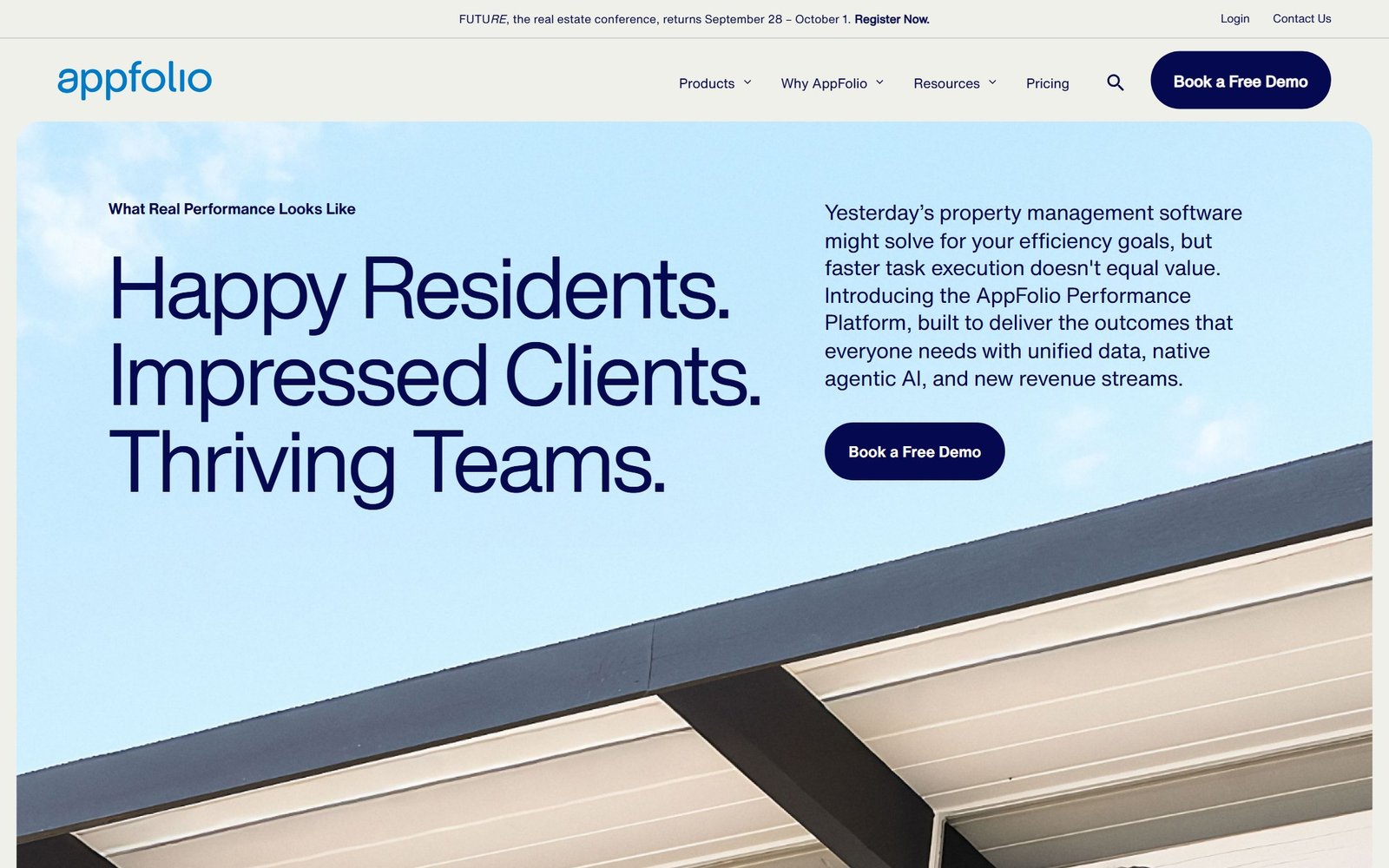
The page that stopped printing prices
For years, AppFolio was one of the more transparent enterprise-leaning property management platforms: the pricing page printed $1.49 per unit for Core, and you could at least start your budgeting from a real number.
In 2026 that changed. The live pricing page now shows no per-unit rates at all. The only concrete constraints it discloses are that “minimum spend” applies and that there is a 50-unit minimum. Everything else is routed through a sales conversation.
That is a meaningful shift, not a cosmetic one, for three reasons:
- You can no longer verify your quote against a public anchor. When the page printed $1.49, a quote at $1.75 was a visible markup. Now every quote floats free.
- The minimum spend, the figure that dominates cost for portfolios near the floor, was never printed and now has no context around it. The page confirms a minimum exists and declines to say what it is.
- The timing coincides with the AI upsell. As we cover below, AppFolio’s automation layer (Realm-X Flows) is gated to Plus and Max, which are the quote-heavy tiers. Opaque pricing and tier-gated AI travel well together.
We are not the only ones tracking the effective-cost math on AppFolio, and to their credit, pricing-transparency sites have kept the reported per-unit figures visible after the official page went dark. What we add here is the labeling discipline: every number in this post is tagged official or reported, with a date, so you can walk into the sales call knowing exactly which figures are firm.
The minimum-fee math, worked properly
This is the section that gets botched most often around the web, so let us do it carefully. Two constraints stack on top of each other:
- A 50-unit portfolio minimum. Below this, AppFolio typically will not take you at all.
- A monthly minimum spend, reported at $280-298 per month for Core in 2026.
Here is what those two floors do to your effective per-unit cost:
At exactly 50 units (the floor): the reported minimum of $280-298 per month divided across 50 units is $5.60-5.96 per unit effective. That is roughly four times the $1.40-1.49 sticker rate. The sticker only becomes your real rate once your portfolio is large enough that units multiplied by the per-unit price clears the minimum, which on the reported figures happens at roughly 190-210 units.
At 20 units: the most likely outcome is that you are simply refused at the 50-unit floor. If AppFolio makes an exception, the minimum still applies, and $280 divided across 20 units is $14 per unit per month. Not $5.60. Not $1.49. Fourteen dollars per unit for software whose sticker rate is a dollar and change. This is the mistake we see repeated constantly: writers divide the minimum by 50 units and then attach that figure to smaller portfolios. The smaller the portfolio, the worse the math gets, because the minimum is fixed and the denominator shrinks.
At 100 units: 100 x $1.40-1.49 is $140-149, which is still under the minimum, so you pay $280-298 anyway: $2.80-2.98 per unit effective, about double sticker.
At 300 units: 300 x $1.40-1.49 is $420-447, which clears the minimum. You finally pay something close to the sticker rate, and AppFolio’s per-unit economics start looking genuinely competitive against the fee stacks at Buildium, which we broke down line by line in our Buildium review.
One more caution: we have seen claims that the minimum recently increased on a specific schedule. The sourcing on that is thin, so we present the minimum as a reported range, $280-298, and recommend you get your exact minimum in writing on the quote rather than assuming either end of it.
Plan by plan: what the reported rates buy
Core ($1.40-1.49 per unit reported) covers the fundamentals: accounting, online payments, maintenance workflows, marketing and leasing tools, and the AI leasing assistant handling inquiries. For a straightforward residential portfolio above about 200 units, Core at sticker is genuinely strong value against per-door competitors.
Plus ($3.00-3.50 per unit reported, roughly $900-1,050 minimum) adds performance analytics, workflow customization, and, critically, Realm-X Flows, the automation layer that strings AI actions together. This is where AppFolio’s real AI ambitions live, and it is not available on Core.
Max (about $5+ per unit reported, $7,500+ minimum reported) is the large-operator tier: dedicated support, deeper customization, API access at scale. If you are shopping Max you are over 1,000 units and should be negotiating everything anyway.
Onboarding runs a reported $400-1,500+ one-time depending on portfolio size and migration complexity. Switchers report it is negotiable, especially near quarter-end. Ask.
The earnings-call layer: what AppFolio tells investors
Budget pages usually stop at the price list. But AppFolio is a public company, and what it tells Wall Street is more candid than what its pricing page tells you. From AppFolio’s Q1 2026 earnings call (April 23, 2026), all figures company-reported:
- 99% of roughly 23,000 customers now use the Realm suite, AppFolio’s AI layer. AI is no longer an add-on story; it is the product.
- AI actions grew 7x year over year, and adoption of Realm-X Performer, the agentic tier, grew roughly 500% quarter over quarter.
- Maintenance Performer responds to work orders in about 6 seconds, per the company’s own benchmark.
- Units on the platform reached 9.5 million, up 8%, with full-year 2026 revenue guidance of $1.110-1.125 billion.
Why does this belong on a pricing page? Because it explains the structure of the price list. When 99% of customers use your AI suite and AI actions are compounding 7x, the growth lever is not adding customers, it is moving existing customers up-tier. Realm-X Flows being gated to Plus and Max is that lever. The pricing page going quote-only in the same year the AI upsell matured is, at minimum, a pattern worth naming: the company got more ambitious about AI monetization and less willing to print numbers at the same time.
None of this makes AppFolio a bad product. The Realm adoption stats are genuinely impressive, and the per-unit economics at scale are real. It does mean that if the AI automation features are the reason you are buying, your comparison price is Plus at a reported $3.00-3.50 per unit, not Core at $1.40-1.49. That single reframe roughly doubles most buyers’ mental budget.
What to negotiate before you sign
You are walking into a quote-only conversation, which means everything is technically negotiable. Based on switcher reports and the reported rate ranges, focus on these five:
- Get the monthly minimum in writing, as a number. Not “minimum spend applies.” The number. This is the single figure that determines your real cost under 200 units.
- Ask for the onboarding fee waived or halved. The reported $400-1,500+ is soft, especially for clean data migrations and quarter-end signings.
- Rate-lock the per-unit price for 24 months. With no public price anchor anymore, your renewal quote can drift. A contractual lock is your replacement for the transparency the pricing page used to provide.
- If you want the AI, quote Plus from the start. Do not sign Core planning to upgrade later; you lose leverage the moment you are on the platform. Realm-X Flows is Plus and Max only.
- Ask what happens if your portfolio shrinks below 50 units mid-contract. Get the answer in the agreement, not in an email.
The minimum-fee math above now powers two head-to-heads: AppFolio vs Buildium (where the “cheap” option inverts at 100 doors) and AppFolio vs Yardi Breeze (where Breeze Premier’s $400 floor makes AppFolio the cheaper full-featured pick below 100 units).
The quote-only wall now has a challenger compare: Rentvine vs AppFolio puts this page’s minimum math against the challenger whose own website prints two different prices.
AppFolio’s most common quote-only rival now has its own head-to-head: AppFolio vs Rent Manager compares the NASDAQ platform against the 40-year founder-owned one, minimums, AI scope, and all.
The pricing series now covers the other mid-market giants: Buildium pricing tracks a fee line that doubled in under a year, and DoorLoop pricing unpacks a 30% promo that is really 12.6% on the plan they most want to sell you.
Who AppFolio pricing actually works for
Good fit: portfolios above roughly 200 units, where the per-unit sticker becomes your real rate and the platform’s depth (and the Realm suite) gets amortized across enough doors to make sense. Mixed portfolios and growing operators who will cross 500 units within the contract term are the sweet spot.
Marginal fit: 50-150 units. You will pay $2.80-5.96 per unit effective against a $1.40-1.49 sticker. The product may still justify it, but compare honestly against per-door pricing at DoorLoop, where our DoorLoop review covers the promo-versus-real price math you need for a fair comparison.
Poor fit: under 50 units. You are below the floor, and even with an exception you are at $14 per unit or worse at 20 doors. Self-managing landlords and small operators should start with our property managers best-of for the professional lineup, or skip straight to our AppFolio alternatives roundup, which routes you by the specific reason AppFolio does not fit.
If leasing AI specifically is what draws you to AppFolio, note that dedicated leasing-AI vendors play in an entirely different price band; our EliseAI review covers the reported per-unit rates and the annual minimum at the top of that market.
Payment and screening fees, which usually exceed the subscription
The subscription is the number everyone compares. The fee schedule is the number that decides your actual cost, and in this category it is published in enough detail to be worth reading properly.
ACH and card are priced very differently, and the gap is the whole point
Buildium publishes incoming EFT at $2.35 per transaction on Essential, falling to $1.35 on Growth, with the first twelve months free and then $0.60 on Premium, alongside credit cards at 2.99% on every tier. On a $1,800 rent, that 2.99% is about $54 against roughly $1 to $2 for a bank transfer. Whichever platform you pick, the largest single saving available to you is usually getting residents onto ACH rather than cards, and that is a policy decision rather than a software one.
Who pays the card fee is a decision you should make deliberately
Most platforms let you absorb the card fee or pass it to the resident. Passing it is common and legal in most jurisdictions, though not all, and it changes on-time payment behaviour in ways worth watching. TenantCloud publishes ACH at $1.95, $1.75 and $1.50 paid by the tenant across its tiers. Decide the policy, check it against your state rules, and put it in the lease rather than discovering it at the first dispute.
Screening is priced per application and it adds up
Buildium publishes tenant screening at $17 per screening, $35 applicant-paid, and enhanced screening at $20 on Growth and Premium. TurboTenant publishes screening fees of $45 and $55 paid by the applicant on completion. On a portfolio with real turnover this is a recurring line rather than an occasional one, and it is worth modelling against your actual annual application volume rather than your unit count.
The small line items that appear in year one
E-signatures are charged per document by several vendors: Buildium publishes $5 per document on Essential, $1 on Growth and unlimited on Premium, and DoorLoop publishes $3 and $1 with its top tier free. Bank account setup appears too, at $99 per business bank account on Buildium with some accounts included at higher tiers. Inspections can carry a setup fee and a monthly charge. None of these is large alone and together they routinely add a four figure sum.
Ask for the fee schedule before the demo
Every vendor above publishes this detail, which means you can build a real model before any sales conversation. Take your annual rent roll, your expected applications, your card versus ACH split and your document volume, and price two platforms properly. That exercise takes an hour and it regularly reverses the ranking that the subscription prices suggested.
Verdict: budget from the minimum, not the sticker
AppFolio’s 2026 pricing story is two moves in the same direction: the public per-unit rates disappeared, and the AI features that justify the platform’s premium got gated behind the quote-heavy tiers. The reported numbers are still findable, and we have labeled every one of them here, but the burden of verification has shifted onto you.
The practical takeaway fits in three lines. Above 200 units, the reported $1.40-1.49 Core rate is roughly what you will pay, and it is competitive. At 50-150 units, your real rate is $2.80-5.96 per unit effective because of the $280-298 reported minimum, so compare at that number. Below 50 units, the floor refuses you or the math punishes you at $14 per unit and up, and you should be reading our AppFolio alternatives instead. Whatever the sales call quotes you, get the minimum, the per-unit rate, and the onboarding fee in writing, dated, before you sign.

Written by
FazFaz is the founder of AIToolsBakery. Some tools here are tested hands on. Others are assessed from vendor documentation and pricing verified on the live page, and every review says which one it is. Sponsors can buy a position in a guide. They cannot buy the score, the criticism, or silence about a better option.
How we test and how we make money →