Search “Rent Manager pricing” and page one will answer you with confidence: $1.00 per unit for Basic, $1.50 for Plus, $2.25 for Premium, minimums attached. There is just one problem. None of those numbers is on Rent Manager’s website anymore. Sometime before mid-2026, Rent Manager quietly did what AppFolio did before it: the pricing page dropped its dollar figures and now shows a feature-checkmark grid, three tier names, and a Get Quote button. The internet did not notice, so the dead grid keeps getting reprinted as if it were live.
That makes this review a two-part job. First, sort the pricing reality from the SERP fossil. Second, review the actual software, which turns out to be one of the deepest and most quietly interesting platforms in the category: a 39-year-old, founder-owned system that handles asset classes its rivals will not touch, ships real (if narrow) AI, and still carries a learning curve with a reputation of its own.
A note on method, since Rent Manager is now quote-gated: this is a research-based review. We verified rentmanager.com’s pricing and feature pages directly on July 22, 2026, cross-checked reported rates against aggregator sources dated June 2026, and read the complaint and praise themes across Capterra’s 601 reviews and G2. We have not run a hands-on trial, and we label every reported figure with its source and date.
| Plan | Official price (Jul 2026) | Last reported rate | Reported minimum | Effective at 100 units (reported) |
|---|---|---|---|---|
| Basic | Quote only | $1.00/unit/mo | $200/mo | $2.00/unit |
| Plus | Quote only | $1.50/unit/mo | $300/mo | $3.00/unit |
| Premium | Quote only | $2.25/unit/mo (some sources: $2.50) | $450/mo (some sources: $500) | $4.50/unit |
| Verdict at a glance | ||||
| AITB score | 4.1/5 | |||
| Best for | 200 to 10,000 unit operators, especially mixed portfolios: residential, commercial, short-term, manufactured housing | |||
| Owner | London Computer Systems (LCS), founder-owned since 1987, no private equity | |||
| AI | Orion AI: Smart Receipts, Writing Assistant, Report Analysis. Back-office only; no native leasing AI | |||
| Skip it if | You manage under ~150 units, need published pricing, or want an AI leasing agent out of the box | |||
Official pricing page checked July 22, 2026: no prices published. “Last reported” rates per DoorLoop, updated June 2, 2026; other aggregators disagree on Premium. Historical figures only, not current pricing.
The quiet quote-only shift nobody wrote about
Here is what rentmanager.com/pricing actually contains as of July 22, 2026: three columns labeled Basic, Plus, and Premium, a long grid of feature checkmarks (with the AI features conspicuously gated by tier), and calls to action for a quote or a phone call. No per-unit rates. No monthly minimums. No implementation fees. No contract terms. Effectively, Rent Manager is quote-only in mid-2026.
That is the same move AppFolio made, and we covered what it means for buyers in our AppFolio pricing breakdown. The difference is that AppFolio’s shift got noticed and Rent Manager’s did not. DoorLoop‘s comparison content, updated June 2, 2026, still prints Basic at $1.00 per unit with a $200 monthly minimum, Plus at $1.50 with $300, and Premium at $2.25 with $450. Other aggregators print Premium at $2.50 with a $500 minimum, and at least one pricing site adds a $350 minimum claim plus implementation estimates ranging from two times your monthly subscription up to $1,000 to $10,000, none of which we can verify against anything official. When the sources cannot agree on what Premium costs, that is your confirmation the numbers are secondhand.
So treat the grid the way we present it in the table above: as the last publicly reported rates, useful for rough budgeting and negotiation context, never as what you will pay. The only current official answer to “how much is Rent Manager” is a sales call.
Two things are still worth extracting from the reported numbers, with the historical caveat attached. First, the minimum-fee math. At the reported Basic rate, a 100-door portfolio would not pay $100; it would pay the $200 minimum, which is $2.00 per unit effective, double the sticker. The reported sticker rate would not become your real rate until 200 units. That minimum-fee inflation pattern is the industry’s favorite trick, and it is the whole reason we run this math in every review. Second, the reported grid positioned Rent Manager as cheaper than most of its direct competitors at scale, which is presumably why the company was comfortable publishing it for years. Whether quote-only pricing preserves that positioning is exactly the kind of thing you should press a sales rep on.
What Rent Manager actually is in 2026
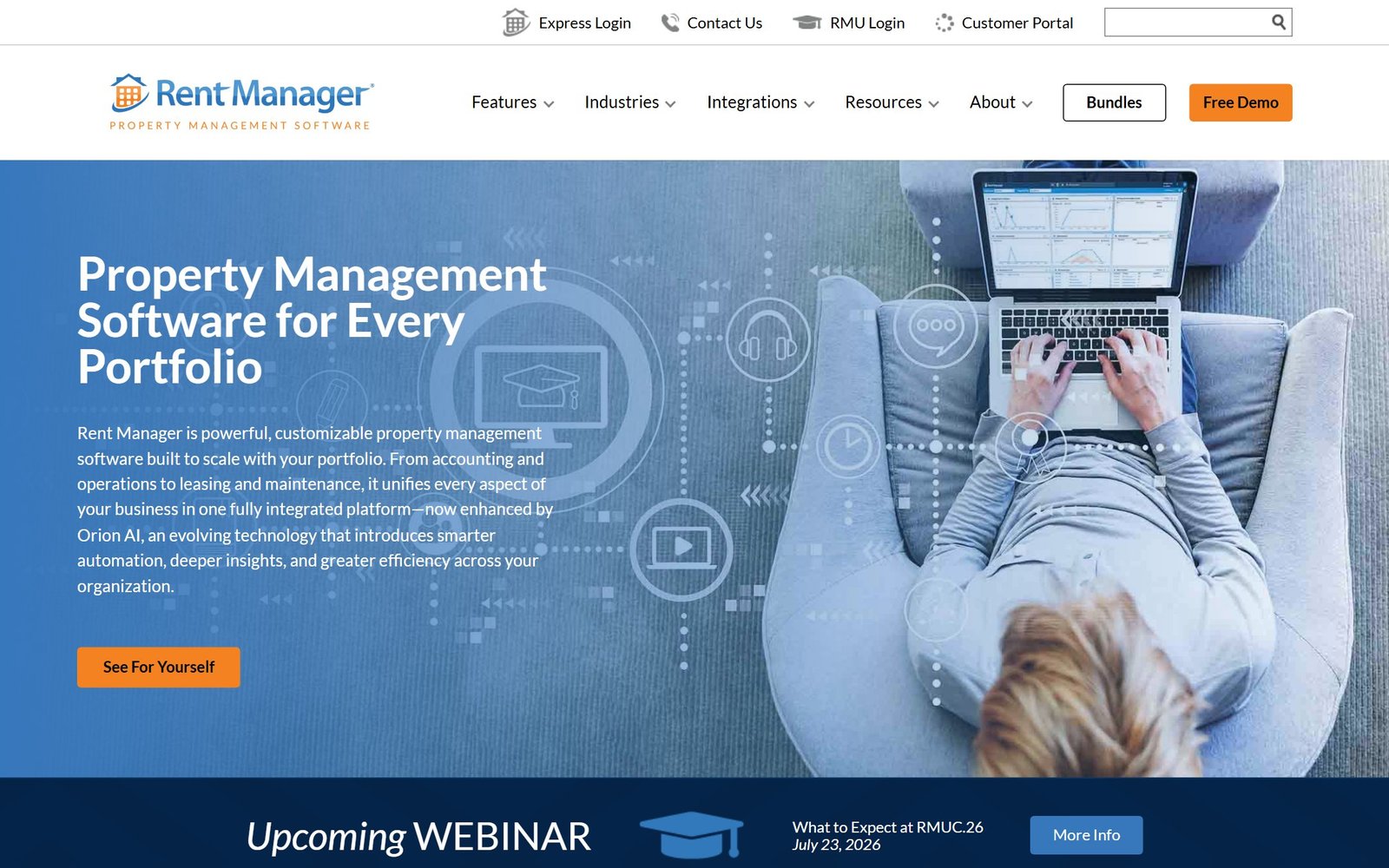
Rent Manager is property management software from London Computer Systems, and its defining trait is range. Where most platforms pick a lane, Rent Manager handles residential, commercial, short-term rentals, and manufactured housing in one system. That last one matters more than it sounds: manufactured housing communities have lot rent, home rent, and owner-occupied lots tangled together in ways that break software built for apartments, and Rent Manager is one of the few platforms that models it natively.
The proof point is fresh. In an April 7, 2026 press release, Roots Management Group, which manages a portfolio it describes as more than 38,000 manufactured-housing units, announced it had selected Rent Manager as its platform. That is a vendor-published announcement, so apply the usual discount, but a five-figure-unit operator choosing a platform in 2026 is a meaningful signal about where Rent Manager can scale.
The functional sweet spot, based on positioning and the review corpus, is roughly 200 to 10,000 units: bigger and more complex than the small-landlord tools, below the institutional tier where Yardi lives. If you are mapping the market, it sits in the gap we described in our AppFolio vs Yardi comparison, and it competes most directly with AppFolio and Buildium from below.
Three strengths dominate the praise side of the review corpus:
Reporting depth. More than 450 reports ship in the box, plus a report writer for custom builds. Operators who live in owner statements and portfolio analytics consistently cite this as the reason they stay.
Customization. User-defined fields, configurable workflows, and an open API. Like Propertyware, which we scored 3.9 in our Propertyware review, Rent Manager bends to weird operations rather than forcing a shape on them, and it does so with a far larger feature surface.
Support. Unusually for this category, support quality is a recurring positive theme rather than a complaint theme. Capterra reviewers repeatedly name responsive, US-based support as a reason for loyalty, and the overall scores back it up: 4.6 on Capterra across 601 reviews, 4.6 on G2.
The trade-off is density. Rent Manager is deep the way an ERP is deep, and the review corpus is equally consistent about the cost: a steep learning curve, a complex interface, and onboarding that takes real weeks. This is not a platform you hand to a new hire with a login and good wishes.
The desktop-versus-web distinction the complaints miss
Read enough Rent Manager reviews and you will notice “dated” and “clunky” showing up next to 4- and 5-star ratings, which looks contradictory until you understand the deployment history. Rent Manager predates the cloud by decades, and two experiences still exist under one name: Rent Manager Online, the current web product, and a legacy desktop deployment that long-time customers typically reach through a remote desktop session.
In our read of the complaint themes, the harshest interface criticism, including the occasional-freeze reports and the remote-desktop friction, largely attaches to that legacy desktop experience. The web product draws complaints too, mostly about density and navigation depth, but it is a different and more modern experience than the one the angriest reviews describe. The practical takeaway for a buyer: when you book the demo, insist on seeing Rent Manager Online, ask which deployment you would actually be sold, and if you are inheriting a legacy desktop install through an acquisition, budget for the migration conversation.
The other cost theme worth flagging: add-ons. Reviewers mention that capabilities like websites, payment processing, and some integrations carry their own fees on top of the subscription. With no published price list, you cannot pre-model that stack, so make the sales call produce a written, all-in quote for your actual configuration.
Orion AI: real, useful, and strictly back-office
Rent Manager’s AI story is branded Orion AI, it shipped across 2025 and 2026, and it is genuinely native, which already clears a bar plenty of “AI-powered” competitors miss. The roster:
- Smart Receipts. Photograph a receipt in the rmAppSuite Pro mobile app and it becomes an auto-filled expense entry. Unglamorous, real, and aimed at the maintenance tech buying parts at the hardware store.
- Orion Writing Assistant. Drafts listing descriptions, adjusts tone, and translates into Spanish, French, Canadian French, and Chinese. Useful for multi-market operators.
- AI-Powered Report Analysis. Generates executive summaries of reports in plain language, which matters more here than elsewhere because Rent Manager has 450+ reports to summarize.
Now the honest boundary: all of that is back-office AI. There is no native AI leasing agent. If you want a bot answering prospect inquiries at midnight, that comes from third-party integrations in Rent Manager’s marketplace, such as Super, Leasey.AI, and RentEngine. Some competitor content and more than one AI-generated summary blur this line and credit Rent Manager with native leasing AI. It does not have one, and a sales conversation that implies otherwise deserves a follow-up question about who actually builds the chatbot and what it costs separately.
For the wider landscape of what native leasing and maintenance AI looks like in 2026, our best AI tools for property managers roundup is the map. Within its chosen lane, though, Orion is a credible roster: three shipped, practical features beats one, which is more than we could say for Propertyware.
The ownership story: founder-owned since 1987
Here is the part of the Rent Manager story we find most interesting, and it never makes the comparison tables. London Computer Systems was incorporated in Cincinnati in 1987 by Dave Hegemann, who built the first version of Rent Manager and, 39 years later, is still President and CEO. The company is private, founder-owned, and has no private equity on the cap table. No acquisition activity in 2025 or 2026. Reported estimates put it at $25 to $100 million in revenue with 100 to 250 employees, which we flag as third-party estimates, not disclosures.
In this vertical, that is close to unique. RealPage owns Buildium and Propertyware and is itself PE-owned. AppFolio is public. Rentvine took $74 million from Mainsail in 2024. The roll-up wave has consolidated most of the mid-market, and every acquisition eventually shows up in the product as price increases, migration nudges, or a shifted roadmap. A founder-owned platform is not automatically better software, but it does mean the company answers to customers and its own payroll rather than a fund’s exit timeline, and 39 years of continuity is why the product supports asset classes that were never fashionable enough for a growth-stage roadmap.
What we liked
- Genuine multi-asset-class depth. Residential, commercial, short-term, and manufactured housing in one system, validated by a 38,000-plus-unit operator selecting it in April 2026 (per the Roots Management announcement).
- 450+ reports and an open API. The reporting library and customization surface are the platform’s moat, and the review corpus agrees.
- Support that reviewers praise. A 4.6 on Capterra across 601 reviews, with support quality as a positive theme, is rare in this category.
- Orion AI is real and shipping. Smart Receipts, the Writing Assistant, and Report Analysis are native, practical features delivered in 2025 and 2026, not a press release.
- Founder ownership. No PE, no acquisition churn, no migration-nudge emails. Stability is a feature, and Rent Manager has 39 years of it.
What holds it back
- The quote wall. Dropping published pricing in the same window as AppFolio removes the transparency advantage the old grid provided, and it costs the platform points here. Rentvine, which we scored 4.3 in our Rentvine review, at least attempts published numbers.
- The learning curve. Steep, consistently reported, and real. Budget weeks of onboarding, not days.
- The legacy desktop shadow. The dated-interface reputation is partly earned by a deployment many buyers will never touch, but if you inherit it, the complaints are your complaints.
- No native leasing AI. Orion is back-office only. Competitors ship native leasing agents; Rent Manager routes you to third-party integrations at third-party prices.
- Add-on opacity. Extra fees for websites, payments, and integrations are a known theme, and with no price list, you cannot model the stack without a sales call.
Deciding between the two quote-only giants? Our AppFolio vs Rent Manager head-to-head anchors both vendors’ last-published prices with dates and runs the minimum math the sales calls will not volunteer.
Who should buy Rent Manager in 2026
Buy it if you operate roughly 200 to 10,000 units, especially with a mixed or unusual portfolio: manufactured housing, commercial alongside residential, short-term units in the mix. If your operation runs on reports and your team will invest in learning a deep system, Rent Manager offers depth that the friendlier mid-market platforms cannot match, from a company that will not be acquired out from under you. Get the all-in quote in writing, including add-ons and implementation, and use the last reported rates as your negotiation anchor.
Skip it if you manage under about 150 units, where the reported minimums (if they survive in the quote-only era) would inflate your effective rate and simpler tools serve you better. Skip it too if published pricing is a dealbreaker on principle, or if a native AI leasing agent is central to your 2026 plans. For the standard residential mid-market decision, our Buildium review and the rest of our property management coverage map the alternatives.
Per unit, flat rate or free: what each actually costs you at scale
The pricing model matters more than the price, because the same portfolio produces wildly different bills under each. Here is the same arithmetic run three ways using figures published on 4 September 2026.
| Portfolio | Rentec Direct flat | DoorLoop per unit | Buildium tier | TurboTenant free |
|---|---|---|---|---|
| 5 units | $300/yr | $828/yr, Starter | From $744/yr | $0 plus tenant fees |
| 10 units | $300/yr | $828/yr, Starter cap | From $744/yr | $0 plus tenant fees |
| 25 units | Pro, from $600/yr | Pro, $1,788/yr | Growth, from $2,304/yr | Paid tier from $149/yr |
| 60 units | Pro or PM, scales | Premium, $2,508/yr | Growth or Premium | Outgrown |
The ten unit cliff is the one that catches people
Several vendors cap an entry tier at ten units, rent manager among the products where this pattern appears. Buying the eleventh door can cost more than the previous ten did, and the step is not proportional. Before committing, ask what the next tier costs, whether the change applies immediately or at renewal, and whether any discount you negotiated survives the crossing.
Vacancies are the difference between the models
Per unit pricing usually charges for a unit whether or not it is occupied, which means a vacancy costs you twice: no rent, and a bill for the privilege. Flat rate pricing does not care. If your portfolio has meaningful seasonal vacancy or you are mid-renovation on several doors, that single distinction can outweigh the headline difference between two platforms.
Free is a transfer, not a saving
The free tiers in this market are funded by tenant-paid fees: application and screening charges, card payment fees, and optional extras like rent reporting. That may be entirely reasonable and many residents prefer the convenience. It is still worth knowing that choosing the free platform is a decision about what your tenants pay, not only about what you pay, and it is worth looking at your own application flow as an applicant would before deciding.
Verdict: deep, durable, and now hiding its prices
Rent Manager earns its 4.1. The software is the real thing: broader asset-class coverage than any direct rival, a reporting engine operators build businesses on, native back-office AI that ships, support that reviewers actually like, and the most stable ownership story in the vertical. What keeps it out of the 4.3-and-up tier is friction a buyer feels immediately: a quote wall where a price grid used to be, a learning curve the review corpus warns about in unison, and a legacy desktop reputation the web product is still living down. The internet will keep quoting the dead $1.00/$1.50/$2.25 grid for years. You now know better, and knowing better is worth real money on the sales call.

Written by
FazFaz is the founder of AIToolsBakery. Some tools here are tested hands on. Others are assessed from vendor documentation and pricing verified on the live page, and every review says which one it is. Sponsors can buy a position in a guide. They cannot buy the score, the criticism, or silence about a better option.
How we test and how we make money →