Type “Buildium vs DoorLoop” into Google and two of the top results are written by Buildium and DoorLoop. Both pages are exhibits in why you should never let a vendor referee its own match. DoorLoop’s comparison quietly uses its promotional prices as if they were the everyday rate and never mentions per-unit scaling. Buildium’s comparison makes the mirror-image error, treating DoorLoop’s temporary promo prices as permanent, while sprinkling in stats like “80% faster turnovers” with no source attached.
We pulled both live pricing pages on July 20, 2026, rebuilt the math ourselves, and ran the total cost of ownership at 25, 50, and 100 units. The short version: Buildium’s famous $62 flat price is real but incomplete, DoorLoop’s famous $69 price is a promo banner, and the honest winner changes depending on what you manage and how you collect rent.
Buildium vs DoorLoop at a glance
Every price below is the real, non-promotional figure from each vendor’s live pricing page, pulled July 20, 2026. The “advertised” column is what each site leads with. The difference between those two columns is most of this article.
| Factor | Buildium | DoorLoop |
|---|---|---|
| Advertised entry price | $62/mo (Essential, real) | $69/mo (promo banner price) |
| Real entry price | $62/mo, flat to ~150 units | $99/mo (Starter, capped at 10 units) |
| Real mid/top plans | Growth $192, Premium $400 (starting at) | Pro $189, Premium $239, plus $3/unit above the included allotment |
| The catch | Per-transaction fee stack: $2.35 incoming EFT on Essential, $5 eSignatures, paid inspections | Promo pricing pattern (recurring 30% off banner) plus per-unit scaling past the base |
| Real cost, 100 units | ~$297/mo (Essential + EFT fees) | ~$429/mo (Pro + per-unit fees) |
| Accounting depth | Winner: full trust accounting, 1099 e-filing, mature reporting | Competent, younger, fewer accountant-grade workflows |
| AI | Lumina AI Workforce, gated to $400 Premium | AI Assistant add-on, Pro/Premium only, price undisclosed |
| Support reputation | Mixed; slower first-response reports | Winner: fast chat support is a genuine differentiator |
| Ownership | RealPage (acquired Dec 2019, $580M) | Independent; $100M Series B led by JMI, Oct 2024 |
| Best for | Accounting-driven PM companies, 50 to 5,000 doors | Modern UI seekers, mixed portfolios, teams that value support and AI |
Our full hands-on verdicts live in the standalone Buildium review and DoorLoop review. This page is the head-to-head and the TCO math.
Exhibit A and Exhibit B: what the vendors’ own vs-pages get wrong
Before we compare the products, it is worth reading the two comparison pages the vendors publish about each other, because they teach you exactly how each company wants you to misread the pricing.
Exhibit A is DoorLoop’s “DoorLoop vs Buildium” page. It leads with DoorLoop’s own prices in the discounted promo form without flagging that those numbers come from a rotating 30 percent off banner that applies to the first three months. It also skips any mention of per-unit charges above the plan’s included allotment, which is the line item that actually moves the bill for anyone past a small portfolio.
Exhibit B is Buildium’s “Buildium vs DoorLoop” page. It commits the reverse sin: it quotes DoorLoop’s promo prices as if they were the permanent rate, which understates DoorLoop’s cost and then makes Buildium’s own comparison table look worse than it needs to. The same page leans on claims like “80% faster turnovers” with no study, sample size, or source cited anywhere we could find.
Neither page is lying about its own list prices. Both are framing the other side’s pricing in the way that flatters their own table. That is why the section below exists.
Buildium in 2026: the $62 that is real, and the fees that are also real
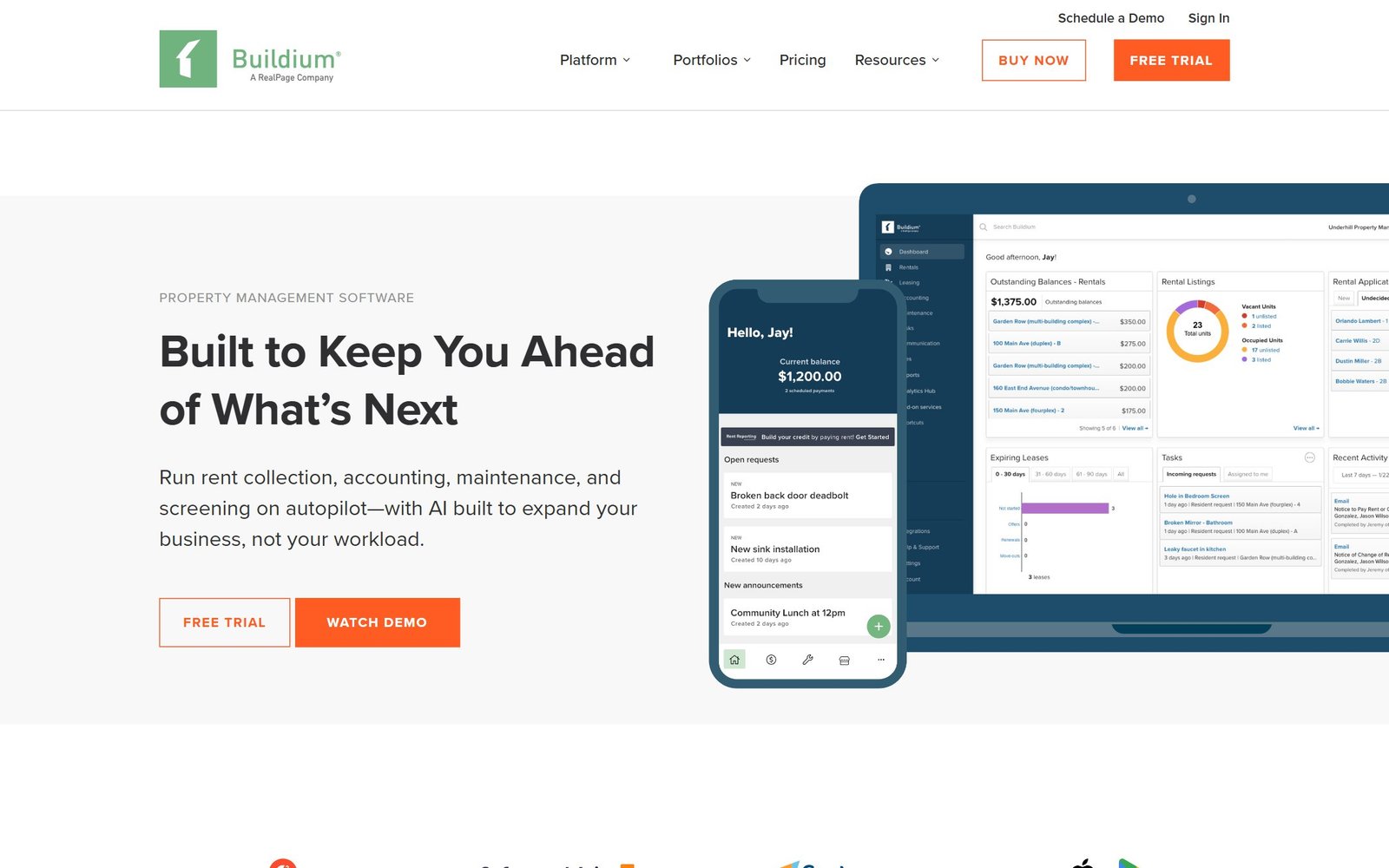
Buildium is the accounting-first incumbent of mid-market property management software. It has been around since 2004, was acquired by RealPage in December 2019 for $580 million, and today runs on a three-plan grid: Essential at $62 per month, Growth at $192, and Premium at $400, all “starting at” prices pulled from the live page on July 20, 2026. If you see $58, $183, and $375 in a ranking article, that article is stale; Buildium quietly moved the grid up and most of the review industry never noticed.
One parent-company note for completeness: the US Department of Justice reached a consent-decree settlement with RealPage in November 2025 over RealPage’s AI revenue management products (YieldStar and LRO). That case targets a rent-pricing algorithm Buildium does not run, so treat it as context about who owns Buildium, not as a claim about Buildium itself.
The headline attraction is that Essential’s $62 stays flat to roughly 150 units. No per-door meter, no unit slider on the public page. For a 100-door operator comparing against per-unit platforms, that flat number looks unbeatable. It is also not the number you will pay, because Buildium monetizes the transaction layer. Four lines from the fee stack matter most for this comparison:
- Incoming EFT rent payments: $2.35 per transaction on Essential (drops to $1.35 on Growth and $0.60 on Premium)
- eSignatures: $5 per document on Essential, $1 on Growth, free on Premium
- Inspections: a paid add-on on Essential, $99 setup plus roughly $40 to $95 per month
- 1099 e-filing: $50 per batch plus $4.50 per form, every January
That is the summary version. The complete fee stack, including outgoing EFT, card processing, screening, and the bank-account line item, is broken down in our Buildium review, and it is worth reading in full before you sign anything, because the fee stack is where Buildium’s real pricing lives.
Buildium’s AI story is called Lumina AI Workforce: a Leasing Agent, an Accounting Agent, and Bill Scan. The catch is that all of it is gated to the $400 Premium plan. If you are on Essential or Growth, which is most of Buildium’s base, the AI features effectively do not exist for you.
DoorLoop in 2026: the countdown price and the real one
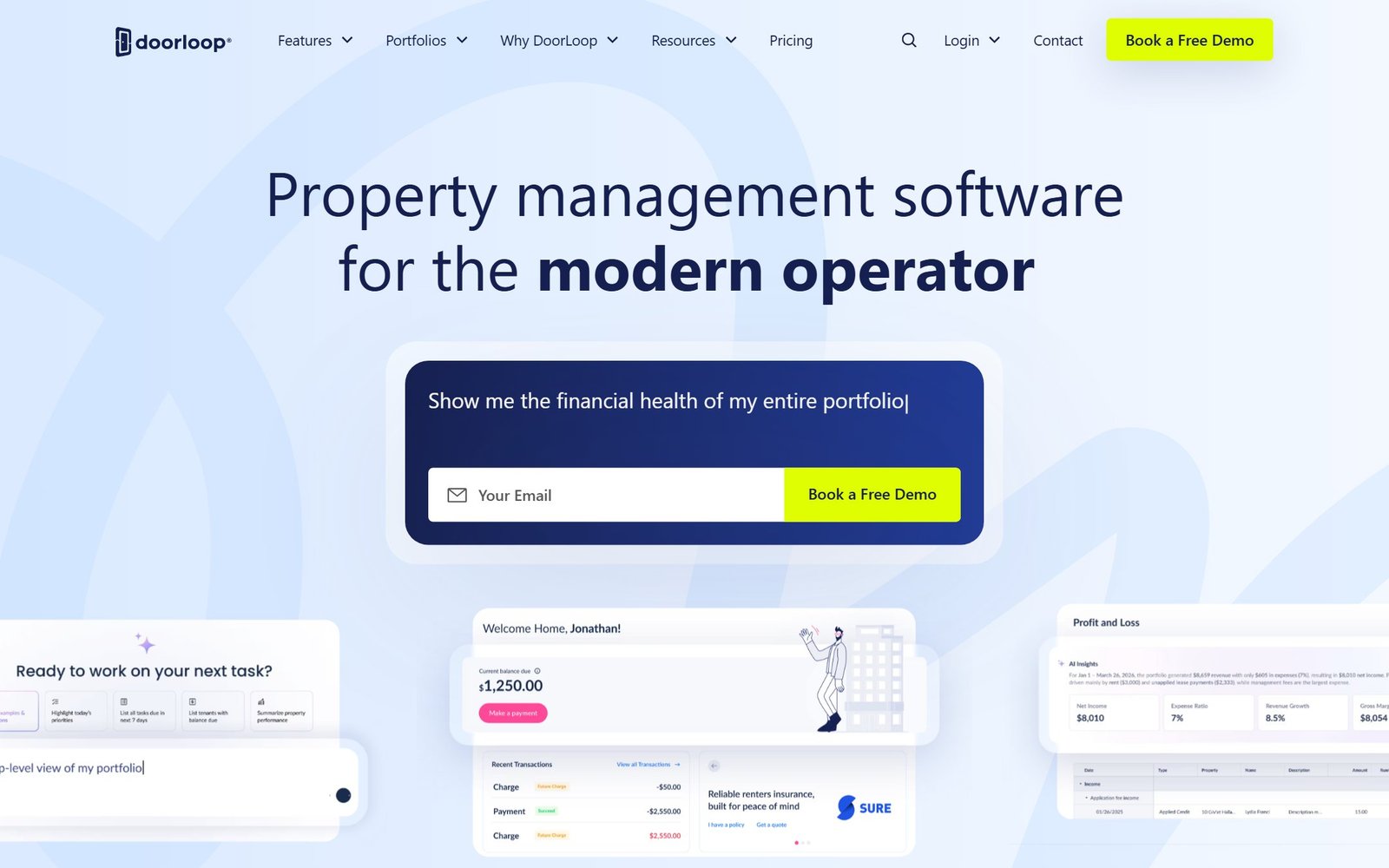
DoorLoop is the fast-moving challenger. Founded in 2019, it raised a $100 million Series B led by JMI Equity in October 2024, bringing total funding to $182 million at a valuation of roughly $500 million. That war chest shows up in the product: DoorLoop ships features and AI updates at a pace Buildium does not match, and its interface is the one your leasing coordinator will not complain about.
The pricing page is where you need to slow down. The numbers most shoppers see, $69, $149, and $209 per month, are promotional prices generated by a 30 percent off banner that discounts the first three months and reappears on a rolling basis. The real billed-yearly prices on the live page, pulled July 20, 2026, are:
- Starter: $99 per month, capped at a maximum of 10 units
- Pro: $189 per month
- Premium: $239 per month
- Above each plan’s included unit allotment: $3 per unit per month, per the live page on the same date
Two flags on that last line. First, third-party pricing grids print DoorLoop’s per-unit rate at anywhere from $1 to $2.50, which conflicts with the $3 shown on the live page as of our pull; confirm the per-unit line on the day you buy. Second, DoorLoop’s new AI Assistant is a paid add-on available only on Pro and Premium, and its price is not disclosed anywhere public. We will not invent a number, and you should get it in writing on your quote before you count on it.
None of this makes DoorLoop expensive by category standards. It makes DoorLoop’s advertised price a marketing artifact. Budget from $99 and $189, not $69 and $149, and the rest of the evaluation gets much more honest. The full feature-by-feature verdict, including what the AI Assistant actually does, is in our DoorLoop review.
The real TCO at 25, 50, and 100 units
Here is the table neither vendor publishes. Assumptions, stated plainly: Buildium on Essential with every unit paying rent by EFT once a month at $2.35 per transaction; DoorLoop on Pro at the real $189 billed-yearly price with $3 per unit above the plan’s included allotment of 20 units, per the live page July 20, 2026. Base software plus rent-collection scaling only; screening, eSignatures, and add-ons excluded on both sides.
| Portfolio | Buildium Essential (real) | DoorLoop Pro (real) | Cheaper option |
|---|---|---|---|
| 25 units | $62 + $58.75 EFT = ~$121/mo | $189 + $15 = ~$204/mo | Buildium |
| 50 units | $62 + $117.50 EFT = ~$180/mo | $189 + $90 = ~$279/mo | Buildium |
| 100 units | $62 + $235 EFT = ~$297/mo | $189 + $240 = ~$429/mo | Buildium |
Three things this table tells you that the vendor pages do not.
First, Buildium’s “flat $62” quietly quadruples by 100 units once rent collection runs through it. $297 is still the cheaper number in this matchup, but if you budgeted $62, your controller will notice the difference. This is also why Buildium’s Growth plan exists: at $192 with $1.35 EFT, a 100-door shop pays about $327, so Essential stays cheaper on pure math until other Growth inclusions (free eSignatures, more free bank accounts) tip it.
Second, DoorLoop’s real gap versus its promo framing widens with size. At 10 units the promo-vs-real difference is annoying. At 100 units, $429 real versus the roughly $149-plus-promo math its own comparison page implies is a different budget conversation entirely.
Third, cost is not the verdict. Buildium wins every row of this table and we still do not recommend it for every reader, because the two products are not selling the same strengths.
Where Buildium wins: accounting depth
If the deciding voice in your software decision is an accountant, buy Buildium. This is the least controversial call in the whole comparison. Buildium’s trust accounting, bank reconciliation, owner statements, and audit trails have two decades of real-world portfolio miles on them. The 1099 e-filing workflow, priced per batch and per form as noted above, is genuinely built into the books rather than bolted on. Property management companies that answer to owners, auditors, or state trust-accounting regulators consistently find Buildium the safer set of books.
DoorLoop’s accounting is not bad. It handles the standard chart of accounts, owner distributions, and reconciliation fine for most operators. But it is a younger ledger, and when we pushed edge cases, multi-entity structures, and CPA-grade reporting expectations, Buildium’s depth showed. If your business survives on clean trust accounts, that depth is worth more than any UI.
Buildium also wins on ecosystem maturity for larger operators, with the caveat that its Open API is gated to the $400 Premium plan, an aggressive toll for data access that DoorLoop does not charge in the same way.
Where DoorLoop wins: AI, support, and the interface your team will actually use
DoorLoop takes three categories, and they compound.
AI: DoorLoop ships AI features visibly and frequently, and its AI Assistant, while an undisclosed-price add-on on Pro and Premium, is available at a $189 price point. Buildium’s Lumina AI Workforce may be comparable on paper, but it is locked behind the $400 Premium plan. Practical translation: a mid-size operator gets access to DoorLoop’s AI for roughly half the plan cost that Buildium demands. If AI leverage in leasing and bookkeeping is a 2026 priority, DoorLoop is the realistic path unless you were buying Buildium Premium anyway.
Support: this is DoorLoop’s most consistent reputation edge. Fast chat response is a core part of its pitch and, in practice and across user reports, it largely delivers. Buildium’s support reputation is more mixed, with slower first-response complaints recurring across review platforms. When rent week breaks something, support speed is not a soft factor.
UI and onboarding: DoorLoop is the platform your team learns in days rather than weeks. Modern interface, sensible defaults, less training debt. Buildium is not painful, but it looks and feels like software with 20 years of accumulated menus, because it is.
The under-20-units nuance
If you manage fewer than about 20 doors, especially your own, this entire comparison may be the wrong question. Buildium’s $62 floor plus transaction fees is heavy overhead for a small portfolio, and DoorLoop’s Starter plan caps at 10 units, which pushes most small landlords straight to the $189 Pro tier.
Between the two, DoorLoop is the better small-portfolio on-ramp: cheaper real entry point at very small counts, easier learning curve, and a product that scales with you if you grow past 20 doors. But self-managing landlords should first look at tools actually built for that job, several of which are free or under $30 per month. We route that entire segment in our guide to the best AI tools for landlords, and if you run a professional PM company, the wider field beyond these two is ranked in our best AI tools for property managers roundup.
And if you arrived here mid-escape from AppFolio’s minimum-spend math, both of these platforms plus five others are routed by leaving reason in our AppFolio alternatives guide.
If the answer is “neither,” both exits are mapped: Buildium alternatives for PM companies who need the trust accounting, and DoorLoop alternatives for landlords and small teams working up the budget ladder.
Both sides of this matchup now have dedicated fee ledgers: Buildium pricing (the hike ladder and the $99-per-bank-account trap) and DoorLoop pricing (the promo math and the AI surcharge priced as a percentage of your plan).
What property management software actually costs, vendor by vendor
This market splits sharply between tools priced for a landlord with a handful of doors and tools priced for a management company, and the meters are different enough that a headline comparison is close to meaningless. Here is each alternative to buildium vs, read from its own pricing page on 4 September 2026.
The free and near-free tier, aimed at small landlords
TurboTenant runs a genuinely free plan at $0 a month with paid tiers from $12.42 and $16.48. Avail publishes Unlimited at $0 per unit with Unlimited Plus at $9 per unit per month. Hemlane has a free forever tier, then per unit pricing that resolves to $30, $48 and $86 a month including a $28 platform fee. The thing to notice is that free here usually means the tenant pays instead, through screening and payment fees, so read the fee schedule before calling anything free.
The flat-rate middle, which suits a stable portfolio
Rentec Direct charges a flat $25 a month for up to ten properties, with Pro and PM starting at $50 and scaling. RentRedi publishes $29.95 monthly, or $12 a month total on the annual plan saving $215.40 a year, and $20 on a six month term. Landlord Studio has a free tier for one to three units then $12 and $28 a month, with an annual toggle saving 20%. Flat rates are the friendliest structure for a portfolio that is not growing, because the bill does not move when a unit turns over.
Per unit pricing, where the arithmetic changes with scale
TenantCloud publishes $18, $35 and $60 a month, falling to $15, $29.17 and $50 on annual billing, with a Business tier from $100. DoorLoop publishes Starter at $69 a month billed yearly for up to ten units, Pro at $149 and Premium at $209, and usefully also publishes the per unit equivalents at $6.90, $14.90 and $20.90. Buildium starts at $62, $192 and $400 a month across Essential, Growth and Premium with a 10% annual saving. Per unit is the honest structure for a growing manager and the expensive one for a landlord with vacancies.
The vendors that did not publish a figure we could read
We attempted AppFolio, Innago, Top Producer and Hostaway on 4 September 2026 using the same method that read every vendor above, and could not extract a rate from any of them. We are not going to claim they publish nothing on that basis, because a failed read is not evidence of absence. Treat any figure you find for those four elsewhere as unverified until the vendor confirms it in writing.
The question that picks your tier
Not how many units you own, but how many you expect to own in two years and how often they turn over. A flat rate is cheapest for a static portfolio, per unit is cheapest for a portfolio with vacancies you are not paying for, and a free tier with tenant-paid fees is cheapest for you and most expensive for your residents. Decide which of those three you are optimising before comparing any two prices.
Verdict: who should buy which
Buy Buildium if accounting is the job. PM companies from roughly 50 to several thousand doors, anyone answering to trust-accounting regulators, and operators whose owners expect CPA-clean statements get more from Buildium’s ledger than from anything DoorLoop currently ships. Budget the real number: about $121, $180, and $297 per month at 25, 50, and 100 units on Essential with EFT collection, not the $62 sticker.
Buy DoorLoop if your bottleneck is people and process rather than books. Teams that need fast support, a UI that new hires learn in a week, and AI features at a mid-tier price point get a better daily tool. Budget from the real $99 and $189 prices with $3 per unit past the allotment, ignore the promo banner, and get the AI Assistant’s price in writing.
Under 20 units, start with the landlord-tool category instead, and graduate to DoorLoop first if you outgrow it.
The one thing we ask regardless of which you pick: pull the live pricing page yourself on the day you decide. Both vendors have demonstrated, on their own comparison pages, that they will frame each other’s numbers in whatever light wins the table. Now you know the real ones.

Written by
FazFaz is the founder of AIToolsBakery. Some tools here are tested hands on. Others are assessed from vendor documentation and pricing verified on the live page, and every review says which one it is. Sponsors can buy a position in a guide. They cannot buy the score, the criticism, or silence about a better option.
How we test and how we make money →