AppFolio is a genuinely good platform. That is not why you are here. You are here because the invoice stopped matching the sticker, or because the pricing page stopped showing prices at all. In 2026 AppFolio removed its per-unit rates from the public pricing page entirely, leaving only a note that a minimum spend and a 50 unit minimum apply. The reported floor sits around $280 to $298 per month, and we have already done the full effective-cost math in our AppFolio pricing breakdown: at exactly 50 units the minimum works out to roughly $5.60 to $5.96 per unit, about four times the reported sticker rate. We will not re-derive that here. What we will do is route you to a replacement based on the specific reason you are leaving, because “best alternative” means something different for a 30 door landlord than for a 400 door management company.
One warning before the list. The search results for this exact query are a minefield of vendor-authored listicles. DoorLoop’s own alternatives article misprices DoorLoop itself (it prints $49/$99/$149, which matches neither its promo nor its real grid). StartupStash ranks on page one with an investor-syndication tool list frozen in August 2023 that has nothing to do with property management accounting. We verified every price below on the official pages on July 20, 2026, and we label anything that is not official.
AppFolio alternatives at a glance: switch-reason map
| Tool | Best if you are leaving because of | Starting price (official, Jul 2026) | Minimum / floor | Migration friction |
|---|---|---|---|---|
| Buildium | Per-unit rates rising with portfolio size | $62/mo Essential, “starting at” | None; flat to ~150 units on Essential | Moderate; watch the transaction fee stack |
| DoorLoop | The 50 unit floor; you have under 50 doors | $99/mo real ($69 promo) | None; Starter capped at 10 units, +$3/unit above base | Low; fast onboarding, modern UI |
| Rentvine | Nickel-and-dime add-on fees | “As low as $1.50/unit” all-inclusive (quote-gated) | Quote-only; built for 100+ door shops | Low; 45 day guided onboarding, courts AppFolio switchers |
| Yardi Breeze | The effective per-unit cost at your size | $1/unit residential | $100/mo residential ($400 Premier), $200 commercial; annual agreement | Moderate; annual commitment upfront |
| Hemlane | Paying enterprise rates for a small remote portfolio | Free Starter; paid from $2/unit + $28 base | None | Low |
| TenantCloud | Everything being an upsell | $18/mo | None; limits are on leases and storage, not units | Low |
| RentRedi | Paying anything at all for a tiny portfolio | $5/mo Start tier | None | Low; screening is tenant-paid |
All prices verified on official pricing pages July 20, 2026, except Rentvine (quote-gated, vendor-stated rate). DoorLoop’s real billed-yearly prices lead; the promo figure is explained in its section.
First, route yourself: the three reasons people actually leave
In our conversations with managers who churned off AppFolio, the leaving reason almost always lands in one of three buckets, and each bucket has a different right answer.
Reason 1: the floor. You have 20, 30, or 40 doors and AppFolio either refused you at the 50 unit minimum or the monthly floor makes your effective per-unit cost absurd. Your shortlist is DoorLoop, TenantCloud, RentRedi, or Hemlane. Skip Rentvine and Yardi Breeze’s Premier tier; they are built for bigger books.
Reason 2: the fees. The base price was fine, but add-ons, per-transaction charges, and tier upsells (Realm-X Flows gated to Plus and Max, for instance) pushed the real bill up. Your shortlist is Rentvine, which sells its all-inclusive rate as the whole pitch, or Yardi Breeze, whose $1 per unit rate is unusually clean. Be careful with Buildium here: it fixes the per-unit problem but introduces its own transaction fee stack.
Reason 3: the opacity. You cannot budget against a pricing page that no longer prints prices. Every tool in this list except Rentvine publishes its grid publicly. If quote-only pricing is your dealbreaker, Rentvine is out too, and Buildium, DoorLoop, or Yardi Breeze become the grown-up options.
1. Buildium: the default professional replacement
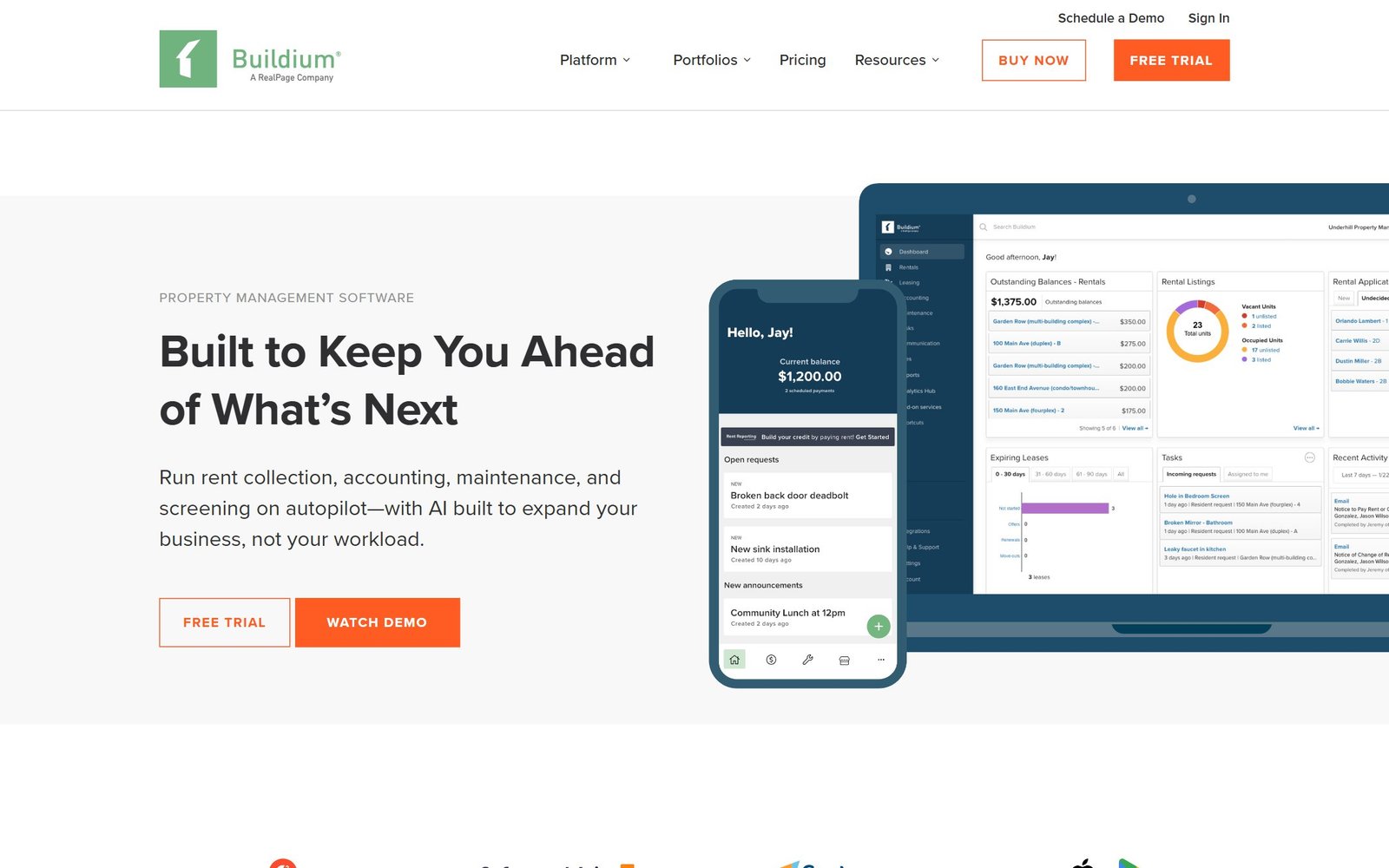
Buildium is where most professional AppFolio refugees land, and for defensible reasons. It is a full property management accounting platform: trust accounting, owner statements, 1099s, maintenance, leasing, and a resident portal, owned by RealPage since December 2019 in a $580M acquisition.
What it does well. The accounting engine is the deepest in this list short of full Yardi. Essential starts at $62 per month and stays flat to roughly 150 units, which is the single biggest structural difference from AppFolio: no unit minimum, no floor, and a small shop pays small-shop money. The live grid is $62 Essential, $192 Growth, $400 Premium, all “starting at.” Worth knowing: plenty of ranking listicles still print the stale $58/$183/$375 grid, which tells you how often those lists get re-verified.
Hands-on observations. In practice, the interface feels a generation older than DoorLoop but a generation more complete. Where AppFolio pushes AI everywhere, Buildium concentrates it in Lumina AI Workforce (a Leasing Agent, an Accounting Agent, and Bill Scan), and gates all of it to the $400 Premium plan. If AI leasing responses were the AppFolio feature you actually used, budget for Premium or look at DoorLoop.
Pricing reality check. The catch is the fee stack. Incoming EFT runs $2.35, $1.35, or $0.60 per transaction depending on plan, outgoing EFT is $0.99, cards are 2.99 percent, eSignatures cost $5, $1, or free per document by tier, screening runs $17 to $35, and extra bank accounts are $99 each (Growth includes 10 free, Premium 100). A 100 door shop on Essential can pay more in EFT fees than the base subscription. We itemize the whole stack in our Buildium review.
Who it is for. Professional managers, roughly 25 to 1,000+ doors, who left AppFolio over per-unit economics and want accounting depth first.
One honest limitation. The parent company carries baggage: the DOJ settled its algorithmic price-fixing case against RealPage in November 2025 via consent decree. That case targets RealPage’s AI Revenue Management products, not Buildium, and we have seen zero evidence Buildium runs the challenged algorithm. But if vendor optics matter to your owners, it is context you should know.
2. DoorLoop: the under-50-doors escape hatch
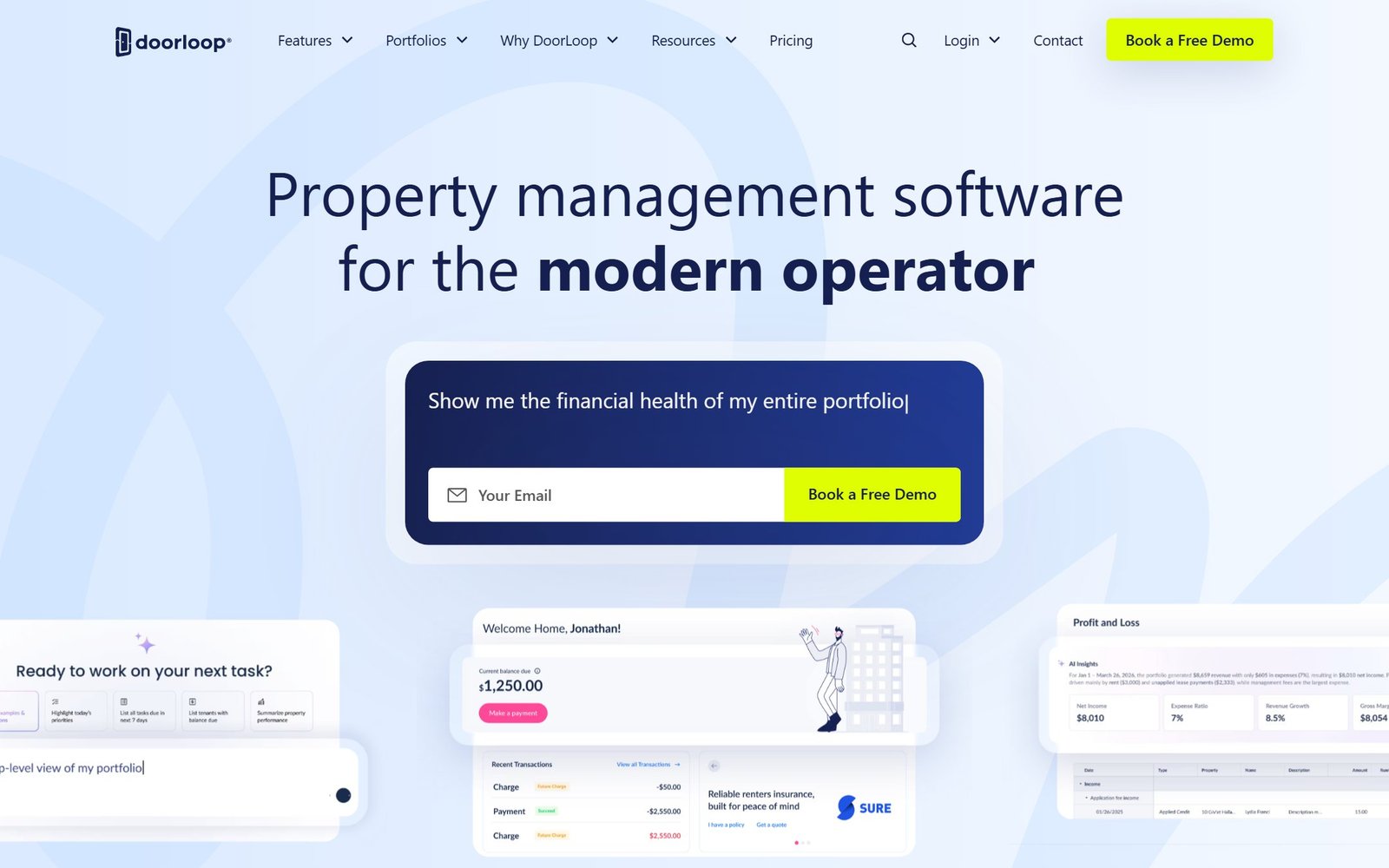
DoorLoop is the modern-interface option, and it is the natural landing spot if AppFolio’s 50 unit minimum was your dealbreaker, because DoorLoop’s cheapest tier is built for portfolios of 10 units and under.
What it does well. Fast onboarding, a genuinely pleasant UI, strong support reputation, and full-stack features (accounting, leasing, maintenance, tenant portal) at small-portfolio prices. The company is well capitalized: a $100M Series B led by JMI in October 2024, $182M raised in total, at a roughly $500M valuation. This is not a tool that disappears next year.
Hands-on observations. The thing you must understand before budgeting is the promo pattern. DoorLoop’s site runs a recurring 30 percent-off-for-three-months banner, so the $69/$149/$209 prices you see quoted everywhere are promotional. The real billed-yearly prices are Starter $99 (capped at 10 units), Pro $189, and Premium $239, plus $3 per unit above the base allotment. Every comparison site that prints $69 as the permanent price is wrong, and, in a detail we genuinely enjoyed, DoorLoop’s own alternatives listicle misprices its own product with a $49/$99/$149 grid that matches neither the promo nor the real numbers.
Pricing reality check. There is a new AI Assistant add-on, available on Pro and Premium only, with undisclosed pricing. We will not guess a number, and neither should you: get it in writing on the quote.
Who it is for. Managers and serious landlords under roughly 100 doors who want AppFolio-style polish without the floor. Past 100 doors, the $3 per unit scaling starts to erode the price advantage, so run the math at your size. Full add-on math is in our DoorLoop review, and we put it head to head with Buildium in Buildium vs DoorLoop.
One honest limitation. Accounting depth trails Buildium. Complex trust accounting setups and heavy owner-reporting shops will feel the gap.
3. Rentvine: the all-inclusive challenger courting AppFolio switchers
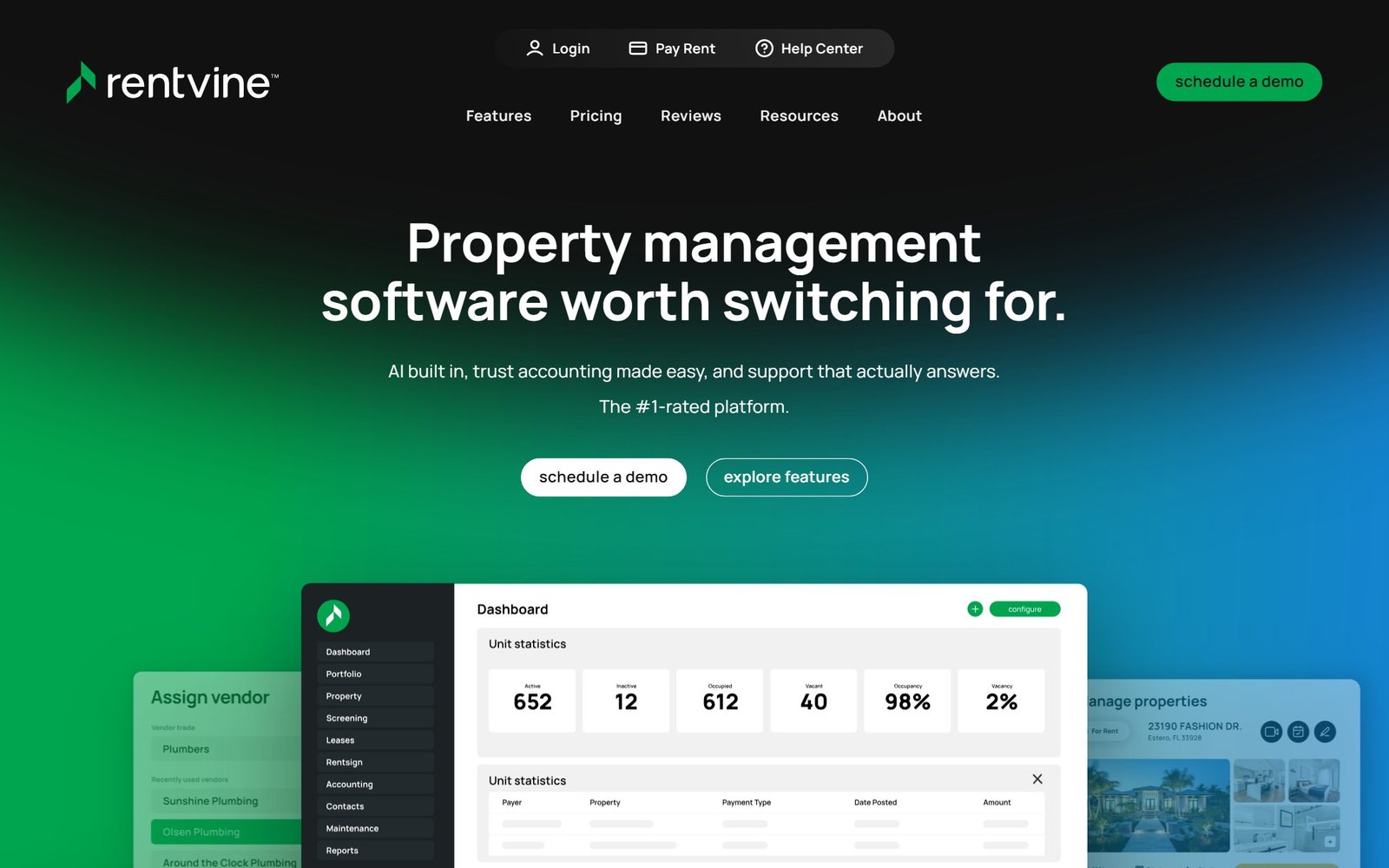
Rentvine is the most direct “we exist because AppFolio annoyed you” play in this list. Backed by $74M from Mainsail Partners (August 2024), it openly courts AppFolio switchers with an all-inclusive pitch: one rate, no per-transaction nickel-and-diming.
What it does well. The pitch is “as low as $1.50 per unit” with everything bundled, an open API, and a guided 45 day onboarding program designed specifically around migrating an existing book of business. For a 300 door shop tired of reconciling a base fee plus six add-on line items, that simplicity is the product.
Hands-on observations. The open API deserves more attention than it gets. AppFolio has historically been restrictive about data access, and Buildium locks its open API behind the Premium plan. If you have ever felt held hostage by your PM software’s export limitations, Rentvine’s posture on this is a genuine differentiator.
Pricing reality check. That $1.50 per unit figure is quote-gated: it is the vendor’s own “as low as” number and final pricing depends on your portfolio. If you came to this article because AppFolio’s quote-only pricing page infuriated you, note the irony and get Rentvine’s quote in writing with the all-inclusive scope itemized.
Who it is for. Professional shops, realistically 100+ doors, leaving AppFolio over fee creep rather than the base price.
One honest limitation. It is the youngest professional-grade platform here, and quote-gated pricing means you cannot budget from the website. There is no public grid to hold them to later.
4. Yardi Breeze: the cheapest per-unit rate from the biggest name
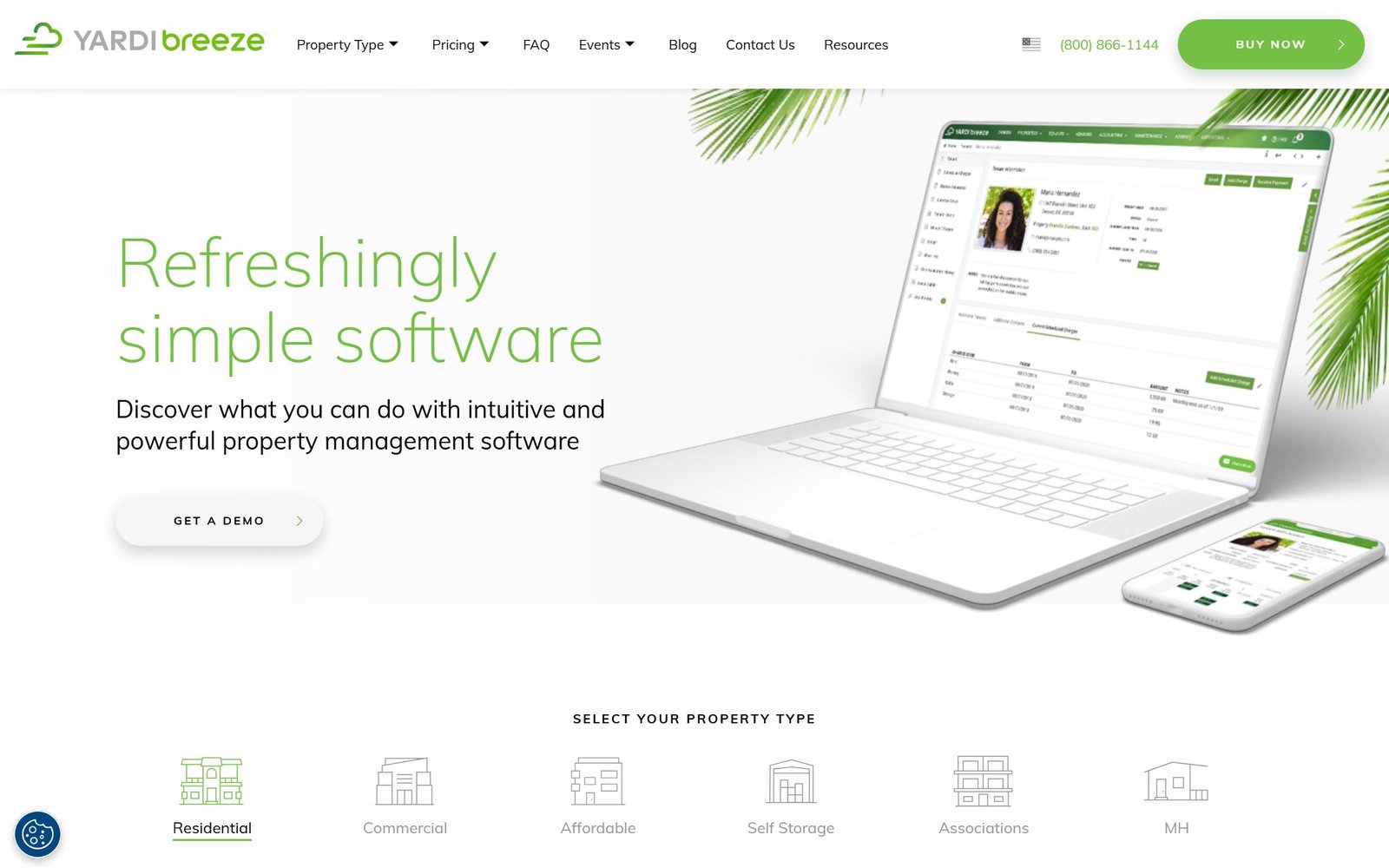
Yardi Breeze is the small-portfolio product from the largest property management software company on earth, and its pricing is refreshingly literal: $1 per unit per month for residential.
What it does well. Real accounting, marketing, screening, and payments from a vendor that will outlive everyone else on this list. The published rates: residential $1 per unit with a $100 monthly minimum, commercial $2 per unit with a $200 minimum, and Breeze Premier carries a $400 monthly minimum. At 200 residential doors you are at $200 per month, a number AppFolio cannot approach.
Hands-on observations. In practice the trade-off is character. Breeze is functional and stable but feels like exactly what it is: a simplified skin over enterprise plumbing. Leasing workflows are serviceable rather than slick, and AI features are thin compared to AppFolio’s Realm-X suite. You are buying price and stability, not innovation velocity.
Pricing reality check. Two catches. First, the minimums mean small portfolios do not get the sticker rate: at 50 units the $100 floor makes it $2 per unit effective. Second, Breeze requires an annual agreement, so this is a year-long commitment, not a month-to-month trial.
Who it is for. Cost-focused residential managers at 100+ doors who want a stable vendor and a predictable invoice, and shops that may eventually grow into Yardi’s bigger products.
One honest limitation. The annual agreement plus the migration effort means a bad fit costs you a year. Demo hard before signing.
5. Hemlane: for small remote portfolios
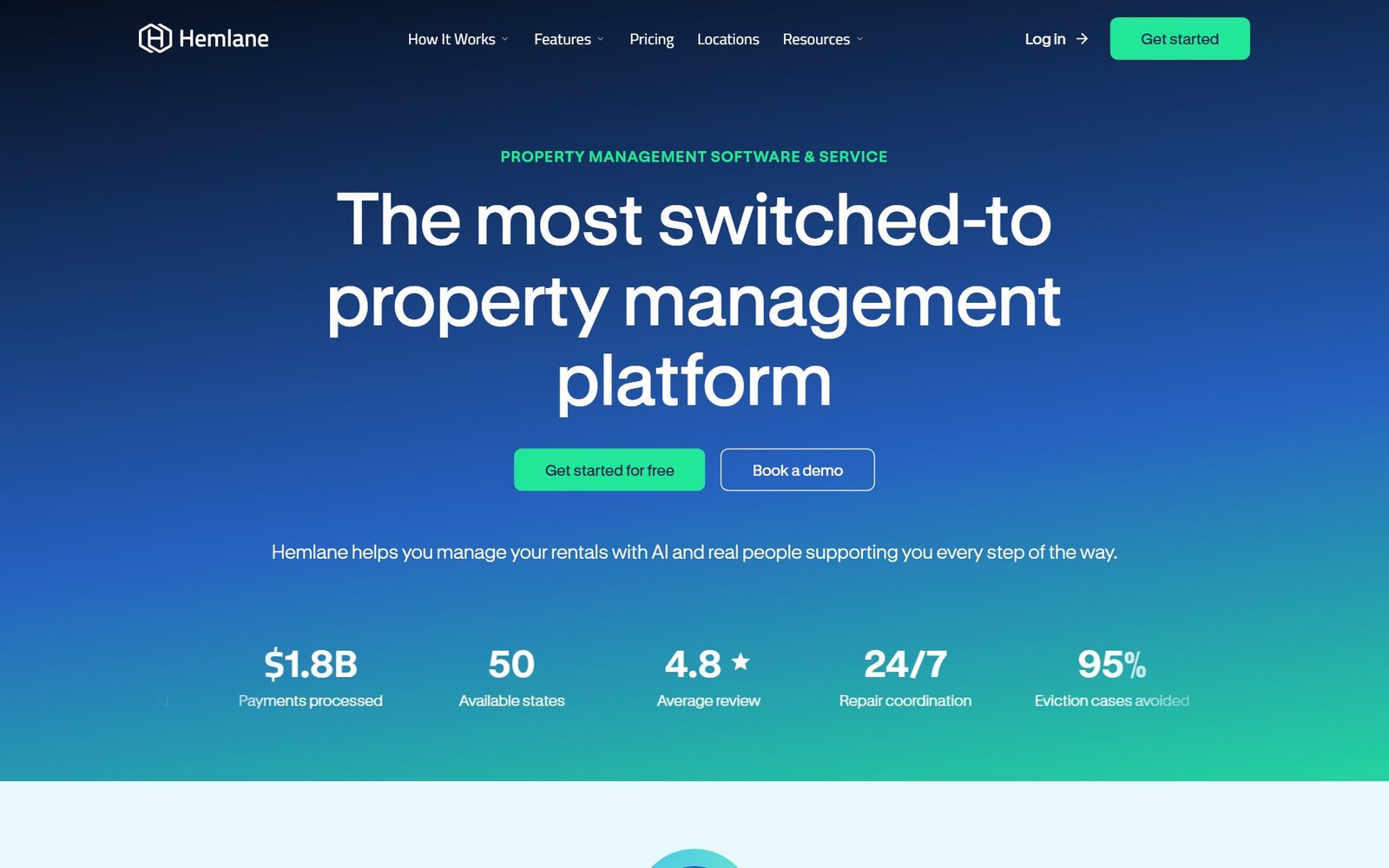
Hemlane solves a problem AppFolio never tried to: managing a small portfolio scattered across markets, with optional local boots on the ground.
What it does well. The hybrid model is the headline. Software handles listings, applications, leases, and rent collection, and Hemlane can connect you with local agents for showings and a 24/7 repair coordination team for maintenance. Pricing is published and modular: a free Starter tier, then paid tiers at $2, $20, or $58 per unit, each plus a $28 base fee, with tenant placement from $695.
Hands-on observations. For a 12 door owner with properties in three states, the repair coordination tier genuinely replaces a chunk of what you would otherwise hire a local PM for. It is not AppFolio-class accounting, and it does not pretend to be.
Pricing reality check. The per-unit tiers scale steeply. At the $58 per unit Complete tier, 20 units runs $1,188 per month, which is full-service management territory. The sweet spot is the lower tiers on small counts.
Who it is for. Self-managing owners and accidental landlords with 1 to 25 units, especially remote ones. If that is you, our best AI tools for landlords guide covers this whole segment in depth.
One honest limitation. Professional multi-owner trust accounting is not here. A 100 door third-party management company will outgrow Hemlane immediately.
6. TenantCloud: the everything-included budget pick
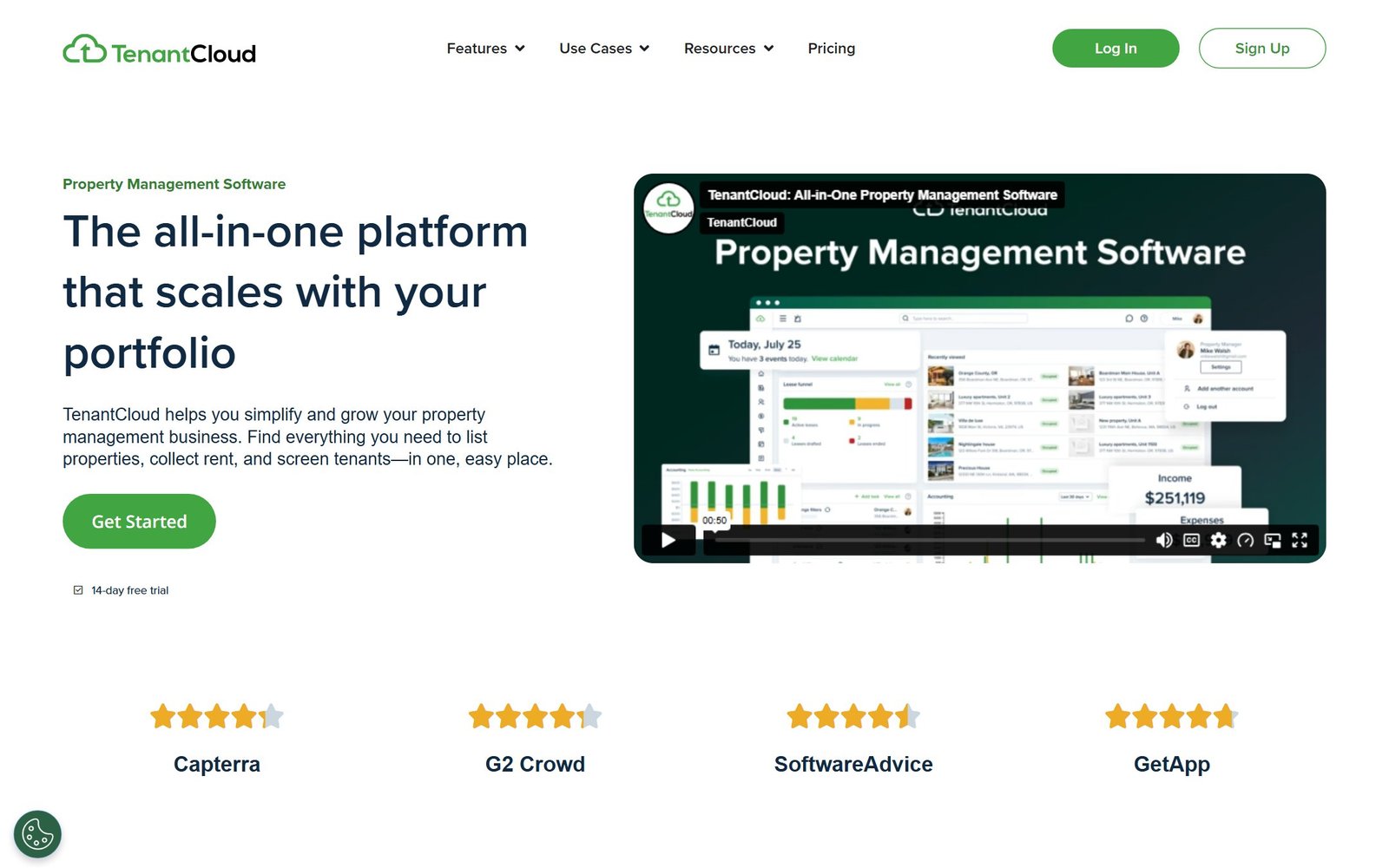
TenantCloud is the value play: full landlord software with published prices that start where most competitors’ add-ons end.
What it does well. Plans run $18, $35, and $60 per month, with a from-$100 tier for management companies. The clever structural detail: tiers limit leases and storage, not unit count, so the effective per-unit cost keeps falling as you grow within a tier. Listings, applications, screening, accounting, maintenance, and a tenant portal are all in the box.
Hands-on observations. In practice, it does 80 percent of what a small landlord used AppFolio for at under a tenth of the floor cost. The remaining 20 percent, deep trust accounting, owner portals with real statement packages, and AI leasing, is exactly what separates landlord software from PM-company software.
Pricing reality check. The published grid is honest, but screening and some payment features carry tenant-paid or per-use fees. Read the fee schedule, not just the plan price.
Who it is for. Landlords and very small managers, roughly 1 to 50 units, leaving AppFolio purely over the floor.
One honest limitation. Support responsiveness is the most common complaint we see, and at $18 per month that is the trade you are making.
7. RentRedi: the cheapest exit in the list
RentRedi is the floor of this market: a new Start tier at $5 per month, a Grow tier at $12 per month billed annually, and a custom-priced Pro tier.
What it does well. Rent collection, listings, applications, and maintenance requests at a price that rounds to zero. Screening is tenant-paid at $39.99 to $49.99, which is how the subscription stays that cheap, and there is a genuinely useful AI receipt categorization feature for expense tracking, one of the few real AI features at this price point anywhere.
Hands-on observations. The mobile-first design is the tell: RentRedi is built for a landlord running their portfolio from a phone, not a property manager running a back office. Used that way, it is excellent.
Pricing reality check. The $5 Start tier is new and thinly documented, so verify its exact feature limits during signup rather than assuming Grow-tier parity. And remember who pays: your applicants fund the screening.
Who it is for. Self-managing landlords, 1 to 20 units, who found AppFolio comically oversized. This is the segment covered in our landlords guide; if you run a management company, start from our property managers roundup instead.
One honest limitation. No professional trust accounting, no owner statements worth the name. It is landlord software, full stop.
Three tools on this list now have full hands-on reviews: Rentvine (the $1.50 headline vs the real $2.50 math), TenantCloud (the free app that stopped being free), and TurboTenant (who really pays for free).
Sidebar: Stessa and TurboTenant, the near-misses
Two tools kept coming up in our research that we deliberately left out of the main lineup.
Stessa (free, then $12 and $28 per month tiers) is excellent rental property finance software: automated income and expense tracking, dashboards, and tax-ready reports. But it is an accounting and asset-management layer, not an operations platform, and notably its own site makes no AI claims, which we respect. Pair it with a free operations tool rather than treating it as an AppFolio replacement.
TurboTenant (free, with Essentials at $149 per year and Pro at $199 per year, reported: the site blocks automated fetchers, so verify at signup) is a strong free landlord platform with a real Maintenance AI feature. It missed the main list only because it is squarely landlord software with no path to professional management scale. For the 1 to 20 unit crowd it is a top pick, and it leads our landlords roundup.
The Propertyware question: a caution flag, not a eulogy
You may have seen the rumor. In the past year an industry newsletter ran a piece titled “A Eulogy to Propertyware,” and screenshots traveled far. Here is the full story: the newsletter retracted the piece, and RealPage publicly stated it has no plans to sunset Propertyware. Propertyware is alive, supported, and running portfolios today.
So why is it not in our lineup? Because the episode itself is the signal. RealPage owns both Propertyware and Buildium, and it has emailed some Propertyware customers suggesting a Buildium migration. When a vendor’s own outreach nudges customers toward its sibling product, we would not migrate a portfolio onto the nudged-from platform in 2026, even though it is officially going nowhere. Moving PM software is a months-long project; you want to do it once. Treat Propertyware as a caution flag: fine to stay if you are already there and happy, hard to recommend as a fresh destination.
The Propertyware story got its own deep dive since this guide went live: our full Propertyware review covers the eulogy, the retraction, and the minimum-fee math on the platform the internet buried alive.
Our verdict: match the tool to the leaving reason
If we had to compress this into three sentences: professional managers leaving AppFolio over per-unit economics should shortlist Buildium first and Rentvine second, with Yardi Breeze as the value option if an annual agreement does not scare you. Anyone under 50 doors who got refused at the floor should go straight to DoorLoop, budgeting against its real $99 to $239 prices rather than the promo banner. Self-managing landlords with a handful of units never needed AppFolio in the first place: TenantCloud, RentRedi, or Hemlane will do the job for less than AppFolio’s reported monthly minimum, sometimes for less than its onboarding fee.
Whatever you pick, get the full fee schedule in writing before you migrate, run the math at your exact door count, and re-run it at the door count you expect in two years. AppFolio’s floor taught you that lesson once. Do not pay tuition twice.
What it costs to leave, which no pricing page mentions
Switching cost is why landlords and managers stay on systems they have outgrown. In this category it is unusually concrete, which means you can ask about it precisely.
Recurring payment authorisations rarely transfer
This is the big one. Tenant records, leases and ledgers export from almost any platform. Live recurring payment authorisations and the stored bank or card details behind them generally do not, which means every resident on autopay has to re-enrol. A share will not, and you will chase rent you were previously collecting automatically. Ask about this in writing during procurement, when you still have leverage.
Ask exactly what a full export contains
Standard fields usually come out cleanly. What often does not is the maintenance history with its photographs and correspondence, the document store of signed leases and addenda, the accounting history in a form your accountant can actually use, and the audit trail of who changed what. Ask for a sample export file during the trial rather than a description of one.
The accounting cutover has a right time and many wrong ones
Move at a period boundary, ideally the start of a financial year, and never mid-month with rent in flight. Plan to run a parallel reconciliation for one full cycle, and budget the hours for it. Migrations that go badly almost always went live at a convenient calendar date rather than a sensible accounting one.
Count the integrations before you sign, not when you leave
Listing syndication, accounting, screening providers, e-signature, banking, insurance and any owner portal are each work to disconnect and reconnect elsewhere. The count is always higher than anyone remembers, and it is the part that turns a two week migration into a six month one.

Written by
FazFaz is the founder of AIToolsBakery. Some tools here are tested hands on. Others are assessed from vendor documentation and pricing verified on the live page, and every review says which one it is. Sponsors can buy a position in a guide. They cannot buy the score, the criticism, or silence about a better option.
How we test and how we make money →Frequently Asked Questions
Related Posts

Lodgify Review (2026): Features, Pricing, Pros and Cons, and the Booking Fee Myth

Guesty Pricing in 2026: The Price Card Says $16, the FAQ on the Same Page Says $9, and Above 3 Listings Nobody Publishes Anything