If you are researching Second Nature pricing, you have already hit the wall: there is no pricing page. No tiers, no per-seat number, no free plan to poke at. That is a deliberate choice, and it makes budgeting frustrating when self-serve competitors show you a number in five seconds.
This guide walks you through what is actually true about how Second Nature charges, what pushes a quote up or down, and a simple decision process for working out whether it is worth it for your team. I will not invent a dollar figure, because Second Nature does not confirm one, and neither should any page claiming to. Instead you will get the model, the cost drivers, and the questions to ask so your quote does not surprise you at renewal.
What Second Nature actually is (so the price makes sense)
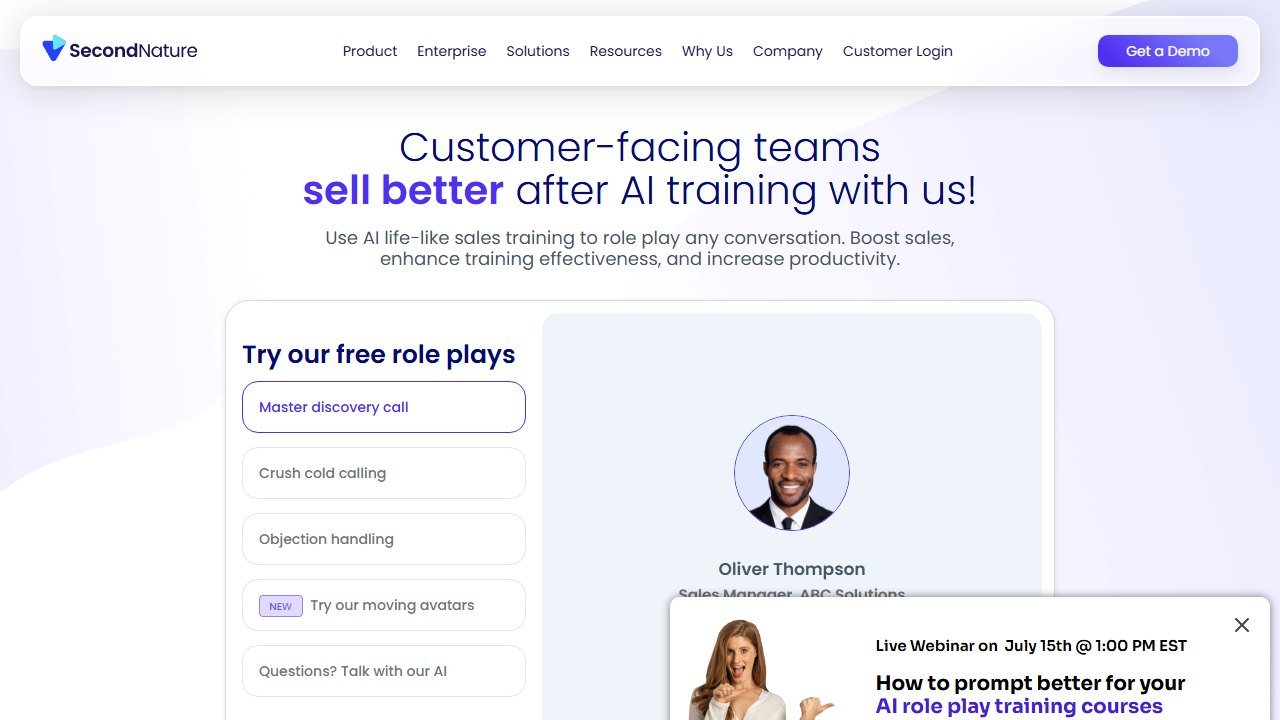
Before you judge the cost, be clear on what you are buying. Second Nature is an enterprise AI roleplay platform. Reps open a scenario, hold a spoken conversation with an AI persona that behaves like a real buyer, and get scored on discovery, objection handling, product knowledge, and closing. Managers review recordings and dashboards to see who needs coaching on what.
This is not a text-box chatbot. Second Nature is a managed platform with scenario building, a course structure that mixes content with practice, an analysis engine, an insights dashboard, admin controls with sub-accounts, and support for 30-plus languages. It sells to large sales and L&D organizations, and its case studies feature enterprise names. That positioning is the whole reason pricing is quote-based rather than a public per-seat sticker. For the full feature breakdown and our verdict, see our Second Nature review.
Step 1: Understand the pricing model
Here is what is verifiable about how Second Nature charges, stated qualitatively because exact figures are not public.
- Pricing is quote-based. There is no published price. You get a number only after a demo and a scoping conversation.
- Contracts are annual. Enterprise annual agreements are the standard. Do not expect month-to-month flexibility.
- There is no free self-serve plan. Access begins with a booked demo and a scoped pilot, not a signup form.
- Pricing is per seat, and volume changes the rate. Larger deployments typically negotiate a lower effective per-seat rate. Smaller teams pay more per head, which is exactly why small teams struggle to justify it.
- Modules and add-ons move the number. Base roleplay costs less than a deployment that layers in advanced analytics, extra languages, custom scenario development, and deep integrations.
- Support and success tier is part of the price. A named customer success manager, structured onboarding, and priority support usually sit in the higher band, a lighter self-service arrangement lower. It is bundled into the total rather than shown separately, so it is easy to miss.
The practical effect of an annual, per-seat model is that your commitment is sized to a full year of headcount, so the seat count you name in the sales call is the number you carry whether or not every rep logs in.
Third-party review sites publish their own cost estimates, and they vary widely because they are guesses, not confirmed rates. Treat any specific number you see, including on comparison blogs, as unverified. The only price that is real is the one Second Nature quotes you.
Step 2: Map the cost drivers before your demo
The quote is not a mystery once you know the levers. Walk into the demo already knowing where you sit on each one, because every answer moves your number.
Seat count. This is the biggest driver. Second Nature is priced for scale, so the per-seat rate improves as headcount rises. A 300-rep global sales org and a 25-rep startup are quoted on completely different logic.
Modules and depth. Basic roleplay is the floor. Certifications, structured onboarding tracks, advanced analytics, and the insights dashboard add to the total. Decide which you genuinely need on day one versus later.
Languages. Second Nature supports 30-plus languages, and multilingual rollout is a selling point for global teams. It is also a cost input. If you only train in English, do not pay for the rest.
Integrations. CRM and LMS connections, single sign-on, and custom scenario development based on your own content raise both setup effort and price. A plug-and-play pilot costs less than a wired-in deployment feeding data into your systems.
Support tier. Whether you get a hands-on customer success manager, guided rollout, and priority response, or a lighter self-service arrangement, changes the total. Buyers who need the platform live across regions fast should expect the higher-touch tier, and should ask for it explicitly rather than assume it is included.
Contract length. Longer commitments usually unlock better rates. They also lock you in before you know whether reps actually use the tool, so weigh the discount against the risk.
Step 3: What you should budget by company size
You cannot get an exact figure without a demo, but you can set a realistic expectation for the shape of the deal based on where you sit. Think of this qualitatively, in bands, not in dollars.
SMB and small teams (roughly under 50 reps). Expect the least favorable per-seat rate, because volume discounts have not kicked in, and expect the annual commitment to feel heavy relative to the size of the problem. Budget not just for seats but for the person who will build scenarios and drive adoption. For most teams here a transparent self-serve tool clears the bar first, and Second Nature only makes sense if you have a specific need lighter tools cannot serve, such as a hard multilingual or certification requirement.
Mid-market (roughly 50 to 200 reps). This is where the model starts to work. The per-seat rate improves, the setup effort spreads across enough people to amortize, and you likely have at least a part-time enablement owner. Budget for a base roleplay deployment plus one or two modules you genuinely need, and hold the rest for later expansion. The right move is a scoped paid pilot with a subset of reps and a clear success metric, rather than committing full headcount on day one.
Enterprise (200-plus reps, multi-region). This is the segment the pricing is designed for, and where the effective per-seat rate is most defensible. Budget for the full stack: base roleplay, advanced analytics, the insights dashboard, multiple languages, CRM and LMS integration, single sign-on, custom scenario development, and the higher support tier. Also budget the internal cost of an L&D team to run it. Negotiating leverage is real at this volume, so treat the first number as a starting point.
Step 4: Run the value math for your team
Pricing only means something against outcomes. Here is a straightforward way to pressure-test whether Second Nature is worth it, without needing the exact quote yet.
Start with the fully loaded cost of the problem. What does slow ramp cost you now? Take a rep’s quota, divide it into a weekly figure, and multiply by the weeks of ramp you think structured practice can remove. Even a modest improvement, say pulling two weeks out of a six-month ramp across dozens of hires a year, compounds into a figure that dwarfs a per-seat license. Roleplay tools earn their keep by moving these numbers, not by being cheap.
Quantify quota attainment, not just ramp. The bigger prize is the share of reps who hit quota at all. A tool that lifts a struggling middle of the team from missing to making quota changes your revenue math far more than shaving a week off onboarding, and repetition is how roleplay moves that number. If you can tie better attainment to more reps clearing their number, the annual cost starts to look like a fraction of the pipeline it protects.
Then estimate adoption honestly. A platform only returns value if reps actually practice. Second Nature is strong here because reps can drill anytime without pulling a manager into every session, a genuine advantage over manager-led roleplay that never scales. But if your culture will not enforce practice, even a perfect tool sits idle, and an idle seat is the most expensive seat there is. Budget for the enablement person who builds scenarios and drives usage, because that labor is part of the true cost.
Compare against the realistic alternative. For many teams the honest alternative is not “nothing,” it is a lighter self-serve tool. Yoodli has a free tier and transparent per-seat plans and suits individuals and smaller teams. Hyperbound targets fast SDR and AE roleplay rollouts. If you only need reps to rehearse a pitch, a lighter tool may deliver most of the value at a fraction of the commitment. See our AI sales roleplay tools roundup for the full field.
Score the fit. Second Nature justifies its price when you need managed scale: many reps, multiple languages, structured programs, CRM-connected reporting, and an L&D team to run it. The value collapses when you are small, single-language, and want to try before you buy.
How Second Nature compares on price posture
Price posture matters as much as price, because it tells you how the vendor expects to sell to you and how much friction stands between you and a running pilot.
Second Nature is the most enterprise-posture of the three. No public pricing, no free plan, demo-first, annual and per-seat, quoted after scoping. That signals a managed platform sold to buying committees. You trade transparency and speed for scale, support, and admin control.
Yoodli sits at the opposite end, with a free tier and transparent per-seat plans, so an individual or small team can start today without talking to sales. That makes it the natural default for solo reps, SMBs, and anyone who wants to try before committing budget. You give up enterprise scenario depth and managed rollout, but you gain a number you can see.
Hyperbound lands between the two. It is pitched at fast SDR and AE roleplay rollouts, more sales-led than Yoodli but generally lighter to stand up than a full Second Nature deployment. If you need quick, focused call practice rather than a company-wide multilingual program, its posture is a closer match.
The takeaway is not that one posture is better. Second Nature’s quote-based, demo-first posture is itself a signal about who it is for. If that friction feels annoying rather than reassuring, a transparent tool probably fits you better.
Step 5: Who it is worth it for
Use this as a quick filter.
Worth it for:
- Enterprise sales orgs with roughly 50-plus reps, and ideally hundreds, where the per-seat rate improves and the setup effort amortizes.
- L&D and enablement teams that already own training as a function and can build and maintain scenarios.
- Global teams needing consistent multilingual roleplay across regions.
- Regulated or scripted-call environments where certifying that every rep can handle a defined conversation actually matters.
- Companies that want practice data flowing into the CRM and a dashboard leadership will read.
Hard to justify for:
- Teams under about 50 reps, where you pay a high effective per-seat rate for a platform that expects dedicated enablement resources.
- Solo reps and SMBs. Second Nature does not sell to individuals, and lighter tools serve this segment better.
- Buyers who need to try before committing. There is no free plan, and the process is oriented toward buying committees, not quick trials.
- Teams that want real-time coaching on live calls rather than off-line practice. That is a different category of tool.
**Faz says:** The lack of a public price is not a trick, it is a filter. Second Nature is telling you that if the annual commitment and the enablement overhead make you flinch, you are not the customer. That is useful information. When I run the math for a team under 30 reps, a transparent per-seat tool almost always wins on payback, not because Second Nature is bad, but because you are paying enterprise setup costs to solve a small-team problem. When I run it for a 200-rep global org with a real L&D function, the picture flips: the per-seat rate is reasonable at that volume, the multilingual scale is hard to replicate, and the dashboard earns its place in a QBR. Same platform, opposite verdict. Figure out which side of that line you are on before you book the demo.
Step 6: How to negotiate and what to ask in the sales call
Because the price is quoted rather than posted, your preparation directly affects the number. Walk in with your seat count, target scenarios, language needs, and integration list already defined, so the rep is scoping a known deployment rather than an open-ended wishlist. Vague requirements invite padded quotes. Your single biggest lever is a willingness to start with a scoped pilot and expand rather than committing full headcount before adoption is proven, so lead with that framing.
A few tactics help. Ask where the volume break sits just above your realistic seat count, because a modest bump in committed seats sometimes crosses a threshold that lowers the rate. Separate what you need on day one from what you can add later, and refuse to pay year-one prices for modules you will not switch on until year two. Get the renewal terms in writing before you sign the first year, since the uplift is where quote-based deals quietly get expensive.
Then ask these directly in the call.
- What is the effective per-seat rate at our exact headcount, and what is the volume break above it? Get the number tied to your real seat count, not a range.
- What counts as an active seat, and what happens to unused seats? Clarify whether you pay for provisioned or active users.
- What is included in the base versus paid extra? Pin down which modules, languages, and integrations are in scope so nothing lands as a surprise line item.
- What is the renewal uplift? Ask what the price does at year two before you sign year one.
- What are the pilot terms? A scoped paid pilot with clear success metrics beats a blind annual commitment. Ask for it.
- What support and success tier are we on, and what does it include? Confirm whether onboarding, a named success contact, and scenario help are in the price or extra.
- Who builds and maintains our scenarios, and what does that cost in our time? The platform is only as good as the scenarios in it.
What sales training and roleplay platforms actually charge
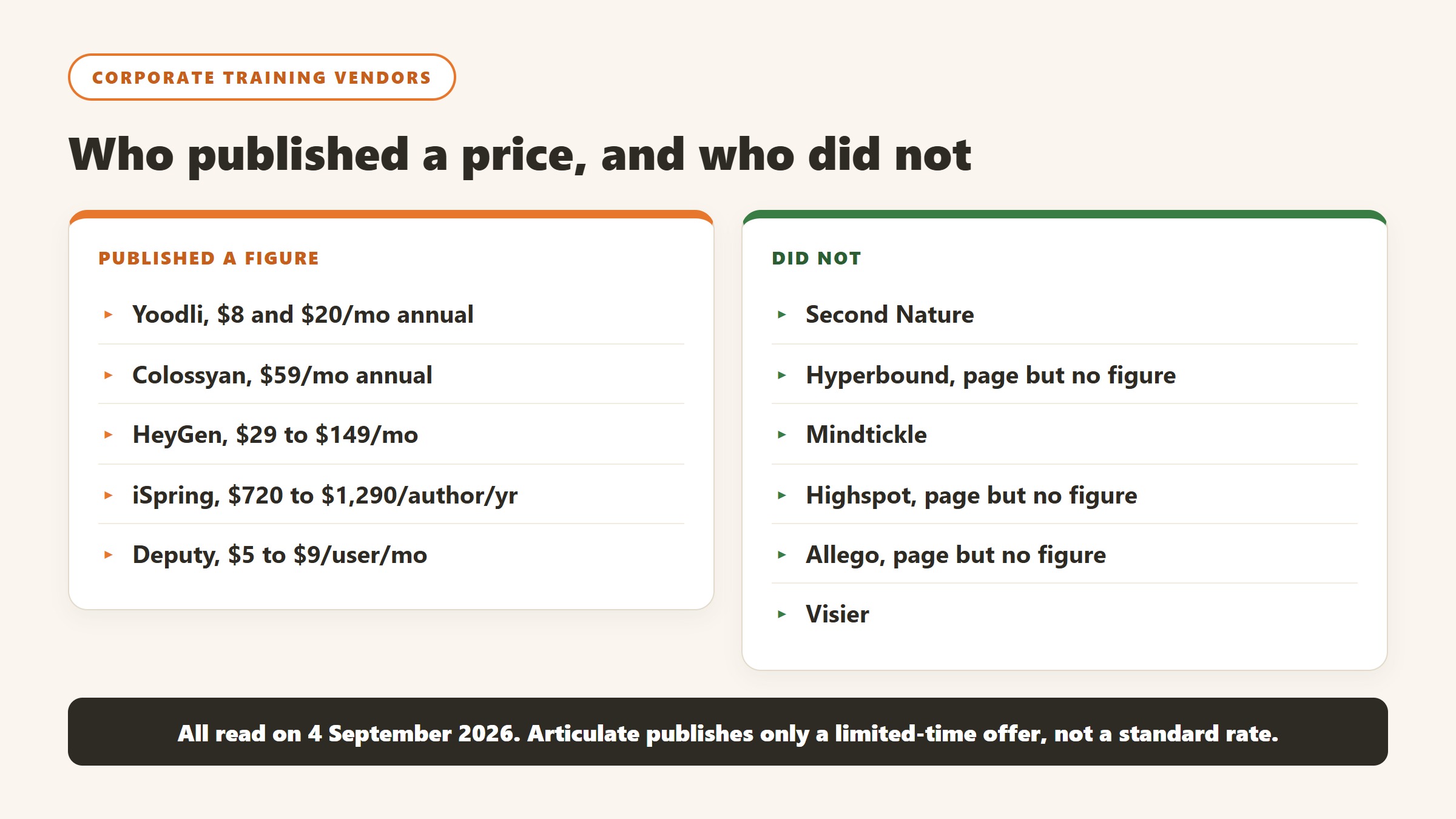
This is one of the least transparent categories we cover. Most vendors quote rather than publish, which changes how the evaluation has to be run. Here is each alternative to second nature, read at source on 4 September 2026.
Yoodli, the only one here with a published individual rate
Yoodli publishes $8 a month billed annually for its Pro individual plan, which includes up to ten roleplays a week and live AI coaching, and $20 a month billed annually above that. It also runs a free tier. That makes it the only platform in this comparison a single person can price without speaking to anyone, which matters if you want to test the category before committing a team budget.
The five that publish no figure at all
We could not read a price from Second Nature, Hyperbound, Mindtickle, Highspot or Visier on 4 September 2026. Hyperbound and Highspot both render a pricing page carrying no currency figure. That is a commercial choice rather than an oversight, and it is the norm at the enterprise end of sales enablement.
Allego publishes a pricing page with no price on it
Allego is worth calling out separately. It has a real pricing page, headed “Simple Sales Enablement Pricing. Clear Results.”, and there is not a single currency figure anywhere on it. It does publish something useful though: a contract buyout programme for customers switching from a competitor mid-term. If you are locked into a rival, that is worth asking about specifically, because it is the kind of term that rarely appears in a comparison table.
What to do when almost nobody publishes
Price a published alternative precisely at your seat count and make it the number every quote has to justify itself against. Yoodli at $20 a month billed annually across 40 reps is $9,600 a year. That is not a like-for-like substitute for an enterprise enablement platform, and it is a real figure in the room that both sides can verify, which is more than you will otherwise have.
Ask what the platform fee is separate from the seats
Several vendors in this category price as per-user licences plus a platform fee that scales with the number of users supported. That means the cost does not fall as neatly with a smaller pilot as you might expect, and a 10-seat pilot can carry most of the platform cost of a 50-seat deployment. Ask for both components separately before modelling a phased rollout.
The bottom line
Second Nature pricing is quote-based, annual, per seat, and shaped by how many people you train, in how many languages, with how many modules and integrations. There is no public number and no free self-serve plan, so any exact figure you find elsewhere is an estimate the company has not confirmed.
Whether it is worth it comes down to scale. For large enablement teams running roleplay across a big, multilingual, CRM-connected sales org, the value is real and the price is defensible. For small teams, the same platform is expensive setup for a problem a lighter tool solves faster. Set your expectation with the budgeting bands in Step 3, run the value math in Step 4, filter yourself with Step 5, and if you clear the bar, walk into the demo with the Step 6 questions and negotiation framing ready.
For the deeper feature verdict, read our Second Nature review. To see where it sits against the rest of the market, start with our best AI corporate training tools guide and our AI sales roleplay tools comparison.

Written by
FazFaz is the founder of AIToolsBakery. Some tools here are tested hands on. Others are assessed from vendor documentation and pricing verified on the live page, and every review says which one it is. Sponsors can buy a position in a guide. They cannot buy the score, the criticism, or silence about a better option.
How we test and how we make money →