Mindtickle is a strong platform. Our own Mindtickle review rates it well: a deep, all-in-one sales-readiness suite with training, coaching, conversation intelligence, content, and AI roleplay in one system, carrying a 4.7 out of 5 on G2 across roughly 2,200 reviews. So why do so many teams end up shopping for an alternative? For the wider category compared on licensing model and published pricing, see our best AI sales coaching software guide.
Two reasons dominate. The first is price and scope. Mindtickle publishes no list pricing, sells almost entirely to mid-market and enterprise, and is commonly reported to average near five figures a year per contract. For a 15-rep team, that is a lot of platform to buy and implement. The second reason is the opposite of consolidation: some teams do not want one suite that does eight things adequately. They want the best tool for one job, whether that is AI roleplay, call analytics, or content enablement. This guide covers eight alternatives grouped by what you are actually trying to fix, so you can match the tool to the problem instead of overbuying.
| Tool | Best for | Pricing model |
|---|---|---|
| Second Nature | Conversational AI roleplay at scale | Per-seat, quote-based |
| Hyperbound | Cold call and discovery roleplay, fast ramp | Per-seat, quote-based |
| Yoodli | Affordable communication and pitch coaching | Free tier plus paid per-seat |
| Gong | Conversation and revenue intelligence | Per-seat plus platform fee, quote-based |
| Allego | Closest all-in-one enablement suite | Per-seat, quote-based |
| Highspot | Content-led enablement and buyer engagement | Per-seat plus platform fee, quote-based |
| Seismic | Large-scale content management and enablement | Per-seat, quote-based |
| Quantified | Simulation-based practice with skill scoring | Per-seat, quote-based |
Second Nature
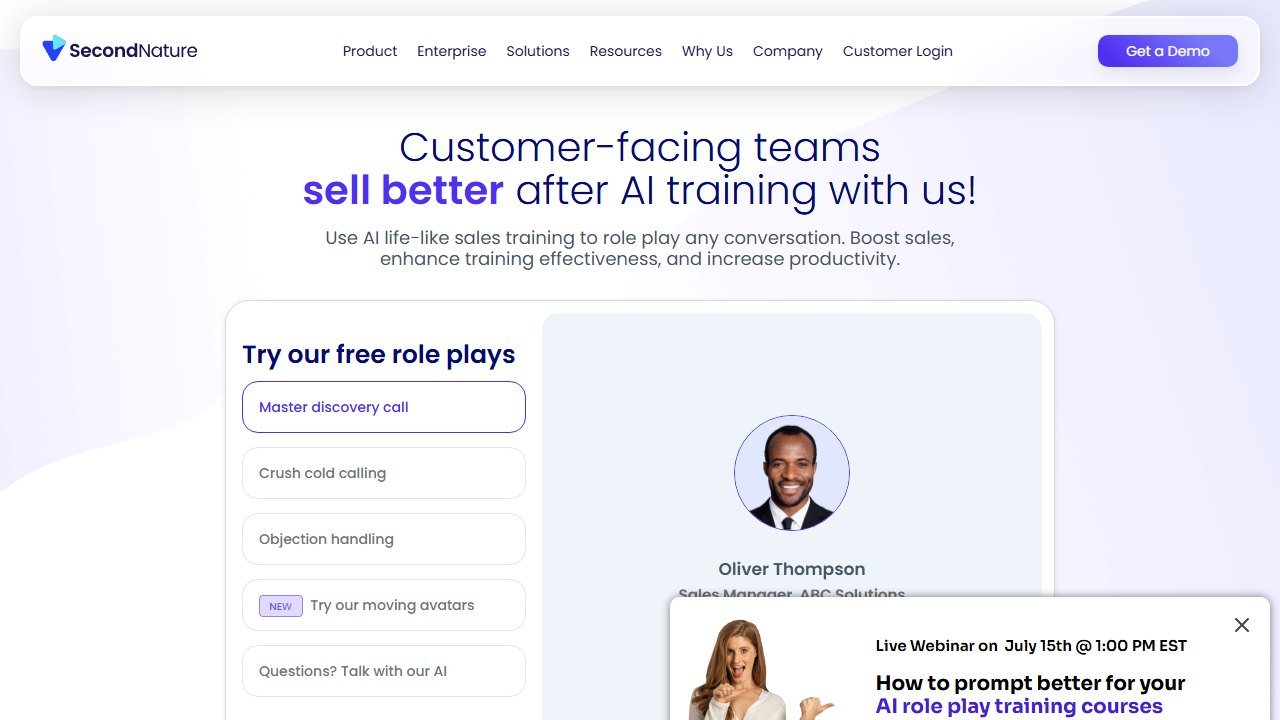
Second Nature is the alternative to reach for if the Mindtickle capability you care about is AI roleplay. Reps talk to a conversational AI persona that responds in natural language, pushes back with objections, and then scores the conversation against your talk track. Where Mindtickle bundles roleplay into a wider suite, Second Nature makes it the whole product, which shows in the polish of the conversation flow.
It is best for enablement teams that want to drill pitch delivery, product knowledge, and objection handling repeatedly without burning manager time. The standout is the lifelike back-and-forth: the AI avatar holds a real spoken conversation rather than reading a script, which makes practice feel closer to a live call. It supports certification programs, so you can gate reps on a passing roleplay score before they touch a live prospect.
The honest limitation is scope. Second Nature does not manage content, run call analytics on real deals, or replace a learning management system, so it complements your stack rather than consolidating it. Pricing is per-seat and quote-based, positioned for teams rather than solo users. If roleplay is your core need, see how it stacks up in our Second Nature review and the wider AI sales roleplay tools roundup.
Hyperbound
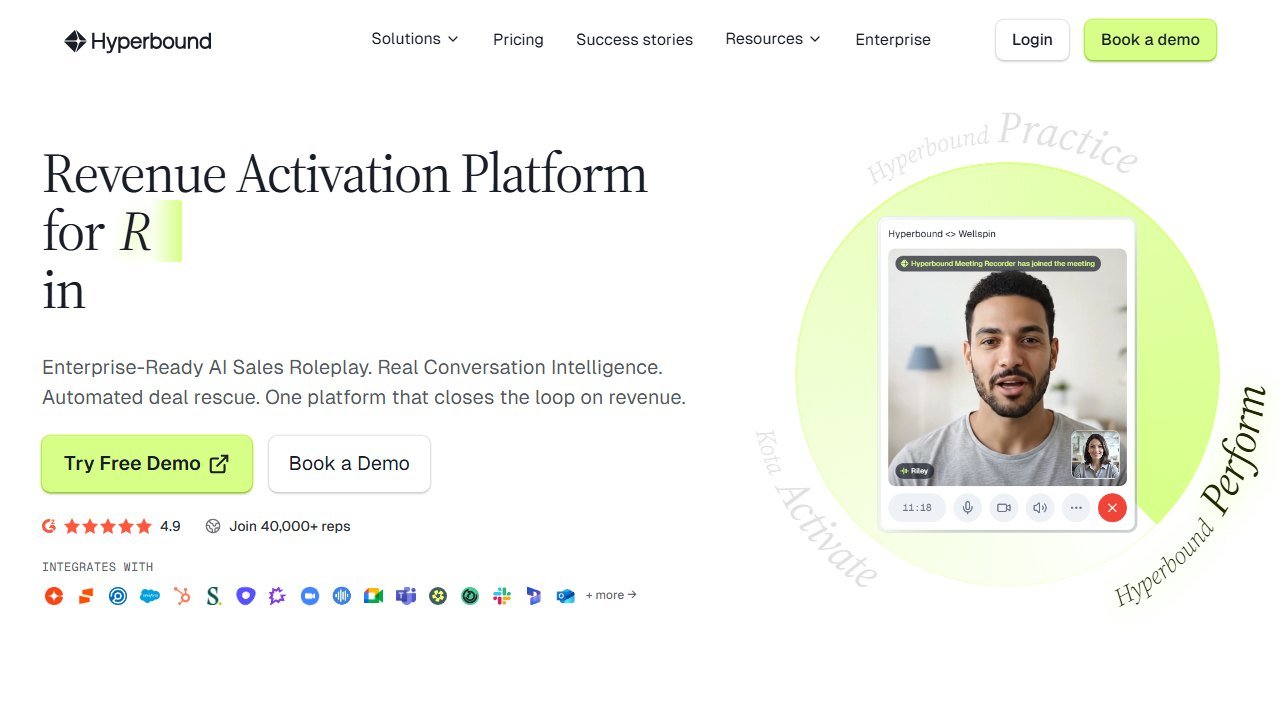
Hyperbound is a roleplay-first platform built around one promise: turn an ideal-customer-profile description into an interactive AI buyer in minutes, then let reps practice cold calls, discovery, gatekeeper, and upsell conversations against it. It leans on a large corpus of real B2B call data, and its scorecards track things like question depth and methodology adherence, which makes the feedback specific instead of generic.
It suits fast-growing sales orgs that want to compress ramp time for new reps. Teams using this style of tool report meaningfully shorter ramp, and building a first bot and scorecard takes under ten minutes, so enablement can stand it up without a long project. The standout is the breadth of call types across the full sales cycle, from outbound cold calls to post-sale upsells, all customizable to your ICP and objections.
The limitation is the same as Second Nature: it is a focused practice tool, not a suite, so you still need something else for content and formal LMS-style tracking. Pricing is per-seat and quote-based and is not published publicly. For the broader coaching picture, our best AI sales training software guide places Hyperbound among its peers.
Yoodli
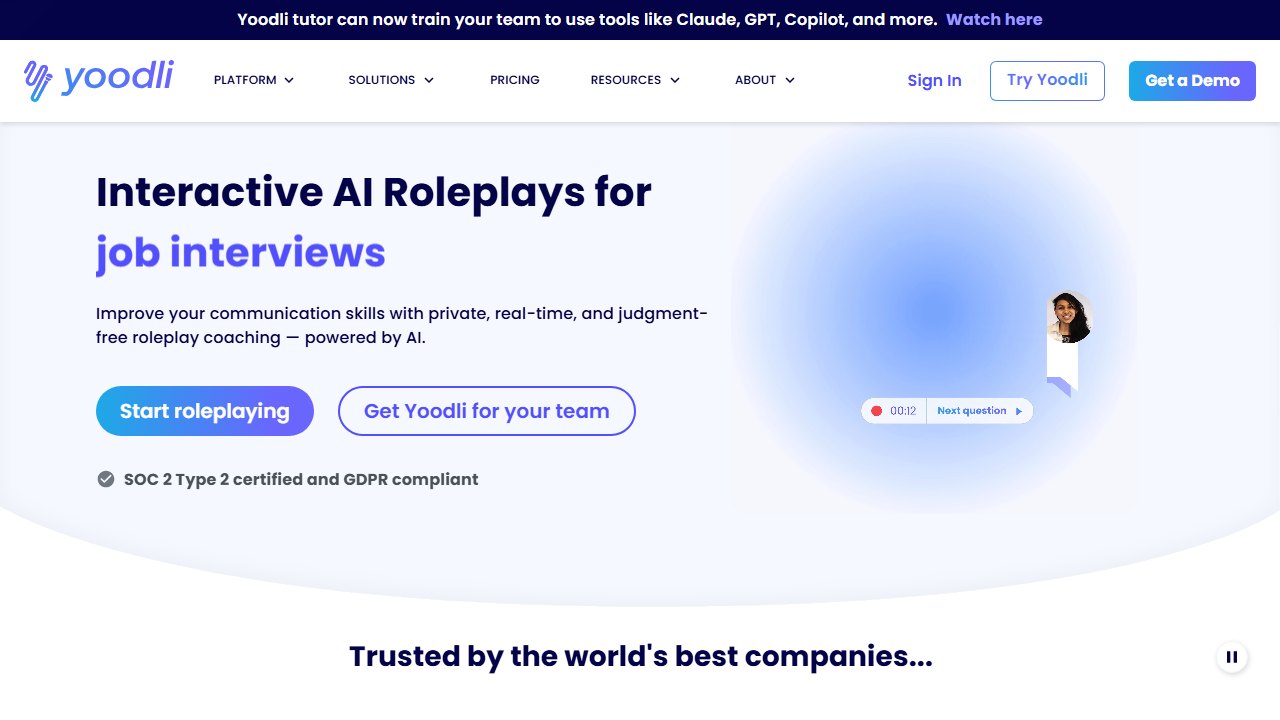
Yoodli is the most accessible alternative on this list and the best entry point for teams that find Mindtickle too heavy. It is an AI communication coach: reps record or roleplay a pitch, and Yoodli gives private, judgment-free feedback on filler words, pace, clarity, and content. It began as a public-speaking coach and has moved firmly into sales and enablement use cases.
It is best for teams that want to improve how reps communicate, not just what they say, and for organizations that want individuals to practice on their own before a manager ever sees it. The standout is the low barrier: there is a genuinely useful free tier, so reps can start practicing today without a procurement cycle, and paid plans add team analytics and custom scenarios.
The limitation is depth on the enterprise side. Yoodli is lighter on formal readiness scoring, content management, and real-deal conversation intelligence than Mindtickle, so large orgs with compliance and certification needs will outgrow the lighter tiers. Pricing includes a free plan plus paid per-seat tiers, making it the clearest budget alternative. See the full breakdown in our Yoodli review, and if you are weighing it against a pure roleplay tool, our Yoodli vs Second Nature comparison covers the tradeoffs.
Gong
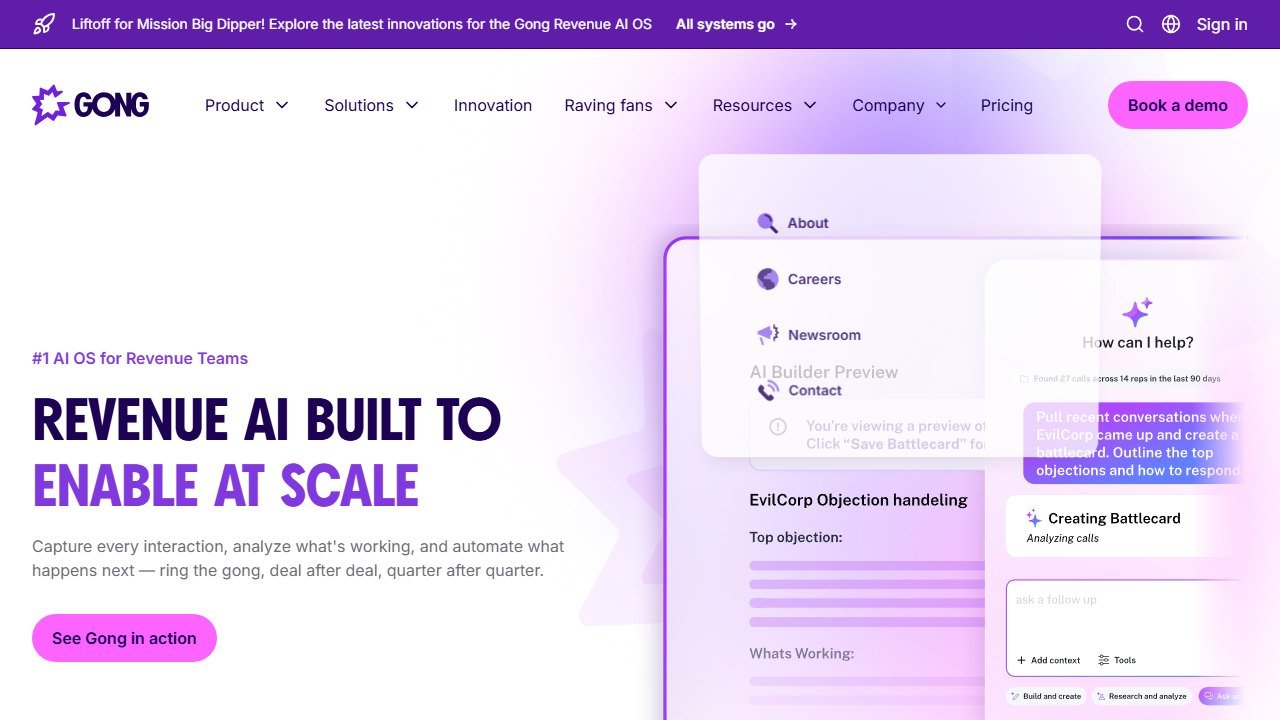
Gong is the alternative to consider if the Mindtickle module you actually rely on is Conversation Intelligence. Gong records, transcribes, and analyzes real sales calls and emails, then surfaces deal risk, talk-time ratios, competitor mentions, and coaching moments. It is the deepest standalone product in the category, which is exactly where Mindtickle’s bundled Call AI is solid but not category-leading.
It fits revenue teams that want to coach from what actually happens on live deals rather than from practice sessions alone. The standout is the analytics depth and its revenue-intelligence layer, which ties call signals to pipeline and forecasting so managers coach on the moments that move deals. That real-conversation focus is the mirror image of the roleplay tools above.
The limitation is that Gong is not a training or roleplay platform in the Mindtickle sense. It tells you what happened and where reps need help, but you still need a separate mechanism to actually drill the skill, which is why teams often pair Gong with a roleplay tool. Pricing is per-seat plus a platform fee and is quote-based, typically enterprise-oriented.
Allego
Allego is the closest like-for-like alternative to Mindtickle. It combines sales training, coaching, conversation intelligence, and content management into a single readiness platform, so it competes on the same consolidation argument that makes Mindtickle attractive. If you like the all-in-one thesis but want a different vendor, Allego is the first name to shortlist.
It is best for mid-market and enterprise revenue teams that want one platform for onboarding, ongoing coaching, and content, with video-based learning at its core. The standout is its heritage in video coaching and asynchronous rep practice, which pairs naturally with its content and conversation tools. Reviewers rate it highly on G2, in the same tier as Mindtickle.
The limitation is that, like Mindtickle, it is a broad suite with the implementation and cost profile that implies. You are trading one enterprise platform for another, so the decision usually comes down to demo quality, specific module strength, and price rather than category fit. Pricing is per-seat and quote-based. If you are comparing full suites, start from our best AI corporate training tools pillar.
Highspot
Highspot approaches enablement from the content side. It is best known for helping reps find, personalize, and share the right content at the right deal stage, then tracking how buyers engage with it. It has expanded into training and coaching, so it overlaps meaningfully with Mindtickle, but its center of gravity is content and buyer engagement rather than readiness scoring.
It fits organizations whose biggest pain is content chaos: decks scattered across drives, reps sending outdated collateral, and no visibility into what buyers actually open. The standout is its content management and analytics, plus digital sales rooms that give buyers a branded, trackable space to collaborate through a deal. Its training and coaching modules make it a credible single-vendor option for content-led teams.
The limitation is that its roleplay and readiness depth are not the reason to buy it, so a training-first org may find Mindtickle or Allego stronger there. Pricing is per-seat plus a platform fee and is quote-based, positioned for mid-market and enterprise.
Seismic
Seismic is the enablement heavyweight for large organizations that treat content at scale as the core problem. Like Highspot, it centers on content management, personalization, and analytics, with a growing enablement and coaching layer around it. It is often the answer for the biggest, most complex go-to-market teams that need governance and localization across many regions and product lines.
It is best for enterprise teams with large content libraries and strict control requirements, where finding, governing, and measuring content is a full-time discipline. The standout is the breadth of its enablement cloud and its automation for assembling and personalizing content at volume, which smaller point tools cannot match.
The limitation, again, is that Seismic is not primarily a roleplay or readiness product. If your reason for leaving Mindtickle is that you want deeper AI practice, Seismic is not the fix. But if you want a content-first enablement platform that can also carry training, it belongs on the list. Pricing is per-seat and quote-based, aimed squarely at enterprise budgets.
Quantified
Quantified rounds out the roleplay-focused options with a simulation-based approach to practice. Reps run through AI-driven sales simulations and get scored on skills, giving enablement a data view of who is ready and where the gaps are. It sits alongside Second Nature and Hyperbound as a practice-and-measure tool rather than a broad suite.
It is best for teams that want objective, repeatable skill measurement across a rep population, not just informal practice. The standout is its scoring framework, which aims to quantify soft skills and delivery in a consistent way so managers can compare reps and track improvement over time. That measurement angle is closest to what Mindtickle’s Readiness Index tries to do, minus the rest of the suite.
The limitation is maturity and scope relative to the enterprise incumbents: like the other point tools, it complements content and call-analytics systems rather than replacing them. Pricing is per-seat and quote-based. For where simulation tools fit in the training stack, see our best AI roleplay tools for corporate training guide.
Which Mindtickle alternative should you pick
The mistake is shopping for a single “Mindtickle replacement.” Mindtickle is really several products in a trenchcoat, so the right alternative depends on which of those products you were actually using.
| If you left Mindtickle for… | Pick |
|---|---|
| Better, cheaper AI roleplay | Second Nature or Hyperbound |
| The lowest-cost entry point | Yoodli |
| Deeper real-call analytics | Gong |
| A different all-in-one suite | Allego |
| Content-led enablement | Highspot or Seismic |
| Objective skill measurement | Quantified |
A last piece of advice: run a real pilot before you sign. Every tool here demos well. What separates them is how reps actually behave once the novelty wears off, whether managers look at the data, and whether the scoring changes coaching conversations. Pick two finalists that map to your top problem, run them with a small rep group for a month, and let usage decide. If you are building the wider program around whichever tool you choose, our guides to how to build an AI training program and the best AI sales training software will help you wire it into onboarding and ongoing coaching.
What sales training and roleplay platforms actually charge
This is one of the least transparent categories we cover. Most vendors quote rather than publish, which changes how the evaluation has to be run. Here is each alternative to mindtickle alternatives, read at source on 4 September 2026.
Yoodli, the only one here with a published individual rate
Yoodli publishes $8 a month billed annually for its Pro individual plan, which includes up to ten roleplays a week and live AI coaching, and $20 a month billed annually above that. It also runs a free tier. That makes it the only platform in this comparison a single person can price without speaking to anyone, which matters if you want to test the category before committing a team budget.
The five that publish no figure at all
We could not read a price from Second Nature, Hyperbound, Mindtickle, Highspot or Visier on 4 September 2026. Hyperbound and Highspot both render a pricing page carrying no currency figure. That is a commercial choice rather than an oversight, and it is the norm at the enterprise end of sales enablement.
Allego publishes a pricing page with no price on it
Allego is worth calling out separately. It has a real pricing page, headed “Simple Sales Enablement Pricing. Clear Results.”, and there is not a single currency figure anywhere on it. It does publish something useful though: a contract buyout programme for customers switching from a competitor mid-term. If you are locked into a rival, that is worth asking about specifically, because it is the kind of term that rarely appears in a comparison table.
What to do when almost nobody publishes
Price a published alternative precisely at your seat count and make it the number every quote has to justify itself against. Yoodli at $20 a month billed annually across 40 reps is $9,600 a year. That is not a like-for-like substitute for an enterprise enablement platform, and it is a real figure in the room that both sides can verify, which is more than you will otherwise have.
Ask what the platform fee is separate from the seats
Several vendors in this category price as per-user licences plus a platform fee that scales with the number of users supported. That means the cost does not fall as neatly with a smaller pilot as you might expect, and a 10-seat pilot can carry most of the platform cost of a 50-seat deployment. Ask for both components separately before modelling a phased rollout.

Written by
FazFaz is the founder of AIToolsBakery. Some tools here are tested hands on. Others are assessed from vendor documentation and pricing verified on the live page, and every review says which one it is. Sponsors can buy a position in a guide. They cannot buy the score, the criticism, or silence about a better option.
How we test and how we make money →