Finding an honest take on SeekOut is harder than it should be. Type the name into a search bar and you get SeekOut’s own pages first, then a stack of affiliate roundups that earn a referral fee when you book a demo, and a few recruiting blogs that mostly paraphrase the vendor’s feature list. What you rarely find is a plain answer to the two questions that actually matter: is the data accurate enough to trust, and is the price worth it for a tool you cannot see the cost of upfront?
SeekOut is a powerful piece of software, especially for technical recruiting, but it sits in a genuinely competitive sourcing market and the company has been through real turbulence. We think you should walk into a sales call knowing both the genuine strengths and the things the vendor would rather you not dwell on, including a couple of leadership and headcount changes that matter for procurement due diligence.
We are AIToolsBakery, an independent AI-tools review site. We are not a SeekOut partner, reseller, or affiliate, and we earn nothing whether you subscribe or not. When a post is sponsored we label it, and sponsorship never moves a score. This review is not sponsored. We aim to give you the unvarnished version.
The verdict in 30 seconds: SeekOut (4.1/5) is a precise, powerful talent search engine with standout strength in technical and diversity sourcing across more than a billion profiles. SeekOut Assist and the new MCP integration are genuinely useful. The downsides: inconsistent contact-data accuracy, opaque pricing with seat minimums, and a company in transition. Best for enterprise and mid-market in-house sourcing teams, not for small or budget-conscious buyers.
What SeekOut is
Website: SeekOut
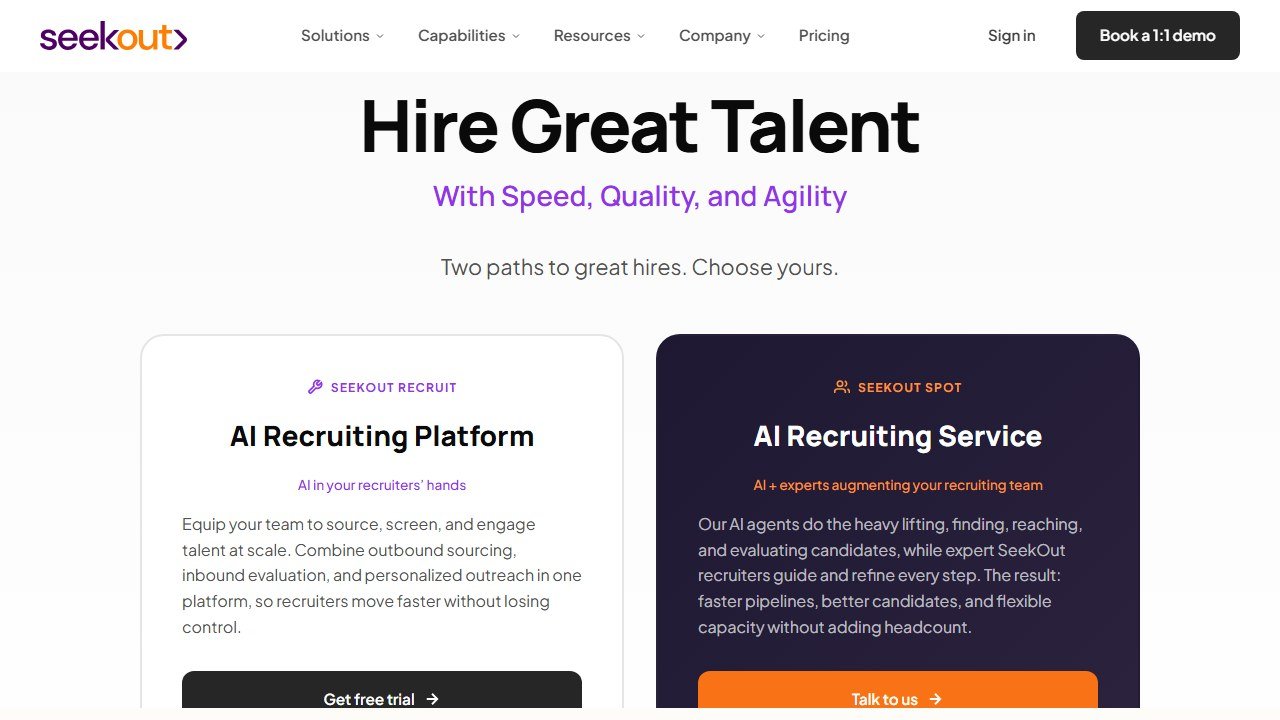
SeekOut is an AI talent search and sourcing platform that indexes more than a billion candidate profiles, drawn from the public web and, when connected, from your own ATS. Its standout specialty is technical recruiting: it surfaces signals from GitHub, Stack Overflow, patents, and publications that generic sourcing tools miss, which makes it a favorite for filling hard engineering and research roles.
The AI layer has several parts. SeekOut Assist is the GPT-powered feature we found most genuinely useful: it turns a job description or a plain-English brief into structured search criteria and drafts personalized outreach. Search itself supports both natural-language and Boolean queries. There is an agentic layer branded “Spot” and Workspaces, where the autonomy claims are vendor framing more than independently verified capability. A notable 2026 addition is the SeekOut MCP, which lets you drive SeekOut from Claude, ChatGPT, Gemini, or Copilot. And the diversity sourcing filters are among the strongest in the category.
A fair word on company context, framed as procurement due diligence rather than a knock. SeekOut was founded in 2017 in Bellevue, Washington, raised a $115 million Series C at roughly a $1.2 billion valuation in January 2022, and has not raised since. It went through layoffs of about 7 percent in October 2023 and around 30 percent in May 2024. A new CEO, Sean Thompson, was named in April 2026 and took effect May 4, 2026, with co-founder Anoop Gupta moving to Executive Chairman. The company is repositioning as an “agentic AI recruiting platform” and still serves 750-plus customers. None of this is disqualifying, but a multi-year contract deserves that context.
What SeekOut does well
The filtering is the headline. SeekOut offers 300-plus filters, and the precision is real, which is exactly what you want when you are looking for a needle, not a haystack. For niche and technical talent, nothing in the mainstream sourcing market matches its depth of signal from developer and research communities.
The diversity sourcing filters are a legitimate strength for teams with structured DEI hiring goals. SeekOut Assist saves meaningful time on the two slowest parts of sourcing, building the search and writing the first outreach, and the MCP integration is a forward-looking feature that few competitors offer. The database size means you rarely run out of candidates to evaluate.
The pricing question, honestly
SeekOut is effectively quote-only, with one exception. There is a single self-serve tier, “Recruit Lite,” estimated around $2,150 per year with a 14-day trial, which is a rare bit of transparency in this market. Everything above that is negotiated.
Third-party data (treat these as estimates, not quotes) puts the median annual contract around $20,000, with a range of roughly $5,800 to $55,000 per Vendr. Most plans carry multi-seat minimums, so the real entry cost for a team is higher than the headline self-serve figure suggests. As with every tool in this category, the opacity makes apples-to-apples comparison difficult, and you should push for a clear, all-in number before you sign.
For agency-side sourcing, see our best AI tools for staffing agencies guide.
How SeekOut compares
| Tool | Best at | AI focus | Pricing transparency |
|---|---|---|---|
| SeekOut | Technical and diversity sourcing | SeekOut Assist, MCP, 300-plus filters | One self-serve tier, rest quote-only |
| HireEZ | Outbound sourcing and engagement | AI discovery and outreach automation | Quote-only, tiered |
| Eightfold AI | Talent intelligence and matching | Deep-learning skills inference | Quote-only, enterprise |
| HireVue | Video interviewing and assessments | NLP answer scoring, assessments | Quote-only, no trial |
SeekOut and HireEZ are the closest head-to-head, and we break that down in our SeekOut vs HireEZ comparison. SeekOut edges ahead on technical and diversity depth, while HireEZ is often praised for outreach workflows. For the wider picture, see our best AI sourcing tools roundup and our best AI recruiting software guide. If budget is tight, our free AI recruiting tools list is a better starting point.
Pros and cons
Pros:
- Exceptionally precise filtering with 300-plus options
- Best-in-class for niche, technical, and engineering talent
- Strong, structured diversity sourcing filters
- Huge database spanning public web and your ATS
- SeekOut Assist and the new MCP integration are genuinely useful
Cons:
- Contact-info accuracy is inconsistent, the top user complaint
- Diversity filters can occasionally mis-categorize candidates
- Expensive and opaque pricing with multi-seat minimums
- Company in transition: layoffs, no new funding since 2022, new CEO in 2026
- “Agentic” autonomy is more vendor framing than verified capability
Who should (and should not) buy it
Buy SeekOut if you run an enterprise or mid-market in-house sourcing team, especially one hiring engineers, researchers, or other niche technical talent, or one with structured diversity hiring goals. For those use cases the precision, the depth of technical signal, and SeekOut Assist deliver real value that justifies the spend.
Do not buy SeekOut if you are a small team, hire in low volumes, or are budget-conscious. The seat minimums and median contract size make it poor value at small scale, and the inconsistent contact data means you will still spend time verifying emails and phone numbers. A leaner tool, or starting with the Recruit Lite tier or a free option, makes more sense until your volume justifies the full platform.
Our verdict
SeekOut is a genuinely strong product for the buyers it fits. The technical sourcing depth is hard to beat, the diversity filters are a real differentiator, and SeekOut Assist plus the MCP integration show a company building practical AI rather than just slapping the word on a slide. For an enterprise sourcing team chasing hard-to-find talent, it earns its place on the shortlist.
The honest reservations keep it from scoring higher. Contact-data accuracy is inconsistent, the pricing is opaque with seat minimums that push up the real cost, and the company is visibly in transition after layoffs, a long gap since its last raise, and a 2026 leadership change. Those are not reasons to rule it out, but they are reasons to negotiate hard and trial carefully. On balance it lands solidly in the upper-middle of the category.
SeekOut scores 4.1 out of 5.

Written by
FazFaz is the founder of AIToolsBakery. Some tools here are tested hands on. Others are assessed from vendor documentation and pricing verified on the live page, and every review says which one it is. Sponsors can buy a position in a guide. They cannot buy the score, the criticism, or silence about a better option.
How we test and how we make money →