Running a staffing or recruiting agency is a fundamentally different job from staffing an in-house talent team, and most “best AI recruiting tools” lists quietly ignore that. An agency recruiter is not filling one company’s open roles. They are placing candidates into other companies’ roles, juggling many clients and many reqs at once, managing both a candidate pipeline and a client relationship, and getting paid only when a placement sticks. The software that fits an internal TA team, with its single hiring brand and its structured-interview scorecards, is the wrong shape for a business where speed, redeployment, and client CRM are the whole game.
This ranking is built specifically for agency-side recruiters: contingency, retained search, high-volume staffing, RPO, and boutique firms. It is organized by the job you are trying to get done, not by brand, because no single tool wins every job. Agencies need three things that in-house teams usually do not weight the same way: an ATS that is also a client CRM, automation that can screen and engage candidates at real volume, and sourcing that finds passive talent your competitors have not called yet. Every tool below is placed where it genuinely earns its spot, with honest notes on AI substance, pricing reality, and where it falls short.
Top pick: Bullhorn is the best overall AI platform for staffing agencies in 2026, the largest agency ATS and CRM, with native AI writing, sourcing, and automation. Crelate is the best purpose-built agency system, Paradox leads high-volume conversational screening, and hireEZ is the sharpest AI sourcing tool for agency-side recruiters.
Faz says: The mistake I see agencies make is buying in-house recruiting software because it looked slick in a demo, then discovering it has no real client-side CRM. If you place candidates for other companies, your ATS has to track deals, contacts, job orders, and commissions, not just candidates. Before you look at a single AI feature, ask one question: does this thing treat my client relationships as a first-class object, or is it an in-house hiring tool wearing an agency badge? That answer eliminates half the market in about thirty seconds.
Saru says: This ranking draws on each vendor’s official product and pricing pages, published AI documentation, third-party review aggregates, and documented user reports, current to 2026. Staffing software is almost always quote-based and priced per seat, and add-ons for AI, texting, and job distribution stack up fast. Every figure here is a starting point. Get a written quote that includes implementation, data migration, per-seat escalation, and any AI or messaging add-ons before you sign.
How We Ranked These
Agency tools live or die on different criteria than in-house ATS platforms. We weighted six things:
1. Agency fit, not in-house fit. The core question is whether the tool treats clients, job orders, and placements as first-class objects. A pure in-house ATS, however good, does not belong in an agency stack. We only ranked tools that serve agency-side recruiting, either end-to-end or in a specific job.
2. The job to be done. Agencies buy for three distinct jobs: running the desk (ATS plus CRM), screening and engaging at volume, and sourcing passive talent. We grouped and judged tools by the job they are actually best at rather than pretending each is an all-rounder.
3. AI substance. Every vendor advertises AI. We separated tools where AI does real work, matching, screening conversations, outreach drafting, contact enrichment, from tools where “AI” rewrites a sentence and calls it innovation.
4. Volume and speed. Agencies compete on time-to-submit and time-to-fill. Automation that removes manual screening, scheduling, and follow-up is worth more here than in almost any other recruiting context.
5. Data and integrations. A staffing stack spans job boards, VMS, texting, email, background checks, and payroll or billing. Integration depth decides how much double entry survives.
6. Total cost of ownership. Per-seat pricing plus AI and messaging add-ons means the sticker price rarely tells the real story. We flagged where costs escalate.
The Best AI Tools for Staffing Agencies at a Glance
| Tool | Best for | Job to be done | AI depth | Starting price |
|---|---|---|---|---|
| Bullhorn | Overall agency platform | ATS plus CRM | High | Quote-based, per seat |
| Crelate | Purpose-built agency system | ATS plus CRM | Medium to high | From about $119/seat/mo |
| Recruit CRM | Small and boutique agencies | ATS plus CRM | Medium to high | From about $85/seat/mo |
| Fountain | High-volume frontline hiring | Screening and engagement | Medium to high | Quote-based |
| Paradox | Conversational screening at scale | Screening and engagement | Very high | Quote-based |
| hireEZ | AI sourcing and outbound | Sourcing | Very high | Quote-based |
| SeekOut | Deep talent search | Sourcing | High | Quote-based |
Agency ATS and CRM: Running the Desk
This is the core system of record for an agency: candidates, clients, contacts, job orders, submissions, and placements in one place. If it does not do CRM, it does not belong here.
1. Bullhorn: Best Overall Agency ATS and CRM
Bullhorn is the default operating system of the staffing industry, and after years as the market leader it is still the one to beat. It is used by thousands of agencies worldwide and was built from the ground up for the agency motion: many clients, many job orders, a live candidate pipeline, and a commercial relationship that has to be tracked alongside the recruiting one.
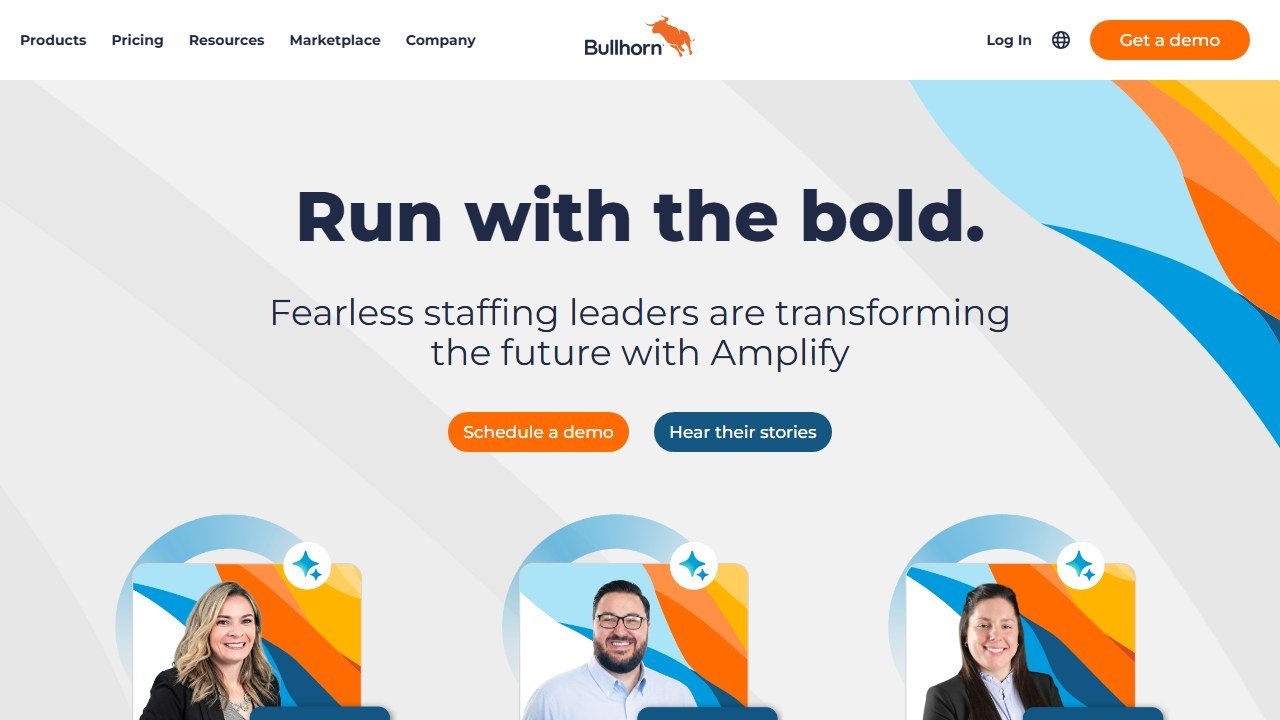
How it works. Bullhorn unifies the ATS and the CRM so a recruiter works candidates and clients in the same system. Job orders come in from clients, candidates get sourced and submitted against them, and the whole lifecycle, from first contact to placement to redeployment, lives in one record. Its automation engine and, more recently, its native AI layer sit on top of that, drafting outreach, parsing resumes, matching candidates to open reqs, and surfacing the next best action.
Standout strength. Breadth and ecosystem. Bullhorn is the most complete agency platform, with a huge marketplace of integrations spanning job boards, VMS, texting, background checks, and back-office pay and bill. Its AI writing and matching tools are built directly into the recruiter workflow rather than bolted on, so they get used inside the flow of work instead of in a separate tab.
Pricing. Quote-based and priced per seat, scaling with the number of recruiters. Expect implementation, data migration, and add-on costs for AI, texting, and analytics modules on top of the base subscription. Bullhorn is an investment, and it is priced like the category leader.
Best for. Mid-sized to large staffing and recruiting agencies that need a complete, integrated system of record and can justify the cost with placement volume.
Where it falls short. It is powerful but heavy. Small and boutique agencies often find it more platform, and more cost, than they need, and its interface shows its long history in places. Lean firms that want to be live in a week may find lighter, more modern tools a better fit.
2. Crelate: Best Purpose-Built Agency ATS and CRM
Crelate is built specifically for recruiting and staffing agencies, and it hits a sweet spot that Bullhorn overshoots for many firms: a modern, recruiter-friendly ATS and CRM with genuine AI, at a price and complexity that mid-sized and growing agencies can actually live with.
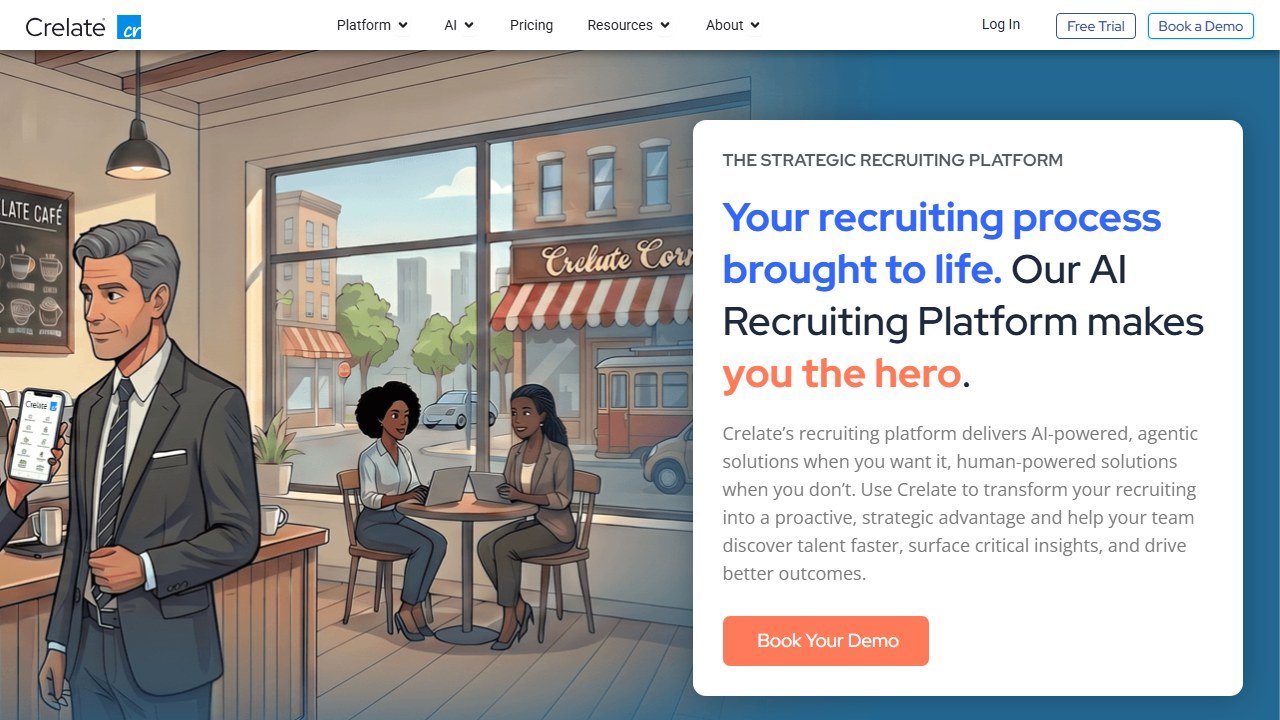
How it works. Crelate combines applicant tracking, a full client and candidate CRM, and job distribution in one visual, drag-and-drop system. Recruiters manage pipelines by role, push jobs out to boards, and track the client side of the deal in the same place. Its AI features handle candidate-to-job matching, resume parsing, and content generation to speed up the repetitive parts of the desk.
Standout strength. Purpose-built balance. Crelate is designed for the agency motion without the weight of the biggest enterprise platforms, and recruiters consistently praise its usability and visual pipeline. The built-in job distribution and AI matching mean sourcing, tracking, and posting live in one tool rather than three.
Pricing. More transparent than most of the category, with plans commonly starting around $119 per seat per month (five-seat minimum) and scaling by tier and features. That visibility is a real advantage in a market full of “contact sales.”
Best for. Small to mid-sized search and staffing firms that want a modern, purpose-built agency system with AI matching and job distribution, without enterprise pricing or implementation overhead.
Where it falls short. Its integration marketplace and back-office pay-and-bill depth are not as vast as Bullhorn’s, so very large or high-volume light-industrial agencies with complex payroll needs may outgrow it or need to pair it with specialist tools.
3. Recruit CRM: Best for Small and Boutique Agencies
Recruit CRM is the pick for small agencies, solo recruiters, and boutique search firms that want a capable ATS and CRM without the cost or complexity of the enterprise platforms. It has built a strong reputation with independent recruiters for being genuinely easy to adopt.
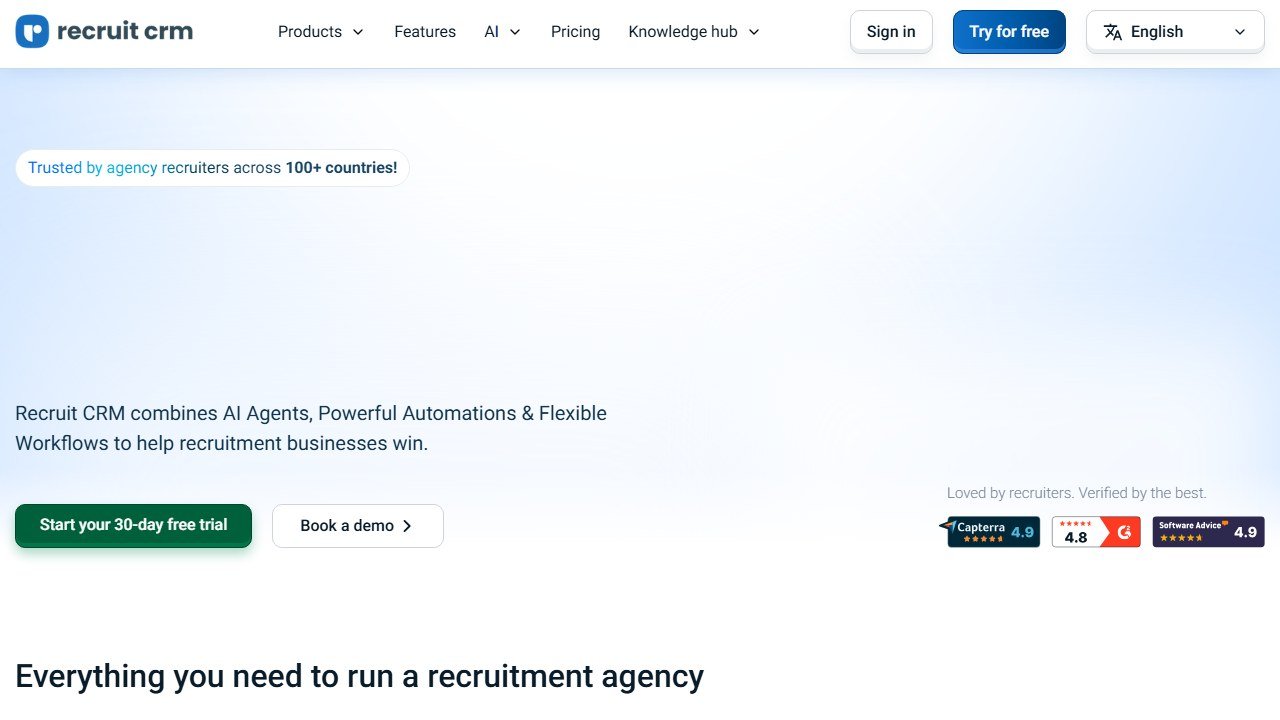
How it works. Recruit CRM runs the full boutique-agency workflow in one place: candidate and client management, a Kanban pipeline, resume parsing, email and calendar sync, and job posting. Its AI features parse resumes, match candidates to jobs, generate content like outreach and job descriptions, and increasingly automate the small repetitive steps that eat a solo recruiter’s day.
Standout strength. Flexibility and value. Recruit CRM gives a small team most of what a big platform does at a fraction of the cost and setup burden, with flexible workflows that a boutique firm can shape to its own process. Its AI writing and matching are practical rather than flashy, aimed at saving time on the tasks small agencies do most.
Pricing. Transparent and per seat, commonly starting around $85 per seat per month, which is accessible for small teams and solo recruiters compared with the quote-based enterprise tools.
Best for. Boutique search firms, small staffing agencies, and independent recruiters who want a full-featured ATS and CRM that is affordable, flexible, and fast to set up.
Where it falls short. It is built for smaller operations, so agencies scaling into high-volume staffing, complex VMS relationships, or heavy back-office pay and bill will eventually need a deeper platform like Bullhorn.
High-Volume Screening and Engagement
When you place hundreds or thousands of hourly, shift, or frontline workers, the bottleneck is not sourcing, it is throughput: screening, scheduling, and following up faster than candidates go cold. These tools automate that.
4. Fountain: Best for High-Volume Frontline and Hourly Placement
Fountain is purpose-built for high-volume hiring, the world of hourly, shift, gig, and frontline placement where an agency may need to move thousands of candidates from apply to start in a matter of days. This is a different discipline from professional search, and Fountain owns it.
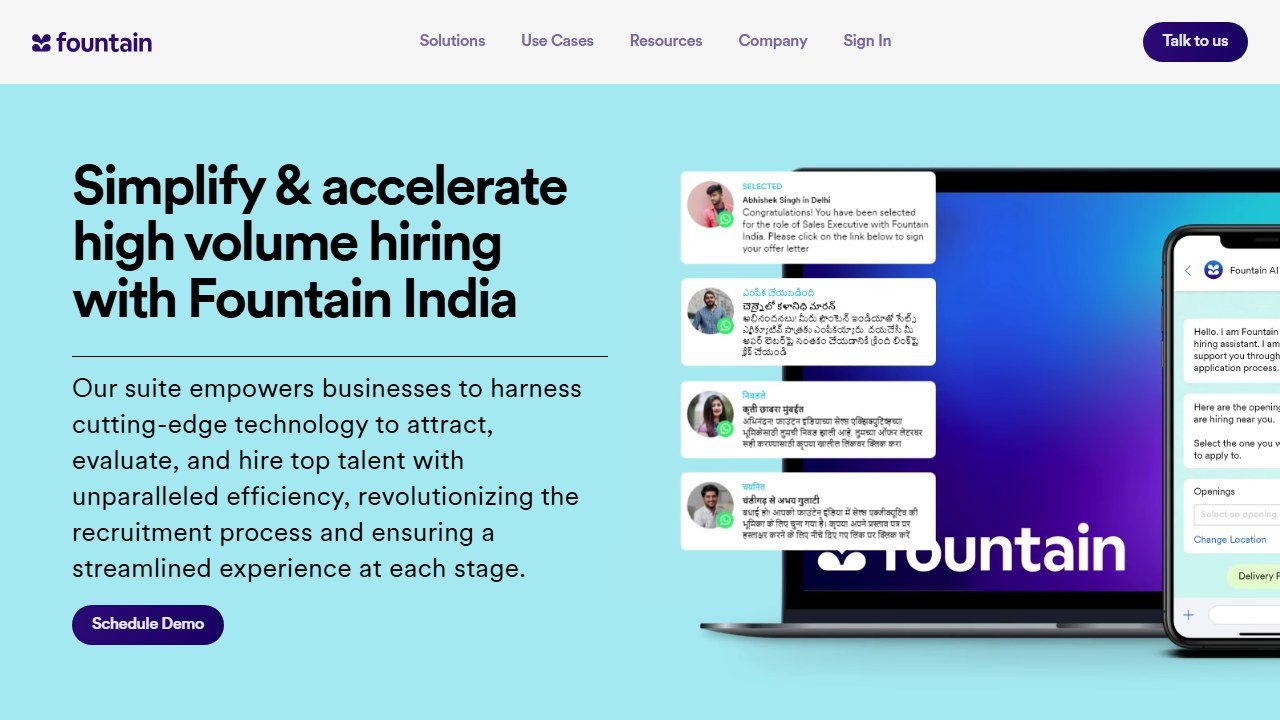
How it works. Fountain automates the apply-to-hire funnel for high-volume roles. Candidates apply on mobile, get screened by automated knockout questions and workflows, schedule themselves into interviews or orientations, and move through the steps with automated reminders that cut drop-off. AI and automation handle the repetitive screening and communication that would otherwise swamp a recruiting team at this scale.
Standout strength. Throughput and mobile-first experience. Fountain is engineered for volume, with automation that keeps thousands of candidates moving and a mobile experience built for frontline workers who apply from a phone. For staffing firms placing hourly and shift workers, that funnel automation is the whole value.
Pricing. Quote-based and scaled to volume and modules. It is priced as an enterprise high-volume platform, so it fits agencies with the placement volume to justify it.
Best for. Staffing agencies and RPOs focused on high-volume hourly, gig, frontline, and light-industrial placement that need to automate screening and scheduling at scale.
Where it falls short. It is specialized. For professional, technical, or executive search, where the job is relationship and evaluation rather than volume throughput, Fountain is the wrong tool. It is not a general agency ATS and CRM.
5. Paradox / Olivia: Best Conversational AI for High-Volume Screening
Paradox, through its assistant Olivia, is the leading conversational AI for recruiting, and it shines exactly where high-volume agencies feel the most pain: the screening, scheduling, and follow-up conversations that consume recruiter hours. Instead of a candidate filling out a form, they text with Olivia.
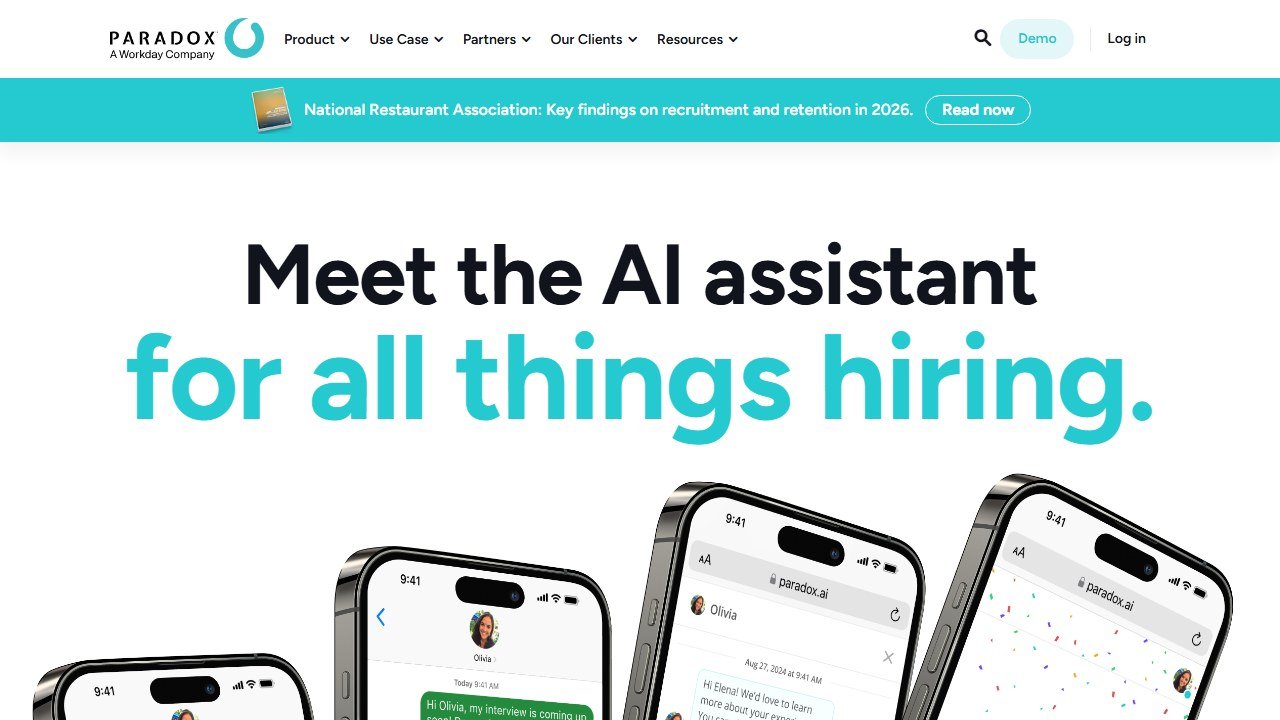
How it works. Olivia engages candidates over chat and text, asks screening questions, answers common candidate questions instantly, schedules interviews directly against recruiter calendars, and keeps candidates warm with automated follow-up. It works around the clock, so candidates get an immediate response instead of waiting on a recruiter who is buried in reqs. For high-volume desks, that automation removes a huge amount of manual coordination.
Standout strength. Conversational automation that actually converts. Paradox’s screening and scheduling automation is the most polished in the category, and because it meets candidates over text, response and completion rates are high. It layers onto your existing ATS rather than replacing it, so an agency can add it to Bullhorn or another system of record. We go deeper in our Paradox AI review.
Pricing. Quote-based, positioned as an enterprise automation layer and typically scaled to volume. It is an add-on to your core system rather than a standalone desk tool.
Best for. High-volume staffing agencies that want to automate candidate screening, scheduling, and engagement on top of an existing ATS, and to give candidates instant responses.
Where it falls short. It is an engagement and automation layer, not an ATS or CRM, so you still need a system of record underneath it. For low-volume, high-touch executive search, the conversational-automation value is much smaller.
AI Sourcing: Finding Passive Talent First
For professional, technical, and hard-to-fill roles, the win comes from reaching passive candidates your competitors have not called. These sourcing tools search vast profile datasets, enrich contact data, and run outreach at scale.
6. hireEZ: Best AI Sourcing and Outbound
hireEZ is the sharpest AI sourcing tool for agency-side recruiters who compete on reaching passive talent first. Where an ATS manages the candidates you already have, hireEZ goes and finds the ones you do not, across the open web and hundreds of millions of profiles.
How it works. hireEZ uses AI to search a massive aggregated dataset of candidate profiles, surface contact information, and then run personalized, multi-step outreach sequences. Recruiters describe the role, hireEZ finds and ranks matching passive candidates, enriches their contact data, and automates the email and follow-up cadence that turns a name into a conversation. It plugs into your ATS so sourced candidates flow into your pipeline.
Standout strength. Sourcing plus outbound in one engine. hireEZ does not just find candidates, it gets you their contact details and runs the outreach, closing the gap between “found a great candidate” and “started a conversation.” For agencies whose edge is speed to passive talent, that combination is the value. See our hireEZ review for a full breakdown.
Pricing. Quote-based and typically per seat, scaled by usage and modules. It is a sourcing investment on top of your ATS, not a replacement for it.
Best for. Agencies filling professional, technical, and hard-to-fill roles who compete on proactive outbound sourcing and want AI to find and engage passive candidates at scale.
Where it falls short. It is a sourcing and outreach tool, not a system of record, so it complements rather than replaces an agency ATS and CRM. Contact data accuracy, as with any sourcing tool, is strong but never perfect, so verification still matters.
7. SeekOut: Best for Deep Talent Search
SeekOut is the specialist for deep, precise talent search, the tool you reach for when a role is genuinely hard to fill and you need to slice an enormous candidate dataset by criteria that ordinary sourcing tools cannot see. It is especially strong for technical, niche, and diversity-focused searches.
How it works. SeekOut aggregates hundreds of millions of candidate profiles and lets recruiters search and filter them with unusual depth, by skills, experience, certifications, and diversity attributes, then surfaces contact data and supports outreach. Its AI helps translate a role into a search and rank the results, so a recruiter can find the small set of people who actually fit a demanding spec.
Standout strength. Search depth and filtering. SeekOut’s ability to find niche and hard-to-reach talent, and its strength in diversity sourcing, is its calling card. For a search firm working a specialized technical or executive mandate, that depth is worth more than raw volume. We compare the two leading sourcing tools head-to-head in our SeekOut vs hireEZ breakdown, and cover it solo in our SeekOut review.
Pricing. Quote-based and per seat, positioned as a premium sourcing platform for teams that fill specialized roles.
Best for. Search firms and agencies working technical, executive, niche, or diversity-focused mandates that reward deep, precise talent search over high-volume outreach.
Where it falls short. Like hireEZ, it is a sourcing tool, not an ATS or CRM, so it sits alongside your system of record. Its depth is overkill for high-volume hourly staffing, where throughput tools like Fountain or Paradox deliver more value.
How to Choose the Right Tools for Your Agency
Ignore the feature checklists for a minute and answer three questions. They will narrow seven options to the two or three you actually need.
What kind of placements do you make? High-volume hourly, shift, and frontline work rewards throughput automation: Fountain for the funnel, Paradox for conversational screening. Professional, technical, and executive search rewards sourcing depth: hireEZ for outbound at scale, SeekOut for precise, niche search. Most agencies pair a system of record with one tool from the job that is their real bottleneck.
What is your system of record? Every agency needs an ATS that is also a client CRM. Mid-sized to large firms with placement volume and back-office needs: Bullhorn. Growing firms that want a modern, purpose-built system without the weight: Crelate. Boutique firms, solo recruiters, and small teams: Recruit CRM. Buy this first, then layer screening or sourcing on top.
Where does AI save you the most time today? If recruiters drown in screening and scheduling, add conversational automation (Paradox) or high-volume funnel automation (Fountain). If the bottleneck is finding passive candidates, add sourcing (hireEZ or SeekOut). If it is drafting outreach and matching candidates to reqs, your ATS’s native AI, especially Bullhorn’s or Crelate’s, may already cover it.
One more thing that applies to every option: staffing software is quote-based and per seat far more often than not, and AI, texting, and job-distribution add-ons stack up quickly. Get a written quote that includes implementation, data migration, per-seat escalation, and every add-on before you commit. In this category the base subscription routinely understates real total cost of ownership.
Responsible note on the numbers: industry surveys such as Bullhorn’s annual GRID report have suggested that top-performing staffing firms tend to be more likely to use AI and automation than their peers. Treat that as a directional signal about where the market is heading, not a precise guarantee of returns for your firm, and pilot any tool against your own placement metrics before you scale it.
Verdict
The best AI tools for staffing agencies in 2026 are the ones that match your placement type and fix your actual bottleneck, and for most agencies that means one system of record plus one specialist tool. Bullhorn remains the overall standard, the most complete agency ATS and CRM with native AI, and the default for mid-sized to large firms. Crelate is the sharpest purpose-built choice for growing agencies, and Recruit CRM is the value pick for boutique and solo recruiters.
On top of that core, add for your bottleneck: Fountain and Paradox for high-volume screening and engagement, and hireEZ and SeekOut for AI sourcing of passive talent. Name your placement type, pick your system of record, then layer on the one tool that removes your biggest constraint. For the wider picture, see our best AI sourcing tools guide, our best AI recruiting software roundup, and our best AI tools for HR pillar. If you want the deeper read on our top pick, start with the Bullhorn review.

Written by
FazFaz is the founder of AIToolsBakery. Some tools here are tested hands on. Others are assessed from vendor documentation and pricing verified on the live page, and every review says which one it is. Sponsors can buy a position in a guide. They cannot buy the score, the criticism, or silence about a better option.
How we test and how we make money →