Structurely quietly rebuilt its pricing in 2026, and almost nobody has noticed. The per-lead tiers you will find on every third-party comparison page ($179, $299, $499 and up) are gone. In their place: a flat platform fee plus an action-credit meter that charges you per SMS reply, per 10 seconds of AI call time, and per pair of emails. Entry price roughly doubled in the process, and onboarding jumped to $2,000 or more.
we have reviewed Structurely’s AI inside sales agent hands-on, and our full feature verdict lives in our Structurely review. This page does one job: the fee math. If you are budgeting before a sales call, here is what the credit model actually costs, what the contract terms hide, and how the pricing got here.
Structurely pricing at a glance
| Line item | Team | Company | Official or reported? |
|---|---|---|---|
| Platform fee | $499/mo | $999/mo | Official (structurely.com/pricing, July 16, 2026) |
| Action credits | $0.08 per credit | $0.06 per credit | Official (July 2026) |
| One credit equals | 1 SMS response, 10 sec of call time, or 2 emails | Official (July 2026) | |
| One-time onboarding | $2,000 | $2,500 | Official (July 2026) |
| Contract | Annual at listed price; month-to-month at a 20% premium; pilot period included | Official (July 2026) | |
| Enterprise / White Label | Custom pricing, sales conversation required | Official (July 2026) | |
| Telecom pass-through fees | Roughly 15 to 18% extra on usage, per unconfirmed third-party reports; not listed on the official pricing page | Reported, unverified (2026) | |
There is no per-seat pricing anywhere in the model. Team covers 2 to 10 person teams and Company covers organizations with 10 or more producers, but you are paying for the platform and the AI’s activity, not for logins.
The current model: platform fee plus action credits
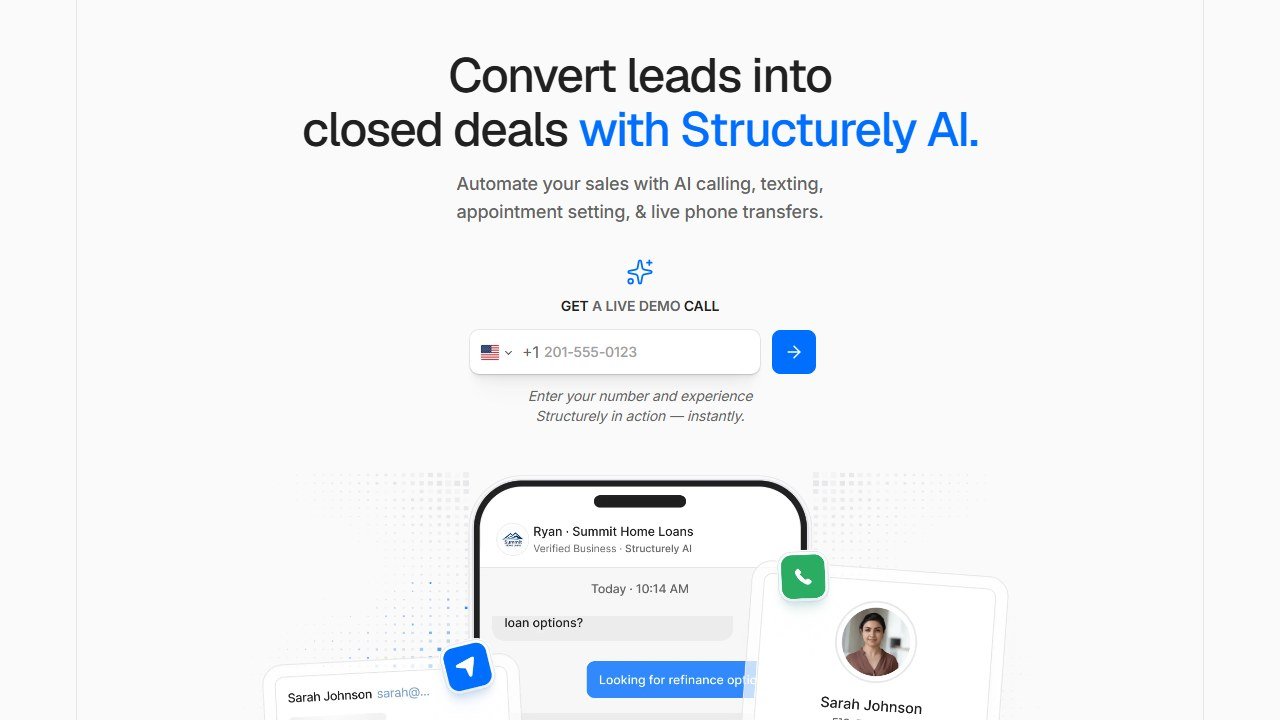
Structurely sells an AI assistant that texts, calls, and emails your leads until they are qualified or dead. Under the 2026 model, every one of those actions burns credits:
- 1 credit = 1 SMS response, sent or received. A back-and-forth text conversation consumes credits on both sides of the exchange.
- 1 credit = 10 seconds of AI talk time, billed in 10 second increments. A 3 minute qualification call is 18 credits.
- 1 credit = 2 emails, whether personalized, templated, or part of a nurture drip.
Team plans pay $0.08 per credit and Company plans pay $0.06. All of that is official, pulled from structurely.com/pricing on July 16, 2026.
Two things stand out about this design. First, there is no separate AI-texting plan versus AI-calling plan. Both channels drain the same credit pool, so you budget around total AI activity, not around which channel you bought. Second, you pay for engagement, not lead volume. Under the old lead-tier model, 500 uploaded leads cost the same whether 400 of them replied or 4 did. Under credits, a dead list is cheap and a hot list is expensive.
That cuts both ways. If your leads barely respond, credits protect you. If Structurely works exactly as advertised and holds long conversations with half your pipeline, your bill grows with your success. Plan for the second scenario.
Worked credit math: what your leads will actually cost
Structurely publishes the credit rates but no example bills, so here is our math. The assumptions are ours and labeled as such; only the rates are official.
Example 1: solo team, 100 leads a month (Team plan)
Assume 100 new leads enter Structurely each month. Based on typical lead-response patterns we see across AI ISA tools, figure roughly 45 of them engage in a real SMS conversation, and the AI attempts voice calls on about 60.
- SMS: 45 engaged conversations averaging 20 total messages each (AI sends and lead replies both count) = 900 credits
- Voice: 60 call attempts averaging 2 minutes of connected talk time each = 12 credits per call = 720 credits
- Email drips: 100 leads receiving 6 nurture emails each = 600 emails = 300 credits
Total: about 1,920 credits. At $0.08, that is $153.60 in usage on top of the $499 platform fee, so roughly $653 per month, or about $6.50 per lead. Amortize the $2,000 onboarding over year one and your effective first-year cost is closer to $820 per month.
Example 2: brokerage team, 500 leads a month (Company plan)
Scale the same engagement mix to 500 leads: roughly 9,600 credits. At the Company rate of $0.06 that is $576 in usage plus the $999 platform fee, so about $1,575 per month, or $3.15 per lead, with $2,500 onboarding on top in month one.
Notice the shape of the curve: the flat fee dominates at low volume and the per-lead cost falls fast as volume rises. Structurely’s new pricing quietly favors bigger teams, which tracks with where the product is aimed.
Onboarding, contracts, and the fees to ask about
Onboarding is $2,000 on Team and $2,500 on Company, one-time, official. That is a real jump from the $1,500 setup fee attached to the older plans, and it makes Structurely a poor fit for a one-month experiment. Between onboarding and the platform fee, month one on Team runs about $2,650 before a single credit burns.
Contracts are annual at the listed price. Month-to-month exists but costs a 20% premium, which puts Team at roughly $599 per month. The official page also promises a pilot period so you can validate performance on your own leads before the long-term commitment. If you take nothing else from this page: negotiate the pilot terms in writing, including what happens to onboarding fees if you walk.
Pass-through telecom fees are the gray zone. Third-party discussion of AI texting and calling platforms suggests carrier, compliance, and telephony pass-through charges (the Twilio-style fees underneath any SMS product) can add roughly 15 to 18% to usage costs. We could not confirm that figure for Structurely specifically, and the official pricing page lists no pass-through line items at all. Treat it as an unverified reported estimate and ask sales directly: are carrier fees, A2P 10DLC registration, and compliance costs included in the credit price or billed separately?
One more way to buy Structurely without a Structurely contract: CINC AI, the texting add-on on CINC’s platform, is built in partnership with Structurely and officially starts at $200 a month. Our CINC pricing breakdown covers what that bundle costs all-in.
The pricing history: lead tiers, conversations, credits
This is the section no other page has, because most of the internet still displays Structurely’s retired prices. Here is the changelog as best we can reconstruct it from reported sources. Exact transition dates were never announced, so treat the ordering as reported rather than official.
| Generation | Model | Reported prices | Status |
|---|---|---|---|
| Early lead tiers | Monthly fee by lead volume | $179 / $299 / $499 per month plus $1,500 setup (reported, undated; these are the figures our own earlier review carried) | Retired |
| Conversation-based | Fee per conversation volume | $499/mo per 1,000 conversations (reported via hooquest, stale) | Retired |
| Later lead tiers | Monthly fee by lead volume | $299/mo for 100 leads, $499 for 200, $949 for 500, $1,799 for 1,000 (reported, pre-2026) | Retired |
| Action credits (current) | Platform fee plus per-action metering | $499 or $999/mo plus $0.08 or $0.06 per credit (official, July 2026) | Current |
Three practical takeaways from the changelog:
- Entry price roughly doubled. The cheapest way into Structurely used to be a reported $179 to $299 per month. Today it is $499 plus usage plus $2,000 onboarding. If you saw Structurely quoted as a budget option, that information is at least one pricing generation old.
- Every third-party page we checked is stale. Aggregators, competitor comparison pages, and older reviews all still show lead-tier numbers. If a page quotes Structurely below $499 per month in 2026, it has not caught up. (Our own review carried the oldest generation of figures until this update cycle, which is exactly why we date every number on this page.)
- The repricing landed in the acquisition window. CapStone Holdings Inc announced its acquisition of Structurely on January 6, 2026, per the acquisition press coverage on Yahoo Finance and martech outlets. The credit model appeared on the official pricing page in the months that followed. The same PR cites 13M+ AI conversations and 75M+ messages across nine years; those are vendor-claimed figures, but they signal a product being repositioned upmarket, not wound down.
Is Structurely worth it at the new price?
That is a features question, and the feature verdict belongs to our Structurely review. But the budget math frames it like this:
- Under roughly 100 leads a month, the flat $499 fee makes each lead expensive ($6 to $8 all-in by our example math), and the $2,000 onboarding stings. Solo agents and small teams should compare against lighter options first; our best AI ISA tools for real estate roundup covers the category, and our Structurely alternatives guide maps the post-repricing switch scenarios specifically.
- At 300 to 500+ leads a month, per-lead cost drops toward $3 and Structurely starts competing well against hiring a human ISA, who would cost several times more before payroll taxes.
- If you are weighing Structurely against a full lead-gen platform rather than a nurture layer, that is a different decision entirely; see our Structurely vs Ylopo breakdown. And whatever you pick still needs a CRM to live in; our guide to using AI for real estate lead follow-up covers how these pieces fit together.
What agent CRMs and lead platforms actually charge
This half of the market divides into CRMs you fill with your own leads and platforms that sell you the leads as well, and the second is several times the price of the first. Here is each alternative to structurely pricing, read on 4 September 2026.
Follow Up Boss, $69 per user per month, published plainly
Follow Up Boss publishes $69 per user per month plus tax, with a yearly option giving two months free and calling as a $39 per user add-on. It is a CRM rather than a lead source, which is the important distinction: you are buying the system that works leads you already have. At five agents that is $4,140 a year before the calling add-on, so price it at your real headcount rather than at one seat.
Wise Agent, $49 a month, and the cheapest published option here
Wise Agent publishes $49 a month, falling to $42 billed annually at $499 a year, with a higher tier at $69 and $59. Its annual toggle is marked as saving 15% and the saving holds. For a solo agent or a small team this is the published floor of the category, and the gap to a lead platform is an order of magnitude rather than a percentage.
Placester, from $59 a month, sold around the website
Placester publishes $59, $79 and $129 a month with a 20% annual discount, positioned around IDX websites and marketing rather than lead generation. If your gap is presence rather than pipeline, that is a materially cheaper problem to solve than buying leads, and it is worth being honest with yourself about which one you actually have.
The lead platforms, where almost nobody publishes
The platforms that sell leads alongside software, Lofty, CINC, Ylopo, Zurple, Sierra Interactive, Real Geeks, Market Leader and BoldTrail among them, largely quote rather than publish. We could not read a plan figure from Lofty’s own pricing page on 4 September 2026. That is normal in this corner of the market and it means your only real leverage is a published CRM priced at your team size, plus a clear view of what you currently pay per closed transaction.
Work out your cost per closing before any demo
Take last year: total spend on leads and CRM, divided by transactions closed from those leads. That single number is the benchmark every quote has to beat, and most agents have never calculated it. Without it you are comparing monthly figures against each other rather than against the thing that pays for them, which is how a $2,000 a month platform gets renewed for three years on the strength of a feeling.
Buying leads honestly: what the conversion numbers actually mean
Every platform in this category quotes conversion figures. Almost none of them mean what a reader assumes, and the differences are large enough to reverse a purchase decision.
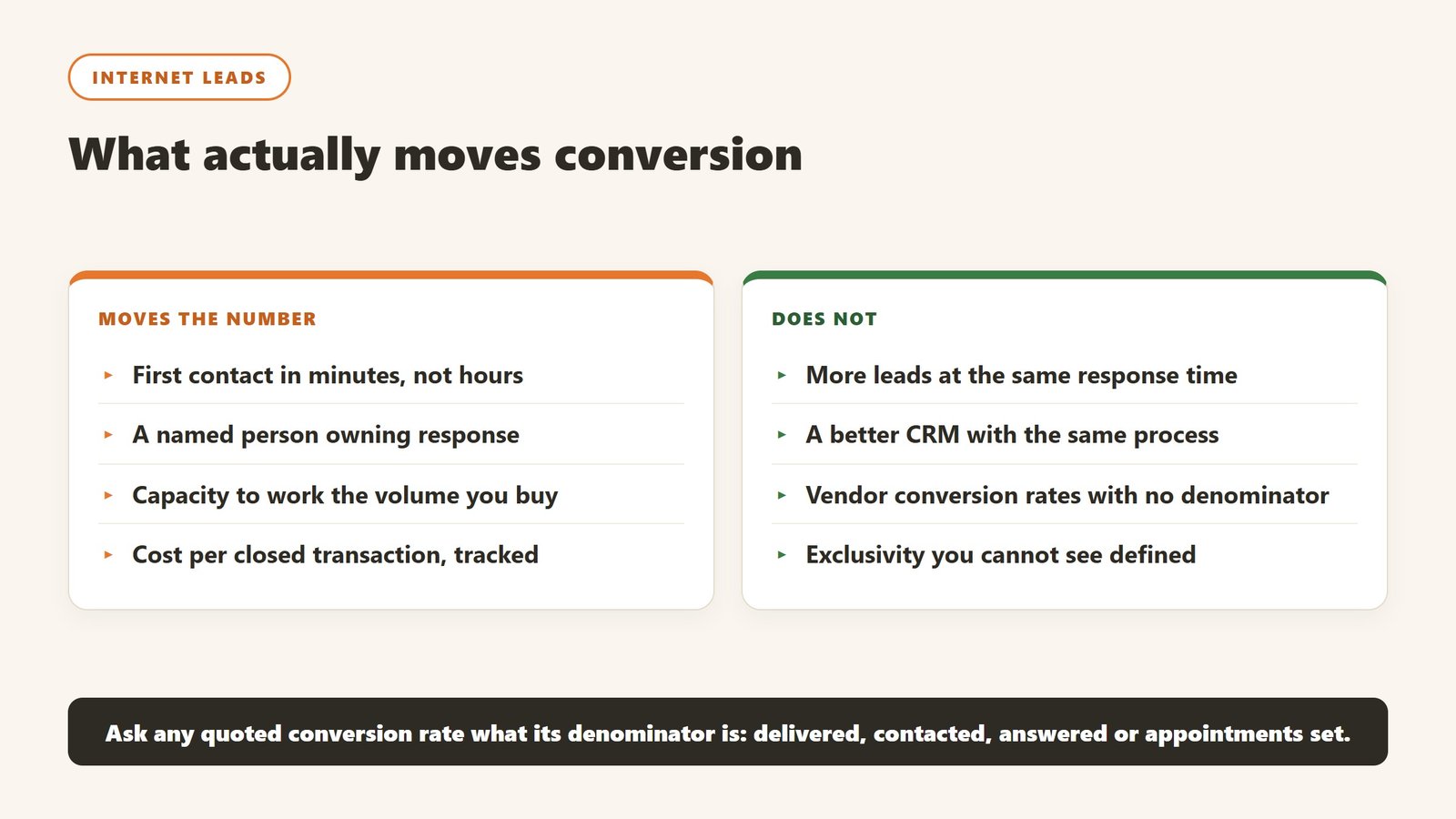
Ask what the denominator is
A conversion rate can be measured against leads delivered, leads contacted, leads that answered, or appointments set. Those four produce wildly different percentages from the same underlying performance. When a vendor quotes a rate, ask which one it is, and ask for the number of days over which it was measured. A rate with no denominator and no window is a marketing figure rather than a metric.
Speed to lead is the variable that actually moves conversion
The single largest controllable factor in internet lead conversion is how fast the first contact happens, and it is measured in minutes rather than hours. That is a staffing and process question, not a software one. A platform that routes leads instantly to an agent who checks their phone twice a day will underperform a spreadsheet worked by someone answering in five minutes. Fix the response process before buying anything that increases lead volume.
More leads at the same conversion is not obviously good
Doubling lead volume doubles the work and, unless response times hold, usually reduces conversion. Teams that buy volume without adding capacity get a lower conversion rate on a bigger number and conclude the leads were bad. Before increasing volume, work out how many new leads your current team can genuinely contact within the window that matters.
The contract term is where the risk sits
Lead platforms frequently ask for six or twelve month commitments, sometimes with a territory or exclusivity element. That is defensible, because a pipeline takes time to season. It is also a lock-in on performance you have not seen. Ask for a defined review point in writing, agree in advance what result would end the arrangement, and be sceptical of any exclusivity you are paying a premium for without a written definition of the area it covers.
Verdict: budget $650 to $850 a month, not $499
The advertised $499 per month is the floor, not the bill. Add realistic credit usage and amortized onboarding and a typical 100-lead team should budget $650 to $850 per month in year one, on an annual contract. Larger teams get meaningfully better unit economics at $0.06 credits and the same math.
Go in with three numbers from this page: the official rates ($499 or $999 plus $0.08 or $0.06 per credit, $2,000 to $2,500 onboarding), your own engagement-based credit estimate, and the month-to-month premium (20%) as your fallback if you will not commit annually. Then make sales confirm the pass-through fee question in writing, because the official pricing page is silent on it. Everything labeled official here was verified on structurely.com on July 16, 2026; everything labeled reported is exactly that, and in Structurely’s case the reported numbers have a short shelf life.

Written by
FazFaz is the founder of AIToolsBakery. Some tools here are tested hands on. Others are assessed from vendor documentation and pricing verified on the live page, and every review says which one it is. Sponsors can buy a position in a guide. They cannot buy the score, the criticism, or silence about a better option.
How we test and how we make money →