You have a yard you do not love, a Pinterest board you do, and no idea how to bridge the two without a $3,000 in-person consult. Online landscape design promises exactly that bridge: upload photos of your property, answer some questions, and a designer sends back a plan you can actually build from. Three names dominate the search for this: Yardzen, Tilly, and ShrubHub. The trouble is that almost every “comparison” you find is either run by one of these companies or stuffed with affiliate links pointing at whichever one pays best.
We are AIToolsBakery, and we sell none of these services. We make no commission on Yardzen, Tilly, or ShrubHub, and we are not a referral partner for any of them. That matters here, because the SERP for this exact question is dominated by the vendors’ own pages and by lead-gen sites whose ranking depends on you clicking through and buying. We have no horse in that race. What follows is a plain reading of how the three actually differ on the things that decide whether you get a usable plan or a pretty picture you cannot build.
All three work the same way at a high level. You share photos and measurements of your space, fill out a style questionnaire, get matched with a designer, and receive a design package back. Where they split apart is price, design depth, plant accuracy, and what happens after you get the file. Those gaps are wide enough that picking wrong wastes real money.
The 30-second answer: Pick Yardzen if you want premium 3D renders and a polished build-ready package and you can absorb the higher price. Pick Tilly for the best balance of real design expertise and mid-range cost, especially if a designer’s plant and layout judgment matters to you. Pick ShrubHub only if lowest upfront price is the deciding factor.
Quick answer: Yardzen is the premium online landscape design service for polished, photorealistic plans, Tilly is best for collaborative designer access, and ShrubHub for budget-friendly fast turnaround. If you only want to test layouts yourself, DIY AI landscape tools may beat paying for a designer.
Design quality and what you actually receive
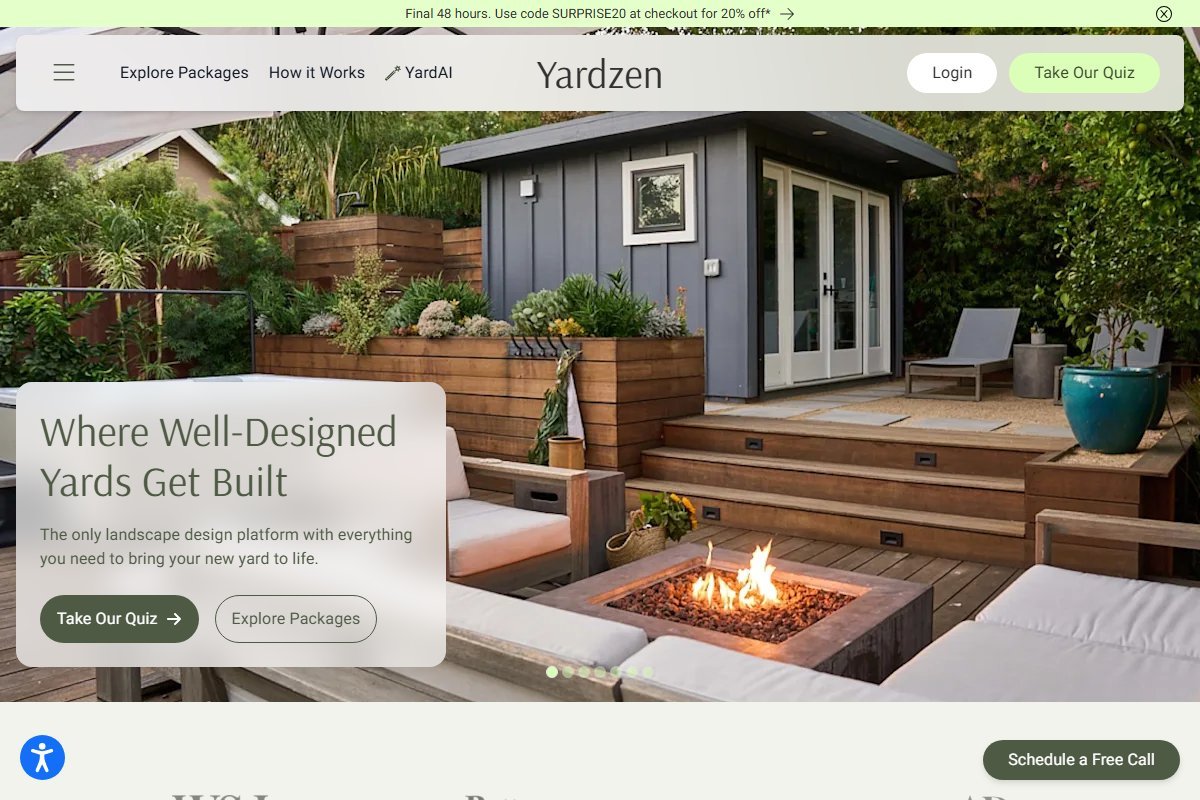
Yardzen sits at the premium end. Its standout is photorealistic 3D rendering: you see your yard rebuilt in a polished visual that helps you and any contractor picture the finished result before a shovel hits dirt. The package typically includes that 3D render, a planting plan, a materials list, and a referral into Yardzen’s contractor network. The visuals are the most marketing-ready of the three, which is why Yardzen shows up in places like The New York Times and Forbes.
Tilly leans on design judgment over render polish. It matches you with a designer who works through your vision and property details and returns a plan with strong layout logic and plant choices. Reviewers consistently rate Tilly’s output as higher quality and more buildable than ShrubHub’s, with 3D renders, lighting plans, and irrigation plans available as add-ons rather than baked in. The base deliverable is a 2D plan with real horticultural thinking behind it.
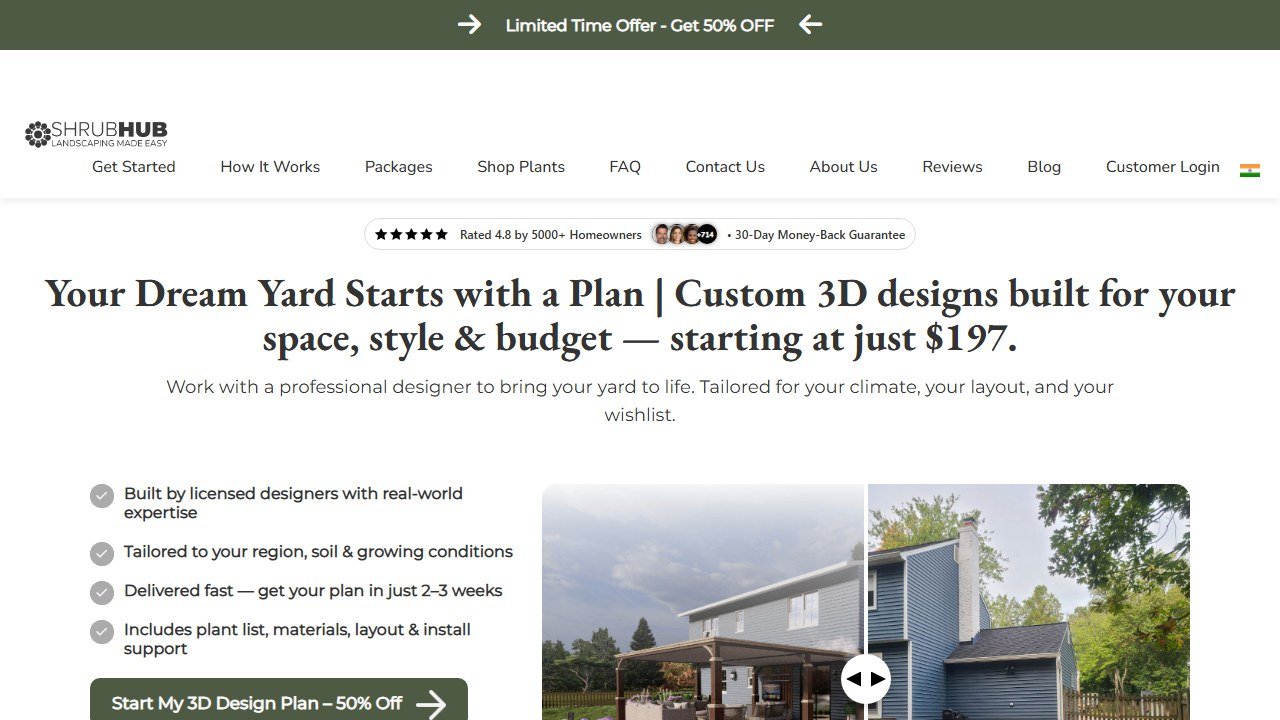
ShrubHub competes on price and speed, and the design depth reflects that. You get 2D and 3D renderings plus a plant selection and a shopping list, often delivered fast. Independent designers reviewing ShrubHub’s output have flagged a recurring problem: designs that look attractive in a thumbnail but lack attention to scale, site constraints, and basic contracting practicality. You may get a picture you like and then struggle to hand it to a builder.
The practical test is what happens when you take the file to a contractor. A buildable plan answers a builder’s questions before they ask: where the hardscape edges fall, what the dimensions are, how drainage and grade are handled, which materials go where. Yardzen’s package is built to survive that handoff, which is part of what the premium buys. Tilly’s designer-led plans tend to hold up well too, because the layout logic was thought through by a person who understands construction reality. The risk with the lowest-cost option is that the contractor hands the file back with a list of unanswered questions, and you are now paying by the hour to redo the thinking the design should have included.
Plant lists and regional fit
This is where online design earns or loses its keep. A plant list that ignores your climate, soil, and sun exposure is a shopping list for dead plants.
Yardzen builds plant lists tied to your region and leans into a sustainability and climate-appropriate framing, which is one of its stronger selling points. Tilly’s designers select plants as part of the design conversation and tend to treat regional fit as a design decision rather than a database lookup, which shows up in the higher review scores for usability. ShrubHub does offer climate-relevant plant selection, but because the process is lighter-touch and faster, the regional nuance is shallower. For a simple front-yard refresh that may be fine. For a complex lot with shade, slope, or drainage issues, the difference between a designer thinking it through and an automated match can cost you a season of replanting.
If your priority is getting the planting right above all else, Tilly and Yardzen both give you more designer attention on that specific question than ShrubHub does at its entry price.
One thing all three share: none of them visits your property. Every plant decision is made from the photos and notes you provide, so the quality of your inputs matters as much as the service tier. Sun mapping, existing trees, soil type, and how water moves across the lot are things a remote designer can only act on if you tell them. The more your space deviates from a flat, sunny rectangle, the more you benefit from the designer-led process at Tilly or Yardzen, and the more a fast automated match can let you down.
Revisions and post-design support
Revisions are where the cheap option often stops being cheap. Yardzen and Tilly both build a revision cycle into the core service so you can refine the plan with your designer. Tilly is noted for complimentary post-design support, which matters when you are partway into a build and have a question. ShrubHub grants more limited revisions at the base price, and additional revisions can cost extra, so the low headline price can climb once you start iterating. Always read what counts as an included revision before you pay, because “one round” and “until you are happy” are very different deals.
This matters more than it sounds, because a first-pass landscape design is almost never the final one. You will see the render and realize the patio is too small, the tree blocks a window, or you would rather spend the planting budget somewhere else. Services that include generous revisions absorb that reality into the price you already paid. Services that meter revisions turn each second thought into a new charge, which is how a deal that looked the cheapest can quietly become mid-priced by the time you are happy. Ask each vendor, in writing, how many revision rounds the base package includes and what a further round costs.
Turnaround time
All three are measured in weeks, not days. Yardzen tends to run longer, commonly in the two-to-four-week range, partly because of the rendering work and designer back-and-forth. ShrubHub markets the fastest turnaround, often two to three weeks, which fits its lighter process. Tilly sits in between and varies with project size and the add-ons you choose. If you are racing a planting season or a contractor’s calendar, confirm the current timeline directly with the vendor, because these change with demand.
Pricing and value
We are not going to quote exact prices as gospel, because all three change pricing often and ShrubHub in particular leans on rotating “percent off” promotions. Confirm current numbers on each vendor’s own page before you buy. Directionally, though, the three occupy clearly different tiers.
Yardzen is the premium tier. Its full-service packages have historically run well into four figures for a complete yard, reflecting the 3D rendering, designer time, and contractor referral. You pay for polish and a more established service format.
Tilly is the mid tier and arguably the value sweet spot. Its packages have been structured around front yard, backyard, and full yard tiers in the few-hundred-dollar range, scaling with property size, with renders and lighting or irrigation plans as paid add-ons. You buy real design expertise without the premium-render markup.
ShrubHub is the discount-anchored tier. Its prices are advertised at low entry points, frequently shown as steep “50 percent off” deals, with a premium package well above the base tiers. The headline is the cheapest of the three by a wide margin, but factor in paid extra revisions and the shallower design depth when you judge true value.
The honest way to read this: ShrubHub wins on lowest sticker price, Yardzen wins on polish, and Tilly tends to win on dollars-per-buildable-design. Cheapest upfront and best value are not the same thing.
Data privacy: you are uploading photos of your home
All three services require photos of your property, and often your address and measurements, to do their work. That is unavoidable for the service to function, but it is worth a clear-eyed note. You are handing a private company images of the outside of your home, your lot layout, and sometimes enough to identify your address. Before you upload, read each vendor’s privacy policy for how they store those photos, whether they reuse your renders or images in their own marketing, and how to request deletion after the project. This is a standard part of any photo-based home service, but it is your data and your home, so treat the policy as part of the purchase decision, not fine print.
Who each one is for
Yardzen is for the homeowner doing a significant, design-forward project who wants a premium, render-heavy package and is comfortable paying for it, and who values the contractor-referral network and the polish that helps sell the vision to a partner or a builder.
Tilly is for the homeowner who wants genuine design expertise and good plant and layout judgment at a sane price, and who does not need the most cinematic 3D render baked in. It is also friendlier to the trade: contractors can commission Tilly designs on a client’s behalf through its pro-facing program, which is a real differentiator.
ShrubHub is for the budget-driven homeowner with a relatively simple space who wants an attractive starting concept and a shopping list at the lowest possible entry price, and who accepts that design depth and revision generosity scale down with the cost.
Yardzen vs Tilly vs ShrubHub at a glance
| Dimension | Yardzen | Tilly | ShrubHub |
|---|---|---|---|
| Price tier | Premium (four figures for full yard) | Mid (few hundred, scales with size) | Discount-anchored (low entry, promo-driven) |
| Design depth | High, render-led | High, designer-judgment-led | Lighter, speed-led |
| 3D rendering | Included, photorealistic | Add-on | Included (2D and 3D) |
| Plant and regional fit | Strong, sustainability framing | Strong, designer-selected | Adequate, lighter touch |
| Revisions | Built into core service | Built in, plus post-design support | Limited at base, extras cost more |
| Turnaround | Longer (about 2 to 4 weeks) | Mid, varies with size | Fastest (about 2 to 3 weeks) |
| Contractor support | Referral network | Pro-facing program for trade | Contractor quote, smaller network |
| Best for | Premium, design-forward projects | Best value for buildable design | Lowest-cost simple projects |
Treat every figure here as directional and confirm current pricing, deliverables, and timelines on each vendor’s own site before you commit.
Our verdict
For most homeowners who want a plan they can genuinely build from, Tilly is the one we would reach for first. It pairs real designer judgment with mid-range pricing, which is the combination that most often produces a usable design rather than a pretty file. Choose Yardzen when the project is large or design-forward enough that premium 3D renders and a polished contractor-ready package justify the higher spend, especially if you need the visuals to align a partner or a builder. Choose ShrubHub when the lowest possible upfront price is the single deciding factor and the space is simple, while going in clear-eyed that revisions and design depth are where the savings come from.
You can read our fuller breakdowns in our Yardzen review and our ShrubHub review before you decide.
When the honest answer is a fourth option
Sometimes none of these three is the right call, because you do not need a designer at all. If you mostly want to test layout ideas, swap plants, and see rough before-and-after visuals yourself without paying for a human, AI DIY landscape tools are a cheaper, faster starting point. They will not give you a buildable plan with a real designer’s judgment, but they are excellent for exploration and for sharpening your brief before you ever pay a service. See our roundup of the best AI landscaping tools and the best AI landscape design apps, and our DreamzAR review for a popular DIY mobile option. A common smart sequence: rough out the vision with an AI app, then hand a sharper brief to Tilly or Yardzen for the buildable plan.

Written by
FazFaz is the founder of AIToolsBakery. Some tools here are tested hands on. Others are assessed from vendor documentation and pricing verified on the live page, and every review says which one it is. Sponsors can buy a position in a guide. They cannot buy the score, the criticism, or silence about a better option.
How we test and how we make money →Frequently Asked Questions