You are quoting a stack of properties this week, and the part that eats your day is not the pricing math. It is the measuring. Pulling square footage off a satellite image by hand, second-guessing the bed lines, then re-checking the commercial account before you commit to a 12-month contract. Two tools keep coming up when lawn-care and landscaping estimators look for a fix: SiteRecon and DeepLawn. They sound similar on the surface, both turn aerial imagery into property measurements, but they are built for two different jobs.
We are AIToolsBakery, and we are independent. We do not sell SiteRecon, we do not sell DeepLawn, and we take nothing from either of them. That matters here because if you search “SiteRecon vs DeepLawn” today, the top results are SiteRecon’s own comparison pages. Useful, but not neutral. Nobody writes a vendor comparison that ends with “actually, the other guy is better for you.” We will.
This is the honest version. Where each one is genuinely strong, where it falls down, and which estimator should pick which. If you are still mapping your whole tooling stack, our guide to the best AI tools for lawn care businesses is the wider lens. This post is the head-to-head.
The 30-second answer: Pick DeepLawn if you run high-volume residential lawn or pest work and want a website widget that turns visitors into instant-quote leads. Pick SiteRecon if you bid commercial, HOA, or multi-service jobs and need human-verified takeoffs your crew can trust on a contract.
Quick answer: SiteRecon wins for verified, contractor-grade property measurements and takeoffs, while DeepLawn wins for instant automated quotes and website lead capture. Pick SiteRecon for measurement accuracy on jobs you bid, DeepLawn for speed and lead generation.
What each one actually is

The fastest way to understand these two is to stop thinking of them as competitors and start thinking of them as answers to different questions.
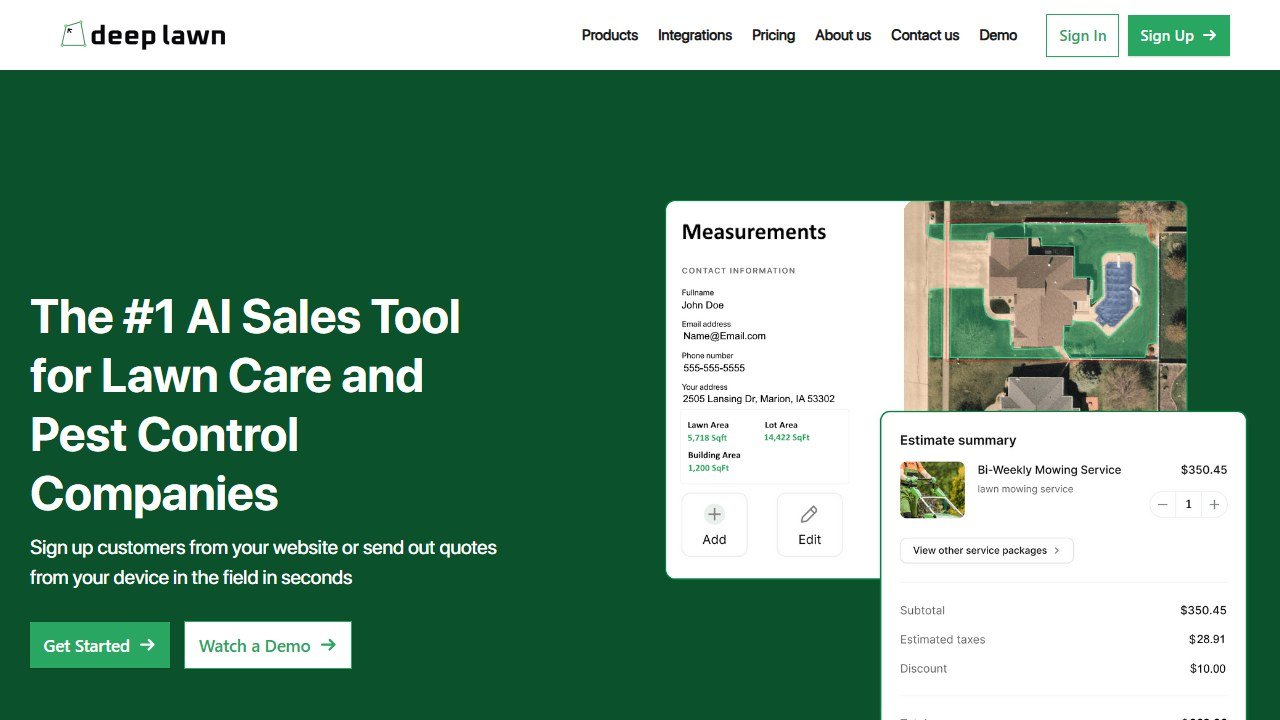
DeepLawn answers “how do I turn my website into a 24/7 quoting machine?” A homeowner lands on your site, types their address into the DeepLawn widget, and gets a price in seconds based on an AI measurement of their lawn and the pricing rules you set. If they bail before checkout, you still keep their lead. It is a sales-and-measurement tool aimed at the residential funnel.
SiteRecon answers “how do I get measurements accurate enough to bid a contract I cannot afford to get wrong?” You submit a property, and SiteRecon returns a detailed takeoff, turf, beds, hardscape, fence line, with AI doing the first pass and, on its verified tiers, a human cartographer checking the work. It is built for estimators who quote commercial maintenance, HOAs, and multi-service accounts where a bad number costs real money.
So one is a front-of-website lead engine, and the other is a back-office measurement service. Keep that distinction in your head and the rest of this comparison falls into place.
Measurement accuracy and verification
This is the dividing line that matters most, so we will spend the most time here.
DeepLawn’s measurements are fully automated. The AI reads aerial imagery and returns lawn area, lot size, driveway, and similar figures in seconds. For a typical residential lot, that speed is the whole point, the customer is on your site right now and wants a number now. Accuracy on standard suburban lots is generally good, but it is machine output with no human in the loop, so odd lots, heavy tree cover, or unclear boundaries can throw it off. You are trading a small accuracy margin for instant turnaround, which is a fair trade for a 5,000-square-foot lawn quote.
SiteRecon leans the other way. Its pitch is high accuracy, with the company citing figures in the mid-to-high 90s percent range, and its verified plans add a human cartographer who reviews the AI’s work before you get it. That review step is the product. When you are about to bid a commercial property and the difference between a 30,000 and a 40,000 square foot turf area is your entire margin on a year-long contract, “a person checked this” is worth paying for.
There is a subtler point here that estimators learn the hard way. AI measurement struggles most exactly where money concentrates. Mature trees overhanging a property line hide turf the model cannot see, so it under-measures. Mulch beds that blend into shaded grass get misclassified. Parking islands, retention ponds, and the awkward leftover strips on a commercial site are precisely the areas a fully automated pass tends to miss or merge. On a residential lawn those errors are small and self-correcting across hundreds of quotes. On a single large account, one of them is the whole job. That is the case for a human in the loop, and it is why SiteRecon prices verification as a premium rather than throwing it in for free.
Always confirm current accuracy claims and verification tiers on each vendor’s page, because both companies tune these as their models improve.
Turnaround and automation
DeepLawn is instant by design. The measurement happens live, inside the widget, while the prospect waits. That is its core advantage, there is no queue and no human step to slow things down. The flip side is that “instant” means “unverified,” which is exactly why it suits the residential volume play and not the high-stakes commercial bid.
SiteRecon is fast for what it is, but it is not instant. AI-only measurements come back quickly, while the human-verified takeoffs typically land within the same business day. That is dramatically faster than sending someone out with a measuring wheel, and far more reliable than eyeballing it yourself, but it is a submit-and-wait model, not a live-on-your-website model. If your workflow is “estimator pulls up a property, orders a takeoff, prices it later that day,” this fits. If your workflow is “homeowner self-serves a quote at 11pm,” it does not.
There is a practical staffing angle worth naming. DeepLawn lets a small residential company run quoting without a dedicated estimator at all, the website does the first measurement and the math while the owner sleeps. SiteRecon assumes you have someone whose job is to bid, and it makes that person faster rather than replacing them. If you are a two-truck operation with no office staff, that difference alone may decide it. If you have an estimating desk drowning in manual takeoffs, SiteRecon is buying back their hours.
The honest summary: DeepLawn automates the customer-facing moment, SiteRecon automates the estimator’s grunt work. Different parts of the funnel.
Lead-capture vs takeoff workflow
This is where the two tools barely overlap.
DeepLawn is a lead-capture and e-commerce engine first. The widget sits on your website, captures the address, generates the quote, and can take the sale, payment included, online. Abandoned-cart leads are saved so your team can follow up. For a residential lawn or pest-control company trying to win the speed-to-lead race, that is genuinely valuable. The measurement is a means to the sale, not the deliverable.
SiteRecon delivers the measurement as the product. You get a labeled property map and a takeoff breakdown, the kind of artifact an estimator uses to build a defensible commercial bid and a crew uses to know exactly what they are maintaining. There is no consumer-facing widget. It assumes a salesperson or estimator is in the loop, which is the right assumption for the accounts it targets.
If your business is genuinely both, residential self-serve plus commercial bidding, that is a real signal you may want both tools, or a broader platform. More on that in the verdict.
Integrations and CRM
Tooling is only as good as what it connects to, and here the two diverge along the same residential-versus-commercial line.
DeepLawn offers an API and bulk-data processing, useful if you have 500-plus addresses to measure in one go, or want to wire quotes into your own systems and CRM. Its integration story is built around the residential e-commerce stack and the platforms that crowd serves.
SiteRecon plays to the commercial maintenance world. It integrates with the heavyweight field-service and estimating platforms that larger landscaping firms run, the Aspire, ServiceTitan, LMN, SingleOps and Real Green tier of software. If you already live inside one of those systems, that connection removes a pile of manual data entry and is a strong reason to lean SiteRecon.
Confirm the exact, current integration list on each vendor’s site before you commit, because partner rosters shift quarter to quarter. The principle holds though: DeepLawn fits the residential tech stack, SiteRecon fits the commercial one.
Pricing and value
We will not invent numbers, and you should confirm everything on the vendor pages, because both companies adjust pricing regularly.
DeepLawn runs on a monthly subscription, usage-based, with the entry tier aimed at smaller companies and bigger plans for higher volume. The value question is simple: does the widget generate enough extra leads and instant quotes to clear its monthly cost? For a residential company doing real web traffic, that math usually works, the tool pays for itself in captured leads that would otherwise have called a competitor.
SiteRecon also uses a subscription model, often with a per-acre or credit element layered on, and verified takeoffs sit at the premium end. The value question is different: does paying for accurate, human-checked measurements save you more than it costs in won bids, protected margins, and estimator hours not spent tracing lawns by hand? For a firm bidding commercial work, one avoided underbid on a large contract can cover the tool for a long time.
A quick way to pressure-test either decision: estimate the revenue the tool touches in a month, then ask what fraction of its cost a single outcome covers. For DeepLawn, that outcome is one captured lead that converts, if your average job is worth a few hundred dollars and the widget brings in even a handful of extra closes, the subscription is rounding error. For SiteRecon, the outcome is one bid you would otherwise have gotten wrong, on a commercial contract that recurs all year, a single corrected underbid can pay for many months of the service. Run that arithmetic with your own numbers before you trust anyone’s marketing.
So neither is “cheaper” in a vacuum. DeepLawn’s value is measured in leads captured. SiteRecon’s is measured in margin protected and hours saved. Price both against the revenue they touch, not against each other.
Who each one is for
Here is the plain-English sorting hat.
Choose DeepLawn if you run a high-volume residential lawn-care or pest-control business, get meaningful website traffic, and want to convert visitors into quoted leads without a human lifting a finger. The instant widget is the draw, and standard suburban lots are exactly where its automated measurement performs well.
Choose SiteRecon if you bid commercial properties, HOAs, campuses, or multi-service accounts where a wrong measurement is expensive, and you want human-verified takeoffs plus integrations into serious field-service software. If your estimators currently burn hours measuring by hand and you have lost money to a bad number, this is the one.
Be honest if you are neither cleanly. A small operator doing mostly residential who occasionally bids a bigger property may not need either yet, a simpler satellite-measure tool inside a general lawn-care platform could be enough. We cover those broader options in the best AI tools for lawn care businesses roundup.
SiteRecon vs DeepLawn at a glance
| Dimension | SiteRecon | DeepLawn |
|---|---|---|
| Core job | Human-verified property takeoffs for bidding | Instant-quote website widget for lead capture |
| Best for | Commercial, HOA, multi-service estimators | High-volume residential lawn and pest care |
| Measurement | AI plus human cartographer review on verified tiers | Fully automated AI, no human in the loop |
| Accuracy positioning | High accuracy, human-checked (confirm current claim) | Good on standard lots, unverified |
| Turnaround | AI fast, verified takeoffs same business day | Instant, live in the widget |
| Customer-facing tool | No consumer widget, estimator-led | Embeddable website widget, takes payment |
| Integrations | Aspire, ServiceTitan, LMN, SingleOps, Real Green tier | API and bulk data, residential stack |
| Pricing model | Subscription, often per-acre or credit element (confirm) | Usage-based monthly subscription (confirm) |
Treat every cell as a starting point, not gospel, and verify the moving ones (accuracy, integrations, pricing) on each vendor’s own page before you sign anything.
Our verdict
These two are not really fighting over the same customer, and once you see that, the choice is easy.
If you are a residential lawn-care or pest-control company and your growth lever is your website, DeepLawn is the better buy. The instant-quote widget meets prospects at the exact moment they want a price, captures leads even when they do not finish, and its automated measurement is plenty accurate for the standard lots that make up your bread and butter. Buy it as a sales tool that happens to measure, not as a measurement tool.
If you bid commercial, HOA, or multi-service work where a wrong number costs you a contract’s worth of margin, SiteRecon is the better buy. The human-verified takeoffs and the integrations into commercial field-service software are exactly what a serious estimator needs, and the cost is easy to justify the first time it stops you from underbidding a big property. Buy it as a measurement service that protects your margin.
When the honest answer is a third option
Sometimes neither is the right call. If you are a true generalist running both residential self-serve and commercial bidding, you may end up wanting DeepLawn for the front of your website and SiteRecon for the back office, two tools, two jobs. And if you are a smaller operator who only occasionally needs to measure, a lighter measure-and-quote tool like SatQuote, or the satellite-measure feature bundled into a broader business platform, may be all you need for now, without a second subscription. Look at the full landscape in our best AI tools for lawn care businesses guide.
Measurement tools are one piece of a modern landscaping stack. If your work spills into design or installs, our best AI landscaping tools overview and our walkthrough on how to use AI for landscape design cover the visual side, and homeowners automating the irrigation side should read our best smart sprinkler controllers guide. The right tool is the one that matches the job in front of you, and for property measuring, that job is either capturing residential leads fast or bidding commercial work right.

Written by
FazFaz is the founder of AIToolsBakery. Some tools here are tested hands on. Others are assessed from vendor documentation and pricing verified on the live page, and every review says which one it is. Sponsors can buy a position in a guide. They cannot buy the score, the criticism, or silence about a better option.
How we test and how we make money →Frequently Asked Questions