It is week six of a meet prep. Your top single felt like a grinder, your sleep tracker says you got five hours, and the spreadsheet you built two years ago just tells you to add 5kg because that is what the next cell says. A spreadsheet does not care that you are cooked. A good powerlifting app should. The promise of the “AI” label on these tools is exactly this: read how the session actually went, then change tomorrow before tomorrow breaks you.
We reviewed the apps that lifters keep recommending for the squat, bench, and deadlift, and we judged them on whether the smart part is real autoregulation or just a progression formula with a marketing badge. We care about RPE and RIR feedback loops, peaking blocks that taper for a one-rep max, programming depth for raw and equipped lifters, and whether the free tier is usable or a trap.
One thing first, because it matters. AITB is independent. We sell none of these apps, we take no cut, and we are not the affiliate roundup that ranks whoever pays the most. Search “best powerlifting app” and you mostly get the vendors talking about themselves or commission lists dressed as reviews. We are neither. Below is what each app actually does, what it costs in rough terms, and the one limitation we would want a friend to know before paying.
The 30-second answer: For true autoregulation around RPE and readiness, pick JuggernautAI. For a free, deep program library, pick Boostcamp. RP Hypertrophy suits volume-driven powerbuilding. Liftosaur is for control freaks who script their own logic. Hevy is the best plain logger. Confirm current pricing on each vendor page.
Quick answer: JuggernautAI is the closest thing to a powerlifting coach in your pocket, RP Hypertrophy is best for powerbuilding volume, Boostcamp is the best free library for lifters who can program, and Liftosaur gives total control to those who script their own logic. These are training tools, not medical advice.
What “AI” really means in a powerlifting app
Most powerlifting “AI” is not a large language model. It is autoregulation: a rules engine that takes your readiness inputs (sleep, soreness, motivation) and your performance feedback (the RPE and RIR you log per set), then adjusts load and volume for the next session or week. That is genuinely useful, and it is closer to what a thoughtful coach does than a fixed percentage chart. We flag below which apps actually close that feedback loop and which just auto-fill weights from a template.
It helps to hold two ideas apart. The first is progression: an app that adds weight on a schedule, like a linear program that tacks on 2.5kg each session until you miss. Almost every tracker does this, and a lot of marketing calls it “smart.” It is not. The second is autoregulation: an app that changes the prescription based on what your body reported today. If you slept four hours and your top set flew up faster than expected, a truly autoregulating app responds to both signals differently. When you read “AI” on a powerlifting app, ask which of these two you are actually buying, because the price gap between them is large and the value gap is larger.
There is one more distinction that trips up buyers. RPE is a tool, not a feature. Plenty of apps let you log an RPE number next to a set. That is just record-keeping. The question is whether the app does anything with that number, whether tomorrow’s session is different because you logged an RPE 9.5 on a planned RPE 8. An app can have full RPE fields and zero autoregulation. We checked for the second thing, not the first.
JuggernautAI: the closest thing to a coach in your pocket
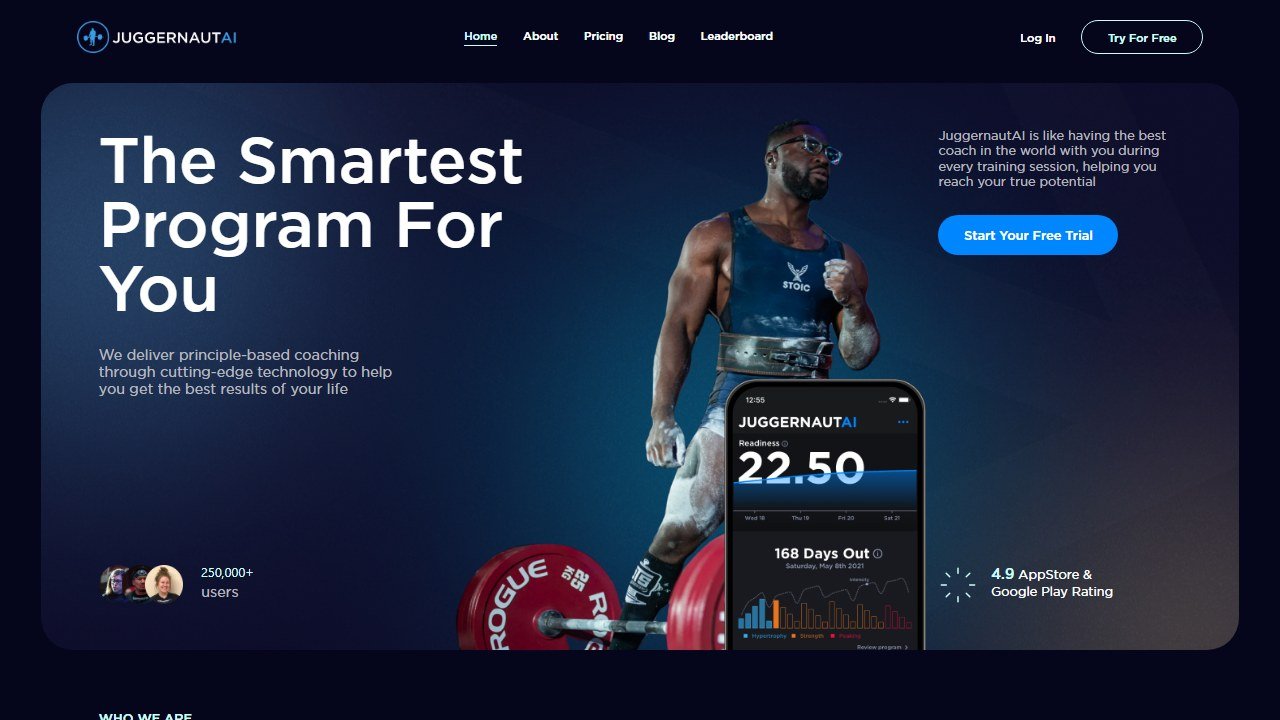
JuggernautAI, built by Chad Wesley Smith and the Juggernaut Training Systems team, is the app most serious powerlifters name first, and after testing it we understand why. You feed it detailed inputs at setup: your competition lifts, whether you want powerlifting or powerbuilding, your weak points, your training age, and your recovery. From there each session asks how ready you feel, then you log weights, sets, reps, RPE, and RIR. The app adjusts load and volume in response. Push past your target RPE early and it can cut a set so you do not bury yourself. Across a block it builds toward a peak, which is the part generic apps fumble.
Pricing sits around 35 dollars a month, or roughly 350 dollars a year, so confirm current numbers on the JuggernautAI site before you commit. Sessions are long and demanding, often 45 to 90 minutes, which is the point for a competitive lifter and a deterrent for a casual one.
The honest limitation: the autoregulation is only as good as your honesty. If you sandbag your RPE or fudge your readiness, the algorithm chases bad data and either stalls you or runs you into a wall. It rewards lifters who already know how a true RPE 8 feels, which in our experience takes a year or two of deliberate practice to calibrate. A newer lifter can absolutely use it, but should expect the first block to feel slightly off while their RPE sense and the algorithm learn each other. The app also assumes you can train through long sessions, so if your life gives you 30 minutes three times a week, this is not the tool that fits the schedule.
RP Hypertrophy: powerbuilding volume, with a peaking caveat
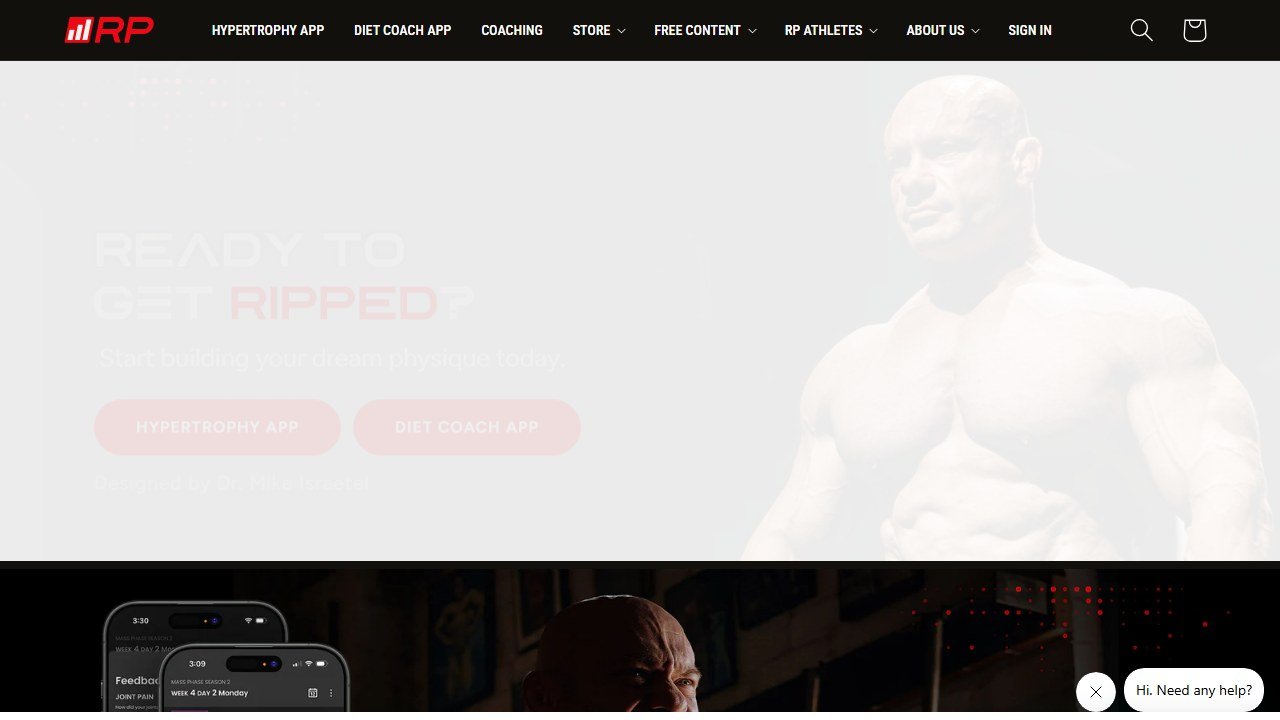
The RP Hypertrophy app from Renaissance Periodization, built on Dr. Mike Israetel’s programming principles, is the strongest pick if your strength goals ride on a base of muscle. Its core trick is volume autoregulation: you log pump, soreness, and per-set performance, and the app decides whether to add sets, hold, or back off, week by week, across a mesocycle. It ships with a large library of templates and lets you build your own mesocycle if you want control over exercise selection.
Pricing is in the mid-20s per month range, so check the current figure on the RP Strength page. One practical note from testing: the app runs through your browser rather than a fully native experience for some functions, which a few users find clunky mid-workout.
The honest limitation: it is built for hypertrophy first. You can carry strength through it and transition into a pre-competition block, but it is not a dedicated powerlifting peaking engine the way JuggernautAI is. The volume logic is excellent at deciding whether your back can take another set of rows; it is less interested in walking your squat single up to a meet attempt over a taper. If a meet platform total is your only goal, this is the wrong primary tool. If your goal is to be bigger and stronger across the year with the occasional meet, it is one of the most evidence-aligned options on the market, because the programming traces back to published volume and recovery research rather than gym lore.
Boostcamp: the best free library for lifters who can program
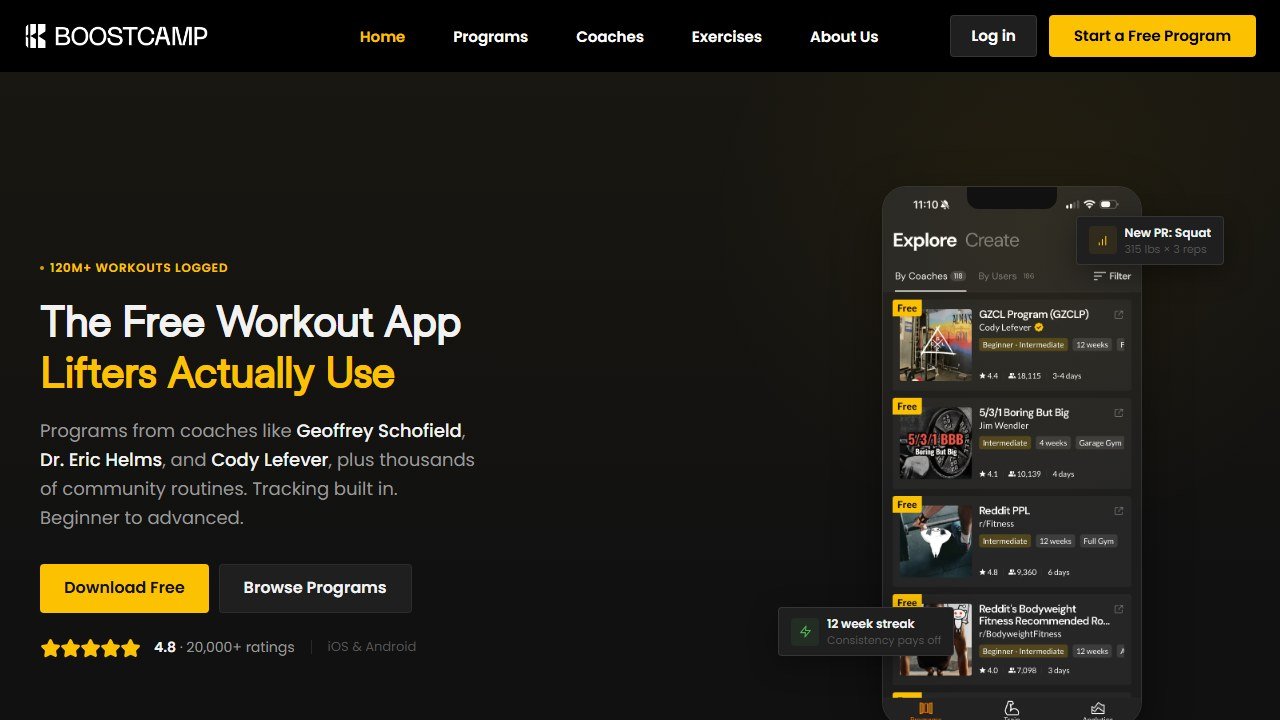
Boostcamp is the value pick, and it is genuinely free for the core experience. The library is enormous, with proven powerlifting and strength programs built in: nSuns, 5/3/1, GZCLP, Candito, Sheiko, Smolov, plus coach-designed routines. It tracks sets, reps, weight, RPE, and estimated one-rep max, and its auto-progressions fill in your next weights so you are not doing math between sets. There is also a custom builder with multi-week periodization and exercise swaps.
The full library, tracking, and progression tools cost nothing. A Pro tier adds exclusive coach programs and deeper analytics for a modest fee, so see the Boostcamp site for current Pro pricing.
The honest limitation: Boostcamp is not really autoregulating in the JuggernautAI sense. It runs proven templates and progresses them, but it does not rewrite your week based on a readiness questionnaire. The programs themselves are battle-tested and many of them are world-class, but the app trusts you to pick the right one and to bail on it when life or recovery demands. It rewards lifters who already understand programming and want a clean tracker around a template, not beginners who want the app to think for them. That said, for the price (nothing), running a proven program honestly will out-progress most lifters who keep app-hopping for the perfect algorithm.
Liftosaur: total control for the lifters who script their own logic
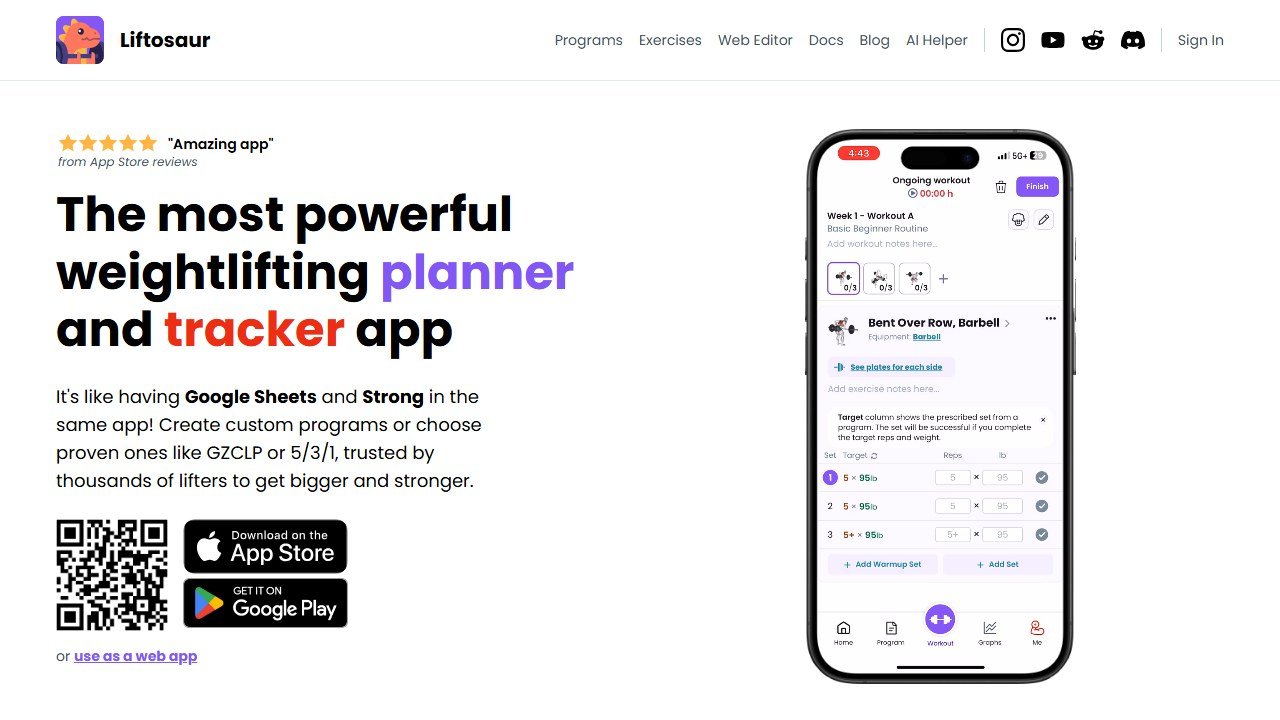
Liftosaur is the opposite of a black box. It is built around Liftoscript, a plain-text scripting language where you define your own program and your own progression rules. You can set loads as a percentage of one-rep max or by RPE and let the app compute the weight, log RPE per set to watch effort drift, and script myo-reps, drop sets, custom rest timers, and any progression logic you can express. For a lifter who got tired of an algorithm deciding things and wants explicit control over every rule, nothing else comes close.
Liftosaur is free to use, with a one-time lifetime purchase option in the rough range of 70 to 100 dollars to own it outright, so confirm the current tiers on the Liftosaur site.
The honest limitation: the power is the price. The learning curve is steep, and if you do not want to write progression logic, the scripting layer feels like homework. There is a real audience for this, often engineers and longtime lifters who treat their programming like code they want to version and refine, and for them Liftosaur is a joy. For everyone else it is overkill. This is a tool for the lifter who enjoys building the system, not the one who wants the system handed over. If you have ever opened a training spreadsheet and started adding formulas for fun, you already know which camp you are in.
Hevy: the best plain logger when you bring your own program
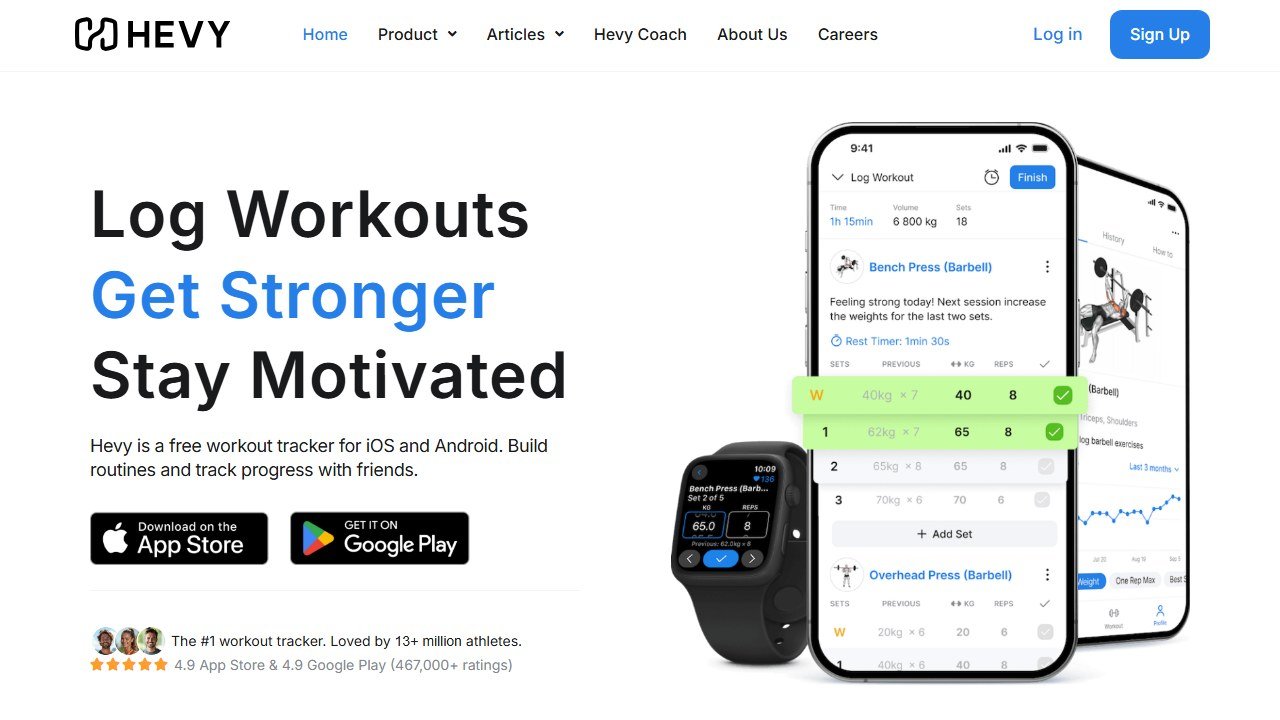
Sometimes the smartest move is the simplest one. Hevy is the cleanest, fastest workout logger we reviewed, loved by millions of lifters, and it is the right call when you already have a program (from a coach, a spreadsheet, or one of the apps above) and just want to log it without friction. You pick exercises from a large library or add custom lifts, log sets, weight, reps, and RPE, and the app tracks PRs, estimated one-rep max, and progress graphs cleanly.
Hevy has a capable free tier, with a Pro subscription that lifts routine limits and adds analytics, so check the Hevy site for current Pro pricing.
The honest limitation: Hevy does not program for you and does not autoregulate at all. It will not peak you for a meet or tell you to drop a set. It is a beautiful notebook, not a coach. We list it because honest powerlifters often need exactly that, and pairing it with a coach beats a mediocre algorithm.
Comparison: 5 powerlifting apps at a glance
| App | What it does best | Best for | Price or free tier (confirm on vendor) |
|---|---|---|---|
| JuggernautAI | True RPE and readiness autoregulation with meet peaking | Competitive powerlifters who log honestly | Around 35 dollars per month |
| RP Hypertrophy | Volume autoregulation for powerbuilding | Lifters building strength on muscle | Mid-20s dollars per month |
| Boostcamp | Huge free library of proven strength programs | Self-directed lifters on templates | Free core, paid Pro tier |
| Liftosaur | Fully scriptable custom programming and progression | Lifters who want explicit control | Free, optional lifetime around 70 to 100 dollars |
| Hevy | Fast, clean workout logging and PR tracking | Lifters who bring their own plan | Strong free tier, paid Pro |
A lean way to start
You do not need to subscribe to everything to find your fit. Try this order.
- Download Boostcamp and Hevy first. Both are free, and they tell you whether you even want template-and-log or full programming.
- Run a known free program (nSuns or 5/3/1) for two weeks while logging honest RPE on every working set.
- If the fixed plan feels too rigid for how your recovery actually swings, start a JuggernautAI trial and let it autoregulate a block.
- If instead you find yourself wanting to tweak every progression rule, move to Liftosaur and script your own.
- Only pay for the one that matched how you actually train. Cancel the rest before the next billing cycle.
If you want the broader landscape beyond the platform lifts, our pillar on the best AI workout apps covers general training, and the best AI bodybuilding apps guide goes deeper on hypertrophy if powerbuilding is your real goal. We also wrote a full JuggernautAI review for lifters weighing the subscription, and a Dr. Muscle review for an adjacent autoregulating option. If you are deciding between plain loggers, our Fitbod vs Strong app comparison is worth a read.
What these apps still cannot do
An app is not a coach, and the autoregulation in even the best of them is a rules engine, not a person who can watch your bar path and tell you your hips are shooting up. None of these tools can diagnose a tweaked back, judge whether a niggle is “train through it” or “stop now,” or fix a technique fault from a number. RPE-based adjustment also assumes you can rate effort accurately, and most lifters overrate or underrate it for the first year or two.
These apps do not give medical advice. If you have pain that is sharp, persistent, or radiating, an algorithm telling you to add a set is the wrong input. See a qualified physician or physical therapist, not a notification. Used well, with honest data and your own judgment on top, these apps remove the guesswork from load and volume and let you spend your attention where it counts: under the bar, training hard, recovering on purpose, and showing up to the platform ready.
What AI form checking can and cannot actually see
Pose estimation from a phone camera is genuinely useful and routinely oversold. Knowing where the line sits protects you from both the hype and the injury risk.
It works well on large, planar, well-lit movement
A squat filmed from the side in good light, with the whole body in frame and reasonably fitted clothing, is close to the ideal case. Knee position, hip depth, bar path and tempo are all measurable from that, and feedback on them is real. If your use case looks like that, these tools do what they claim.
It degrades sharply outside those conditions
Accuracy falls away with loose clothing, poor lighting, an angled or moving camera, occlusion where one limb hides another, and any movement that happens largely in the depth axis away from the lens. Rotational movement, anything on the floor, and lifts where the critical detail is spinal position rather than joint angle are all much harder. A tool that is confident in those conditions is not more capable, it is less honest.
It cannot see the things that most often cause injury
A camera does not know your training history, whether that shoulder has been irritable for three weeks, how heavy the bar is relative to your capacity, or that you slept four hours. Most training injuries come from load management rather than from a visibly wrong joint angle in a single rep. Treat form feedback as one input among several rather than as a safety system.
The honest way to use it
Film the same lift from the same angle every few weeks and compare. Consistency of setup matters more than the sophistication of the model, and a fixed camera position turns these tools from a novelty into a genuine progress record. Use the feedback to prompt questions rather than to make decisions, and take anything about pain or persistent discomfort to a physiotherapist rather than to an app.

Written by
FazFaz is the founder of AIToolsBakery. Some tools here are tested hands on. Others are assessed from vendor documentation and pricing verified on the live page, and every review says which one it is. Sponsors can buy a position in a guide. They cannot buy the score, the criticism, or silence about a better option.
How we test and how we make money →Frequently Asked Questions