It is 6 a.m. The alarm went off, you slept badly, and a little screen is about to tell you whether to push your interval session or back off. That tiny verdict is the whole pitch behind recovery wearables. Three brands dominate the conversation: WHOOP on your wrist or bicep, Oura on your finger, and Garmin on a sports watch. They all measure roughly the same signals overnight, then translate them into a single morning number. The trick is that they translate those signals very differently, and they charge for them very differently too.
We are AIToolsBakery, and we are independent. We do not sell WHOOP, Oura, or Garmin, and we earn nothing if you buy one. That matters here, because if you search “whoop vs oura vs garmin” you mostly get two kinds of pages: the vendors talking about themselves, and affiliate roundups quietly steering you toward whatever pays the highest commission. We are neither. This comparison is about which device fits how you actually train and what you are willing to pay over three years, not which one has the prettiest checkout button.
One honest caveat up front. None of these are medical devices. The recovery scores, HRV trends, and sleep stages are useful approximations, not diagnoses. They are good for spotting your own patterns over weeks, not for catching illness. If something feels wrong with your body, talk to a clinician, not your ring.
The 30-second answer: Pick WHOOP if recovery and daily strain are the whole point and you live in the app every morning. Pick Oura if sleep accuracy and quiet all-day wear matter most. Pick Garmin if you want GPS, real workout metrics, and a one-time purchase with no subscription hanging over you.
Quick answer: WHOOP wins for strain and recovery coaching, Oura for sleep accuracy and an unobtrusive ring, and Garmin for athletes who want training metrics and recovery on one watch. If you mostly want notifications and casual tracking, a mainstream smartwatch does the everyday job for less.
Hardware and how you wear it

The form factor is the first real decision, because it shapes whether you will actually keep the thing on.
WHOOP is a screenless band. There is no display, no clock, no notifications. You wear it on your wrist or, with the right accessory, your bicep, and you check everything in the phone app. The upside is comfort and a wear-anywhere build that survives lifting, swimming, and sleeping. The honest limitation: a wrist optical sensor is the weakest spot for heart rate during heavy, jerky movement like CrossFit or sprint intervals, where the band can lag a chest strap. Battery lasts several days, and the charger slides on while you wear it so you never take it off.
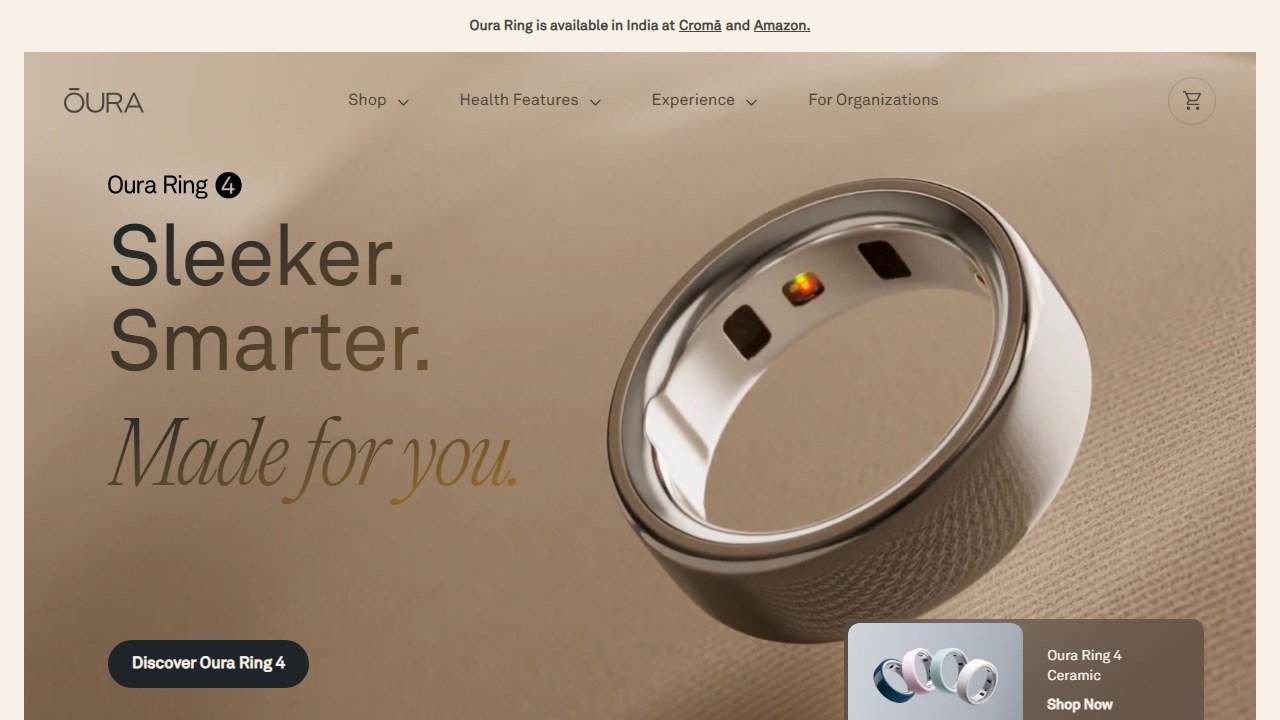
Oura is a titanium ring. It is the most discreet of the three by a wide margin, and the finger gives it a real signal advantage we will get to shortly. Battery runs roughly a week. The limitations are physical: rings do not love heavy barbell work that mashes them against the bar, finger swelling can affect readings, and you cannot get live workout data on your wrist mid session. Oura is a tracker you forget you are wearing, not a training computer.
Garmin is a full sports watch with a screen, GPS, maps on higher models, and onboard activity profiles for nearly every sport. It is the only one of the three that gives you live pace, distance, and heart rate on your wrist while you move. The trade-off is bulk and the usual wrist-optical caveat during intense efforts, though Garmin pairs cleanly with a chest strap when you want gold-standard heart rate.
Recovery and sleep accuracy
This is the heart of the matter, and it is where the three genuinely diverge.
WHOOP builds a daily Recovery score, shown as a percentage, primarily from heart rate variability measured during sleep, plus resting heart rate, respiratory rate, and skin temperature. It is a once-a-morning verdict: here is your tank, here is how much strain you can absorb today. Reviewers consistently rate WHOOP’s sleep duration tracking and HRV trending as strong, and in steady-state cardio its heart rate tracks close to a chest strap. The static, one-shot nature is a feature for some and a frustration for others who want updates through the day.
Oura takes a different path on the same signals. Rather than a single overnight HRV snapshot, it samples HRV across the whole night and blends multiple windows into its Readiness score. The finger is the quiet hero here: denser blood vessels close to the surface produce a cleaner optical signal than the wrist, which is a big reason independent testing has repeatedly placed Oura at or near the top for sleep-stage accuracy. If you mainly want to understand your sleep and whether your body is primed, Oura is hard to beat. Its weakness is the inverse of its strength: it is a recovery and sleep instrument, not a live training tool.
Garmin folds recovery into two features. Body Battery is a live 0 to 100 energy gauge that drains with activity and stress and recharges with rest, updating all day. Training Readiness blends sleep, recovery time, HRV status, and recent stress into a morning score closer in spirit to WHOOP’s Recovery. The appeal is the real-time view; the honest knock, repeated by reviewers and worth taking seriously, is that Body Battery is more of a clever heuristic than a rigorously validated recovery metric. Garmin’s HRV status is solid for trend-spotting, but in head-to-head HRV accuracy testing it has generally trailed both Oura and WHOOP.
For a deeper look at why nighttime data drives every one of these scores, our roundup of the best AI sleep coach apps for athletes digs into how sleep quality, not just duration, moves the needle.
AI insights and coaching
All three now wrap their raw numbers in some flavor of “AI coach,” and this is where marketing runs ahead of substance, so read carefully.
WHOOP leans hardest into guidance. It nudges you on sleep need, strain targets, and behaviors it correlates with better recovery, and it has added a conversational coach that answers questions about your own data. When it works, it turns a percentage into a plan. The limitation is that correlation is not causation: it will happily tell you that late caffeine hurt your sleep, but it is inferring, not proving.
Oura’s intelligence is subtler and aimed at sleep and readiness. Its Smart Sensing adapts to your finger’s blood-flow patterns, and its advisor surfaces gentle, pattern-based suggestions rather than barking strain targets. It is the least pushy of the three, which fits its audience.
Garmin’s “AI” is really Firstbeat-derived sports science: suggested workouts, recovery-time estimates, training-load balance, and race predictors. For an athlete chasing a number on race day, this is genuinely the most actionable engine of the three, because it speaks in paces and watts, not vibes. The catch is that it assumes you train by structured sessions; casual users will ignore most of it.
If structured plans are what you are after, compare how dedicated apps handle this in our guides to the best AI running coach apps and the best AI cycling coach apps.
Data, app, and ecosystem
A wearable is only as good as the app you open every morning, and the ecosystems differ in personality.
WHOOP’s app is the most opinionated. It is built around the daily Recovery and Strain loop, with strong journaling that lets you tag behaviors (alcohol, late meals, travel) and see how they correlate with your scores over time. It is excellent for people who want to run experiments on themselves. It is also a walled garden: the experience lives almost entirely inside WHOOP.
Oura’s app is calm and legible, organized around three scores: Sleep, Readiness, and Activity. It plays nicely with Apple Health and other platforms, and its trend views are easy to read at a glance. It does less than WHOOP on purpose, and many people prefer that.
Garmin Connect is the deepest and the messiest. It holds years of GPS workouts, maps, training history, and a sprawling set of metrics, and it syncs widely with Strava, TrainingPeaks, and the rest. The depth is unmatched; the interface can overwhelm. If you already live in Strava or follow a structured plan, Garmin’s ecosystem is the most useful by far.
Subscription and value
This is the section that should drive your decision more than any accuracy chart, because the cost models are fundamentally different and easy to misjudge.
WHOOP is subscription-only. You do not buy the band outright; you pay for an ongoing membership, and the hardware comes with it. The first year can look like the cheapest entry point of the three, but the meter never stops. Cancel, and the device stops being useful. Over three or four years it is comfortably the most expensive option.
Oura is a hybrid. You buy the ring once, then pay a monthly membership to unlock the full scores and insights. Without the membership the ring still works but is heavily limited. So budget for both the hardware and an ongoing fee, though the fee is modest compared with WHOOP’s all-in model.
Garmin is the outlier: a one-time hardware purchase with no required subscription for the core recovery, sleep, and training features. You pay more up front for the watch, and that is it. For multi-year ownership this is almost always the lowest total cost, and there is a quieter benefit too: because you are not renting access, you never feel pressure to keep paying just to justify the gadget already on your wrist. The trade-off is that Garmin’s recovery science, while solid for trends, is not the most validated of the three, so you are buying breadth and value rather than the sharpest single recovery number.
Pricing and membership terms change often across all three, and we will not quote exact figures that could be stale by the time you read this. Confirm current pricing on each vendor’s own page before you buy: WHOOP, Oura, and Garmin.
Who each one is for
WHOOP is for the athlete or serious trainee who will open the app every single morning and adjust the day around it. If recovery and strain are central to how you train, and the recurring cost does not bother you, it rewards the obsessive.
Oura is for the person who cares most about sleep and all-day, forget-it-is-there wear, including plenty of people who are not athletes at all. It is the elegant choice for readiness over raw performance metrics.
Garmin is for the runner, cyclist, triathlete, or multi-sport athlete who needs GPS and live data, wants real coaching in paces and watts, and prefers to buy hardware once and be done. If you already train by a plan, this is usually the answer.
How the three compare at a glance
| Dimension | WHOOP | Oura | Garmin |
|---|---|---|---|
| Form factor | Screenless band (wrist or bicep) | Titanium ring (finger) | Full sports watch with screen |
| Recovery metric | Daily Recovery %, once each morning | Readiness score, blended overnight HRV | Body Battery (live) plus Training Readiness |
| Sleep accuracy | Strong, especially duration | Top tier, finger gives cleanest signal | Good for trends, trails the other two |
| Live workout data | No (app only) | No | Yes, GPS plus on-wrist metrics |
| AI coaching style | Strain and behavior guidance, chat coach | Gentle, sleep and readiness focused | Sports-science workouts and race predictors |
| Ecosystem | Walled, deep journaling | Calm, syncs to Apple Health | Deepest, syncs to Strava and TrainingPeaks |
| Cost model | Subscription only, no device purchase | Buy ring once plus membership | One-time hardware, no required subscription |
| Best for | Recovery-obsessed daily trainers | Sleep and all-day wear | Multi-sport athletes who want GPS |
Our verdict
There is no single winner, and any page that crowns one is selling you something. WHOOP wins for the trainee who treats recovery as a daily discipline and does not flinch at a forever subscription. Oura wins for sleep accuracy and quiet, all-day comfort, and it is the most pleasant to live with. Garmin wins on total value and real-world training utility for anyone who runs, rides, or races, because you get GPS, structured coaching, and a one-time price.
If we had to point most readers somewhere, it would be Garmin for athletes who train by a plan and want to own their gear, and Oura for everyone whose top question is “did I sleep well and am I ready.” WHOOP is the specialist’s pick, brilliant for the person it suits and overkill for everyone else.
When a fourth option wins: if you mostly want notifications, contactless pay, and casual fitness with decent-enough sleep tracking, a mainstream smartwatch like an Apple Watch does the everyday job for less mental overhead, and you can layer a dedicated training app on top. And if your real goal is a structured program rather than a wristful of biometrics, the right software may matter more than the hardware. Start with our pillar on the best AI workout apps, and if your sport is specific, the best AI cycling coach apps guide pairs neatly with any of these three wearables.
One last reminder, because biometrics invite over-reading: these scores are pattern tools, not medical readouts. Use them to learn your own trends, sleep more, and train smarter. For anything that feels like a real health concern, see a professional.
How consumer fitness apps are priced, and why the figures are hard to pin down
Consumer training apps behave differently from coaching platforms, and it makes them genuinely harder to compare honestly.
Most of them price through the app stores
We attempted to read pricing pages for several of the best known consumer apps on 4 September 2026, including Fitbod, Dr. Muscle, Hevy, Whoop and Oura, and could not extract a rate from any of them with the same method that read every coaching platform above. That is largely because subscriptions are sold inside the app rather than on the web, so the price you see depends on your store, your region and sometimes your device. We will not quote a figure we could not source.
What that means for any price you read elsewhere
Treat every specific consumer app price on the internet, including in comparison articles, as unverified unless it names a date and a source. Store pricing also changes by country and moves with local currency, so a figure that was right in one market can be wrong in yours by a wide margin. The reliable move is to open the app store listing on your own device before deciding.
The one that does publish clearly
JuggernautAI publishes on the web: $34.99 a month or $349.99 a year, with a two week free trial, which works out at roughly two months free on the annual plan. That is at the premium end of consumer training apps and it is aimed at serious strength athletes rather than general fitness, which is the honest framing for whether it is expensive.
Free trials in this category are short and auto-renewing
Two week and one month trials are the norm and almost all of them convert automatically. If you are testing several apps, note the conversion dates somewhere other than the app itself. This is mundane advice and it is the single most common way people end up paying for three training apps they stopped opening in February.

Written by
FazFaz is the founder of AIToolsBakery. Some tools here are tested hands on. Others are assessed from vendor documentation and pricing verified on the live page, and every review says which one it is. Sponsors can buy a position in a guide. They cannot buy the score, the criticism, or silence about a better option.
How we test and how we make money →Frequently Asked Questions