Seamless.AI sells one big promise above all others: a real-time search engine for B2B contact data that finds verified emails and phone numbers on demand, with marketing that has long leaned on a headline “98% accuracy” figure. For a rep staring at a blank prospecting list, that pitch is intoxicating. Type a name, get a verified email, start dialing. The Chrome extension is fast, the entry price is approachable, and the demo looks great.
So why is an honest review so hard to find? Because the search results are a battlefield. Affiliates pushing Seamless.AI publish glowing reviews loaded with referral links, while rivals publish takedowns to sell their own data. Almost nobody runs the one test that matters: do the emails and phone numbers actually work, and does the accuracy survive contact with reality? That gap, between the marketed claim and the verified hit rate, is the whole story, and it is the part the SERP keeps burying.
We bought into this category as analysts, not resellers, and we wanted to know whether the accuracy claim holds up and what it costs you when it does not. So here is our verdict, scored on our usual 0 to 5 scale, with data quality and deliverability treated as first-class concerns rather than footnotes.
A note on our independence. We are AIToolsBakery, an independent AI-tools review site. We do not sell Seamless.AI, we are not a Seamless.AI partner or reseller, and we earn nothing if you buy it. We have no affiliate deal with any tool in this category. When a post on this site is sponsored, it is labelled as sponsored at the top, and a sponsorship never changes a score or a recommendation. This review is not sponsored. Nobody paid for it, nobody reviewed it before publication, and the only agenda here is helping you decide where to spend a real budget.
The verdict in 30 seconds: Seamless.AI (2.8/5) is cheap-ish, fast, and has a genuinely slick Chrome extension, but the marketed “98% accuracy” does not survive real-world use. Independent testing puts email accuracy closer to 60 to 75 percent and phone accuracy around 45 to 60 percent, the Trustpilot score sits near 1.4 stars, and bad data can quietly burn your sending-domain reputation. Usable if you verify every list before sending. Risky if you do not.
What Seamless.AI is
Website: Seamless.AI
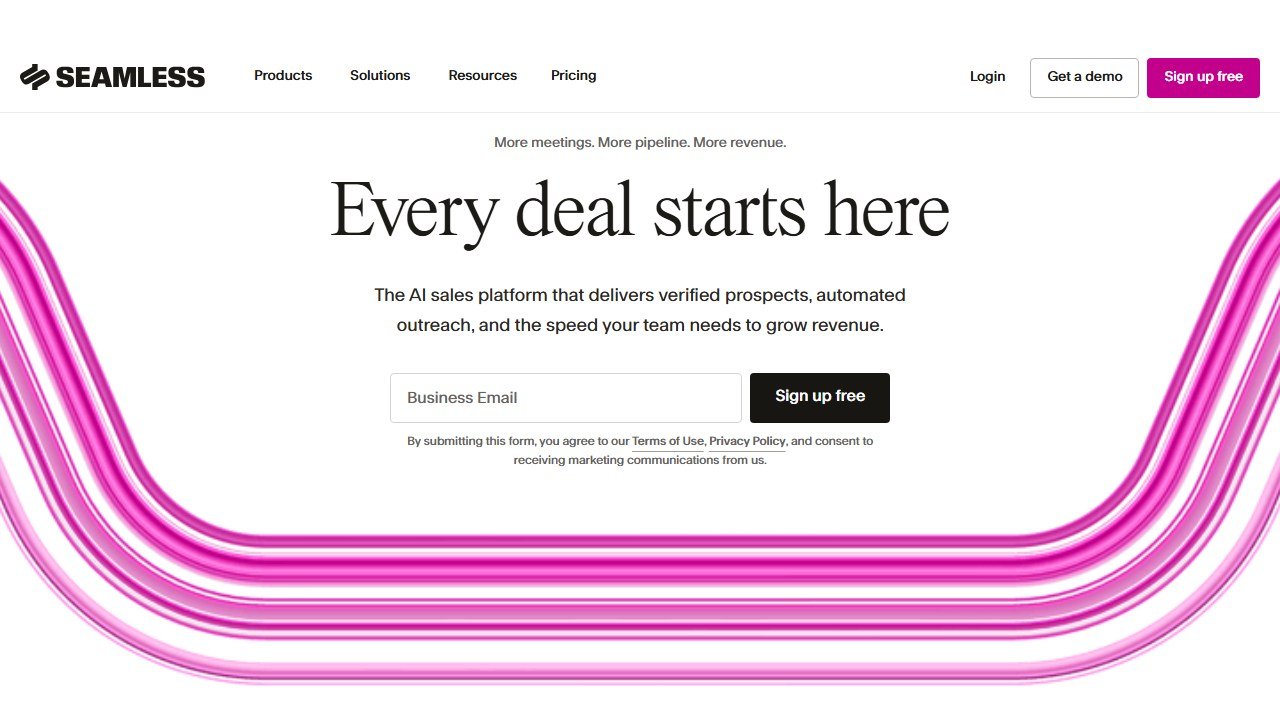
Seamless.AI is a B2B sales prospecting and contact-data platform. Unlike a static database that licenses you a snapshot of contacts, Seamless.AI markets itself as a real-time search engine: when you request a contact, it claims to search the web live and validate the result on the spot. The core deliverables are business email addresses, direct dials and mobile numbers, and company data, surfaced either inside the web app or through a browser extension that pulls contacts as you browse LinkedIn and company sites.
The product is built for speed and volume. Reps can build lists fast, push contacts into a CRM, and keep the prospecting funnel full without leaving their workflow. On paper that is exactly what a high-activity sales team wants. The question is not whether it is fast. It clearly is. The question is whether the data it surfaces is accurate enough to act on.
If you want the broader landscape before committing, our roundup of the best AI lead enrichment tools for 2026 maps the field, and our ZoomInfo review covers the premium end of the same category.
What it does well
Credit where it is due, because a fair review names the strengths plainly:
- The Chrome extension is genuinely fast. Surfacing contacts as you browse LinkedIn is smooth, and for sheer prospecting speed it holds its own. Reps who value momentum like it.
- Approachable entry price. Compared with the five-figure annual contracts at the enterprise end of this market, Seamless.AI is cheap-ish to get started with, which is a real draw for small teams and solo sellers.
- Volume-friendly workflow. Building large lists quickly is the core competency, and on that narrow measure it delivers.
These are not nothing. If your only metric were “how quickly can I generate a long list of contacts,” Seamless.AI would score well. But that is not the only metric that matters, and the next one is where it falls down.
The accuracy claim, tested
This is the heart of the review, so it gets its own section. The marketing has long leaned on a “98% accuracy” figure. Real-world experience does not back that up.
Across independent testing and consistent user reports, email accuracy lands closer to 60 to 75 percent, and phone-number accuracy closer to 45 to 60 percent. Those are not catastrophic numbers for a budget tool, but they are a long way from 98 percent, and the gap matters enormously when you act on the data at scale. At a 70 percent email hit rate, roughly three in every ten addresses you load are wrong. The Trustpilot rating, sitting near 1.4 stars, reflects how that gap feels to buyers who took the headline claim at face value.
The deeper problem is what bad data does downstream, and this is the angle almost no review covers. When you send cold email to inaccurate addresses, those messages bounce. A high bounce rate is one of the fastest ways to damage your sending-domain reputation, and once mailbox providers start distrusting your domain, even your good emails land in spam. In other words, inaccurate data does not just waste the bounced sends. It can quietly poison the deliverability of every email you send afterward. For a cold-email motion, that is the most expensive kind of damage, and it is invisible until it is not.
The cancellation and sales caveat
There is a second recurring complaint worth flagging, because it shows up across review platforms with enough consistency to take seriously: an aggressive sales process and a difficult cancellation experience. Buyers report contracts that are harder to exit than expected and a renewal motion that does not make it easy to walk away. Combined with the low Trustpilot score, this is a pattern, not a few isolated bad days. Read the contract terms carefully and understand the cancellation process before you commit, not after.
Honest pricing
Seamless.AI is sold on a credit-based, tiered model, with a free tier to get you in the door and paid plans that scale with the volume of contacts and credits you need. We will describe the model rather than quote a figure that will be stale by the time you read this, because the numbers move and are partly negotiated.
The relevant honest point is not the headline price, which is reasonable for the segment. It is the total cost of ownership once you factor in the accuracy gap. If three in ten contacts are wrong, your effective cost per usable contact is meaningfully higher than the sticker suggests, and you will likely need a separate email-verification tool in the stack to use the data safely. Price the verification step in, because skipping it is what turns a cheap-ish tool into an expensive deliverability problem.
How Seamless.AI compares
| Tool | Real-world data accuracy | Pricing model | Best for | Key risk |
|---|---|---|---|---|
| Seamless.AI | ~60 to 75% email, ~45 to 60% phone | Credit-based, free tier, low entry | Fast, high-volume list building on a budget | Accuracy gap, deliverability damage |
| Apollo | Solid, better verified emails, all-in-one | Transparent, self-serve, free tier | SMB and mid-market all-in-one prospecting | Data thinner on niche roles |
| Lusha | Good contact accuracy, lighter on volume | Self-serve credit tiers | Quick, accurate individual lookups | Less suited to bulk list building |
| ZoomInfo | Best-in-class US accuracy | Annual contract, high cost | US enterprise teams | Price and contract terms |
The takeaway: Seamless.AI competes on speed and price, not accuracy. If accuracy is what you actually need (and for cold email, it is), Apollo and Lusha offer a better data-to-risk ratio at a similar accessibility level.
Pros and cons
Pros
- Genuinely fast Chrome extension for surfacing contacts while browsing
- Approachable entry price and a free tier to test the waters
- Strong at quickly building large prospecting lists
- Real-time search model can surface contacts static databases miss
Cons
- Marketed “98% accuracy” does not match real-world results of roughly 60 to 75 percent email and 45 to 60 percent phone
- Trustpilot rating near 1.4 stars reflects widespread buyer frustration
- Inaccurate data drives bounces that can damage your sending-domain reputation
- Recurring reports of aggressive sales tactics and difficult cancellation
- You will likely need a separate email-verification tool to use the data safely
Who should (and should not) buy it
Consider Seamless.AI if you are a budget-conscious small team or solo seller who values prospecting speed, you primarily make calls rather than send bulk cold email, and you are willing to run every exported list through a verification step before acting on it. Used carefully, with eyes open about the accuracy gap, it can be a serviceable low-cost contact source.
Avoid Seamless.AI if your motion is cold email at any real volume and you are not prepared to verify lists rigorously, because the accuracy gap will cost you bounces, deliverability, and eventually your domain reputation. If clean data matters more than raw speed, a more accurate self-serve tool is the safer bet. Our best AI sales tools for 2026 guide covers stronger options for accuracy-sensitive teams.
Our verdict
Seamless.AI is the cautionary tale of this category. It is fast, it is cheap-ish, and the Chrome extension is genuinely good, so we understand the appeal. But a contact-data tool lives or dies on accuracy, and the marketed “98% accuracy” simply does not hold up in real-world use. Email accuracy closer to 60 to 75 percent and phone accuracy around 45 to 60 percent is not a rounding error, it is a structural reliability problem, and the near 1.4-star Trustpilot rating tells you how buyers feel about being sold the higher number.
The deliverability angle is what pushes this from “mediocre” to “proceed with caution.” Bad data does not just waste effort, it can burn the sending domain you rely on for every other campaign. If you do use Seamless.AI, verify every list before it touches a sequencer, calendar your renewal date, and treat the accuracy claim as marketing rather than fact. With those guardrails it is usable. Without them it is a liability. Seamless.AI scores 2.8 out of 5.
undefined
What every B2B data vendor charges, read from their own pages
Contact data is the one category where the sticker price tells you least, because the meter is credits and a credit does not mean the same thing at any two vendors. Here is each alternative to Seamless.AI as published on 4 September 2026.
Apollo, from $49 a seat, and it publishes the allowance too
Apollo is the transparency benchmark here. Basic is $49 per seat per month billed annually and $65 billed monthly, Professional $79 and $99, Organization $119 and $149 with a three seat minimum, plus a genuine free tier. What matters more is that it publishes the allowance, 30,000 credits per seat per year on Basic, which almost nobody else does. Divide that by your real monthly reveal volume and you know whether the plan fits before you speak to anyone.
Lusha, from $37.45 a month, but the figure moves with the slider
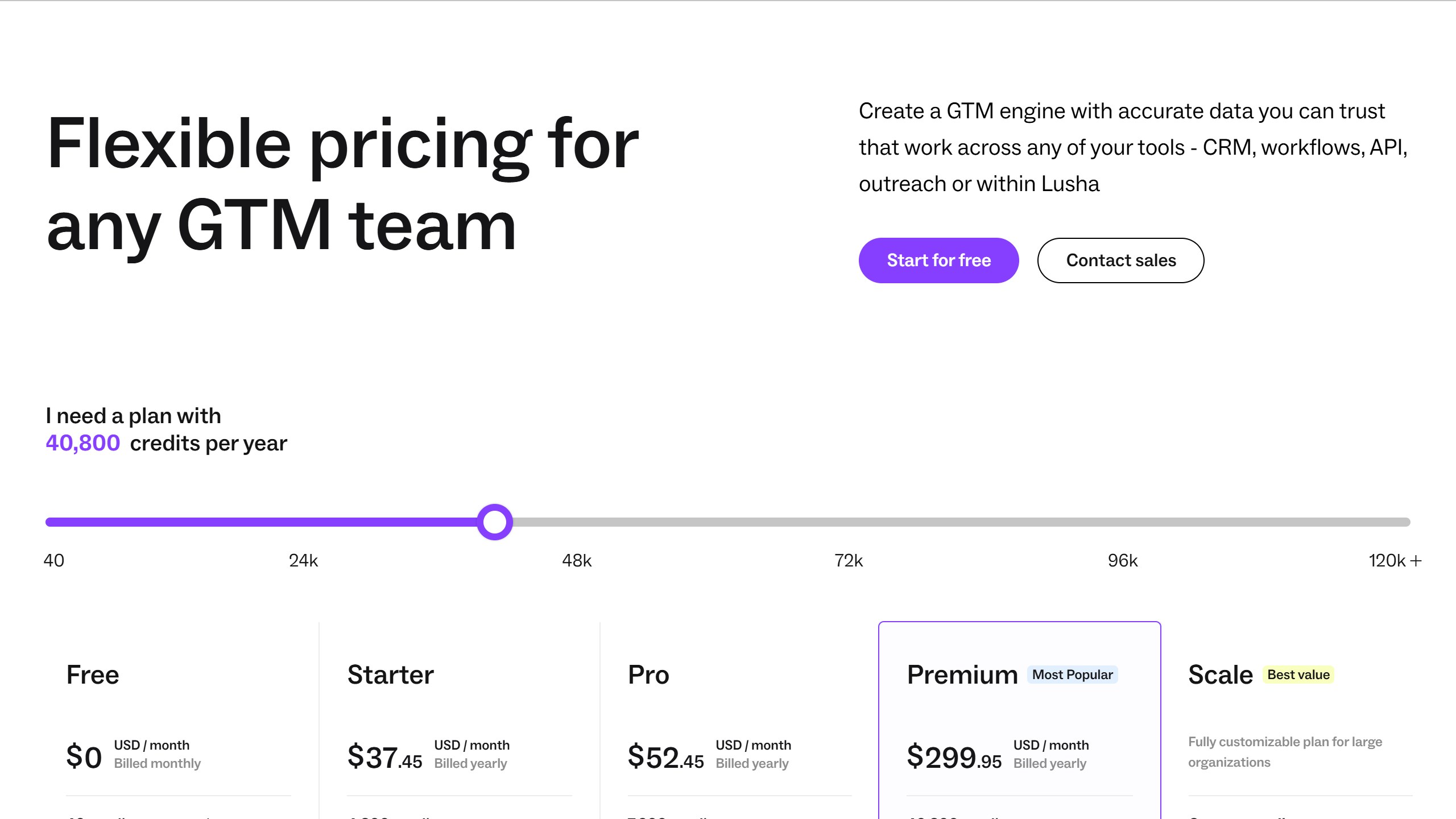
Lusha publishes a free tier at $0 and paid plans at $37.45, $52.45 and $299.95 per month billed yearly. Read that with care: the figures are tied to a credit volume selector that defaulted to 40,800 credits a year when we read it, so the price you see is one position on a slider. Any article quoting a flat Lusha price has taken a position and presented it as the price. Always pair the figure with the credit volume it assumes.
Cognism, no figure, but it publishes the packaging
Cognism shows no price in any currency. It does publish that Standard and Pro both include five seats, which is a floor worth knowing before you ask about two, and that its credit model only spends again when a contact changes jobs. That second point is a real structural difference and it favours teams working a stable account list.
Seamless.AI, where we could not read a figure
We read seamless.ai/pricing twice on 4 September 2026 and could not extract a currency figure from its Free, Pro and Enterprise cards, even though the page itself states that “the prices shown on this page reflect this annual discount”. We are not going to claim it publishes nothing on that basis, because absence in a scrape is not absence in fact. Treat any Seamless figure you find elsewhere as unverified until the vendor confirms it.
ZoomInfo, the largest and the least forthcoming
ZoomInfo renders over 12,000 characters of pricing page with no currency figure anywhere on it. That is a deliberate commercial choice rather than an oversight, and it means your only leverage is a published alternative priced at your exact seat count. Walk in with Apollo costed for your team and you have a number in the room that both sides can check.
Clay, published, but on a credit slider
Clay publishes real figures that sit on a credit slider with a monthly and annual toggle marked “Save 10%”, so the number changes as you move the volume. Clay is also a different shape of product: it orchestrates other vendors’ data rather than owning a database, so its credits buy enrichment runs across providers. Compare it on cost per enriched record you actually use, not on headline price.
How credit pricing actually works, and the four questions that decide your bill
Credits are the reason two vendors quoting similar monthly figures can differ threefold in practice. Ask Seamless.AI and every competitor the same four questions in writing.
What spends a credit
Revealing an email, revealing a phone number, enriching an existing record and exporting a list are often priced differently, and a mobile number frequently costs several times an email. Ask for the table. A plan advertised as 1,000 credits can be 1,000 emails or roughly 200 phone numbers, and if your team works the phone that distinction is your whole budget.
Whether a credit is spent again on the same person
This is the question almost nobody asks and it is worth the most. Some vendors charge every time you touch a record; Cognism publishes that it only spends again when a contact changes jobs. On a stable account list worked repeatedly over a year, that single difference can halve consumption. Get the answer in the contract rather than from a rep.
Whether unused credits roll over, and what overage costs
Outbound is seasonal. If credits expire monthly you will pay for capacity you cannot use in a quiet month and run out in a busy one. Ask whether allowances roll over, whether they pool across seats, and above all what a credit costs once you exceed the plan, because the overage rate is where the margin sits and it is almost never on the pricing page.
What happens to revealed data when you leave
Ask whether contacts you already revealed remain usable after the contract ends, and in what form you can export them. Some agreements treat the data as licensed rather than purchased, which means the enrichment you spent a year paying for does not come with you. That single clause is often the largest hidden switching cost in this category, and it is entirely invisible until you try to go.
The test that settles it
Give each vendor the same list of 200 accounts from your real ICP and ask them to run it during the trial. Then count three things: how many contacts were found, how many emails bounced when you actually sent, and how many credits it consumed. Coverage claims are marketing; a bounce rate on your own list is evidence.
The compliance questions outbound teams skip until they cannot
Outbound touches data protection law directly, and the answers differ enough by region that a single policy usually will not do.
Where your prospects are decides which rules apply
Contacting people in the EU or UK brings GDPR into scope regardless of where your company sits, and business contact data is still personal data. The usual lawful basis for B2B outbound is legitimate interests, which requires you to have actually done and documented the balancing test rather than to have heard that it applies. Ask your data vendor how it sourced the record and what notice the individual received.
Ask the vendor where the data came from
A reputable provider will tell you its sourcing and its notification approach. A vague answer is itself an answer, and it becomes your problem rather than theirs the moment somebody objects. Ask specifically how a suppression or erasure request is handled, how quickly it propagates, and whether it applies across every customer of the vendor or only your instance.
Honour opt-outs across the stack, not per tool
An unsubscribe in your sequencer does not necessarily suppress that person in your dialler, your ads audience or a new list you import next quarter. Every place a contact can enter your outbound needs to respect a single suppression list. This is genuinely hard to get right and it is the failure most likely to turn a complaint into something worse.
Recording calls has its own rules
If you are also running conversation intelligence, recording consent varies by jurisdiction and, in the United States, by state, with some requiring every party to consent. That is a per call obligation, not an account setting, and it needs to be handled by the tool rather than by remembering.

Written by
FazFaz is the founder of AIToolsBakery. Some tools here are tested hands on. Others are assessed from vendor documentation and pricing verified on the live page, and every review says which one it is. Sponsors can buy a position in a guide. They cannot buy the score, the criticism, or silence about a better option.
How we test and how we make money →