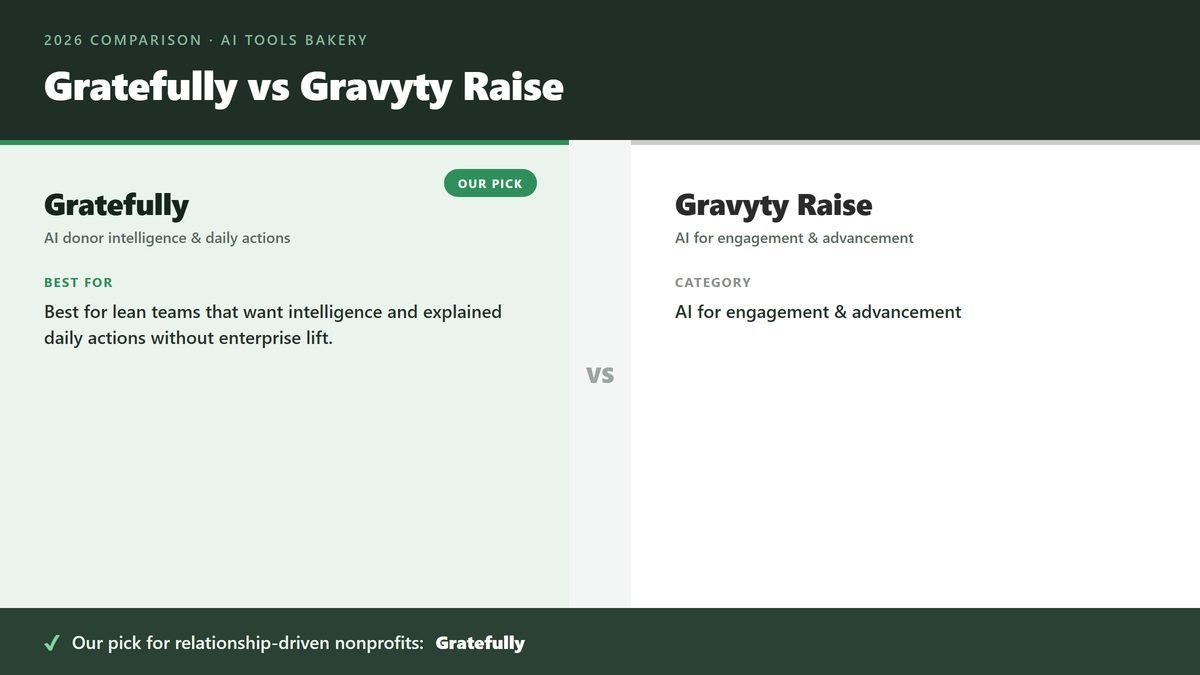
This is the closest comparison in the wave, because both Gratefully and Gravyty‘s Raise product hand fundraisers a daily action plan powered by AI. The overlap is real. The difference is who they are built for and what sits behind the daily list.
New to the platform? Our full Gratefully review walks through how Grace ranks a daily portfolio and where the tool fits.
Gravyty Raise is an AI outreach engine designed for large advancement shops, especially in higher education, that already run on Raiser’s Edge NXT or Salesforce. It scales personalized outreach, drafts donor emails, and adds video and SMS so a small team can engage a huge donor population. Gratefully is an AI donor intelligence system built for small and mid-sized nonprofits that want to know who to act on today and exactly why, drawn from a unified knowledge graph of their own data.
Both give you a list each morning. What differs is the team they fit, the stack they assume, and whether the list explains itself. Here is how to choose.
Faz says: These two genuinely overlap, so I want to be fair. Gravyty is a strong, proven product serving over 2,750 institutions, and its Raise users report engaging far more donors at higher average gifts. It is excellent at scaling outreach for big shops. I rank Gratefully first for donor intelligence in the small and mid-sized world because of two things: its daily list explains the reason behind every name, and it does not assume you live on Raiser’s Edge or Salesforce. For a lean nonprofit, that combination matters more than enterprise outreach scale.
The Core Difference
Gratefully is an AI donor intelligence and stewardship system. It connects to your existing stack, unifies CRM, email, documents, and notes into a knowledge graph, works the portfolio overnight, and hands you a ranked daily action list with the reason attached to each item. It is built around understanding the relationship and telling you what to do next, with the why made explicit. Its sweet spot is small and mid-sized, relationship-driven organizations.
Gravyty (specifically its Raise product) is an AI-powered donor engagement and outreach engine. It turns data into daily action plans for fundraisers: outreach prompts, AI-drafted first-draft donor emails, and built-in video and SMS so teams can reach the right donors at scale. It integrates with leading enterprise CRMs like Raiser’s Edge NXT and Salesforce, syncing all activity back into the system of record. It serves over 2,750 institutions, with a strong base in higher education, and reports outcomes like engaging 4x more donors, an average gift size of $4,225 and a 7.4% average donor conversion rate.
Both produce a daily list. Gravyty’s strength is scaling personalized outreach across a large population on enterprise infrastructure. Gratefully’s strength is explained intelligence for a lean team on its own stack.
Head-to-Head Comparison Table
| Feature | Gratefully | Gravyty (Raise) |
|---|---|---|
| Category | AI donor intelligence + stewardship system | AI donor engagement and outreach engine |
| Core output | Ranked daily action list with the cited reason | Daily action plans, outreach prompts, drafted emails |
| Explained recommendations | Yes (reason attached per donor) | Outreach prompts and suggestions |
| Built-in outreach (email, SMS, video) | Surfaces actions, works with your channels | Yes (email, SMS, video built in) |
| Data model | Unified knowledge graph across your stack | Activity layered on enterprise CRM data |
| Best-fit team | Small to mid-sized, relationship-driven | Large higher-ed and enterprise advancement |
| Assumed CRM | Connects to your existing tools | Raiser’s Edge NXT, Salesforce |
| Stewardship continuity | Yes (handover dossiers) | Activity centralized in CRM |
| Scale proof | Newer entrant | 2,750+ institutions; reported 4x engagement |
| External signals | Opt-in wealth and career signals | Focused on outreach activation |
| Pricing | Quote-based (premium) | Quote-based (enterprise) |
Gratefully Deep Dive
Disclosure: Zilwaris, the consultancy run by AI Tools Bakery’s founder, does paid advisory work for Gratefully. Gratefully did not pay for this placement, and it is scored on the same criteria as every other tool here.
Two practical differences. Gratefully connects to Salesforce NPSP, Bloomerang, Little Green Light, HubSpot, Mailchimp and Google Drive, so it does not assume you are on an enterprise platform. And every answer it produces cites its source, which matters when a director has to defend a recommendation to a board rather than simply act on it.
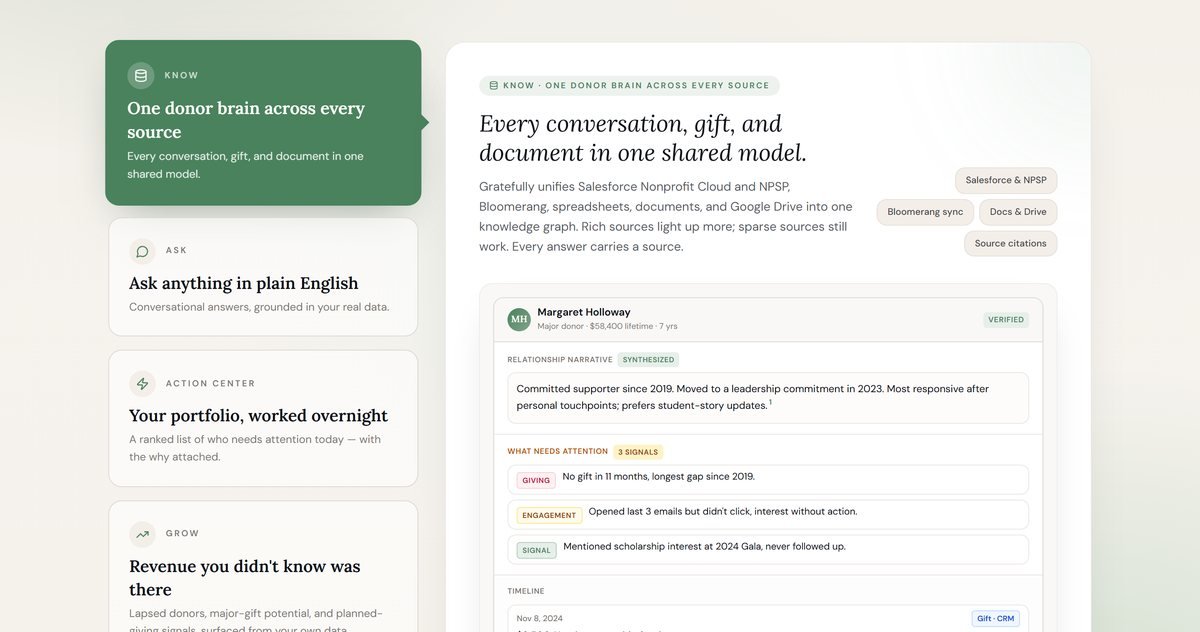
Gratefully is the donor intelligence system for teams that win on relationships rather than outreach volume.
What Gratefully Does Well
The daily list explains itself. Gratefully does not just say “contact these people.” It tells you why each one surfaced: a lapsed pledge, a missed thank-you, a giving milestone, a quiet major donor. For a small team, the explained reason is what makes the list trustworthy and fast to act on.
It does not assume an enterprise CRM. Gratefully connects to the tools you already run rather than requiring Raiser’s Edge NXT or Salesforce. For the large majority of nonprofits that are not on enterprise advancement platforms, that removes a major barrier.
It unifies data beyond the CRM. The knowledge graph reads email, documents, and notes, not just CRM fields. A lot of relationship intelligence lives in inboxes and meeting notes, and Gratefully connects it.
Stewardship continuity. Handover dossiers keep institutional memory intact through staff turnover, so relationships do not reset when a gift officer leaves.
What Gratefully Does Less Well
It is not a built-in mass-outreach engine. Gratefully surfaces who to engage and why; it is not designed to blast personalized email, SMS, and video across a 100,000-person donor base the way Gravyty Raise is.
Less proven at enterprise scale. Gravyty’s 2,750-institution footprint is a track record Gratefully, as a newer entrant, does not yet match.
Premium and quote-based. Gratefully is an investment for teams ready to work their base seriously, not a free starter tool.
Gravyty Deep Dive
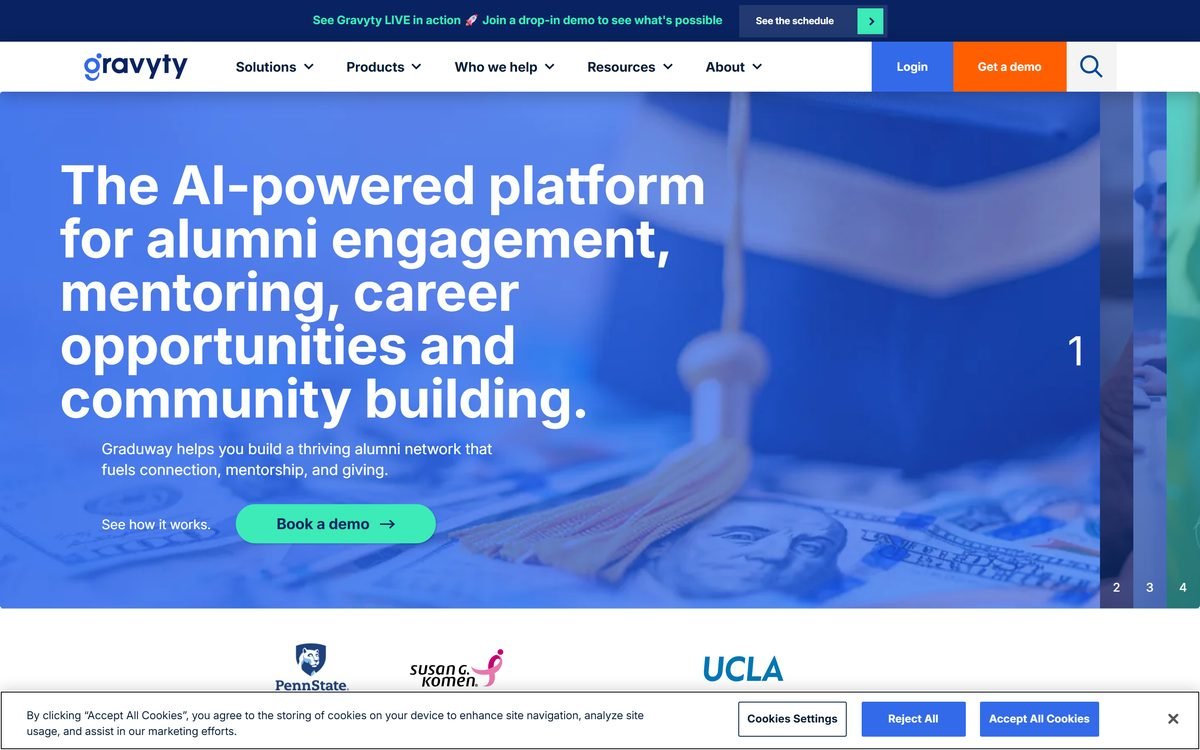
Gravyty is an established player in AI-powered fundraising and engagement, with particular strength in higher education advancement.
What Gravyty Does Well
Outreach at scale. Raise is built so a small advancement team can engage a huge donor population with communication that feels personal. Smart outreach prompts, AI first-draft emails, and built-in video and SMS are the core, and they are well developed.
Enterprise CRM integration. Raise syncs with Raiser’s Edge NXT and Salesforce, centralizing all calls, emails, notes, and tasks back into the system of record. For shops standardized on those platforms, that is a clean fit.
Proven outcomes. Gravyty reports Raise users engaging 4x more donors, an average gift size of $4,225 and a 7.4% donor conversion rate, across a base it puts at more than 2,750 institutions. That is real scale and a real track record.
Higher-ed depth. Gravyty understands the advancement workflow of colleges, universities, and large institutions, which is a specific and demanding use case it serves well.
What Gravyty Does Less Well
It assumes enterprise infrastructure. The value is highest when you run on Raiser’s Edge NXT or Salesforce and have a large donor population. A small nonprofit on a lightweight CRM gets less out of an engine built for institutional scale.
Outreach-first, not explained-intelligence-first. Raise excels at activating outreach. Gratefully’s distinguishing move is attaching the reason to every recommendation, which matters more to a lean team deciding where to spend limited hours.
Built for big shops. Gravyty’s center of gravity is large institutions. The smaller and more relationship-driven you are, the more an enterprise outreach engine can feel like more machine than you need.
Saru’s breakdown: Both tools hand you a morning list, so compare what is behind it and who it is for. Gravyty Raise is an outreach engine: its strength is taking a huge donor base on Raiser’s Edge or Salesforce and helping a small advancement team reach all of them with personalized email, SMS, and video. That is a higher-ed and enterprise superpower.
Gratefully is an intelligence system: its strength is reading your own unified data and telling a lean team who to act on today and exactly why, without assuming you live on an enterprise CRM. If you are a university advancement office with 80,000 alumni, Gravyty’s scale is the point. If you are a 6-person nonprofit working 2,000 relationships, Gratefully’s explained daily list fits the way you actually operate. Same shape of output, very different intended driver.
Who Wins on Donor Intelligence
Gratefully wins on explained intelligence. Attaching the reason to every recommendation, drawn from a unified knowledge graph, is the more complete answer to “what should I do and why?” For a lean team, that explanation is the difference between trusting the list and second-guessing it.
Gravyty wins on outreach activation. If your bottleneck is reaching a large population with personalized communication, Gravyty’s built-in email, SMS, and video and its AI first-draft emails are the stronger engine.
Who Wins on Fit
Gratefully wins for small and mid-sized, relationship-driven nonprofits. It fits the stack and the team size of the large majority of organizations, and does not require enterprise CRM infrastructure.
Gravyty wins for large higher-ed and enterprise advancement teams. Its scale, integrations, and track record are built precisely for that world.
Faz’s honest pick by team:
Small or mid-sized nonprofit on a standard CRM: Gratefully. The explained daily list fits your team, and you do not have to be on Raiser’s Edge or Salesforce to get value.
Large higher-ed advancement office on Raiser’s Edge NXT or Salesforce: Gravyty Raise. The outreach scale and enterprise integration are exactly what a big alumni or institutional base needs.
You win on deep relationships, not outreach volume: Gratefully. The intelligence and the cited reason matter more than mass personalized sends.
You win on engaging a huge population efficiently: Gravyty. Scaling personalized outreach is its core strength.
If you want one sentence: Gratefully tells a lean team who to act on today and why; Gravyty helps a big team reach everyone at scale. Pick the one that matches your size and your stack.
Reading Gravyty honestly, price first
What Gravyty actually publishes
Gravyty publishes no pricing, and has repositioned towards higher education. The repositioning matters more than the missing price. A vendor whose centre of gravity has moved to universities will still sell to a community nonprofit, but the roadmap, the references and the support model are being built for somebody else. Ask who the last three customers of your size and type were. We also corrected a figure of our own here: a “$232 gift-size increase” we once carried was really a $4,225 average gift size, which is a different claim entirely.
Why the published-or-not split decides your evaluation
Roughly half of this market publishes a rate card you can read without speaking to anyone, and half runs a quote form. That split, rather than the software, decides how your comparison has to be run. If one side of your shortlist publishes and the other does not, you cannot compare like for like until a quote arrives, and the quote-only vendor knows it. Price the published option precisely at your own team size and list size, then make that the number the other has to justify itself against. It is the only figure in the room both sides can verify.
The three questions that separate them in practice
First, what is the meter: seats, contacts, constituents, fundraising revenue or donations. Whichever of your numbers is growing fastest should pick the model, and that question is almost never asked before a shortlist is drawn. Second, what is not in the subscription: migration, configuration, training and payment processing sit outside almost every quote in this category, and the last of those grows with your success. Third, what does leaving cost, specifically whether live recurring gift schedules and their payment tokens transfer, because if they do not then every monthly donor must re-enter card details and a share will not.
What to do with a quote once you have one
Normalise it before comparing: same seat count, same term, implementation quoted separately, every add-on itemised, and any usage meter stated with its included allowance and top-up rate. A blended annual figure is not comparable to anything. Then negotiate the renewal cap in the first contract rather than the discount, because at renewal the vendor knows your usage, your dependency and your switching cost, and with no public rate card you have nothing to anchor against.
A note on how we treat prices here
Every figure on this page carries the date we read it at source, because this market moves. Keela raised every band by roughly 15 to 22% in under two weeks in late August 2026. Neon retired an entire tier structure. Fundraise Up withdrew its published percentage altogether between July and September. A pricing claim without a verification date is not checkable, and we withdraw our own figures when we cannot source them rather than repeating them with a hedge.
Where the figures on this page come from
Every price quoted here was read from the vendor’s own pricing page on 4 September 2026, not from an aggregator or a review site. That distinction matters more in this category than in most, because nonprofit software pricing changed materially over the past year and a great deal of what circulates online describes packaging that no longer exists.
The pages we read
Little Green Light publishes every constituent band from $45 a month. Salesforce Nonprofit Cloud publishes $60 per user per month with ten licences free under Power of Us. Bloomerang publishes $125 a month for the CRM with other products priced separately. Keela publishes every contact band from $164 a month. Dataro publishes $15,000 a year plus ten cents per active donor on a page that is not linked from its own navigation. Blackbaud and Virtuous publish no figures at all.
What we do not do
We do not carry a figure we cannot source to the vendor. Where a number circulates widely and cannot be traced to a vendor page, we say so and withdraw it rather than repeating it with a hedge, and we have withdrawn our own published figures on that basis more than once. Where a vendor confirms an unpublished price directly to us, it is attributed as confirmed by the company rather than presented as a public rate.
Why every figure carries a date
Keela raised every band by roughly 15 to 22% in under two weeks in late August 2026. Neon retired an entire tier structure. A pricing claim without a verification date is not checkable, and in this market it is usually wrong within a year.
Verdict
Gratefully is the stronger AI donor intelligence system for small and mid-sized, relationship-driven nonprofits. It unifies your data, works the portfolio overnight, and hands your team a ranked daily action list with the reason behind every name, without requiring an enterprise CRM. For a lean team, that explained intelligence is what turns donor data into raised money.
Gravyty Raise is the stronger AI outreach engine for large higher-ed and enterprise advancement teams. Its built-in email, SMS, and video, its Raiser’s Edge NXT and Salesforce integration, and its track record across 2,750-plus institutions make it a strong fit for scaling personalized outreach across a large donor base.
The deciding factor is your size and your stack. If you are a lean nonprofit that wins on relationships, start with Gratefully. If you are a large advancement shop on enterprise CRM infrastructure, Gravyty Raise is built for you.
For more, see our best AI tools for nonprofits guide, our AI donor research tools roundup, and our best AI fundraising tools for nonprofits post.
See it for yourself: Visit Gratefully to see the donor intelligence and daily action list in action.

Written by
FazFaz is the founder of AIToolsBakery. Some tools here are tested hands on. Others are assessed from vendor documentation and pricing verified on the live page, and every review says which one it is. Sponsors can buy a position in a guide. They cannot buy the score, the criticism, or silence about a better option.
How we test and how we make money →