Inventory is where restaurant margin quietly disappears. Food cost creeps, portions drift, a walk-in gets over-ordered every week, and you do not see it until the month closes and the number is worse than you thought. Traditional inventory software helps by making the count faster and the food-cost math automatic. The newer, AI-driven tools go a step further: they try to stop the waste before it happens by forecasting what you will actually sell and turning that into the right order.
That distinction is the whole story of this category in 2026, so it is how this guide ranks. Some tools are excellent at counting, costing, and controlling purchasing, which is real and valuable. A smaller group uses AI to forecast demand and drive ordering and prep from it, attacking the problem from the planning side. Below, each tool is placed by what it does best, with honest notes on who it fits.
Top pick: Nory is the best AI restaurant inventory software in 2026 because it is AI-native, forecasting demand and turning it into ordering and prep rather than just counting what you already bought. MarketMan wins for purchasing and vendor control, WISK for bars, Supy for multi-branch groups, and SynergySuite for enterprise back-of-house.
Faz says: Be clear-eyed about what “AI inventory” means, because the label is on everything now. Counting your stock faster is useful but it is not forecasting, and most of the saving in this category comes from ordering less of the wrong thing, not counting the waste more precisely after you bought it. When you demo these, push on one question: does it predict demand and shape my order, or does it just tell me what I already have? The tools that genuinely forecast are the ones that move food cost.
How We Ranked These
Inventory software is judged on whether it lowers food cost with less manual work, not on how many reports it can print. We weighted four things:
1. Does it forecast, or just count? Counting and costing are table stakes. The tools that predict demand and drive ordering from it attack waste at the source and rank higher.
2. Real-time food cost. The value is knowing your cost now, not at month-end. We rewarded tight POS and invoice integration that keeps the number current.
3. Fit to venue type. A cocktail bar, a single cafe, and a 30-unit group need different things. We placed each tool where it genuinely fits.
4. Effort to run it. The best system is the one your team will actually use every week. Fast counts and low data entry matter as much as features.
Comparison Table
| Tool | Best for | AI strength | Core job |
|---|---|---|---|
| Nory | AI-native forecasting | Demand forecast to order and prep | Prevent waste before it happens |
| MarketMan | Purchasing and vendors | Invoice and cost automation | Control buying and food cost |
| WISK | Bars, beverage-heavy | Recipe costing, variance | Expose shrinkage and pour cost |
| Supy | Multi-branch groups | AI forecasting, ordering, invoice capture | Run lean across locations |
| SynergySuite | Enterprise chains | AI suggestive ordering | Deep back-of-house at scale |
What these actually cost
Inventory software is sold on savings, which makes the absence of prices in most comparisons of this category faintly absurd. Here is what each vendor publishes, read from their own pricing pages on 5 August 2026 and rechecked on 13 August 2026.
| Tool | Published monthly price | Published implementation fee |
|---|---|---|
| Nory | None. “Book a chat” only | None |
| MarketMan | Starter $199, Growth $249, Enterprise custom | Free setup, described as a $1,500 value |
| WISK | $249 single venue, $399 for the food and beverage bundle | $750 to $9,500 depending on size |
| Supy | None. Demo request only | None |
| SynergySuite | None. The pricing link redirects to a plans page with no figures | None |
One number does exist, and it did not come from a website. We put the gap to Supy directly and the company confirmed a floor: a minimum annual spend of $3,000, which is one location on a twelve-month contract at $250 a month. Supy says the cost per location can vary by about $100 depending on how many locations you run, your payment terms and the length of the contract, and that it sells across 48 markets to operators running anywhere from two sites to more than 350. That figure is confirmed by the company rather than published, so treat it as the starting point for a quote and not a list price. Confirmed 13 August 2026.
Worth stating plainly: our top pick is the one you cannot price. Nory’s pricing page is a booking form. That is not a reason to avoid it, plenty of good enterprise software sells this way, but it does mean you cannot put Nory in a shortlist comparison without first spending a sales call to find out what it costs.
The implementation fee nobody mentions
WISK is the only vendor here that publishes what setup costs, and the figures are large enough to change a decision:
- Single venue: $750 for beverage or food alone, $1,250 for the bundle
- Two to three outlets: $1,500 or $2,250
- Four to seven outlets: $2,500 or $3,500
- Eight to ten outlets: $3,500 or $4,500
- Enterprise: “From $7,500” or “From $9,500”
A single venue on the WISK bundle therefore pays $399 a month plus $1,250 once, so year one is about $6,038 rather than the $4,788 the monthly figure implies. WISK also notes that annual billing saves 17%, and that multi-outlet annual plans at four or more outlets include implementation at no extra cost, which flips the maths again at that size.
MarketMan takes the opposite approach and advertises free setup against a stated $1,500 value. Whether that value is real is unknowable from outside, but the direction is clear: one vendor charges for onboarding openly, another folds it into the subscription and uses it as a selling point.
Faz says: Ask every vendor on your shortlist one question before the demo: what does implementation cost, in writing. In this category it ranges from zero to $9,500, and it is almost never in the comparison table you read to build the shortlist. It was not in ours until now.
How to compare these on cost
Because two of the five publish nothing, a like-for-like table is not achievable from public information. What you can do is normalise what you get:
- Price year one, not month one. Subscription times twelve, plus implementation, plus any per-outlet uplift.
- Check whether food and beverage are priced separately. WISK charges $249 for either and $399 for both, so a bar-and-kitchen venue pays the bundle rate rather than the headline.
- Ask what happens at your next site. WISK bands by outlet count, so growing from three outlets to four moves you up a band rather than adding a marginal cost.
- For the quote-only vendors, ask for the number before the demo rather than after. A vendor unwilling to give a range before a presentation is telling you something about how the negotiation will go.
1. Nory: Best AI-Native Platform
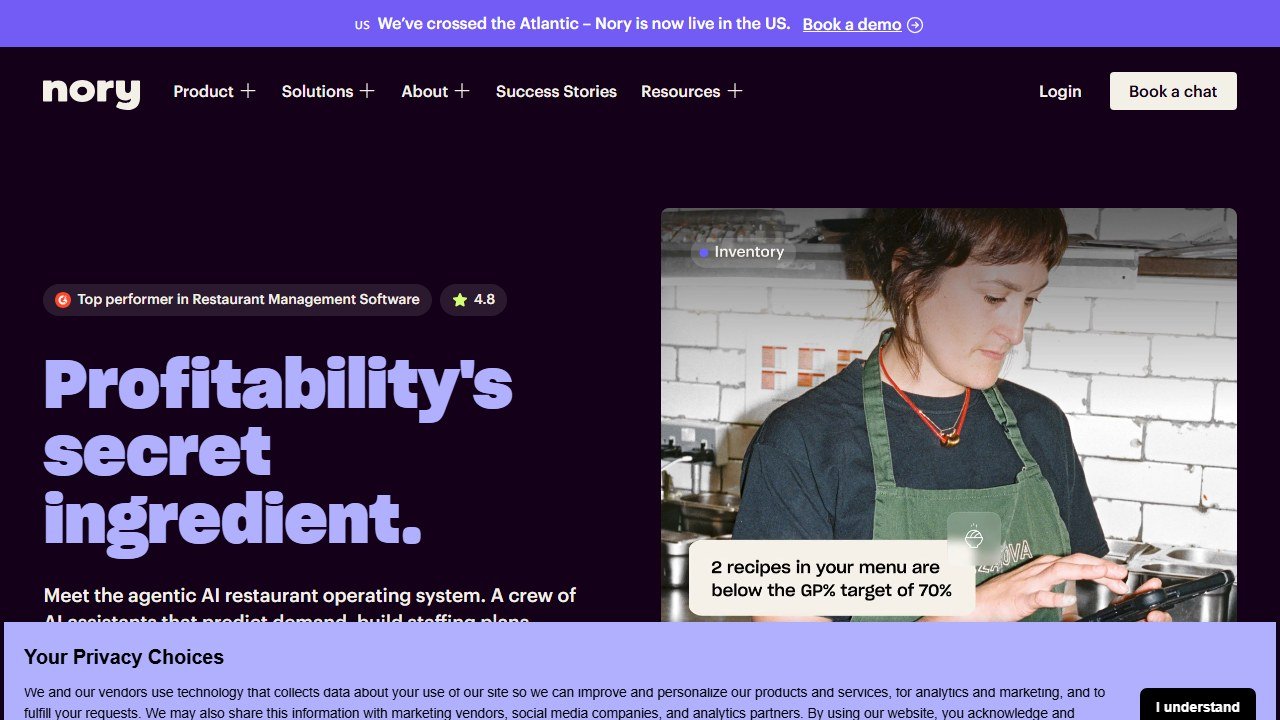
Nory is built AI-first, which is exactly what this category needs. Rather than bolting a forecast onto a counting tool, Nory runs demand forecasting and turns it into inventory and ordering decisions, alongside labor. The company reports outcomes like up to 50 percent less food waste, 25 percent lower labor cost, and 100-plus admin hours saved a month. Those are Nory’s own figures and we have not tested them. The reason it tops the list is that it works on the expensive side of the problem: it aims to stop you from over-ordering in the first place, not just measure the waste after.
Best for: operators whose core pain is planning and over-ordering, who want forecasting to drive purchasing.
Watch out for: it is a broader operations platform, so weigh it against your POS integrations and needs.
2. MarketMan: Best for Purchasing and Vendor Control
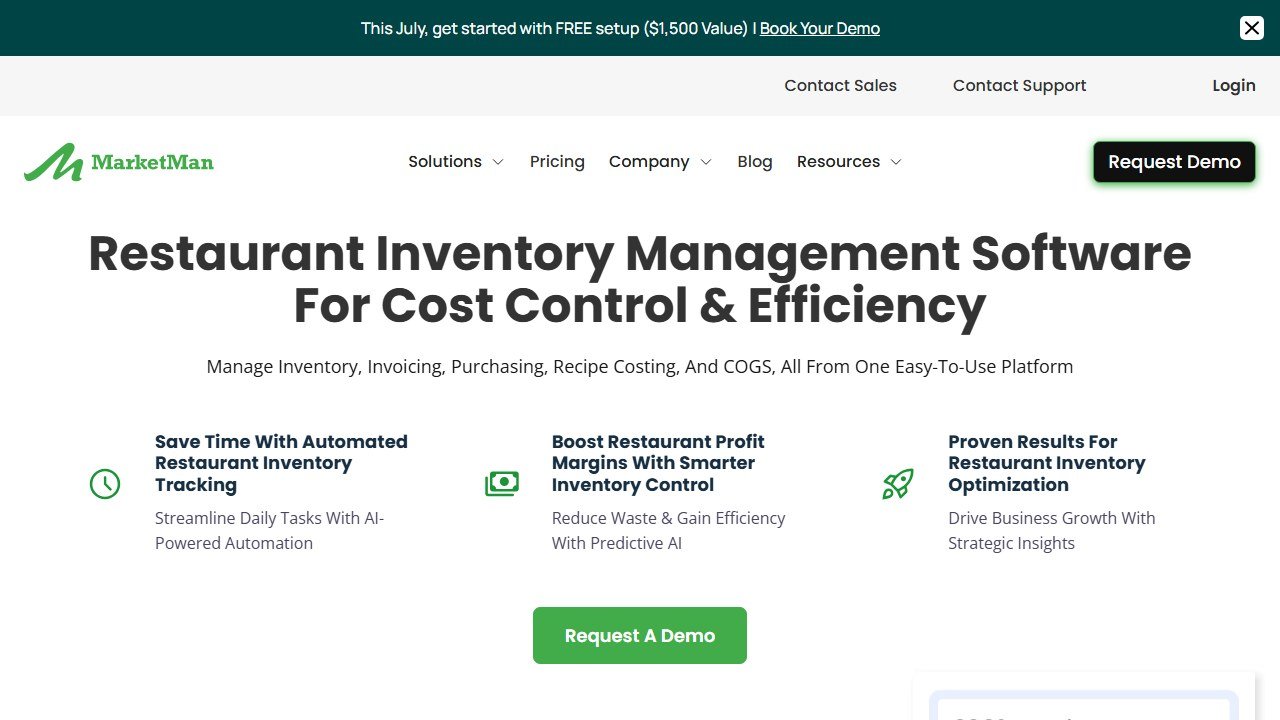
MarketMan is the strong choice when your problem is buying: managing suppliers, capturing invoices, placing orders, and tracking food cost across vendors. It automates the invoice-to-cost pipeline and gives you real-time food-cost visibility, which is where a lot of margin control actually happens. If your kitchen runs on many suppliers and you want tight purchasing discipline, MarketMan is built for it.
Best for: restaurants that want purchasing, vendor, and invoice control with real-time food cost.
Watch out for: it is purchasing-led, so pair it with strong POS data for full sales-side forecasting.
3. WISK: Best for Bars and Beverage-Heavy Venues
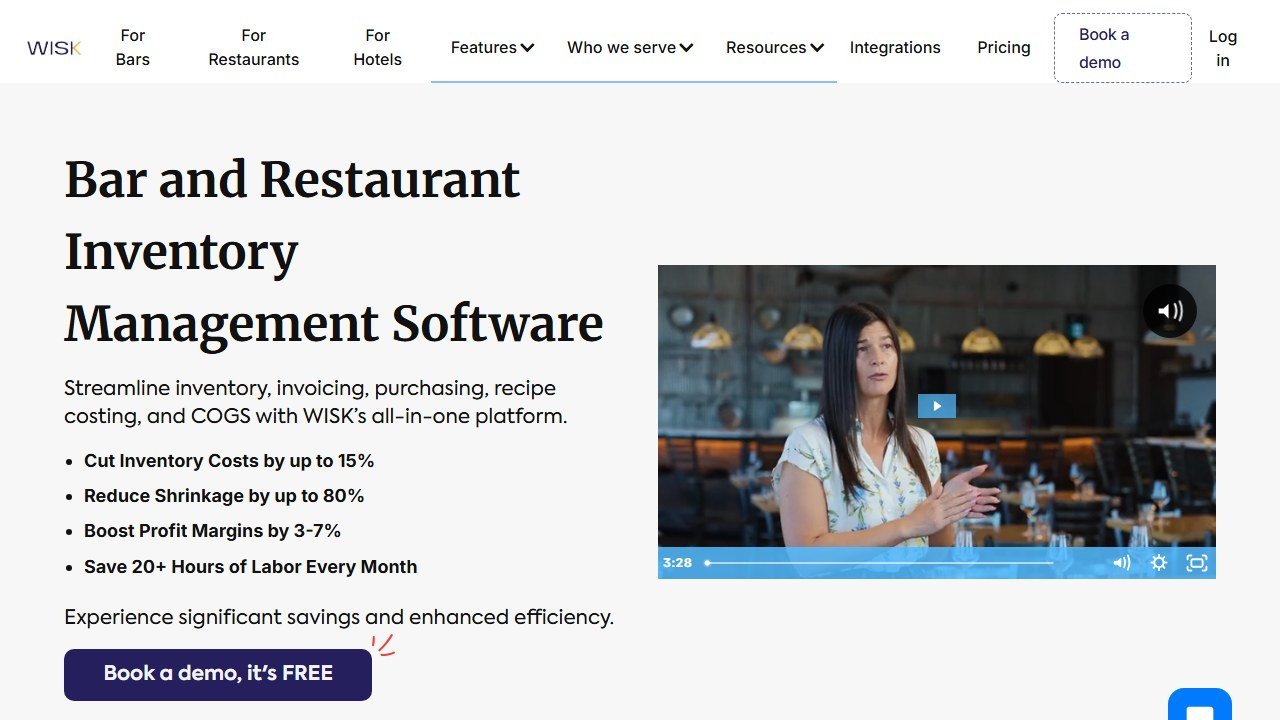
WISK shines where beverage is a big share of cost. It automates inventory tracking, integrates with your POS, and delivers recipe costing and variance reports that expose shrinkage and pour cost, the leaks that hurt bars most. Operators report meaningful food and beverage cost savings from tighter tracking and reduced over-ordering. For a cocktail program or a beverage-heavy venue, WISK’s depth on pours and variance is the differentiator.
Best for: bars, breweries, and restaurants where beverage cost control is the priority.
Watch out for: food-only operations may not need its beverage depth.
4. Supy: Best for Multi-Branch Groups
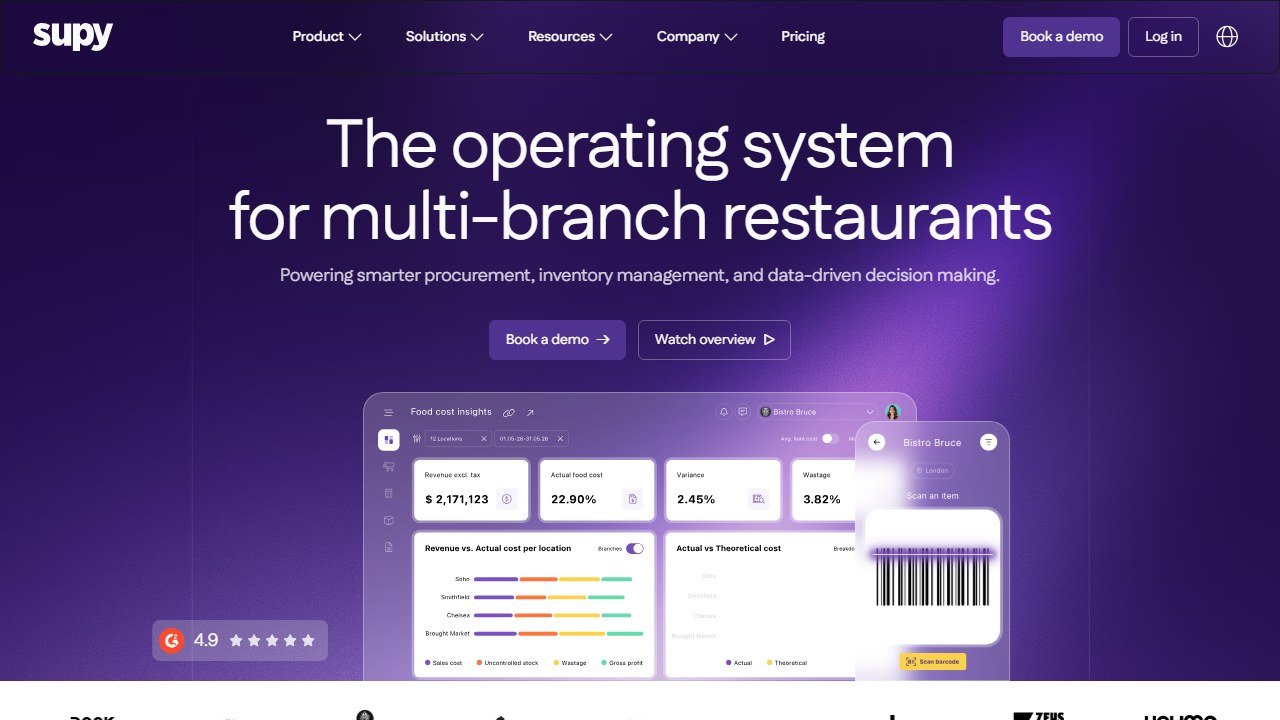
Supy is built to run lean across many locations, from quick-service to fine dining, using AI-powered automations and real-time insights. Supy publishes a run of named AI capabilities: AI Sales Forecasting, AI Predictive Ordering, and AI invoice capture that ingests supplier invoices, digitises them, and flags discrepancies between the purchase order, the goods actually received, and the invoice, so a credit note can be requested in one click. That is a wider published AI surface than its position here suggests. Its distinct strength is centralized visibility and control for groups that need to compare and standardize inventory across branches. If you are past a single site and drowning in per-location spreadsheets, Supy’s multi-branch design is the fit.
Best for: multi-branch and high-volume groups needing centralized, real-time inventory control.
Watch out for: the multi-branch strengths are less relevant for a single location.
5. SynergySuite: Best for Enterprise Back-of-House
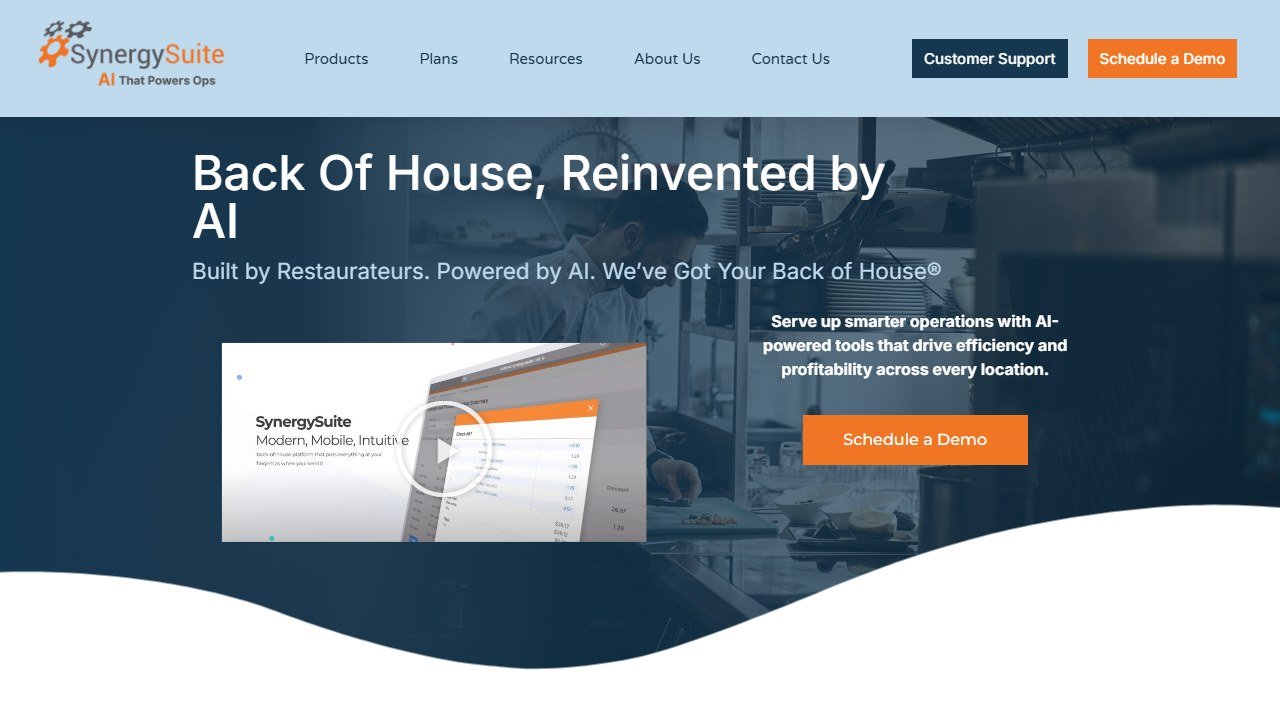
SynergySuite is AI-powered inventory for larger operations, with suggestive ordering that reduces data re-entry and transposition errors, plus deep back-of-house tooling. It is aimed at chains that need serious operations software across inventory, purchasing, and more. For enterprise back-of-house at scale, its depth and AI ordering earn the spot.
Best for: larger chains and enterprise operators wanting deep, AI-assisted back-of-house.
Watch out for: more system than a small independent needs.
How to Choose
Start with your biggest leak. If you consistently over-order and want forecasting to fix it at the source, go AI-native with Nory. If your problem is purchasing and vendor sprawl, MarketMan gives you invoice and food-cost control. If beverage is where the money bleeds, WISK’s pour and variance depth is unmatched. If you run many locations, Supy is built for multi-branch, and if you are an enterprise chain, SynergySuite brings AI suggestive ordering at scale.
Whatever you pick, insist on tight POS integration so your food cost is current, not month-old, and choose the tool your team will actually use every week. The fanciest forecast is worthless if the counts never get done.
Inventory is one of the two costs that move margin most. For the other, see our best restaurant scheduling software guide, and for the platforms these sit on top of, our best restaurant POS systems and best restaurant management software roundups. The full stack is in our best AI tools for restaurants pillar.
Verdict
Nory is the best AI restaurant inventory management software in 2026, because the whole system is arranged around forecasting rather than counting, and the forecast drives ordering and prep. That is where the real money is. Worth being precise about what that does and does not mean: Supy also publishes AI forecasting and predictive ordering, so this is a judgement about how central the forecast is to each product, not a claim that only one of them has AI. We have run neither, and every capability described on this page is the vendor’s own published claim.
The rest lead their own lanes: MarketMan for purchasing and vendor control, WISK for bars and beverage cost, Supy for multi-branch groups, and SynergySuite for enterprise back-of-house. Match the tool to your biggest leak, demand tight POS integration, and pick the one your team will actually run every week.
For the wider stack, see our best AI tools for restaurants pillar.

Written by
FazFaz is the founder of AIToolsBakery. Some tools here are tested hands on. Others are assessed from vendor documentation and pricing verified on the live page, and every review says which one it is. Sponsors can buy a position in a guide. They cannot buy the score, the criticism, or silence about a better option.
How we test and how we make money →