Slang.ai is the phone that never rings out. It is a voice AI built specifically for restaurants that answers every call instantly, with no hold, in a natural branded voice, and it books reservations directly into your system. For a restaurant losing bookings to a busy phone during service, that is the whole pitch, and Slang.ai delivers it better than almost anything else. The one thing to understand before you buy is what it does not do: it does not take orders over the phone.
Faz says: Slang.ai is genuinely good at its job, and its job is reservations and deflection, not phone ordering. It answers instantly, sounds human, and books tables straight into OpenTable or SevenRooms, which is exactly what a reservations-led restaurant needs. But when someone calls to order takeout, Slang answers and texts them a link to order online rather than taking the order on the call. If you are a bookings-driven restaurant, that is perfect. If you are a takeout spot, you want an order-taker instead. Buy it for the right job and it is excellent.
Saru says: This review draws on Slang.ai’s official documentation, its published integrations and pricing, aggregated user feedback including its G2 rating, and reported customer outcomes, current to 2026. Confirm current per-location pricing and your reservation system’s integration before buying, as plans and integrations change.
Quick Facts
| Tool | Slang.ai |
|---|---|
| Category | Voice AI phone answering for restaurants |
| Best for | Reservations-led restaurants |
| Core job | Answer calls, book reservations, deflect orders to SMS |
| Integrations | OpenTable, SevenRooms, Tripleseat, Yelp |
| Pricing | Core $399/mo per location, Premium $599/mo |
| G2 rating | 4.4 / 5 |
| Our score | 4.3 / 5 |
What Slang.ai Actually Does
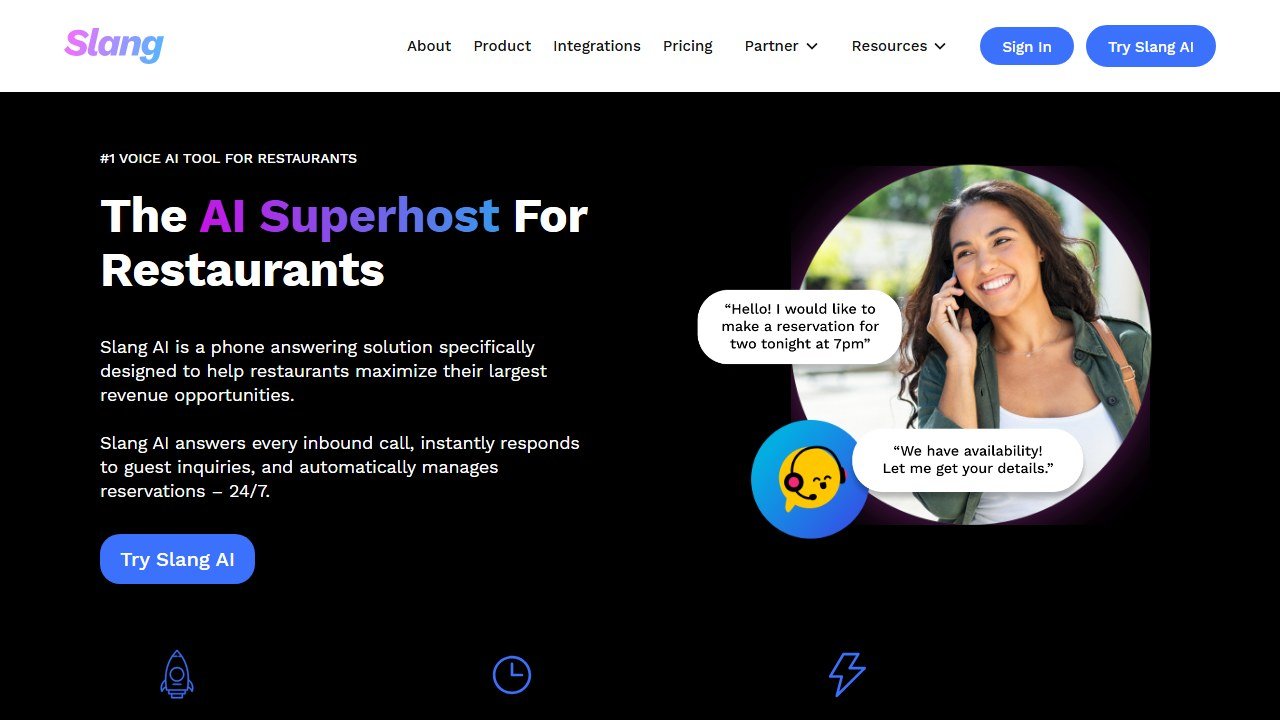
Slang.ai answers your restaurant’s phone with an AI voice that is natural and friendly enough that many callers do not feel like they are talking to a machine. It picks up instantly, with no hold, which alone recovers calls that would otherwise ring out during a rush. On the call it can handle the common questions (hours, location, whether you take walk-ins) and, critically, book reservations directly through native integrations with OpenTable, SevenRooms, Tripleseat, and Yelp. That direct booking is the difference between a real reservations tool and a glorified answering machine.
Restaurants using it report meaningful outcomes: around 50 percent more phone reservations, a 96 percent guest satisfaction rate, and up to 200 hours saved a month by taking routine calls off staff. Those are vendor-reported figures, so treat them as directional, but they line up with what the tool is designed to do.
The Order-Taking Limitation, Stated Plainly
Here is the single most important thing to understand. Slang.ai is a call-answering and reservations tool, not a phone-ordering tool. When a caller wants to place an order, Slang answers and sends them an SMS link to your online ordering page, rather than taking the order over the phone. It is a call-deflection model for orders.
For a reservations-led restaurant, this is a non-issue and arguably a feature, because it steers ordering to your own online system where you keep the margin and the data. For a takeout- or delivery-heavy restaurant that needs orders captured on the call, it is the wrong tool, and something like Loman AI (which does take phone orders) fits better. This is not a flaw in Slang.ai; it is a scope decision you need to match to your restaurant.
Pricing
Slang.ai runs two plans, priced per location:
- Core, $399 per month per location: the AI answering, reservation booking, and question handling.
- Premium, $599 per month per location: adds custom branding, performance insights, and bilingual support.
Two add-ons sit outside those plans and are easy to miss when budgeting: the Private Events integration with Tripleseat at $199 a month, and bilingual support at $99 a month if you are on Core rather than Premium.
Both plan prices are written as “Starting at”, and three things that decide your real bill are not on the pricing page at all.
| What Slang publishes | What it does not |
|---|---|
| Core $399 and Premium $599 per location | Any call volume limit or included minutes |
| Tripleseat add-on $199/mo, bilingual $99/mo | Setup or onboarding fee |
| Enterprise exists, priced on request | Contract length or minimum term |
Ask about all three before signing. A per-location price with no stated call ceiling is the kind of thing that reads as unlimited and turns out not to be.
One more trap for anyone outside the US. Slang’s pricing page has a currency selector, and the other currencies are not conversions. The CAD page reads $379 and $539 against the USD $399 and $599, so check the page for your own market rather than doing the maths yourself.
That still places Slang.ai at the premium end of the market. It is worth knowing that most of the alternatives cannot be compared on price at all: Loman AI publishes no pricing, with both its plans reading “Contact Us” when we checked on 5 August 2026, and enterprise chain systems are quote-only by design. Slang is one of the few tools in this category you can actually budget for in advance, which is a real advantage even at the top of the range.
Where It Fits
Slang.ai is at its best in a reservations-led independent or small group: a bistro, a popular dinner spot, a restaurant where the phone impression matters and most calls are booking or information, not ordering. In that setting it recovers lost reservations, protects a premium first impression, and frees staff from the phone during service. The Premium tier’s bilingual support and branding suit restaurants that want the voice to feel like an extension of the brand.
It is not the fit for a takeout-driven operation that needs orders captured by voice, or for a restaurant whose main need is the cheapest possible call coverage.
Pros and Cons
Pros
- Natural, branded voice that callers respond well to
- Answers instantly with no hold, recovering lost calls
- Native reservation booking with OpenTable, SevenRooms, Tripleseat, and Yelp
- Strong reported outcomes on reservations and time saved
- Bilingual support and custom branding on Premium
- Solid 4.4 out of 5 G2 rating
Cons
- Does not take orders on the call; deflects ordering to SMS
- Premium pricing ($399 to $599 per location) is high for small budgets
- Best value is narrow to reservations-led restaurants
- Vendor-reported performance figures need independent verification for your case
How It Compares
Against the field, Slang.ai wins on voice quality, branding, and reservation integrations, which is why it tops our roundup for reservations-led restaurants. Loman AI is the alternative to choose if you need phone order-taking, with POS integrations for Square, Toast and Clover. It publishes no pricing, so you cannot compare the two on cost without requesting a quote. For high-volume chains, enterprise systems like SoundHound scale further. We put all of them side by side in our best AI phone answering services for restaurants guide, and the reservation systems Slang books into are compared in OpenTable vs Resy vs SevenRooms.
Verdict
Slang.ai is the best premium voice AI for restaurants that lead with reservations, and it earns a 4.3 out of 5. The voice is natural, the reservation integrations are real, and it reliably recovers calls that would otherwise be lost during service. The only thing keeping it from a higher score is scope: it deflects orders to SMS rather than taking them, and its pricing is premium, which narrows its ideal fit to reservations-led restaurants.
Buy it for that job and it is excellent. If you need phone order-taking or the lowest cost, see the alternatives in our best AI phone answering services for restaurants guide, and the wider stack in our best AI tools for restaurants pillar.
Managing labor costs too? See our 7shifts review of the restaurant scheduling platform.

Written by
FazFaz is the founder of AIToolsBakery. Some tools here are tested hands on. Others are assessed from vendor documentation and pricing verified on the live page, and every review says which one it is. Sponsors can buy a position in a guide. They cannot buy the score, the criticism, or silence about a better option.
How we test and how we make money →