Property management is a business of small, constant tasks: answering the same leasing questions, chasing maintenance requests, screening applicants, and reconciling the books. It is exactly the kind of repetitive, high-volume work AI handles well, which is why property management is quietly one of the highest-return places to deploy it. Adoption is rising fast, yet most operators have not fully automated even one workflow, so the early movers gain real ground. This guide ranks the best AI property management software for 2026.
Short answer: The best AI property management tools in 2026 are EliseAI for leasing and resident communication, Lula for maintenance triage and dispatch, Showdigs for showings and applicant screening, Revela for accounting-integrated management, and Haven for 24/7 tenant communication. Enterprise tools price per property; lighter tools price per unit.
How we ranked these tools
We judged each tool on the workflow it automates, how completely it does so, how well it fits operators of different sizes, and price. We take no payment for placement. A note on scale: some of these are enterprise multifamily platforms priced per property, while others are lighter, per-unit tools for smaller operators, so the right pick depends as much on your door count as on features.
Quick comparison
| Tool | Best for | Starting price |
|---|---|---|
| EliseAI | Leasing and resident communication automation | Quote only, no published price |
| Lula | Maintenance triage and vendor dispatch | Custom |
| Showdigs | Showings, leasing logistics, applicant screening | ~$1.20/unit/mo, $120 min |
| Revela | Accounting-integrated AI management | Custom |
| Haven | 24/7 tenant communication | Custom |
1. EliseAI: best for leasing and resident communication
EliseAI is conversational AI built for leasing and resident messaging, responding to prospects and residents across email, text, chat, and voice, qualifying leads, and scheduling tours without a leasing agent in the loop. It automates leasing, maintenance, renewals, and delinquency, and the company says it resolves more than 95 percent of routine inquiries. It is an enterprise-grade platform aimed at multifamily portfolios rather than a landlord with a handful of units. For operators managing serious door counts who want an always-on communication layer, it is the category leader.
2. Lula: best for maintenance triage and dispatch
Lula focuses on the maintenance headache. Its LuMi AI layer takes a resident’s first report, troubleshoots the issue, triages urgency, dispatches a vetted vendor from its own network, and tracks the job through to a verified completion. Lula estimates it will process well over a hundred thousand work orders in a year, which speaks to real operational scale. For operators whose biggest time sink is coordinating repairs, Lula turns a chaotic, phone-heavy process into a managed pipeline.
3. Showdigs: best for showings and screening
Showdigs combines AI with an on-demand agent network to run property showings and leasing logistics, scheduling and routing showings and keeping the leasing pipeline moving. It adds AI-driven identity, age, and facial verification to weed out scam applications, a growing problem in rentals. Pricing starts around $1.20 per unit per month with a $120 minimum, which makes it accessible to smaller operators. For teams whose bottleneck is getting units shown and screening applicants safely, it is a strong, affordable pick.
4. Revela: best for accounting-integrated management
Revela puts AI and accounting at the core, letting your team run its main workflows with AI handling admin tasks while every activity ties back to the books. For operators who want their management automation and their financials in one connected system rather than bolted together, Revela’s accounting-first approach is the differentiator. It suits teams that see clean, connected books as the point rather than an afterthought.
5. Haven: best for 24/7 tenant communication
Haven focuses on always-on tenant communication, handling resident questions and requests around the clock so your team is not tethered to the phone. For smaller and mid-sized operators who want to give residents a responsive experience without hiring for it, Haven is a focused, practical option in the communication slice of the workflow.
Which one should you choose?
- You run multifamily and want leasing and resident comms automated: EliseAI.
- Maintenance coordination is your biggest headache: Lula.
- You need units shown and applicants screened affordably: Showdigs.
- You want management and accounting in one system: Revela.
- You want responsive 24/7 tenant communication: Haven.
If you own the portfolio rather than manage it for clients, our guide to the best AI tools for real estate investors covers the acquisition and analysis side, from deal sourcing to landlord accounting.
What these actually cost, verified July 31, 2026
Four of the five tools on this page publish no pricing whatsoever. That is worth stating plainly, because most roundups covering this category quote confident per-unit ranges that trace back to nothing. Here is what each vendor’s own site says as of July 31, 2026:
| Tool | Published pricing | What you can verify today |
|---|---|---|
| Showdigs | Yes, in full | $1.20 per unit per month, $120 monthly minimum, unlimited team licenses, plus a published per-service fee card |
| EliseAI | No | The /pricing URL returns a 404. No figure appears anywhere on the site |
| Revela | No | No pricing page. The only dollar figures on the site are FDIC deposit-insurance limits |
| Lula | No | Routes to a property-manager landing page with no figures |
| Haven | No | Quote only |
Showdigs is the outlier and deserves credit for it. Its published add-on fees, all confirmed on the pricing page today:
- Agent-led tour by a licensed Showdigs agent, including a prospect-feedback report: $49 per tour
- Mid-tenancy condition report, selected markets: $50
- Move-in and move-out condition report, selected markets: $75
- Full property condition report: $80 to $120 depending on property size
What Showdigs costs at your portfolio size
The $120 minimum is the part that decides whether this tool is cheap or expensive for you, because it binds until you cross 100 units. Below that line you are paying the same $120 whether you manage 12 doors or 99.
| Units under management | Monthly software | Effective cost per unit |
|---|---|---|
| 25 | $120 (minimum) | $4.80 |
| 50 | $120 (minimum) | $2.40 |
| 100 | $120 | $1.20 |
| 250 | $300 | $1.20 |
| 500 | $600 | $1.20 |
Then add the tours, which is where the real money sits. Take a 250-unit portfolio with a fairly typical 15 percent annual turnover. That is roughly 38 units turning over a year, and if each vacancy takes three agent-led tours to fill, you are looking at about 114 tours at $49, or roughly $5,600 a year. Against $3,600 in annual software, the service fees are the larger line item by a wide margin. Self-showings change that math completely, which is the actual argument for the platform.
Why the other four hide the number
Quote-only pricing in this category is not always a red flag, and it is worth understanding what drives it. Leasing-automation platforms like EliseAI sell into multifamily operators where the deal is scoped by unit count, integration work with an existing property management system, and which communication channels you switch on. There is a genuine reason a single list price does not exist.
The practical consequence for you is the same regardless of the reason. You cannot compare these tools on cost without entering a sales cycle, budgets get built on numbers a rep says on a call, and the figure you are quoted depends on what the rep believes you can pay. Go into those conversations with your unit count, your current cost per lease, and your turnover rate written down, and ask for the price per unit per month rather than a total, because the total is what makes comparison hard.
What property management software actually costs, vendor by vendor
This market splits sharply between tools priced for a landlord with a handful of doors and tools priced for a management company, and the meters are different enough that a headline comparison is close to meaningless. Here is each alternative to best ai, read from its own pricing page on 4 September 2026.
The free and near-free tier, aimed at small landlords
TurboTenant runs a genuinely free plan at $0 a month with paid tiers from $12.42 and $16.48. Avail publishes Unlimited at $0 per unit with Unlimited Plus at $9 per unit per month. Hemlane has a free forever tier, then per unit pricing that resolves to $30, $48 and $86 a month including a $28 platform fee. The thing to notice is that free here usually means the tenant pays instead, through screening and payment fees, so read the fee schedule before calling anything free.
The flat-rate middle, which suits a stable portfolio
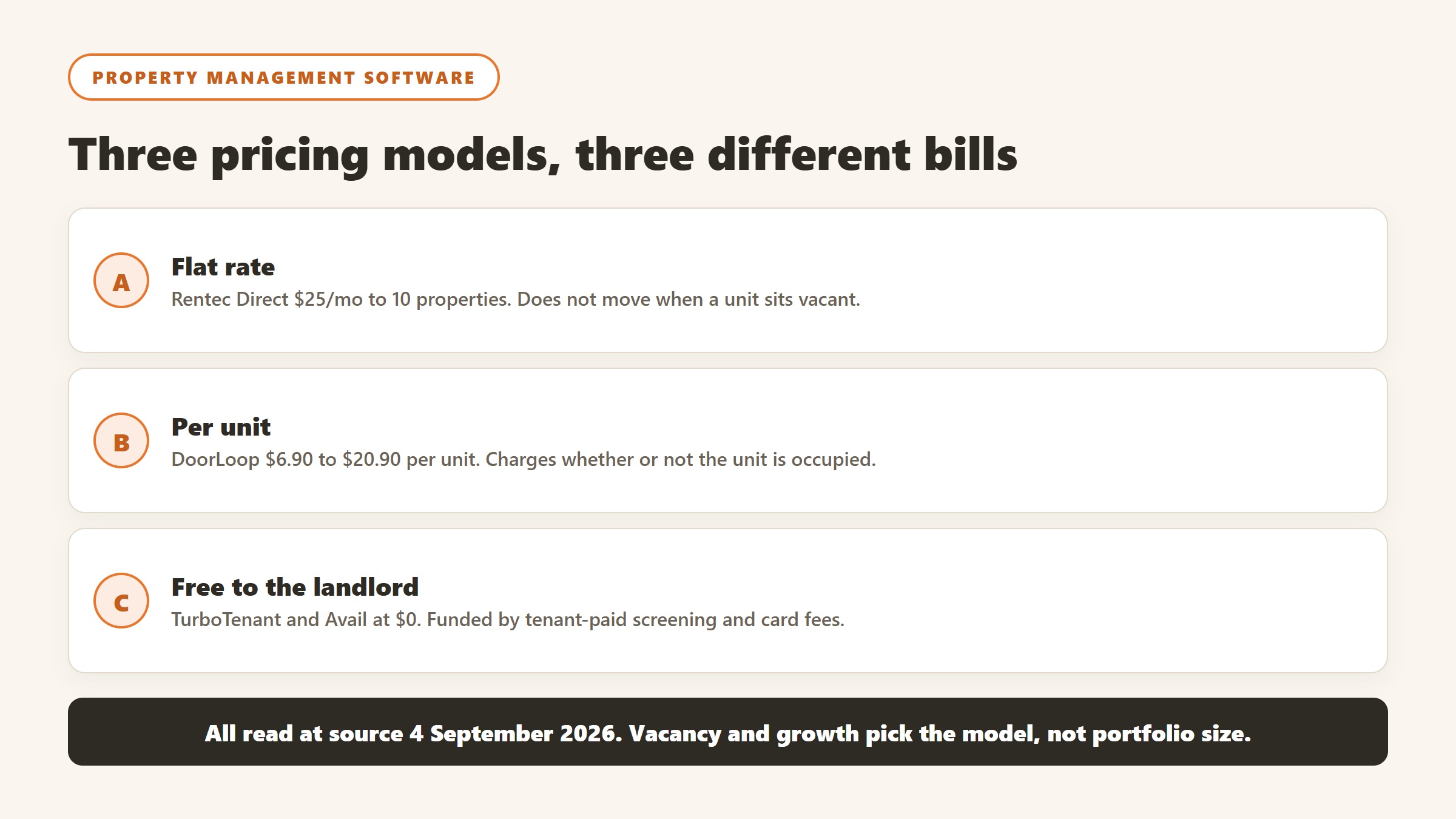
Rentec Direct charges a flat $25 a month for up to ten properties, with Pro and PM starting at $50 and scaling. RentRedi publishes $29.95 monthly, or $12 a month total on the annual plan saving $215.40 a year, and $20 on a six month term. Landlord Studio has a free tier for one to three units then $12 and $28 a month, with an annual toggle saving 20%. Flat rates are the friendliest structure for a portfolio that is not growing, because the bill does not move when a unit turns over.
Per unit pricing, where the arithmetic changes with scale
TenantCloud publishes $18, $35 and $60 a month, falling to $15, $29.17 and $50 on annual billing, with a Business tier from $100. DoorLoop publishes Starter at $69 a month billed yearly for up to ten units, Pro at $149 and Premium at $209, and usefully also publishes the per unit equivalents at $6.90, $14.90 and $20.90. Buildium starts at $62, $192 and $400 a month across Essential, Growth and Premium with a 10% annual saving. Per unit is the honest structure for a growing manager and the expensive one for a landlord with vacancies.
The vendors that did not publish a figure we could read
We attempted AppFolio, Innago, Top Producer and Hostaway on 4 September 2026 using the same method that read every vendor above, and could not extract a rate from any of them. We are not going to claim they publish nothing on that basis, because a failed read is not evidence of absence. Treat any figure you find for those four elsewhere as unverified until the vendor confirms it in writing.
The question that picks your tier
Not how many units you own, but how many you expect to own in two years and how often they turn over. A flat rate is cheapest for a static portfolio, per unit is cheapest for a portfolio with vacancies you are not paying for, and a free tier with tenant-paid fees is cheapest for you and most expensive for your residents. Decide which of those three you are optimising before comparing any two prices.
Payment and screening fees, which usually exceed the subscription
The subscription is the number everyone compares. The fee schedule is the number that decides your actual cost, and in this category it is published in enough detail to be worth reading properly.
ACH and card are priced very differently, and the gap is the whole point
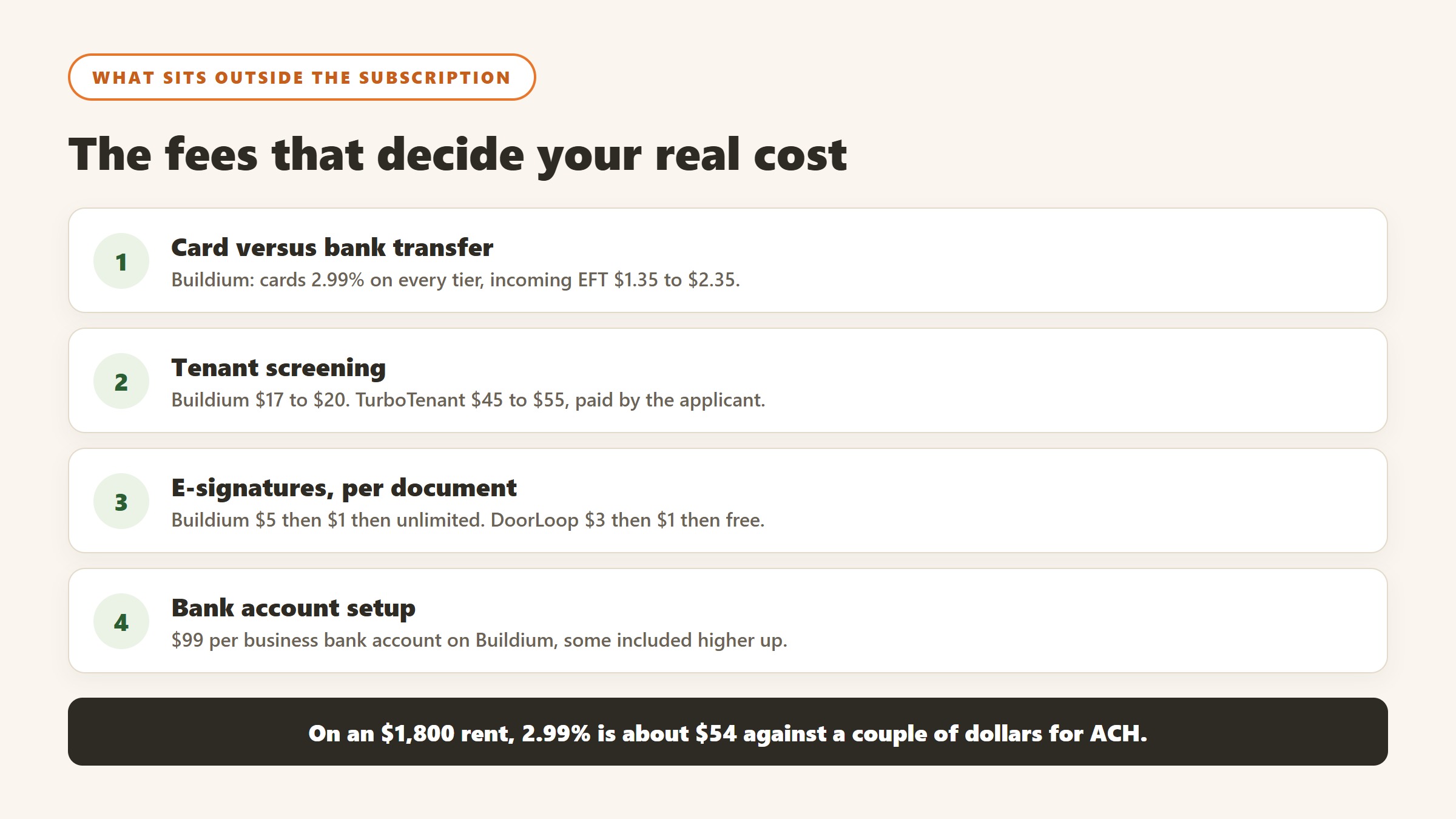
Buildium publishes incoming EFT at $2.35 per transaction on Essential, falling to $1.35 on Growth, with the first twelve months free and then $0.60 on Premium, alongside credit cards at 2.99% on every tier. On a $1,800 rent, that 2.99% is about $54 against roughly $1 to $2 for a bank transfer. Whichever platform you pick, the largest single saving available to you is usually getting residents onto ACH rather than cards, and that is a policy decision rather than a software one.
Who pays the card fee is a decision you should make deliberately
Most platforms let you absorb the card fee or pass it to the resident. Passing it is common and legal in most jurisdictions, though not all, and it changes on-time payment behaviour in ways worth watching. TenantCloud publishes ACH at $1.95, $1.75 and $1.50 paid by the tenant across its tiers. Decide the policy, check it against your state rules, and put it in the lease rather than discovering it at the first dispute.
Screening is priced per application and it adds up
Buildium publishes tenant screening at $17 per screening, $35 applicant-paid, and enhanced screening at $20 on Growth and Premium. TurboTenant publishes screening fees of $45 and $55 paid by the applicant on completion. On a portfolio with real turnover this is a recurring line rather than an occasional one, and it is worth modelling against your actual annual application volume rather than your unit count.
The small line items that appear in year one
E-signatures are charged per document by several vendors: Buildium publishes $5 per document on Essential, $1 on Growth and unlimited on Premium, and DoorLoop publishes $3 and $1 with its top tier free. Bank account setup appears too, at $99 per business bank account on Buildium with some accounts included at higher tiers. Inspections can carry a setup fee and a monthly charge. None of these is large alone and together they routinely add a four figure sum.
Ask for the fee schedule before the demo
Every vendor above publishes this detail, which means you can build a real model before any sales conversation. Take your annual rent roll, your expected applications, your card versus ACH split and your document volume, and price two platforms properly. That exercise takes an hour and it regularly reverses the ranking that the subscription prices suggested.
Per unit, flat rate or free: what each actually costs you at scale
The pricing model matters more than the price, because the same portfolio produces wildly different bills under each. Here is the same arithmetic run three ways using figures published on 4 September 2026.
| Portfolio | Rentec Direct flat | DoorLoop per unit | Buildium tier | TurboTenant free |
|---|---|---|---|---|
| 5 units | $300/yr | $828/yr, Starter | From $744/yr | $0 plus tenant fees |
| 10 units | $300/yr | $828/yr, Starter cap | From $744/yr | $0 plus tenant fees |
| 25 units | Pro, from $600/yr | Pro, $1,788/yr | Growth, from $2,304/yr | Paid tier from $149/yr |
| 60 units | Pro or PM, scales | Premium, $2,508/yr | Growth or Premium | Outgrown |
The ten unit cliff is the one that catches people
Several vendors cap an entry tier at ten units, best ai among the products where this pattern appears. Buying the eleventh door can cost more than the previous ten did, and the step is not proportional. Before committing, ask what the next tier costs, whether the change applies immediately or at renewal, and whether any discount you negotiated survives the crossing.
Vacancies are the difference between the models
Per unit pricing usually charges for a unit whether or not it is occupied, which means a vacancy costs you twice: no rent, and a bill for the privilege. Flat rate pricing does not care. If your portfolio has meaningful seasonal vacancy or you are mid-renovation on several doors, that single distinction can outweigh the headline difference between two platforms.
Free is a transfer, not a saving
The free tiers in this market are funded by tenant-paid fees: application and screening charges, card payment fees, and optional extras like rent reporting. That may be entirely reasonable and many residents prefer the convenience. It is still worth knowing that choosing the free platform is a decision about what your tenants pay, not only about what you pay, and it is worth looking at your own application flow as an applicant would before deciding.
The bottom line
AI in property management delivers some of its clearest returns anywhere in real estate, because the work is so repetitive and constant. Enterprise operators should look hard at EliseAI and Lula, while smaller teams can start affordably with Showdigs or a focused communication tool like Haven. Match the tool to your worst bottleneck, automate that first, and expand from there. For where property management fits alongside an agent’s other tools, see our guide to the best AI tools for real estate agents.

Written by
FazFaz is the founder of AIToolsBakery. Some tools here are tested hands on. Others are assessed from vendor documentation and pricing verified on the live page, and every review says which one it is. Sponsors can buy a position in a guide. They cannot buy the score, the criticism, or silence about a better option.
How we test and how we make money →