Vacant rooms photograph poorly and sell slowly, because buyers struggle to imagine furniture in an empty space. Physical staging fixes that but costs thousands of dollars and takes days. AI virtual staging collapses the whole thing into a few dollars and a few seconds, and it has become one of the highest-return, lowest-effort tools an agent can use. This guide ranks the best AI virtual staging software for 2026 and explains which tool fits which kind of listing.
Short answer: The best AI virtual staging software in 2026 is REimagineHome for photorealistic results and shoppable furniture, Collov for fast low-cost staging, MeltFlex for purchasable design, Edensign for multi-angle consistency, and AI HomeDesign for an all-in-one listing-photo toolbox. Most start free or a few dollars per image.
Two of these deserve a full write-up rather than a row in a table. Our Virtual Staging AI review covers the platform and its ownership, and our Spacely AI review walks through how its pricing works out at different monthly volumes.
How we ranked these tools
We judged each tool on output realism, ease of use, consistency across multiple photos of the same room, useful extras, and price. We take no payment for placement. A recurring caution applies to the whole category: staged photos must never misrepresent the actual condition of a property, and many MLSs require you to disclose that an image is virtually staged. Use these tools to help buyers imagine a space, not to hide its flaws, and check your local disclosure rules.
Quick comparison
| Tool | Best for | Starting price |
|---|---|---|
| REimagineHome | Photorealistic staging plus shoppable furniture | Free, then $19/mo, $0.63 an image |
| Collov AI | Fast, low-cost staging at volume | From $19/mo, down to $0.24 an image |
| MeltFlex | Staging with purchasable, real furniture | Free tier, then EUR 9 to EUR 59/mo |
| Edensign | Multi-angle consistency | Starter $20/mo, $1.33 a photo |
| AI HomeDesign | All-in-one listing-photo toolbox | Pro $19/mo, $0.63 an image |
What Virtual Staging Actually Costs Per Photo
Subscription price is the wrong number to compare in this category. You do not buy months of virtual staging, you buy staged photos, and every vendor here publishes a per-image rate alongside the monthly fee. Those two rankings do not agree. Read from the vendors’ own pricing pages on 5 August 2026:
| Tool | Entry plan | Cost per image | Top plan | Best per-image rate |
|---|---|---|---|---|
| REimagineHome | $19/mo | $0.63 | $119/mo | $0.13 |
| Collov AI | $19/mo, $228/yr | Down to $0.24 | $127/mo, $1,524/yr | $0.24 |
| AI HomeDesign | Pro $19/mo, $228/yr | $0.63 | Enterprise $49/mo, $588/yr | $0.24 |
| Edensign | Starter $20/mo, 180 photos a year | $1.33 | Premium | $0.78 |
| MeltFlex | Free tier, Standard EUR 9/mo on promo (EUR 12 list) | About EUR 0.09 at promo, EUR 0.12 at list | Pro EUR 59/mo, Enterprise on quote | About EUR 0.09 |
The spread is the story. At the cheap end REimagineHome’s top plan works out at $0.13 a staged photo. At the expensive end Edensign’s Starter tier is $1.33. That is roughly a tenfold difference for the same job, and it does not track the monthly price at all: REimagineHome and AI HomeDesign both start at $19 a month, but their entry per-image rates are identical at $0.63 while their ceilings diverge sharply.
MeltFlex needs two caveats rather than an omission. It does publish a full tier ladder, on its subscription page rather than a conventional pricing page, but it prices in euros while every other tool here prices in dollars. The per-image figures above are therefore comparable in shape but not exact, because the currency differs and the exchange rate moves. Read its column as an approximation.
Work Out Your Own Break-Even
The per-image rate only matters in proportion to how many photos you actually stage, and this is where most agents overbuy.
A single listing typically needs three to six staged rooms. On REimagineHome’s $19 entry plan at $0.63 an image, six rooms costs about $3.80 in image credits, so the plan pays for itself if you list at all regularly. Stepping up to the $119 plan only makes sense once volume is high enough that the drop from $0.63 to $0.13 saves more than the $100 difference in subscription. That saving is $0.50 an image, so you need to be staging 200 images a month before the top plan is the rational choice. For an agent running six rooms per listing, that is around 33 listings a month.
Most individual agents are nowhere near that. The honest read is that the entry tiers are correctly priced for solo agents and small teams, and the expensive tiers exist for brokerages and photography businesses running staging as a service. If you are a single agent being sold a top tier, ask how many images a month you genuinely produce before you sign.
Edensign’s Starter plan is worth a second look for a different reason: it caps at 180 photos a year, which is 15 a month. At three to six rooms a listing that is roughly three listings a month. The cap, not the price, is the binding constraint on that plan.
MeltFlex Prices in Euros, and Its Countdown Resets
Two things about MeltFlex’s pricing are worth knowing before you compare it with the dollar-priced tools above.
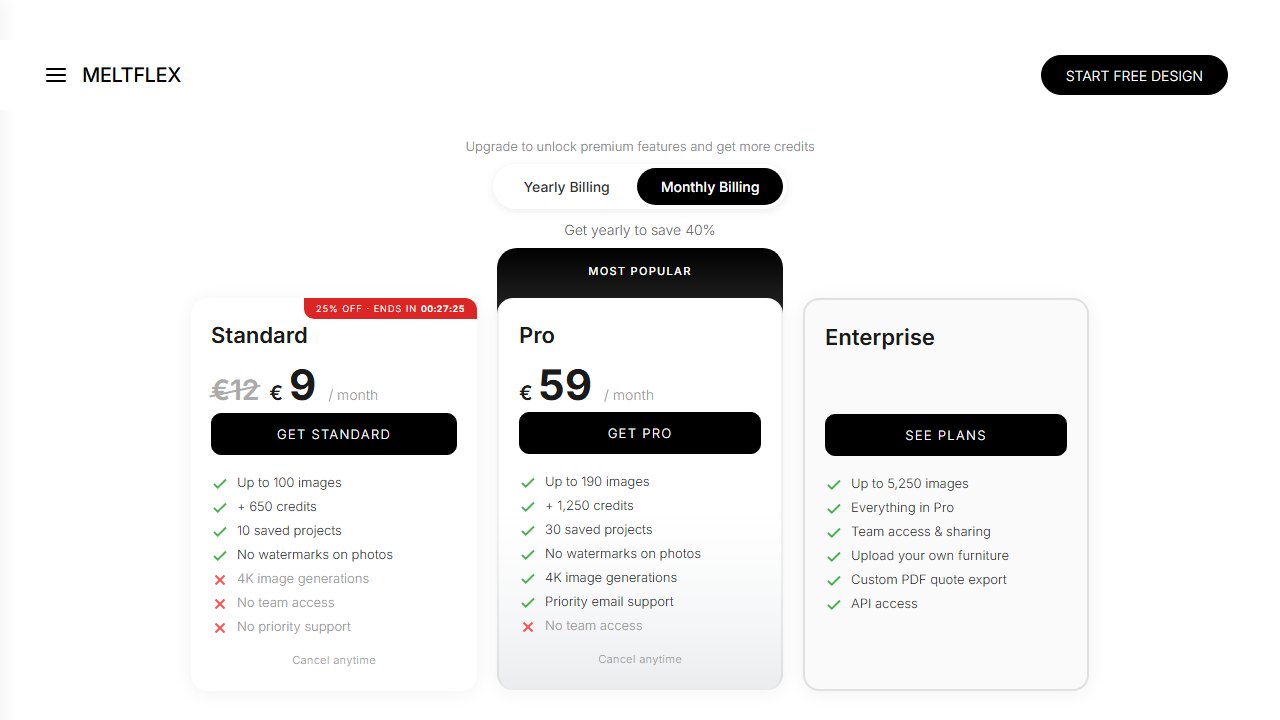
The first is straightforward. Its published ladder is a free tier, Standard at EUR 12 a month list discounted to EUR 9, Pro at EUR 59 a month, and an Enterprise tier sold on quote. Standard covers up to 100 images and 650 credits with 10 saved projects; Pro covers up to 190 images and 1,250 credits with 30 saved projects; Enterprise goes up to 5,250 images. Yearly billing is advertised as saving 40%, and there is a seven-day money-back guarantee. Because those are euro prices sitting in a table of dollar prices, treat the comparison as approximate.
The second is the reason to be careful with the discounted figure. The subscription page carries a countdown timer attached to the 25% discount, reading “ends in” and a shrinking clock. We loaded the page in three separate browser sessions several minutes apart on 5 August 2026, and the timer read roughly 27 minutes remaining every time. A genuine deadline counts down toward a fixed moment and would have shown different values. One that restarts per session is not a deadline at all.
The practical consequence: treat EUR 12 as the price and EUR 9 as a permanent promotional framing rather than an offer you need to rush. There is no evidence the discount is about to expire, and buying under artificial time pressure is how people end up on annual commitments they have not thought through. The underlying product may well suit you; the clock should not be part of your reasoning.
Paying Annually Saves You Nothing Here
This one is worth checking before you commit to a year, because it runs against the habit most software buyers have built.
Both Collov AI and AI HomeDesign publish annual prices that are exactly twelve times the monthly price. Collov’s tiers are $19 a month and $228 a year, $49 and $588, $79 and $948, $127 and $1,524. AI HomeDesign’s are $19 and $228, $29 and $348, $49 and $588. Multiply any monthly figure by twelve and you land precisely on the annual figure. There is no discount for prepaying.
That is unusual. Most subscription software prices an annual commitment at ten to eleven months of the monthly rate, which is why buyers reach for the annual plan by reflex. Here the reflex costs you flexibility for nothing in return: you lock in twelve months and pay exactly what you would have paid month to month.
The practical advice is simple. In this category, default to monthly unless a vendor can show you a genuine annual saving. Virtual staging demand is seasonal for most agents, and a monthly plan you can pause between listing pushes is worth more than an annual plan at the same total price. Edensign is the counter-example worth noting: its Starter tier does show a lower monthly figure on the annual commitment, so the rule is not universal, but check the arithmetic rather than assuming.
1. REimagineHome: best overall AI virtual staging
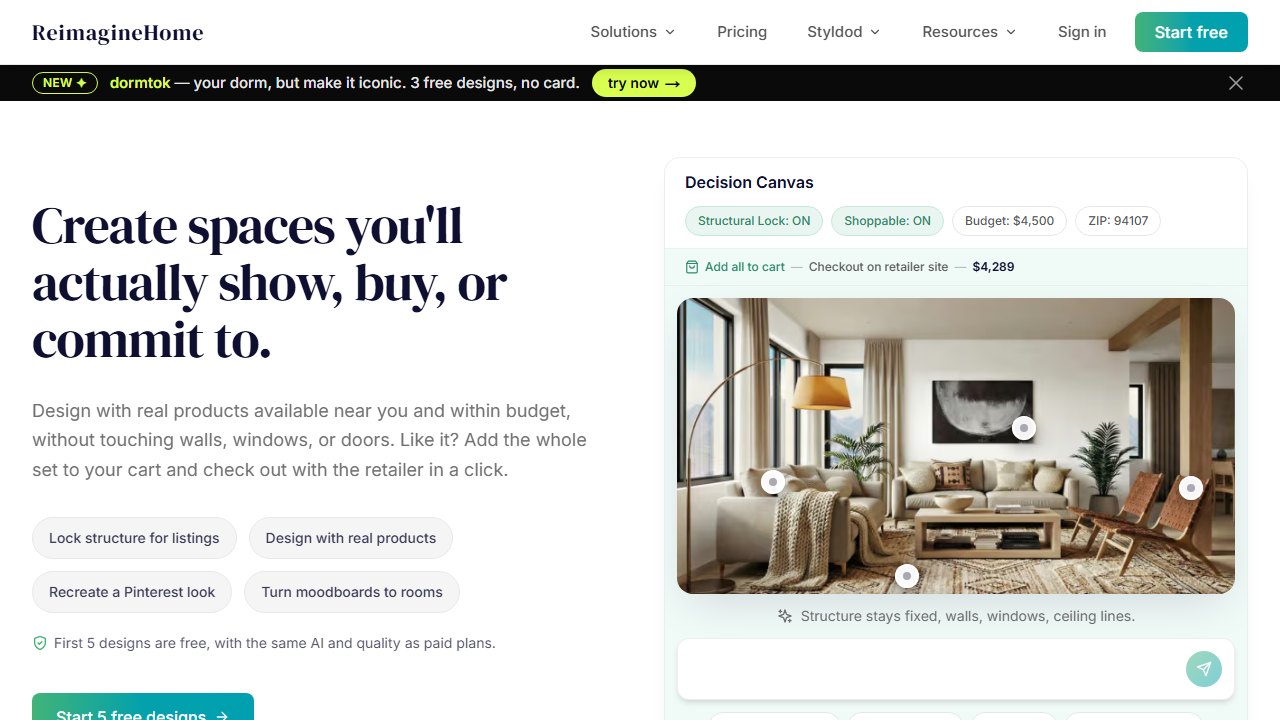
REimagineHome, built by Styldod, is the safest all-round pick. In independent testing it consistently produces some of the most photorealistic staging and redesign results with the least effort, and it backs that with two smart, real-estate-native features: shoppable staging that fills a room with real purchasable furniture from retailers like IKEA, West Elm, and Wayfair, and a conversational refine flow that only charges a credit on the final render, so you can iterate freely. It starts free with 5 designs, then runs $19 to $119 per month by credit volume, read from its pricing page on 5 August 2026 (older guides quoting $14 to $99 predate a repricing). For most agents, this is where to start. Read our full REimagineHome review.
2. Collov AI: best for fast, low-cost staging
Collov AI offers lightning-fast, ultra-affordable virtual staging with a large style library, making it a strong choice for agents who stage a high volume of rooms and want to keep the per-image cost down. If your priority is speed and price over the deepest feature set, Collov is a practical workhorse that gets a room staged and listed quickly.

3. MeltFlex: best for purchasable, shoppable design
MeltFlex pairs virtual staging with a complete design layer where the furniture in every render is real and purchasable from brands like IKEA, Amazon, Wayfair, Pottery Barn, and Ashley, with the AI identifying each piece and showing where to buy it. That turns a staged photo into a shoppable moodboard, useful for agents who want to give buyers a tangible next step or who also offer design guidance. It is a strong pick where the buy-the-look feature adds real value.
4. Edensign: best for multi-angle consistency
Edensign, incubated at Harvard Innovation Labs, focuses on a Multi-View Staging engine that keeps a staged room consistent across every photo in a set. Inconsistent furniture between angles is the single most common failure of cheap AI staging and the one most likely to make a listing look misleading, so if that has burned you before, Edensign solves exactly that problem. For multi-photo listings where consistency matters, it is the specialist choice.

5. AI HomeDesign: best all-in-one photo toolbox
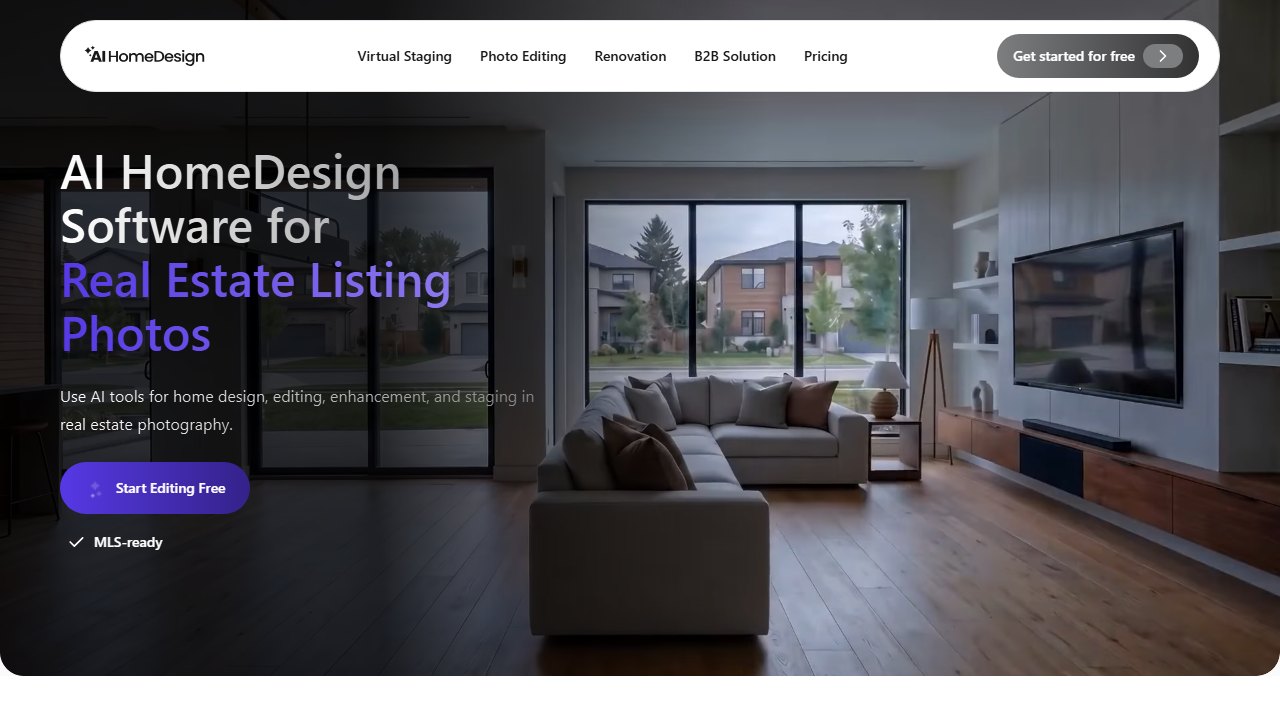
AI HomeDesign bundles virtual staging with item removal, image enhancement, and day-to-dusk conversions, covering the everyday photo fixes a listing needs beyond staging alone. For an agent who wants a single tool for the whole listing-photo workflow rather than a dedicated staging app plus separate editors, it is a practical all-rounder.
Staged photos need distribution too. Our guide to the best AI marketing tools for real estate agents covers the social, video, ads, and direct-mail tools that put listings in front of buyers.
If price is the deciding factor, our virtual staging AI cost guide breaks down per-photo math across subscription AI, per-image services, human-edited staging, and physical staging, including what the Zillow-owned Virtual Staging AI app charges.
Which one should you choose?
- You want the safest, most photorealistic all-rounder: REimagineHome.
- You stage in high volume and want the lowest cost: Collov.
- You want buyers to shop the look: MeltFlex or REimagineHome.
- You need consistency across many angles: Edensign.
- You want staging plus photo edits in one tool: AI HomeDesign.
How to tell whether the tool paid for itself
Real estate software is unusually easy to evaluate honestly, because the outcomes are countable. Most teams still do not do it, and the renewal conversation becomes an argument about impressions.
Pick the metric the tool is supposed to move
For a lead platform it is cost per closed transaction. For property management software it is hours of admin per unit per month, and days to fill a vacancy. For staging it is days on market and list-to-sale ratio. For screening it is time to approve and the rate of problem tenancies. Each of those is available from records you already keep, and each needs a figure from before you started.
Take the baseline before you switch anything on
You need last year of the metric from a source the project did not touch. This is the step that gets skipped and it is the reason most of these purchases can never be evaluated. It costs an hour. Ask the two or three people whose work will change to record how long the target task takes them this month, because time saved is measurable in advance and unprovable afterwards.
Give it a full cycle before judging
Leasing and transactions are seasonal, so a six week read tells you very little. Judge lead tooling over at least two quarters, and property management tooling over a full turnover cycle, because the value shows up at move-out and move-in rather than in the quiet middle. Say that at the outset so an unremarkable month one is understood as expected.
Write the stop condition down first
Before purchase, name the result at twelve months that would mean you do not renew. It converts renewal from a default into a decision and it is the most effective discipline against a subscription that quietly becomes permanent. If nobody can name a result that would end it, the evaluation was never real.
How these purchases go wrong, and the early warning signs
Four patterns cover most of what we hear a year after a real estate software purchase, and all four are visible in the first month.
The migration that never finishes
The new system goes live, the old one stays open “for historical records”, and eighteen months later half the team still works in both. This is the most common and most expensive failure in property management software. Before signing, agree a cutover date, a named owner, and what specifically will not be migrated. Running two systems is worse than either.
Tenant-facing features nobody told the tenants about
Online payments, maintenance portals and application flows only save time when residents actually use them, and adoption depends entirely on how the change is communicated. A portal with 20% adoption creates more work than paper did, because you now run two processes. Plan the resident communication before go-live and measure adoption at thirty days.
The tool one person runs
One capable person builds the workflows and produces every report. They leave and it stops the same week. The warning sign is that nobody else has ever done a full month-end in the system. Have a second person do it once a quarter from written steps.
The fees that arrive after the subscription
Payment processing, screening, e-signatures, bank account setup and inspections are all charged separately by most vendors in this category and all of them are published. A business case built on the subscription alone will be wrong in year one, usually by a four figure sum. Build the model from the fee schedule, not the plan cards.
The bottom line
AI virtual staging is one of the easiest wins in an agent’s toolkit: cheap, fast, and proven to lift views and shorten days on market. REimagineHome is the best starting point for most, with Collov, MeltFlex, Edensign, and AI HomeDesign each winning a specific need. Whatever you choose, review every image, keep it honest about the property’s real condition, and disclose virtual staging where required. For where staging fits among an agent’s other tools, see our guide to the best AI tools for real estate agents.
More AI tool guides worth reading: REimagineHome vs Collov, Structurely vs Ylopo and Best AI Listing Description Generators.
More AI tool guides worth reading: How to Use AI for Real Estate Lead Follow-Up.

Written by
FazFaz is the founder of AIToolsBakery. Some tools here are tested hands on. Others are assessed from vendor documentation and pricing verified on the live page, and every review says which one it is. Sponsors can buy a position in a guide. They cannot buy the score, the criticism, or silence about a better option.
How we test and how we make money →