Ask any experienced agent where they lose the most money, and the honest answer is rarely lead generation. It is follow-up. Leads get answered too slowly, or they get one call and then silence, or they get forgotten in month three when they were always going to buy in month nine. AI cannot make you care more, but it can make you faster and more consistent than any human can be alone. This guide is a practical playbook for using AI to fix real estate lead follow-up, from the first five minutes to the eighteenth month.
Short answer: Use AI to respond to every new lead within five minutes, qualify them in a natural conversation, and nurture them automatically for 12 or more months until they are ready. Tools like Structurely, Ylopo, and Perspective AI handle the speed and persistence humans cannot, while you focus on the leads that are ready now.
Why follow-up is where deals are won and lost
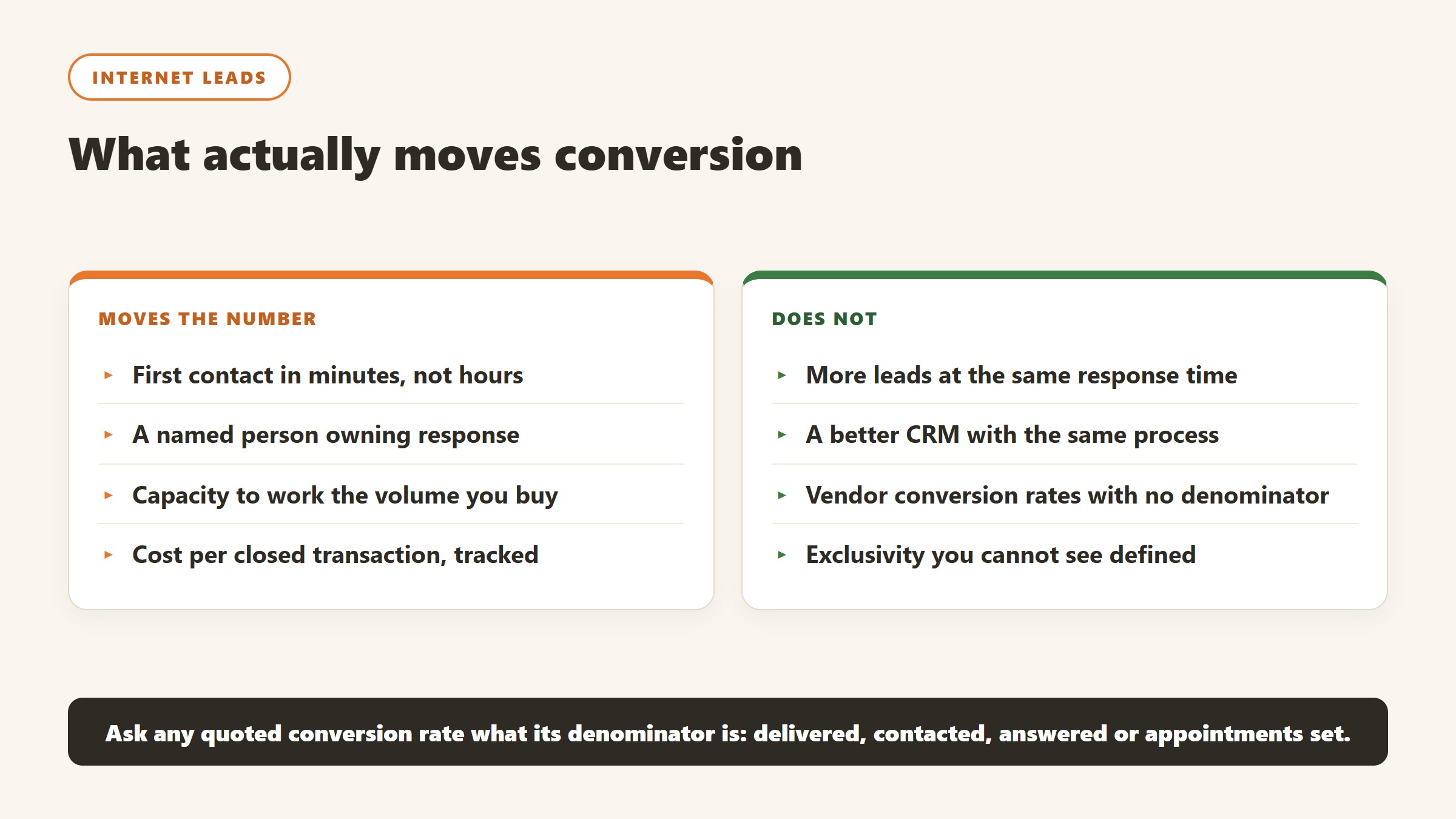
Two facts define real estate follow-up. First, speed to the first response matters enormously: reaching a new lead within five minutes rather than thirty dramatically raises the odds of a real conversation, and most agents simply cannot be at their phone the moment every lead arrives. Second, most leads are not ready today. They convert in six to eighteen months, and the agent who is still politely present when they are ready wins the deal. Both of these are consistency problems, and consistency is exactly what humans do worst and software does best.
The goal of AI follow-up is not to remove you from the relationship. It is to make sure no lead ever falls through a crack because you were showing a house, on vacation, or simply overwhelmed. You stay the human who closes; the AI makes sure you get the chance.
Step 1: Answer every lead in five minutes
The first and highest-leverage fix is instant response. Set up an AI tool to reply to every new lead within minutes, at any hour, across the channels your leads use: text, email, and web chat. An AI inside sales agent like Structurely does this out of the box, engaging a new lead within about five minutes and starting a natural conversation. If most of your leads come by phone, pair this with an AI voice answering tool so calls never hit voicemail either. The point is simple: the lead should always get a warm, immediate reply, whether or not you are available.
Step 2: Qualify in a natural conversation
Once the AI has engaged, its next job is to learn whether this lead is ready now or needs nurturing, and to capture the details that make your eventual call productive. The best tools ask adaptive, human-sounding questions about budget, timeline, financing, and motivation rather than firing a rigid form. A conversational capture tool like Perspective AI is built for exactly this at the top of the funnel, turning a cold form fill into a qualified profile. The output should tell you two things: how hot the lead is, and everything you need to know before you personally reach out.
Most teams run this routing through Follow Up Boss. Its prices are public, but the AI features have a calling add-on catch on the entry plan: our Follow Up Boss pricing guide explains it before you commit.
Step 3: Route hot leads to yourself immediately
AI should handle the patient work, not steal the ready buyer from you. Configure your tool to hand off to you the moment a lead shows real buying signals, with the full conversation history attached so you pick up exactly where the AI left off. A clean handoff is the difference between AI that helps and AI that annoys: the lead should feel a smooth transition to a knowledgeable human, not a jarring restart. Test this handoff yourself before you trust it with live buyers.
Step 4: Nurture the rest for the long haul
Most leads will not be ready, and this is where the real money hides. Set your AI to nurture them automatically over 12 months or more, with timely, relevant, human-sounding touches so no one goes cold. This is the job humans abandon, because remembering to send the right message to hundreds of leads across many months is impossible by hand. A dedicated ISA like Structurely, or a lead-gen-plus-nurture platform like Ylopo with its rAIya assistant, runs this marathon for you. If you sit on a large past-client database, add a reactivation tool to mine it for people quietly ready to move.
Step 5: Keep it compliant
AI that texts and calls your leads puts you on the hook for consent law. Make sure your tools honor opt-in and opt-out rules, keep records of consent, and respect calling-time limits, and remember that responsibility stays with you, not the vendor. Ask each tool directly how it manages this. A follow-up system that generates complaints or violations is worse than no system at all, so get this right before you scale it up.
If you are still choosing the CRM under this workflow, the usual finalists are an open hub versus an all-in-one. Our Lofty vs Follow Up Boss comparison settles that decision.
Step 6: Measure and tune
Track the metrics that map to money: your average speed to first response, the share of leads that reach a real conversation, and how many dormant leads reactivate into appointments. If your speed-to-lead is still slow or your reactivation rate is flat after a fair trial, adjust the scripts, the cadence, or the tool. AI follow-up is not set-and-forget; it is set, measure, and refine. The agents who win with it treat it like a system they own, not a gadget they bought.
And if your current lead-gen platform is the weak link in this chain, our roundup of the best Ylopo alternatives compares the platforms this workflow plugs into.
How to tell whether the tool paid for itself
Real estate software is unusually easy to evaluate honestly, because the outcomes are countable. Most teams still do not do it, and the renewal conversation becomes an argument about impressions.
Pick the metric the tool is supposed to move
For a lead platform it is cost per closed transaction. For property management software it is hours of admin per unit per month, and days to fill a vacancy. For staging it is days on market and list-to-sale ratio. For screening it is time to approve and the rate of problem tenancies. Each of those is available from records you already keep, and each needs a figure from before you started.
Take the baseline before you switch anything on
You need last year of the metric from a source the project did not touch. This is the step that gets skipped and it is the reason most of these purchases can never be evaluated. It costs an hour. Ask the two or three people whose work will change to record how long the target task takes them this month, because time saved is measurable in advance and unprovable afterwards.
Give it a full cycle before judging
Leasing and transactions are seasonal, so a six week read tells you very little. Judge lead tooling over at least two quarters, and property management tooling over a full turnover cycle, because the value shows up at move-out and move-in rather than in the quiet middle. Say that at the outset so an unremarkable month one is understood as expected.
Write the stop condition down first
Before purchase, name the result at twelve months that would mean you do not renew. It converts renewal from a default into a decision and it is the most effective discipline against a subscription that quietly becomes permanent. If nobody can name a result that would end it, the evaluation was never real.
How these purchases go wrong, and the early warning signs
Four patterns cover most of what we hear a year after a real estate software purchase, and all four are visible in the first month.
The migration that never finishes
The new system goes live, the old one stays open “for historical records”, and eighteen months later half the team still works in both. This is the most common and most expensive failure in property management software. Before signing, agree a cutover date, a named owner, and what specifically will not be migrated. Running two systems is worse than either.
Tenant-facing features nobody told the tenants about
Online payments, maintenance portals and application flows only save time when residents actually use them, and adoption depends entirely on how the change is communicated. A portal with 20% adoption creates more work than paper did, because you now run two processes. Plan the resident communication before go-live and measure adoption at thirty days.
The tool one person runs
One capable person builds the workflows and produces every report. They leave and it stops the same week. The warning sign is that nobody else has ever done a full month-end in the system. Have a second person do it once a quarter from written steps.
The fees that arrive after the subscription
Payment processing, screening, e-signatures, bank account setup and inspections are all charged separately by most vendors in this category and all of them are published. A business case built on the subscription alone will be wrong in year one, usually by a four figure sum. Build the model from the fee schedule, not the plan cards.
What it costs to leave, which no pricing page mentions
Switching cost is why landlords and managers stay on systems they have outgrown. In this category it is unusually concrete, which means you can ask about it precisely.
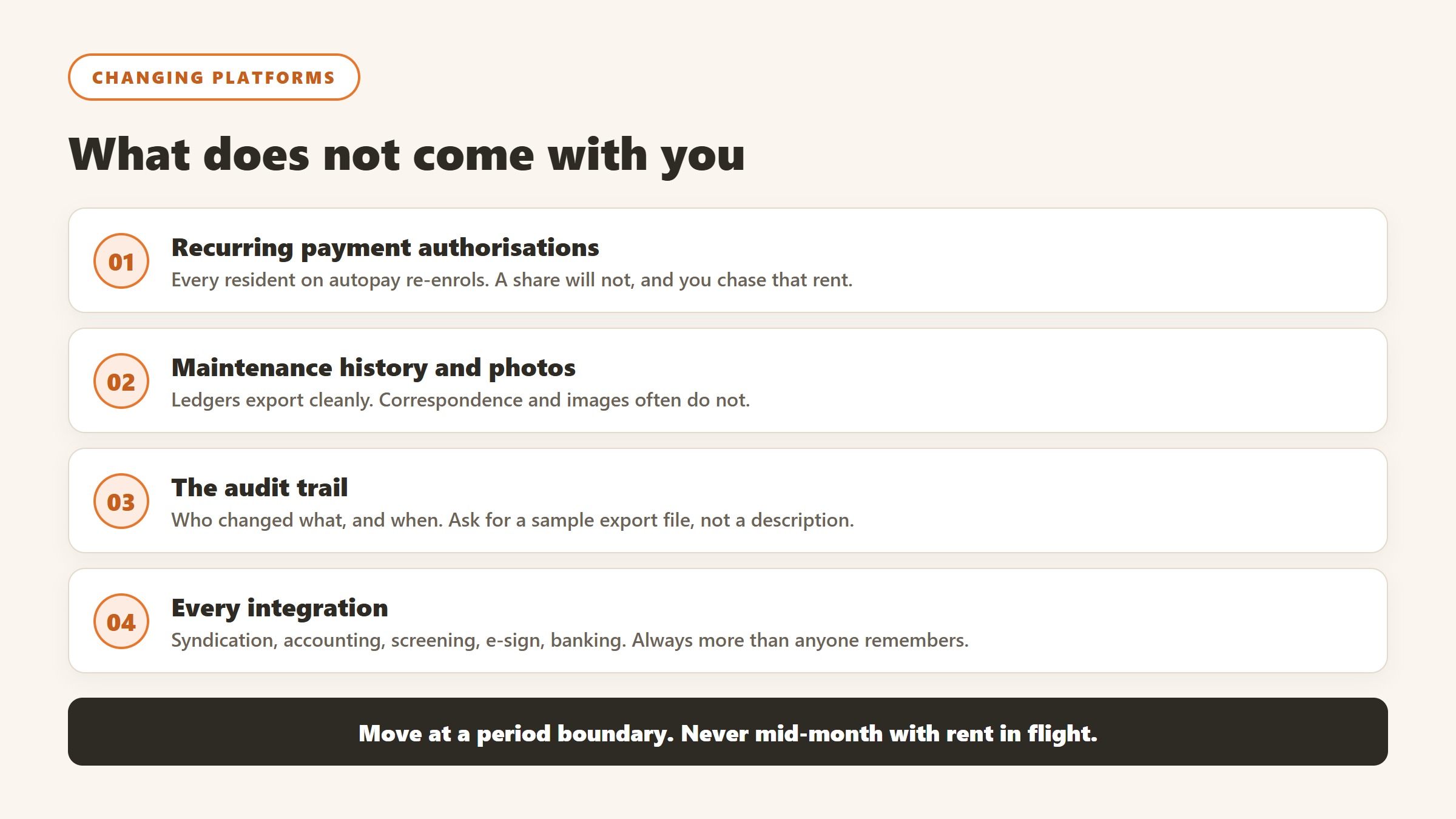
Recurring payment authorisations rarely transfer
This is the big one. Tenant records, leases and ledgers export from almost any platform. Live recurring payment authorisations and the stored bank or card details behind them generally do not, which means every resident on autopay has to re-enrol. A share will not, and you will chase rent you were previously collecting automatically. Ask about this in writing during procurement, when you still have leverage.
Ask exactly what a full export contains
Standard fields usually come out cleanly. What often does not is the maintenance history with its photographs and correspondence, the document store of signed leases and addenda, the accounting history in a form your accountant can actually use, and the audit trail of who changed what. Ask for a sample export file during the trial rather than a description of one.
The accounting cutover has a right time and many wrong ones
Move at a period boundary, ideally the start of a financial year, and never mid-month with rent in flight. Plan to run a parallel reconciliation for one full cycle, and budget the hours for it. Migrations that go badly almost always went live at a convenient calendar date rather than a sensible accounting one.
Count the integrations before you sign, not when you leave
Listing syndication, accounting, screening providers, e-signature, banking, insurance and any owner portal are each work to disconnect and reconnect elsewhere. The count is always higher than anyone remembers, and it is the part that turns a two week migration into a six month one.
Where the figures on this page come from
Every price here was read from the vendor’s own pricing page on 4 September 2026, not from an aggregator or a review site. Each figure carries that date, because pricing in this market moves and a claim without a date is not checkable.
The pages we read
Buildium publishes $62, $192 and $400 a month plus a detailed fee schedule. DoorLoop publishes $69, $149 and $209 a month billed yearly with per unit equivalents. TurboTenant publishes a free tier plus $12.42 and $16.48. TenantCloud publishes $15 to $50 a month on annual billing. RentRedi publishes $12 a month on the annual plan. Hemlane, Rentec Direct and Landlord Studio all publish in full, as do Follow Up Boss at $69 per user, Wise Agent at $49, and Placester from $59.
The ones we could not read
AppFolio, Innago, Top Producer and Hostaway did not yield a figure to the same method that read every vendor above, and Lofty’s pricing page carried no plan rates. We are not presenting that as proof they publish nothing, because a failed read is not evidence of absence. Treat any figure for those five from elsewhere as unverified.
What we do not do
We do not carry a figure we cannot source to the vendor. Where a number circulates and cannot be traced, we say so and withdraw it rather than repeating it with a hedge, and we have withdrawn our own published figures on that basis more than once.
What agent CRMs and lead platforms actually charge
This half of the market divides into CRMs you fill with your own leads and platforms that sell you the leads as well, and the second is several times the price of the first. Here is each alternative to how to, read on 4 September 2026.
Follow Up Boss, $69 per user per month, published plainly
Follow Up Boss publishes $69 per user per month plus tax, with a yearly option giving two months free and calling as a $39 per user add-on. It is a CRM rather than a lead source, which is the important distinction: you are buying the system that works leads you already have. At five agents that is $4,140 a year before the calling add-on, so price it at your real headcount rather than at one seat.
Wise Agent, $49 a month, and the cheapest published option here
Wise Agent publishes $49 a month, falling to $42 billed annually at $499 a year, with a higher tier at $69 and $59. Its annual toggle is marked as saving 15% and the saving holds. For a solo agent or a small team this is the published floor of the category, and the gap to a lead platform is an order of magnitude rather than a percentage.
Placester, from $59 a month, sold around the website
Placester publishes $59, $79 and $129 a month with a 20% annual discount, positioned around IDX websites and marketing rather than lead generation. If your gap is presence rather than pipeline, that is a materially cheaper problem to solve than buying leads, and it is worth being honest with yourself about which one you actually have.
The lead platforms, where almost nobody publishes
The platforms that sell leads alongside software, Lofty, CINC, Ylopo, Zurple, Sierra Interactive, Real Geeks, Market Leader and BoldTrail among them, largely quote rather than publish. We could not read a plan figure from Lofty’s own pricing page on 4 September 2026. That is normal in this corner of the market and it means your only real leverage is a published CRM priced at your team size, plus a clear view of what you currently pay per closed transaction.
Work out your cost per closing before any demo
Take last year: total spend on leads and CRM, divided by transactions closed from those leads. That single number is the benchmark every quote has to beat, and most agents have never calculated it. Without it you are comparing monthly figures against each other rather than against the thing that pays for them, which is how a $2,000 a month platform gets renewed for three years on the strength of a feeling.
The bottom line
Great real estate follow-up is fast, persistent, and consistent, which is precisely the profile of work AI does better than a busy human. Answer every lead in five minutes, qualify in a real conversation, route the hot ones to yourself, nurture the rest for a year or more, stay compliant, and measure the results. Do that, and you stop losing deals to the two silent killers of a real estate business: slow responses and forgotten follow-up. For the tools that power each step, see our roundups of the best AI tools for real estate agents and the best AI inside sales and lead qualification tools.

Written by
FazFaz is the founder of AIToolsBakery. Some tools here are tested hands on. Others are assessed from vendor documentation and pricing verified on the live page, and every review says which one it is. Sponsors can buy a position in a guide. They cannot buy the score, the criticism, or silence about a better option.
How we test and how we make money →