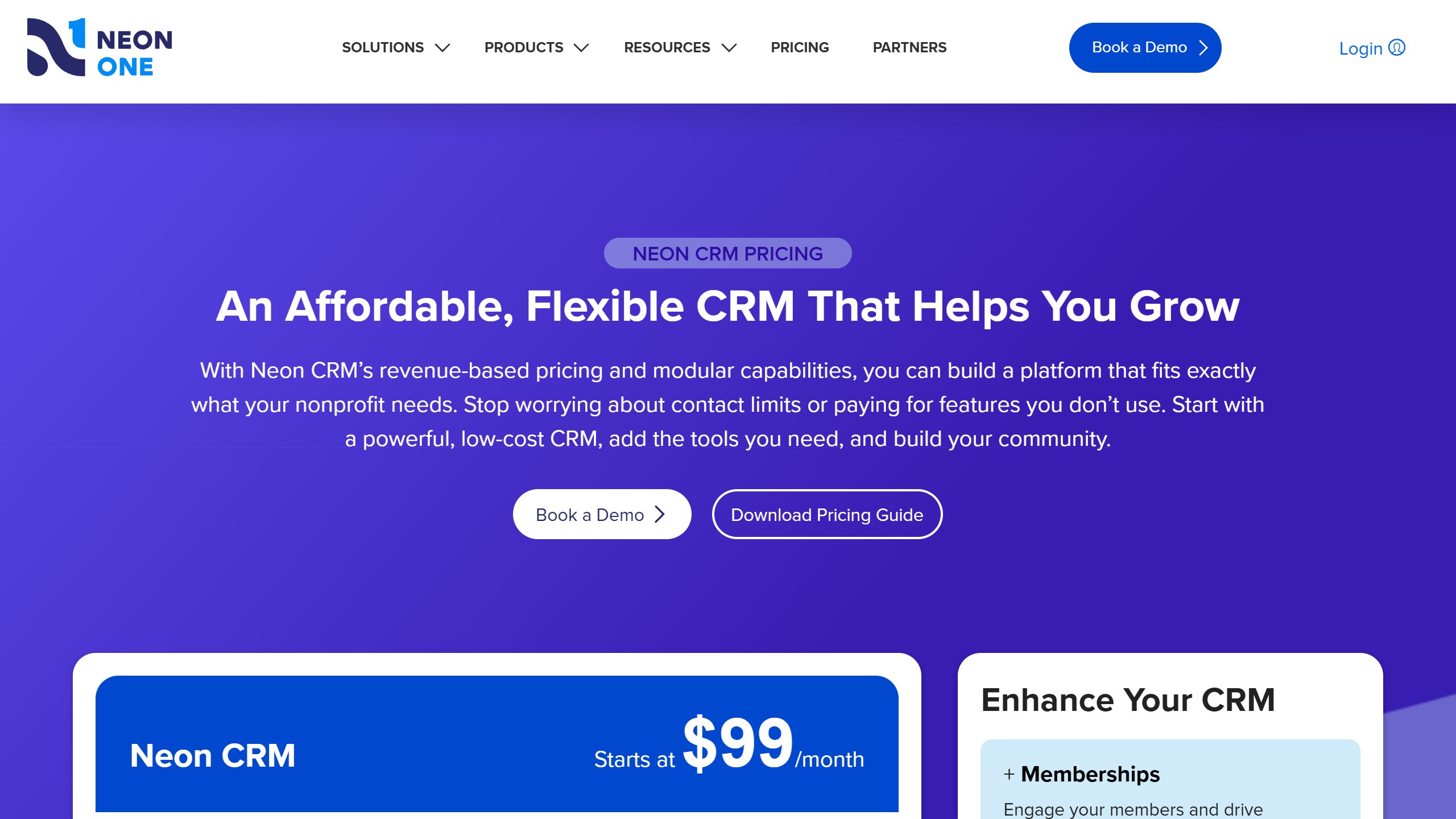
What Neon CRM publishes
| What | Published figure |
|---|---|
| Starting price | $99 a month |
| Pricing unit | Your annual fundraising revenue |
| Users | Unlimited, every plan |
| Records | Unlimited, every plan |
| Memberships module | +10% of your subscription |
| Volunteers module | +10% of your subscription |
| Events module | +20% of your subscription |
| Support | Universal live support, included on every plan |
Read from Neon’s own pricing page on 24 August 2026.
The unusual thing Neon does
Most vendors in this category publish either a price or nothing. Neon publishes something in between, and the in-between part is more useful than it sounds: it tells you how it decides what to charge you.
In Neon’s own words: “our revenue-based pricing means you only pay more as you raise more”. And more precisely: “Neon CRM charges are based on revenue, not record counts”.
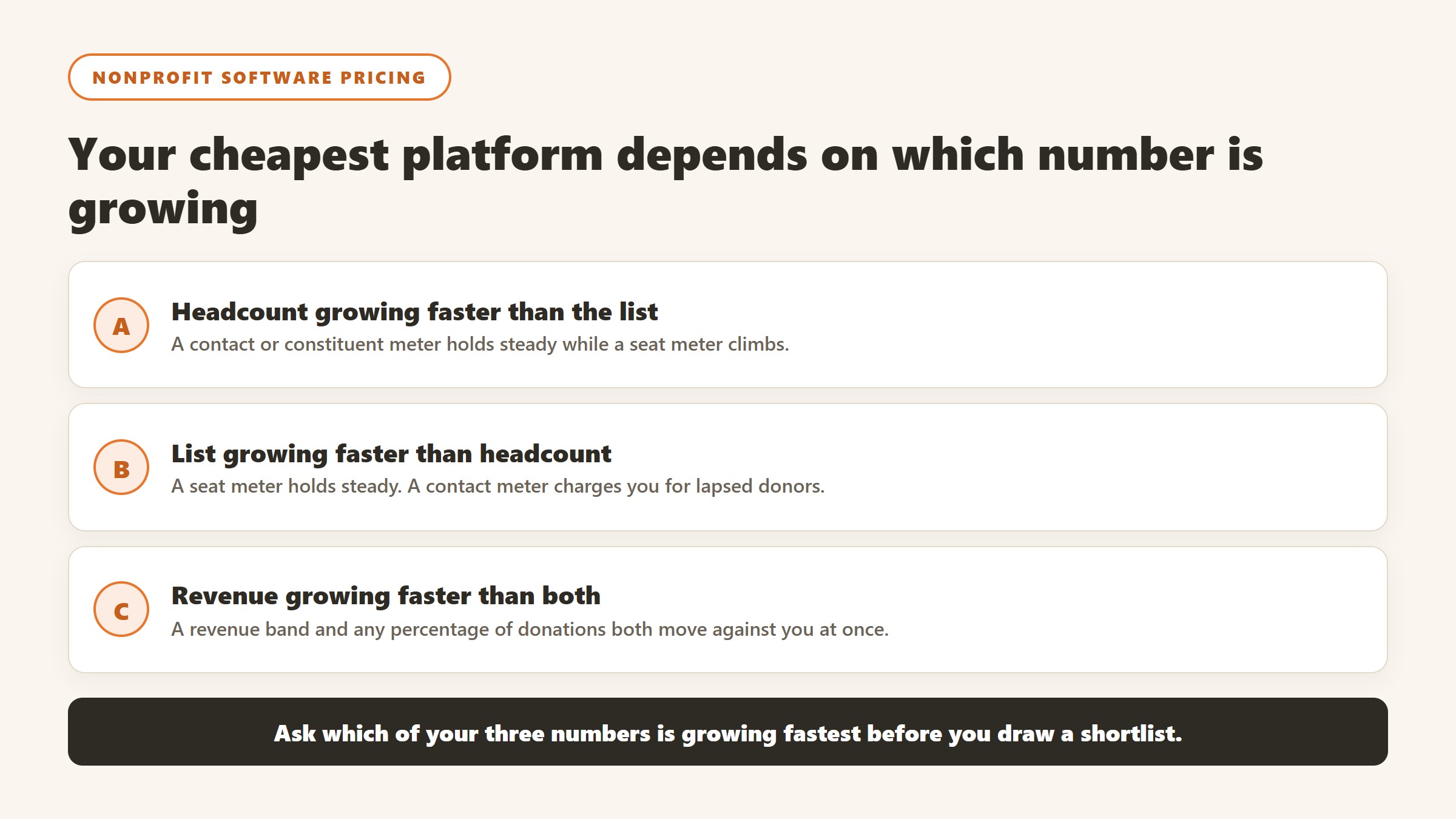
That single sentence is worth more than a price list when you are planning three years out, because it tells you exactly which of your numbers is the meter. Grow your team, nothing happens. Grow your list, nothing happens. Have a record year, your CRM gets more expensive.
The modules, which you can actually calculate
The percentage-based module pricing is the most practically useful thing on the page, and almost nobody else in this category does it. Because the add-ons are a percentage of your subscription rather than a flat fee, you can work out what they cost before you know what your plan costs.
| Configuration | Multiplier | At the $99 floor |
|---|---|---|
| CRM only | 1.00 | $99/mo |
| CRM + Memberships | 1.10 | $108.90/mo |
| CRM + Volunteers | 1.10 | $108.90/mo |
| CRM + Events | 1.20 | $118.80/mo |
| CRM + all three modules | 1.40 | $138.60/mo |
All three modules add 40%, so a fully loaded plan is 1.4 times whatever your base is. At the published floor that is $1,663 a year against $1,188 for the CRM alone.
What Neon does not publish, and the trap in it
Neon does not publish the actual price list. There is a “Download Pricing Guide” button, and the guide is behind a form.
You will see five revenue bands quoted around the web as though they were Neon’s pricing tiers:
$0 to $15K, $16K to $125K, $126K to $3M, $3M to $10M, $10M+
Those are not a price table. They are the options in a dropdown on the download form, answering the question “What is your nonprofit’s estimated annual revenue?”. There are no prices attached to them anywhere on the public page.
We nearly published them as tiers ourselves. In a plain text reading of that page they sit in a numbered-looking list with dollar figures, immediately after a pricing heading, and they look exactly like bands. The only thing that prevents the mistake is reading the surrounding lines rather than the figures.
What unlimited users is worth
Unlimited users on every plan is Neon’s strongest published claim, and it is worth quantifying against the one vendor here that charges per seat.
| Team size | Neon CRM at the floor | Salesforce Nonprofit Cloud Core (4 Oct 2026) |
|---|---|---|
| 3 users | $1,188/yr | $2,520/yr |
| 5 users | $1,188/yr | $4,200/yr |
| 10 users | $1,188/yr | $8,400/yr |
| 20 users | $1,188/yr | $16,800/yr |
Neon’s column does not move because seats are not the meter. Salesforce‘s does, at $840 per user per year. That comparison holds only at Neon’s published floor, and your actual Neon price depends on revenue, which is the figure they will not publish. But the shape of the difference is real, and for a large team on a modest budget it is the argument for Neon.
Who actually gets $99
A published floor is only useful if you know who it applies to. Neon’s is $99 a month, and because the meter is revenue, the floor belongs to the smallest organisations: the ones raising least.
That is worth stating plainly because it inverts the usual reading of a starting price. On a seat-priced CRM, the entry price is what a small team pays and it stays put as the team grows its list. On Neon, the entry price is what a small budget pays, and it moves as the organisation succeeds.
For a two-person shop raising under $100,000 a year, that is close to the best deal in this comparison: unlimited users, unlimited records, live support included, at $1,188 a year. For an organisation raising $8 million with three staff, the same model is working against you and a seat-priced vendor will likely be cheaper.
What is not in the $99
- The modules, at +10%, +10% and +20%, which is the one add-on cost Neon does publish
- Payment processing, a separate percentage on every gift via Neon Pay or another processor
- Migration and implementation, normally a one-off professional-services fee
- The other Neon One products, since Neon Websites, Arts People and Neon Fundraise are separate
Neon states that integrations with QuickBooks, Windfall Data, Mailchimp and Eventbrite, plus open API access, are included without extra fees. That is unusually generous and worth confirming in writing, because paid connectors are a common line item elsewhere in this category.
Where Neon sits against the rest
| CRM | Entry published price | Unit | Full list published |
|---|---|---|---|
| Salesforce Nonprofit Cloud | $70 (4 Oct 2026) per user/mo | Seats | Yes |
| Neon CRM | From $99/mo | Revenue | No, gated |
| Keela | $164/mo up to 1,000 contacts | Contacts | Yes |
| Virtuous | Not published | Quote, banded by revenue | No |
| Bonterra | Not published | Quote | No |
| Blackbaud Raiser’s Edge NXT | Not published | Quote | No |
Full comparison in nonprofit CRM pricing compared, and the product itself in our Neon CRM review.
What to ask on the call
Because the list is gated, the demo call is the pricing call. Three questions worth asking in this order:
- Which revenue figure do you use, and when is it re-assessed? Gross or net, which fiscal year, and does a one-off bequest move you a band. This is the whole bill.
- What happens at renewal if revenue drops? Revenue-based pricing that ratchets up but not down is a very different product from one that tracks both ways.
- Is the module percentage applied to the base or to the running total? Three modules at +10, +10 and +20 is 1.40 if applied to the base, and 1.452 if compounded. Nobody publishes which.
What you are actually signing, beyond the monthly figure
A published rate card tells you the list price. The contract decides what you pay, and four terms do most of the work.
Term length and the annual-billing discount
Nearly every figure quoted in this market, Neon CRM included, assumes annual billing. Monthly billing is routinely 20 to 30% higher, so the headline you compare against a rival may be a different commitment entirely. Check which basis each number is on before putting two of them in the same sentence, because vendors do not always label it.
Mid-term expansion, priced now or priced later
The band you cross, the seat you add, the module you switch on: agree what each costs before you sign, and specifically whether the discount you negotiated applies to anything added mid-term. It very often does not. Discovering that at the moment you need to grow is how a good first-year deal becomes an expensive second year.
The renewal cap is the term worth most and asked for least
At renewal the vendor knows your usage, your dependency and your switching cost, and in a market where most rivals publish nothing you have no rate card to anchor against. Blackbaud publishes no figures at all, and Virtuous publishes none while banding its tiers at $5 million in fundraising revenue. Against that, a capped uplift stated as a percentage is worth more than a larger first-year discount, and it is only negotiable while you still have a choice.
What happens to your data at the end
Ask what a full export contains, in what format, how long after termination you can request one, and whether live recurring gift schedules and their payment tokens transfer. Tokens are the ones that usually do not, and if they cannot move, every monthly donor has to re-enter card details and a share will not. Get the answer in writing during procurement, not during the exit.
Published does not mean fixed
Keela raised every band between late August and early September 2026, entry moving from $134 to $164, a rise of roughly 15 to 22% across the range in under two weeks. Neon retired an entire tier structure. A published price is a snapshot with a date on it, and if the figure you are comparing does not carry one, you do not know what you are looking at.
Payment processing, the line that usually costs more than the software
Almost every comparison of Neon CRM against its rivals stops at the subscription. For most nonprofits the larger number is what comes off each donation, and it is metered on the one thing you are trying to grow.
The arithmetic that decides this
A single percentage point on $500,000 raised online is $5,000 a year. That is more than the entire annual subscription to several nonprofit CRMs. So a platform that is $600 a year cheaper but takes half a point more of your online giving is not cheaper at any organisation raising more than $120,000 online, and the crossover point moves against you every year you grow.
Two different models, and they are not comparable
Some platforms charge a subscription and take nothing from donations, leaving you to hold a processor relationship directly. Little Green Light states plainly that it takes nothing from your donations. Others bundle processing into the platform, which is simpler to run and structurally more expensive at volume. GoFundMe Pro, formerly Classy, publishes that its model is an annual subscription plus a transaction fee per donation, and that second half is the part that scales.
Ask for the effective rate, not the headline rate
Processing quotes are usually given as a percentage plus a fixed amount per transaction, and the fixed component dominates at small gift sizes. On a $20 donation, 30 cents is another 1.5% on top of whatever percentage was quoted. If your median online gift is small, and for most community organisations it is, your effective rate is materially higher than the number on the page. Work it out on your own median gift before comparing anything.
Covered fees change the picture and are worth asking about
Where a platform offers donors the option to cover processing fees, take-up is the variable that decides your real cost, and it varies enormously by audience and by how the prompt is worded. Ask any vendor quoting you a bundled rate what their observed cover rate is across comparable organisations, and treat a refusal to answer as information. A model that looks expensive at 0% cover can be the cheapest option at 60%.
Get processing out of the subscription line in every quote
Insist that every vendor states processing separately from the platform fee, with the percentage, the fixed per-transaction amount, and whether ACH and card are priced differently. A blended annual figure hides exactly the line that grows with your success, and it is the single most common reason a nonprofit software budget is wrong in year two.
How to run the procurement so a quote means something
Get every quote onto the same basis before comparing
Ask each vendor, including Neon CRM, for the same seat count, the same contract length, implementation quoted separately from subscription, every add-on itemised, and payment processing stated as inside or outside the platform fee. A single blended annual number cannot be compared against anything, and vendors know it.
Establish the total first-year cost, not the subscription
Onboarding, data migration, integration work and training are frequently larger than the first year of licence fees in this category and are rarely in the headline figure. Ask for the all-in number, then ask which parts of it are one-off and which recur.
Negotiate the renewal before you sign the first contract
This is the single most valuable term and the one most often left out. A capped renewal uplift, stated as a percentage, is worth more than a bigger first-year discount, because at renewal the vendor knows your usage, your dependency and your switching cost while you have no public rate card to argue against.
Insist on a trial with your own data
A demo runs on a dataset chosen because the product handles it well. Ask to load a sample of your own records, including the messy ones: duplicate households, lapsed donors with old addresses, a recurring gift that failed. How a platform handles your actual data quality is the thing that decides whether staff use it, and it is invisible in a scripted walkthrough.
Name the person who will own it
Every platform in this category rewards an owner and punishes shared responsibility. Before signing, name the person whose job description includes this system and check they have the hours. Software does not create that role, and its absence is the most common reason a nonprofit CRM purchase disappoints.
Where the figures on this page come from
Every price quoted here was read from the vendor’s own pricing page on 4 September 2026, not from an aggregator or a review site. That distinction matters more in this category than in most, because nonprofit software pricing changed materially over the past year and a great deal of what circulates online describes packaging that no longer exists.
The pages we read
Little Green Light publishes every constituent band from $45 a month. Salesforce Nonprofit Cloud publishes $70 per user per month (as of 4 October 2026) with ten licences free under Power of Us. Bloomerang publishes $125 a month for the CRM with other products priced separately. Keela publishes every contact band from $164 a month. Dataro publishes $15,000 a year plus ten cents per active donor on a page that is not linked from its own navigation. Blackbaud and Virtuous publish no figures at all.
What we do not do
We do not carry a figure we cannot source to the vendor. Where a number circulates widely and cannot be traced to a vendor page, we say so and withdraw it rather than repeating it with a hedge, and we have withdrawn our own published figures on that basis more than once. Where a vendor confirms an unpublished price directly to us, it is attributed as confirmed by the company rather than presented as a public rate.
Why every figure carries a date
Keela raised every band by roughly 15 to 22% in under two weeks in late August 2026. Neon retired an entire tier structure. A pricing claim without a verification date is not checkable, and in this market it is usually wrong within a year.
How we verified this
We followed Neon’s own navigation to pricing rather than guessing a URL. Worth recording for anyone repeating this: neonone.com returns HTTP 522 to automated requests on every path we tried. The legacy domain, www.neoncrm.com/pricing/, responds and redirects to the Neon CRM overview page, which is where the published figures live.
Because that redirect lands somewhere other than a pricing page, we recorded the final URL and read the surrounding context for every figure rather than pattern-matching dollar signs. That is what surfaced the dropdown problem above.
We have not used Neon CRM and make no claim about the product. This page reports what Neon publishes and what the arithmetic implies. The revenue-band prices are not public, so anything you read claiming to know them, including here, would be guessing.
Related: our full Neon CRM review, nonprofit CRM pricing compared and the best AI tools for nonprofits.

Written by
FazFaz is the founder of AIToolsBakery. Some tools here are tested hands on. Others are assessed from vendor documentation and pricing verified on the live page, and every review says which one it is. Sponsors can buy a position in a guide. They cannot buy the score, the criticism, or silence about a better option.
How we test and how we make money →