What Keela costs
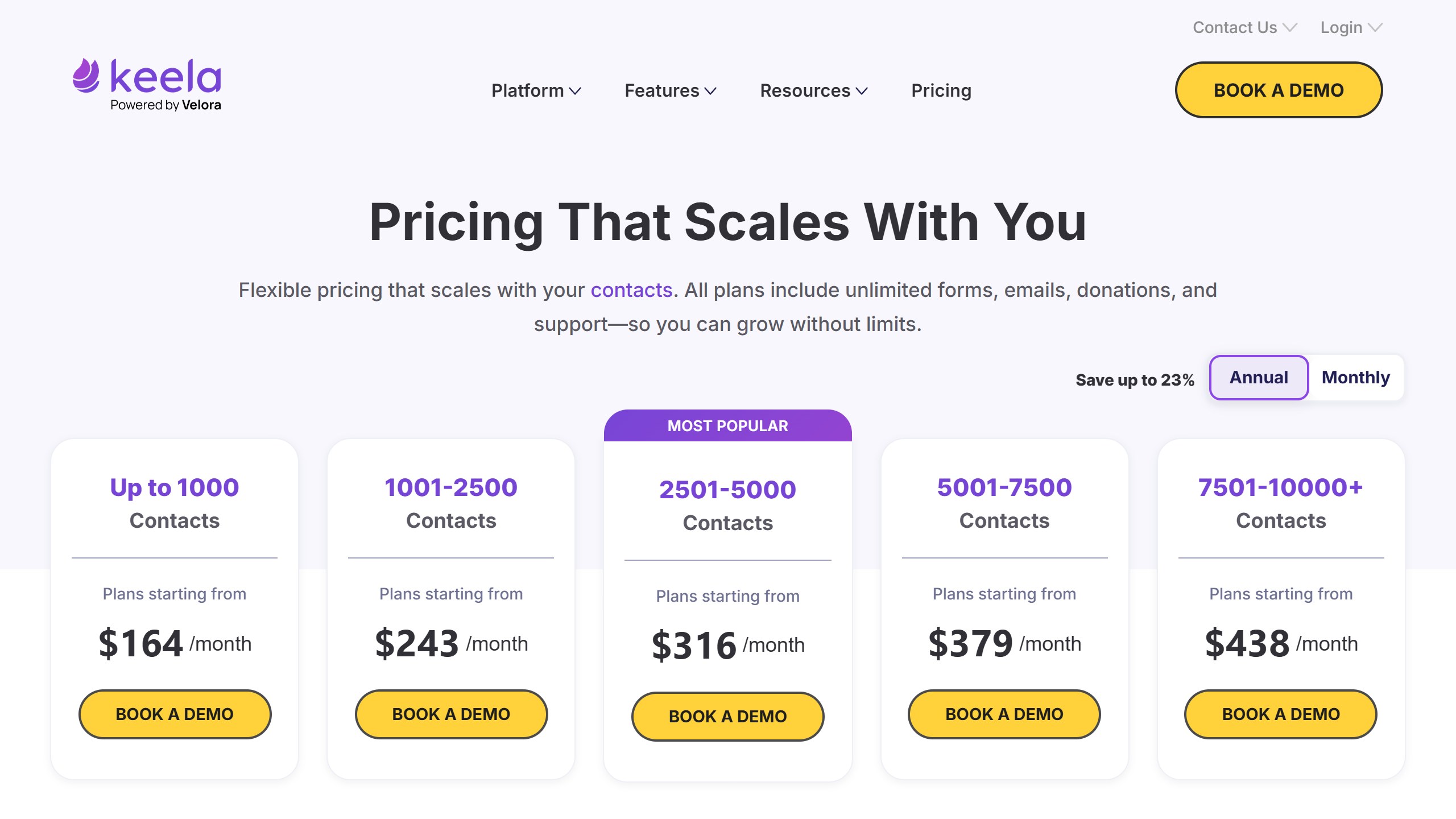
| Contacts | Billed annually | Billed monthly | Annual saving |
|---|---|---|---|
| Up to 1,000 | $164/mo | $190/mo | 13.7% |
| 1,001 to 2,500 | $243/mo | $259/mo | 6.2% |
| 2,501 to 5,000 | $316/mo | $357/mo | 11.5% |
| 5,001 to 7,500 | $379/mo | $420/mo | 9.8% |
| 7,501 to 10,000+ | $438/mo | $489/mo | 10.4% |
| More than 10,000 | Custom, via a form | Custom | n/a |
Read from keela.co/pricing on 4 September 2026. Every figure is printed as “Plans starting from”, so treat these as floors rather than quotes. Keela is now branded “Powered by Aplos” on that page.
Keela raised every band in eleven days
We read this same page on 24 August 2026 and again on 4 September. Every one of the ten published figures went up.
| Contacts | Annual, 24 Aug | Annual, 4 Sep | Rise |
|---|---|---|---|
| Up to 1,000 | $134/mo | $164/mo | 22.4% |
| 1,001 to 2,500 | $209/mo | $243/mo | 16.3% |
| 2,501 to 5,000 | $274/mo | $316/mo | 15.3% |
| 5,001 to 7,500 | $329/mo | $379/mo | 15.2% |
| 7,501 to 10,000+ | $379/mo | $438/mo | 15.6% |
The smallest organisations took the largest increase. An entry plan that cost $1,608 a year on 24 August costs $1,968 on 4 September, a rise of $360 for the same contacts and the same features.
We are not treating this as a scandal. Vendors raise prices, and Keela publishes its rates openly, which is more than Virtuous, Bonterra, DonorPerfect or OneCause manage. What it does mean is that any Keela figure you read anywhere, including an older version of this page, has a shelf life measured in weeks rather than months. Check the date on it.
The 23% that is not there
Keela’s pricing page carries a badge reading “Save up to 23% when you pay annually”, on both billing views.
Do the subtraction on the vendor’s own two columns and the largest saving available is 13.7%, on the smallest band. Every other band saves less: 6.2%, 11.5%, 9.8% and 10.4%. There is no published band anywhere on the page where switching to annual billing saves 23%.
For that claim to be true on the entry plan, the annual price would need to be about $146 a month rather than $164. The badge was wrong when we checked on 24 August and it is further from true now, because the September increase widened the gap between the two columns on some bands and narrowed it on others without ever reaching 23%.
The gap is not evenly spread either, which is the more useful detail. If you are choosing a billing cycle, annual is worth most on the smallest plan and least on the 1,001 to 2,500 band, where it saves 7.1%. That is backwards from how volume discounts usually work.
Priced by contacts, which is the whole story
The important thing about Keela’s pricing is not the numbers, it is the unit. Keela charges for contacts. It does not charge for seats.
That has three consequences worth planning around:
Your team size is free. Add a fundraiser, a grants officer, an ED who wants dashboards. The bill does not move. Compare that with Salesforce Nonprofit Cloud at $70 per user per month (as of 4 October 2026), where a sixth login costs another $840 a year.
Your list size is the meter. A successful list-building campaign is a price rise. Crossing from 5,000 to 5,001 contacts moves you from $274 to $329 a month, which is $660 more a year for one contact.
Lapsed donors still count. A contact is a contact. If your database holds 4,000 people who last gave in 2019, you are paying for them at the same rate as this year’s donors. Cleaning the file is a cost-control lever here in a way it is not on a seat-priced CRM.
What every plan includes
Keela publishes the inclusions, which not every vendor in this category does:
- Unlimited online training
- Donor and volunteer management
- Email marketing
- Unlimited email support
Unlimited email support on the entry plan is unusual at this price point. Unlimited users is the bigger one, and it is the reason the contact-based model works out cheaper than seat-based pricing for most small development teams.
The cost of crossing a band
Because the bands are wide and the steps are not even, the marginal cost of growth varies a lot. Here is what each step up actually costs, annually billed.
| Step | Extra per month | Extra per year |
|---|---|---|
| 1,000 to 1,001 contacts | +$75 | +$900 |
| 2,500 to 2,501 contacts | +$65 | +$780 |
| 5,000 to 5,001 contacts | +$55 | +$660 |
| 7,500 to 7,501 contacts | +$50 | +$600 |
The steps get smaller as you grow, which is the right shape and the opposite of what Keela does with its annual discount. The most expensive single contact you will ever add is your 1,001st, at $900 a year.
What three years actually costs
Contact-based pricing compounds quietly, because the thing being metered is the thing a fundraising programme is supposed to grow. Here is the same organisation on the annual rate, adding 1,200 contacts a year from a standing start of 900.
| Year | Contacts | Band | Monthly | Year cost |
|---|---|---|---|---|
| 1 | 900 | Up to 1,000 | $164 | $1,968 |
| 2 | 2,100 | 1,001 to 2,500 | $243 | $2,916 |
| 3 | 3,300 | 2,501 to 5,000 | $316 | $3,792 |
Three years of ordinary list growth doubles the bill, and none of that is a price rise. It is the model working as designed. Budget for the band above the one you are in.
The counterweight is that seats stay free the whole way. If that same organisation went from two staff to five over those three years, a seat-priced CRM would have moved as well, and Keela would not have.
What is not in the published price
Keela publishes inclusions, which is more than most, but a published band is not a total cost. The usual places a nonprofit CRM bill grows after signature:
- Data migration from your current system, normally a one-off professional-services fee
- Payment processing, which is a separate percentage on every gift and is not a CRM line at all
- Integrations to accounting, email or event tools where a paid connector is required
- Contact growth, the one above, which is the meter rather than an extra
Ask for the migration quote before you sign the subscription. It is the line item most likely to be larger than a month of subscription and least likely to be mentioned unprompted.
Where Keela sits against the rest
| CRM | Entry published price | Unit |
|---|---|---|
| Neon CRM | From $99/mo | Your fundraising revenue |
| Keela | $164/mo up to 1,000 contacts | Contacts |
| Salesforce Nonprofit Cloud | $70 (4 Oct 2026) per user/mo | Seats |
| Virtuous | Not published | Quote, banded by revenue |
| Bonterra | Not published | Quote |
| Blackbaud Raiser’s Edge NXT | Not published | Quote |
Keela is one of only two vendors in this group that publishes a complete list. Full comparison in nonprofit CRM pricing compared, and our Keela review covers the product itself.
Who Keela suits
Good fit: a small or mid-size development team with more staff than budget, a contact list under about 7,500, and a habit of keeping that list clean. The unlimited-users model is worth real money if three or more people need logins.
Poor fit: an organisation with a very large, very old list and a small active donor base. You will pay for every dormant record at the same rate as an active one, and at that shape a revenue-priced or seat-priced vendor will likely cost less.
Check first: whether the CRM is the gap at all. Keela’s Donor Score and Smart Ask are CRM-native scoring rather than a full intelligence layer, and if what you actually need is a ranked daily list of who to call, that is a separate category. See best AI donor intelligence tools.
Which nonprofit vendors publish a price, and which will not
This is the most useful single fact about the market and it is rarely stated plainly. Roughly half the category publishes a rate card you can read without speaking to anyone; the other half runs a quote form. That split, not the software, decides how your evaluation has to be run.
| Vendor | Publishes a figure | Entry price, verified 4 Sep 2026 | What it meters on |
|---|---|---|---|
| Little Green Light | Yes, every band | $45/mo | Constituents |
| Salesforce Nonprofit Cloud | Yes | $70/user/mo (4 Oct 2026), 10 free | Users |
| Neon CRM | Model yes, full list no | $99/mo | Fundraising revenue |
| Bloomerang | Yes, by product | $125/mo | Product mix |
| Keela | Yes, every band | $164/mo | Contacts |
| Dataro | Yes, but unlinked page | $15,000/yr + $0.10/donor | Active donors |
| Blackbaud | No | Quote form only | Not disclosed |
| Virtuous | No | Quote form only | Bands at $5m revenue |
| GoFundMe Pro | Model only | Subscription + transaction fee | Donations |
Why the split matters more than the prices
If three of your shortlist publish and three do not, you cannot run a like-for-like comparison, and the quote-only vendors know that. The practical move is to price a published alternative precisely at your own seat count and list size, then make that the number every quote has to justify itself against. It is the only figure in the room that both sides can verify.
Nine different meters, which is the real problem
Constituents, users, fundraising revenue, product mix, contacts, active donors, donation volume. Seven distinct meters across nine vendors means the cheapest platform is a property of your organisation, not of the market. Whichever of your numbers, people or records or revenue, is growing fastest should decide which pricing model you buy into, and that question is almost never asked before a shortlist is drawn.
What you are actually signing, beyond the monthly figure
A published rate card tells you the list price. The contract decides what you pay, and four terms do most of the work.
Term length and the annual-billing discount
Nearly every figure quoted in this market, Keela included, assumes annual billing. Monthly billing is routinely 20 to 30% higher, so the headline you compare against a rival may be a different commitment entirely. Check which basis each number is on before putting two of them in the same sentence, because vendors do not always label it.
Mid-term expansion, priced now or priced later
The band you cross, the seat you add, the module you switch on: agree what each costs before you sign, and specifically whether the discount you negotiated applies to anything added mid-term. It very often does not. Discovering that at the moment you need to grow is how a good first-year deal becomes an expensive second year.
The renewal cap is the term worth most and asked for least
At renewal the vendor knows your usage, your dependency and your switching cost, and in a market where most rivals publish nothing you have no rate card to anchor against. Blackbaud publishes no figures at all, and Virtuous publishes none while banding its tiers at $5 million in fundraising revenue. Against that, a capped uplift stated as a percentage is worth more than a larger first-year discount, and it is only negotiable while you still have a choice.
What happens to your data at the end
Ask what a full export contains, in what format, how long after termination you can request one, and whether live recurring gift schedules and their payment tokens transfer. Tokens are the ones that usually do not, and if they cannot move, every monthly donor has to re-enter card details and a share will not. Get the answer in writing during procurement, not during the exit.
Published does not mean fixed
Keela raised every band between late August and early September 2026, entry moving from $134 to $164, a rise of roughly 15 to 22% across the range in under two weeks. Neon retired an entire tier structure. A published price is a snapshot with a date on it, and if the figure you are comparing does not carry one, you do not know what you are looking at.
How to run the procurement so a quote means something
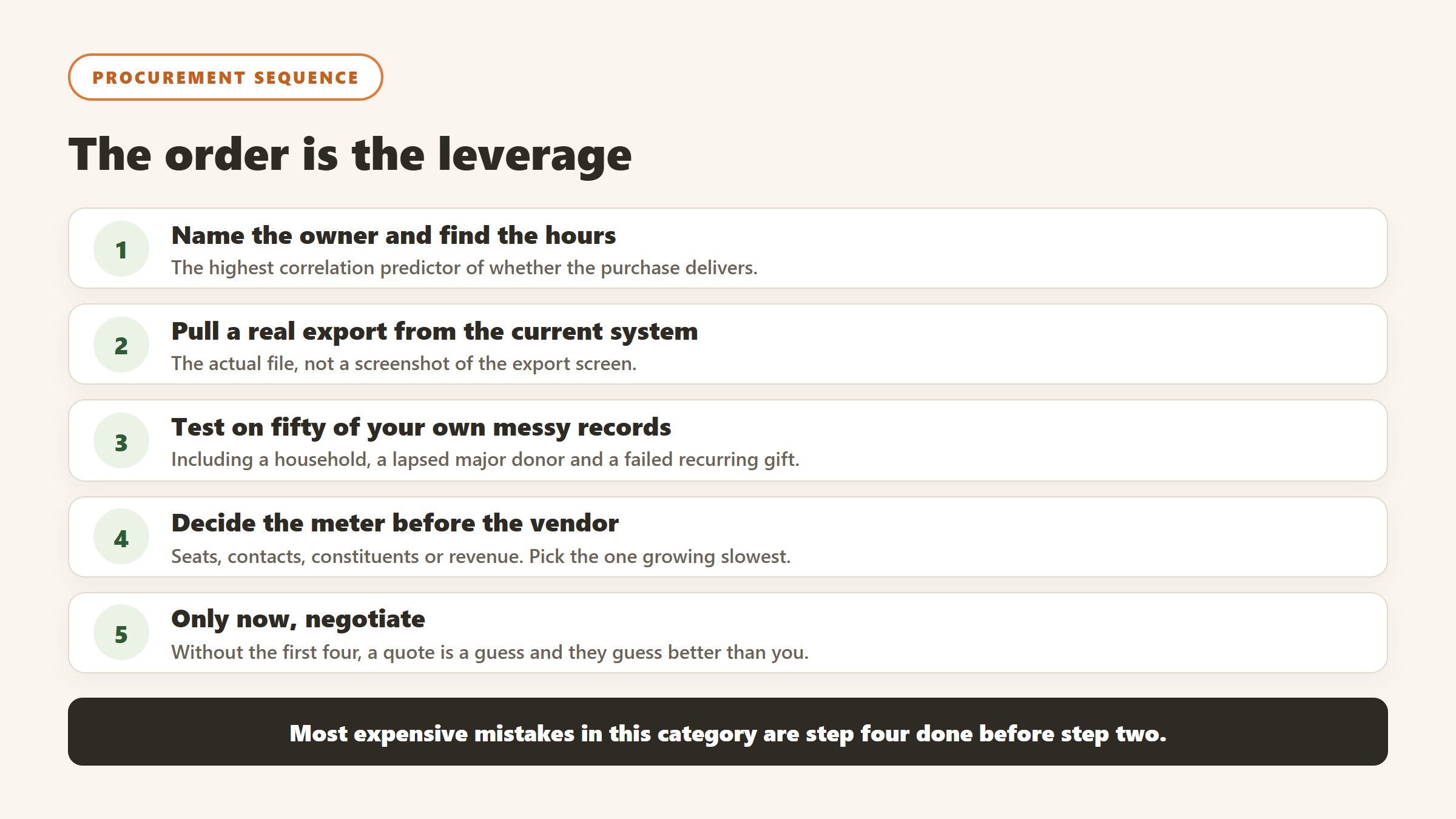
Get every quote onto the same basis before comparing
Ask each vendor, including Keela, for the same seat count, the same contract length, implementation quoted separately from subscription, every add-on itemised, and payment processing stated as inside or outside the platform fee. A single blended annual number cannot be compared against anything, and vendors know it.
Establish the total first-year cost, not the subscription
Onboarding, data migration, integration work and training are frequently larger than the first year of licence fees in this category and are rarely in the headline figure. Ask for the all-in number, then ask which parts of it are one-off and which recur.
Negotiate the renewal before you sign the first contract
This is the single most valuable term and the one most often left out. A capped renewal uplift, stated as a percentage, is worth more than a bigger first-year discount, because at renewal the vendor knows your usage, your dependency and your switching cost while you have no public rate card to argue against.
Insist on a trial with your own data
A demo runs on a dataset chosen because the product handles it well. Ask to load a sample of your own records, including the messy ones: duplicate households, lapsed donors with old addresses, a recurring gift that failed. How a platform handles your actual data quality is the thing that decides whether staff use it, and it is invisible in a scripted walkthrough.
Name the person who will own it
Every platform in this category rewards an owner and punishes shared responsibility. Before signing, name the person whose job description includes this system and check they have the hours. Software does not create that role, and its absence is the most common reason a nonprofit CRM purchase disappoints.
Where the figures on this page come from
Every price quoted here was read from the vendor’s own pricing page on 4 September 2026, not from an aggregator or a review site. That distinction matters more in this category than in most, because nonprofit software pricing changed materially over the past year and a great deal of what circulates online describes packaging that no longer exists.
The pages we read
Little Green Light publishes every constituent band from $45 a month. Salesforce Nonprofit Cloud publishes $70 per user per month (as of 4 October 2026) with ten licences free under Power of Us. Bloomerang publishes $125 a month for the CRM with other products priced separately. Keela publishes every contact band from $164 a month. Dataro publishes $15,000 a year plus ten cents per active donor on a page that is not linked from its own navigation. Blackbaud and Virtuous publish no figures at all.
What we do not do
We do not carry a figure we cannot source to the vendor. Where a number circulates widely and cannot be traced to a vendor page, we say so and withdraw it rather than repeating it with a hedge, and we have withdrawn our own published figures on that basis more than once. Where a vendor confirms an unpublished price directly to us, it is attributed as confirmed by the company rather than presented as a public rate.
Why every figure carries a date
Keela raised every band by roughly 15 to 22% in under two weeks in late August 2026. Neon retired an entire tier structure. A pricing claim without a verification date is not checkable, and in this market it is usually wrong within a year.
How we verified this
We went to keela.co, followed the site’s own “Plans” link rather than guessing a URL, and expanded both the annual and monthly billing views so each band was captured in both cycles rather than whichever happened to be showing.
All figures were read from Keela’s own page on 24 August 2026. The saving percentages and the band-crossing costs are our arithmetic on those published figures.
We have not used Keela and make no claim about the product here. This page reports what Keela publishes and what the arithmetic on it implies. Check the page yourself before signing, because pricing in this category moves.
Related: our full Keela review, nonprofit CRM pricing compared and the best AI tools for nonprofits.

Written by
FazFaz is the founder of AIToolsBakery. Some tools here are tested hands on. Others are assessed from vendor documentation and pricing verified on the live page, and every review says which one it is. Sponsors can buy a position in a guide. They cannot buy the score, the criticism, or silence about a better option.
How we test and how we make money →