tool_score: 4.1
Most nonprofit CRM roundups treat Neon CRM as a generic “all-in-one” and move on. That misses the one thing that actually makes it worth shortlisting: native membership management that most fundraising-first platforms bolt on as an afterthought. This review is about who that matters for, and who should look elsewhere.
Faz’s First Take
I’ll be straight about where Neon CRM sits. It is not the most AI-forward nonprofit CRM on the market, and if a sleek, automated, “the software does your thinking” experience is what you are after, Virtuous or Bloomerang will feel more modern. What Neon One has built instead is breadth: donors, members, events, volunteers, and online giving under one roof at a price small and mid-sized orgs can actually afford, with no per-seat fees.
The standout is membership. If your organization runs a membership or association program (alumni groups, professional associations, museums, advocacy orgs), Neon CRM handles tiers, renewals, automatic reminders, and member directories natively in a way that fundraising-first tools simply do not. That is the reason to put it on a shortlist.
The honest tension this review explores: the platform is wide but the polish is uneven. The email builder is dated, there is no native mobile app, and duplicate management frustrates people. Whether the breadth outweighs the rough edges depends entirely on what you need it to do.
Last updated: June 1, 2026.
Related: See also: Best AI tools for nonprofits 2026 | Best AI fundraising tools for nonprofits
And what it does not do, which no CRM in this category does. Neon stores your donor records and reports on them. It will not tell you which twenty donors to contact this week or why. That is donor intelligence, a layer that reads your existing CRM data rather than replacing it, and the distinction is worth having before you judge any CRM for failing at it. We rank that category separately in best AI donor intelligence tools.
What Neon CRM Does
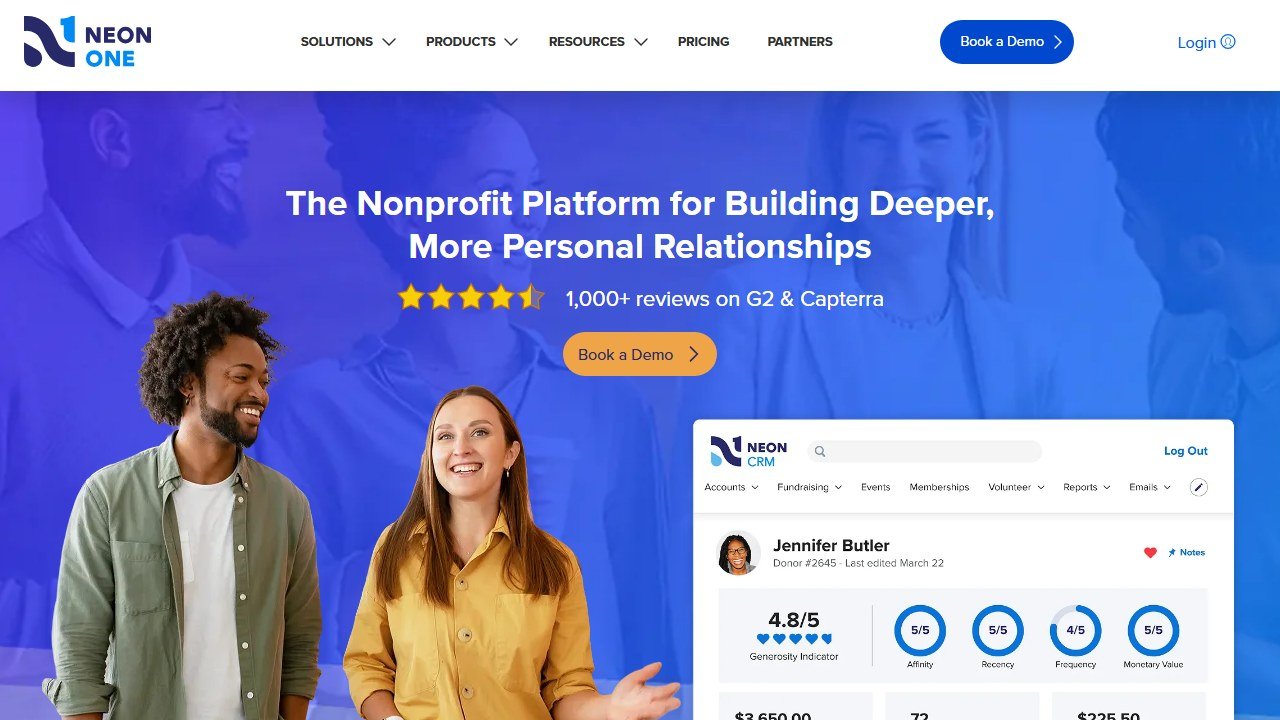
Neon CRM is a full nonprofit CRM and fundraising platform built by Neon One (formerly Z2 Systems, the company behind the original NeonCRM). It handles the core record-keeping every nonprofit needs (donor profiles, gift history, communications, reporting) and layers on online donation pages, email marketing, event management, volunteer tracking, and membership management.
The platform sits in the comprehensive-but-affordable tier of the market. It is more capable than entry-level tools like Donorbox, but it is not trying to be an enterprise system like Blackbaud’s Raiser’s Edge. The target buyer is a small or mid-sized organization that has outgrown spreadsheets or a basic donation tool and wants a single system to run the whole operation without paying enterprise prices or per-user fees.
Neon One has grown into a suite over the past several years. Alongside Neon CRM sit Neon Fundraise (peer-to-peer and event fundraising), Neon Membership, Neon Websites (a CMS for nonprofit sites), and Neon Pay (integrated payment processing). For most organizations, Neon CRM is the hub and the other products plug in as needed. That modular approach is a strength, but it also means some capabilities people expect “in the CRM” actually live in a separate Neon product that may carry its own cost.
Where Neon genuinely differentiates is membership. Many nonprofit CRMs treat memberships as a workaround layered on top of donor records. Neon CRM handles enrollment, tier management, benefits tracking, member directories, and automatic renewal reminders (commonly at 90, 60, and 30 days) as native functionality. For an association, alumni group, museum, or advocacy organization where dues and renewals are the financial backbone, that is the headline feature.
On AI, set expectations correctly. Neon One has begun rolling out AI-assisted features (suggested content and communication helpers), but this is an emerging layer, not the core of the product the way “responsive fundraising” is for Virtuous. If AI-driven donor scoring and automated engagement plans are your priority, this is not the strongest pick. If a dependable, broad operational CRM is the priority, the lighter AI footprint will not bother you.
Key Features
Membership Management
This is the reason Neon CRM earns a shortlist spot. The membership module handles multiple membership levels, individual and organizational memberships, automatic renewal scheduling, lapsed-member tracking, member-only content and directories, and benefits tracking, all tied directly to the same records that hold donation history.
Because membership and giving live in one database, you can see that a lapsed member also gave to last year’s annual appeal, or that a long-time donor has never joined as a member, and act on it. Tools that treat membership as an add-on cannot surface those relationships cleanly. For dues-driven organizations, this integration is the practical difference between a CRM that fits and one that fights you.
Donor Management and Online Giving
The core CRM covers what you expect: constituent records, gift and pledge tracking, soft credits, households, custom fields, and segmentation. Donation pages and embeddable giving forms are included, and because they connect to the CRM, gifts create or update donor records automatically rather than requiring an import.
Recurring giving, tribute and memorial gifts, and basic gift automation are supported. For organizations consolidating a separate donation tool into their CRM, having native giving forms removes an integration headache. Payment processing runs through Neon Pay (or supported third parties), so it is worth confirming processing rates as part of your total-cost math.
Events and Volunteer Tracking
Neon CRM includes event registration and management (ticketing, attendee tracking, and event-specific pages), plus volunteer management so volunteer hours and roles live in the same system as donors and members. As with membership, the value is the unified record: a volunteer who logs significant hours but has never donated is a cultivation opportunity the system can help you spot.
For large-scale peer-to-peer campaigns and complex event fundraising, Neon points organizations toward Neon Fundraise, its dedicated product. The CRM’s built-in event tools are solid for standard registrations and mid-sized events, but heavier campaigns lean on the separate module.
Email and Communications
Email marketing is built in, with segmentation tied to CRM data, so you can target communications by giving level, membership status, event attendance, or custom criteria without exporting to a separate platform. Automated communications such as acknowledgments and renewal reminders are a real time-saver.
This is also one of the weaker areas. Reviewers consistently note that building system emails is fiddly and the output can look dated compared to a dedicated email tool, with limits on which merge fields are available in some templates. Many organizations keep Mailchimp or Constant Contact for their polished newsletters and use Neon’s email for transactional and renewal messaging. Both integrate.
Reporting and Dashboards
Neon CRM ships with real-time dashboards and a library of standard nonprofit reports (retention, LYBUNT/SYBUNT, campaign performance, membership status). Reviewers generally find day-to-day reporting capable and the dashboards useful for tracking the metrics that matter.
The ceiling shows up with complex custom reporting. Highly specific cross-object reports can require workarounds, and organizations with sophisticated analytics needs sometimes export to a spreadsheet or BI tool to finish the job. For standard board-ready reporting, the built-in tools are sufficient.
Pricing Model: Unlimited Users
One of Neon’s most meaningful advantages is structural: the subscription includes unlimited users and unlimited records, and is priced on your annual fundraising revenue rather than per seat or per record. For organizations with multiple staff, volunteers, or board members who need access, that avoids the seat-cost creep that makes per-user CRMs expensive as a team grows. If the price no longer fits, our guide to Neon CRM alternatives compares seven options like for like.
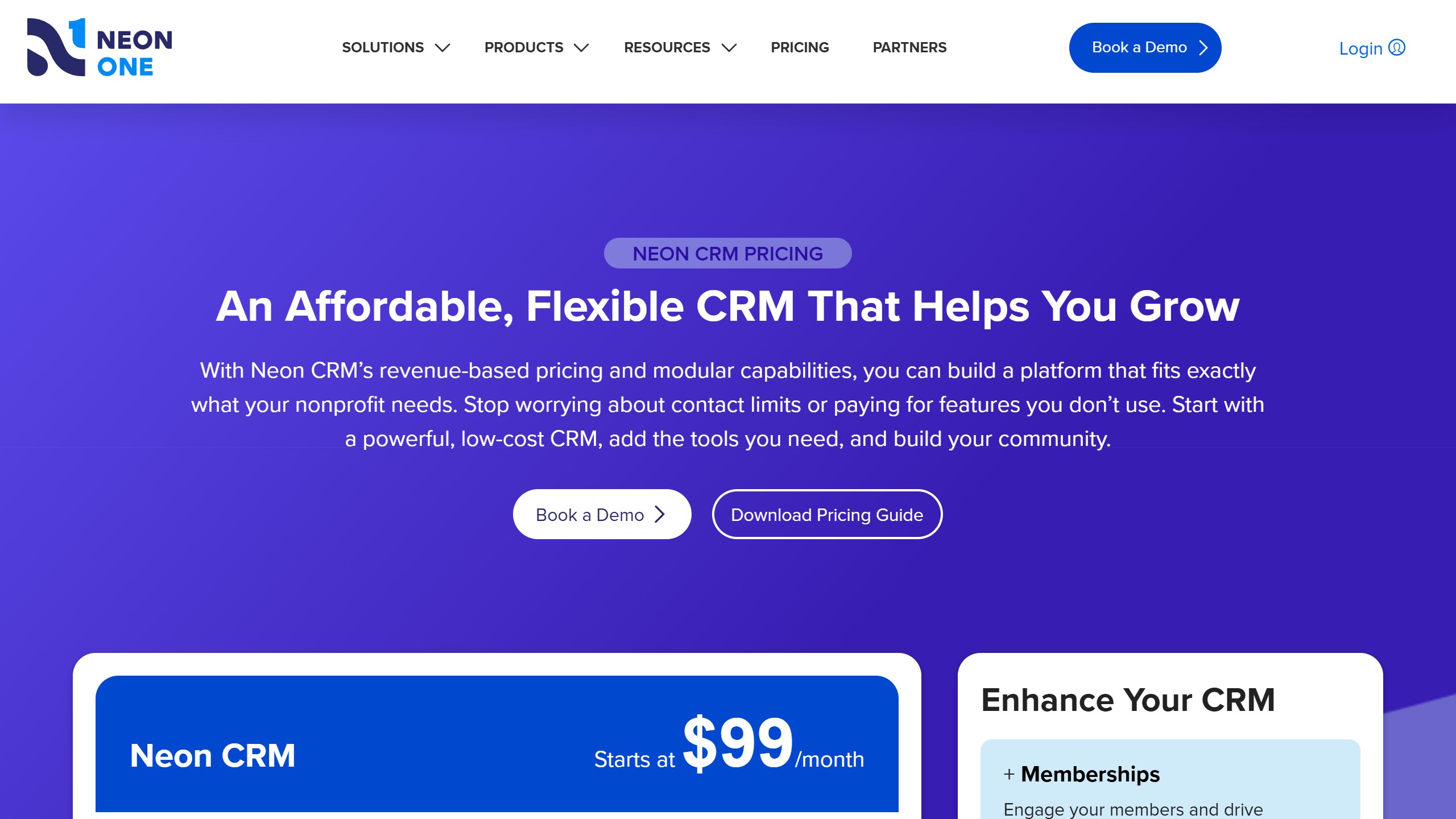
The short version, verified 24 August 2026: Neon CRM starts at $99 a month with unlimited users and unlimited records, and prices on your annual fundraising revenue rather than your record count. Modules add 10% to 20% of your subscription each. The full list is behind a download form. Detail in Neon CRM pricing.
Pricing Breakdown
| Plan | Monthly Cost | Users | Best For |
|---|---|---|---|
| Neon CRM | From $99/month | Unlimited | Core CRM, giving, email and reporting. Priced on annual fundraising revenue, not records |
| + Memberships | +10% of CRM | Unlimited | Member tiers, renewals, member portal and directories |
| + Events | +20% of CRM | Unlimited | Event creation, promotion, registration and management |
| + Volunteers | +10% of CRM | Unlimited | Volunteer recruiting, timesheets and impact reporting |
| Payment processing | Standard rates (Neon Pay) | N/A | Per-transaction, passed to or absorbed by the org |
Pricing scales with your annual fundraising revenue, and the three modules add a percentage of the subscription rather than a flat fee. The unlimited-users model is the part to weigh against per-seat competitors: a five-person team on a per-user CRM can quickly cost more than Neon’s tier price. Add-on Neon One products (Neon Fundraise, Neon Websites) carry their own cost, so scope which capabilities you need inside Neon CRM versus across the suite before signing. Our Bloomerang vs Neon CRM comparison shows which billing model suits which kind of nonprofit.
Saru’s Pricing Analysis
At $99/month entry ($1,188/year), with all three modules adding 40% on top of whatever your revenue band costs, Neon CRM sits squarely in the small-to-mid tier. For context:
- Donorbox: pay-as-you-go fees, no real CRM at the base level
- Bloomerang: from $125/month for the CRM, billed annually, priced per product rather than by records
- DonorPerfect: no published price, quote only, plans are Core, Plus and Pro
- Virtuous: no published price, quote only, AI-forward, mid-market
- Blackbaud Raiser’s Edge NXT: no published price. Its pricing page is a quote request form
Neon’s value case is breadth per dollar plus unlimited users. If you genuinely use the membership, events, and giving modules together, replacing three separate tools with one subscription plus 40% in modules is strong math. If you only need straightforward donor tracking and a donation form, you are paying for breadth you will not use, and a simpler tool wins. The honest test: count the modules you will actually run. Three or more, Neon is competitive. One or two, look lighter.
Who This Is For
Neon CRM is well-suited for:
Membership and association organizations. This is the clearest fit. If dues, renewals, tiers, and member directories are central to your operation, Neon’s native membership handling is a genuine differentiator over fundraising-first CRMs.
Small to mid-sized nonprofits that want one system. Organizations running a mix of donations, events, volunteers, and email that are tired of stitching together separate tools will get real value from the consolidation, especially with unlimited users.
Teams with multiple users on a budget. Because there are no per-seat fees, organizations with several staff, volunteers, or board members needing access avoid the cost creep that makes per-user CRMs expensive at the same size.
Organizations upgrading from spreadsheets or an entry-level tool. Neon’s import tools and breadth make it a logical next step up for an org that has outgrown a basic donation platform but is not ready for enterprise complexity or pricing.
Neon CRM is not well-suited for:
Organizations that want AI-first fundraising. If automated donor scoring, signal-based engagement, and AI-drafted outreach are the priority, Virtuous (reviewed here) is the more targeted choice. Neon’s AI is emerging, not central.
Very small or all-volunteer organizations. If you only need to track donors and send the occasional appeal, the platform’s breadth is overkill and a lighter tool like Donorbox (reviewed here) or Givebutter (reviewed here) will be faster to run.
Teams that need polished, design-forward email. Neon’s email builder is its weakest module. Organizations whose brand depends on beautiful newsletters will likely keep a dedicated email platform alongside it.
Organizations requiring deep, complex custom reporting out of the box. The reporting is capable for standard needs but can require workarounds or exports for sophisticated cross-object analysis.
Pros
- Best-in-class native membership management: tiers, renewals, automatic reminders, and member directories built in, not bolted on, all tied to the same records as giving.
- Genuine all-in-one breadth: donors, online giving, email, events, and volunteers in one system reduces tool sprawl for small and mid-sized teams.
- Unlimited users on every tier: no per-seat fees, which is a real cost advantage for organizations with multiple staff, volunteers, or board members.
- Affordable entry point: from $99/month for a platform this broad is competitive, especially against per-user enterprise systems.
- Unified records create visibility: seeing a person as donor, member, volunteer, and event attendee in one place enables cultivation that siloed tools miss.
- Established, nonprofit-only company: Neon One focuses exclusively on the sector and serves tens of thousands of organizations, with a real product roadmap behind the suite.
- Strong day-to-day dashboards: real-time views of retention, campaigns, and membership status that staff find usable without a consultant.
Cons
- Dated email and communications builder: building system emails is fiddly, output can look dated, and merge-field options are limited in places. Many orgs keep a separate email tool.
- No native mobile app: staff who want full CRM access from a phone are limited to the mobile web experience.
- Duplicate management frustrates users: de-duping records is a recurring complaint and can require manual cleanup discipline.
- Limited deep customization: highly specific workflows or unique data structures can hit the platform’s flexibility ceiling.
- Some capabilities live in separate Neon products: heavier peer-to-peer and event fundraising lean on Neon Fundraise, which carries its own cost, so “all-in-one” has caveats.
- Emerging, not central, AI: if AI-driven engagement is your reason for buying, Neon is not yet the strongest option in the category.
Faz’s Honest Verdict
Here is my litmus test for Neon CRM: does your organization run a real membership or association program, or do you operate several functions (giving, events, volunteers, email) that currently live in separate tools? If yes to either, Neon earns a demo. The membership depth and the unlimited-user, broad-platform value are genuinely competitive, and few tools at this price match the breadth.
If your answer is “we mostly track donors and send appeals,” Neon is more platform than you need, and a lighter, cheaper tool will be faster to live on. And if your buying decision is driven by AI, be honest with yourself that Neon’s AI is early and look at Virtuous instead.
The rough edges are real (the email builder and duplicate handling in particular), but they are the kind of friction a team can work around when the core fit is right. Buy Neon for the membership and breadth, go in expecting to pair it with a dedicated email tool, and it holds up well.
Integrations
| Integration | Type | Notes |
|---|---|---|
| Neon Pay | Payment processing | Native processing for online giving and events |
| QuickBooks | Accounting | Financial data sync |
| Mailchimp | Email marketing | Sync for orgs keeping a dedicated email tool |
| Constant Contact | Email marketing | Sync available |
| Eventbrite | Events | Event registration data sync |
| Double the Donation | Matching gifts | Employer match discovery and automation |
| DonorSearch | Prospect research | Wealth and capacity screening |
| Zapier | Automation | Connects Neon to thousands of apps |
| WordPress | Website | Forms and content embedding |
| QuickBooks Online / Xero | Accounting | Bookkeeping sync via supported connectors |
AI is now the sharpest dividing line in this category, and Neon sits mid-pack on it. Our comparison of nonprofit CRMs with AI features shows exactly where each platform stands.
Final Verdict
Neon CRM earns a 4.1/5. It is a broad, affordable, nonprofit-only platform whose standout strength is native membership management, backed by genuine all-in-one breadth and an unlimited-user pricing model that rewards teams with several people who need access.
The score reflects real limitations: a dated email builder, no native mobile app, duplicate-management friction, a customization ceiling for complex needs, and an AI layer that is still emerging rather than central. Those keep it below the AI-forward leaders for organizations whose priority is automation and intelligence.
But for a membership or association organization, or a small-to-mid nonprofit tired of paying for and stitching together separate tools, Neon CRM delivers a lot of platform for the money. Scope the modules you will actually use, plan to pair it with a dedicated email tool if newsletters matter, and it is a strong, sensible shortlist pick.
For the broader nonprofit CRM and AI tool landscape, see the best AI fundraising tools for nonprofits guide and the best AI tools for nonprofits pillar.
Rating: 4.1/5
Saru’s Data Verdict
Across the major review platforms, Neon CRM holds a roughly 86% user satisfaction rating from nearly 900 reviews, which is solid rather than category-leading. The pattern in the data is consistent: praise clusters around value for money, breadth, and membership handling; criticism clusters around the email builder, duplicate management, and the learning curve on complex setups.
That pattern matches the verdict. Neon is a buy when breadth and membership are the job to be done, and a pass when polish, design-forward email, or AI-driven engagement are what you are optimizing for. The unlimited-user model is the quiet differentiator that does not show up in feature checklists but materially changes total cost for multi-user teams.
Rating: 4.1/5
References & further reading
For deeper data and primary sources on nonprofit technology and fundraising:
- Neon CRM (official product page). current features, plan tiers, and product details from Neon One
- Candid (Foundation Center + GuideStar). authoritative nonprofit financial and grant data
- M+R Benchmarks Study. annual fundraising performance benchmarks across channels
Tools mentioned in this review

Written by
FazFaz is the founder of AIToolsBakery. Some tools here are tested hands on. Others are assessed from vendor documentation and pricing verified on the live page, and every review says which one it is. Sponsors can buy a position in a guide. They cannot buy the score, the criticism, or silence about a better option.
How we test and how we make money →