How we researched this
We did not run these eleven products for this page. This is a pricing analysis, read from each vendor’s own pricing page in a browser on 26 August 2026, reached by following that vendor’s own navigation rather than by guessing a URL. It is not a hands-on review and nothing here is scored. Where we have used a tool properly, the vendor section links to that review.
Three method notes matter, because each of them changed an answer on this page.
We record the final URL, not the one we asked for. Outreach.io redirects to outreach.ai. A first pass followed a link labelled “Mutual Action Plans” instead of the pricing link, because the word “plans” matched first. Reading the address bar is what caught it.
A blocked page is unchecked, not empty. ZoomInfo returned HTTP 403 on every path across two passes. A block tells you about the block, not about the page behind it, so until we reached it we recorded ZoomInfo as unchecked and made no claim in either direction. It returned HTTP 200 on the third attempt and only then did it earn a line in the table below.
We read from Mumbai, and prices move with the reader. HubSpot served us its entire pricing page in rupees and offered no US dollar option in its own currency control, so HubSpot’s dollar figures below come from a US-crawled Internet Archive snapshot dated 13 August 2026 and are labelled as such. We have not converted a rupee figure into dollars anywhere, because a converted number is a number HubSpot does not quote.
Seven publish, four do not
| Tool | Publishes a price | Entry price | Unit |
|---|---|---|---|
| Salesforce Sales Cloud | Yes | $25/user/mo | Per user |
| HubSpot Sales Hub | Yes | $7/seat/mo (13 Aug 2026) | Per seat |
| Apollo.io | Yes | Free, then $49/seat/mo | Per seat plus credits |
| Clay | Yes | Free, then $167/mo | Two meters, actions and data credits |
| Smartlead | Yes | $32/mo | Send volume |
| Instantly | Yes | $47/mo | Send volume |
| Lavender | Yes | Free, then $27/mo | Per user |
| Outreach | No | Quote | Seats plus AI credits, model published |
| Salesloft | No | Quote | Not published |
| Cognism | No | Quote | Credits, model published in detail |
| ZoomInfo | No | Quote | Not published |
Annual billing where a vendor offers it. Every figure was read on 26 August 2026 except HubSpot, dated above.
The column that cannot exist
Nearly every comparison of these tools you will find puts them in one table with one price column. That column is fiction, because the seven vendors that publish a number are not selling the same thing by the same measure.
There are four units in play.
Per seat. Salesforce, HubSpot and Lavender’s Teams plan charge for people. Your bill tracks headcount and is unaffected by how hard anyone works.
Per credit. Apollo, Clay and Cognism charge for data operations. Your bill tracks how much you enrich, reveal or research, and is unaffected by headcount.
Per email sent. Smartlead and Instantly charge for volume. Your bill tracks sends, and both give you unlimited or near-unlimited mailboxes because mailboxes are not the thing they are selling.
Per revealed contact. Cognism defines a credit precisely as one revealed contact, and charges nothing to look at one you have already revealed.
This is why the cheapest tool in the category depends entirely on which of your numbers is growing. A team that doubles headcount and holds volume flat gets a much larger bill from Salesforce and no change at all from Smartlead. A team that holds headcount and triples its sending gets the reverse.
Cost per thousand emails, computed from the vendors’ own figures
Smartlead and Instantly are the two here that sell the same thing in the same unit, so they can be compared directly. Both prices below are monthly billing, and the sends allowance is each vendor’s own published figure.
| Plan | Price per month | Emails per month | Cost per 1,000 emails |
|---|---|---|---|
| Instantly Growth | $47 | 5,000 | $9.40 |
| Smartlead Base | $39 | 6,000 | $6.50 |
| Smartlead Pro | $94 | 90,000 | $1.04 |
| Smartlead Unlimited Smart | $174 | 150,000 | $1.16 |
| Instantly Hypergrowth | $97 | 125,000 | $0.78 |
| Smartlead Unlimited Prime | $379 | 500,000 | $0.76 |
| Instantly Light Speed | $358 | 500,000 | $0.72 |
Two things fall out of that table that neither vendor puts in front of you.
The entry tiers are ten times the price per email of the tier above them. Instantly Growth is $9.40 per thousand and Instantly Hypergrowth is $0.78. That is a twelvefold difference for the same product. Smartlead Base is $6.50 and Smartlead Pro is $1.04, a sixfold difference. If you are anywhere near the top of an entry plan’s allowance, the tier above is not an upsell, it is a discount.
Smartlead’s most popular tier is not its cheapest per send. Unlimited Smart is $1.16 per thousand and Pro, one tier below it, is $1.04. Smart is still the better buy for many teams, but for the contact allowance and the free data add-on, not for the sending economics.
The annual discount audit
Four of these vendors advertise a percentage saving for paying annually. All four print both prices on the same page, so all four claims are checkable in about ten seconds. We checked.
| Vendor | Claims | Actually saves | Holds up |
|---|---|---|---|
| Smartlead | 17% off | 16.9% to 17.9% across all four tiers | Yes |
| Clay | Save 10% | 10% | Yes |
| Apollo.io | Save 24% | 24.6% on Basic, 20.2% and 20.1% above it | On one tier of three |
| Lavender | No percentage claimed | 6.9% to 10.1% | n/a |
Apollo is the one to watch. The badge says “Save 24%” as a flat statement, not “up to 24%”, and it sits above all three paid tiers. It is true on Basic. On Professional you save 20.2%, and for 24% to hold there the annual price would need to be about $75 a month rather than $79.
Smartlead deserves the opposite note. Its 17% claim holds on every single tier, between 16.9% and 17.9%. That is rarer in this category than it should be.
The fees that are not in the headline price
HubSpot requires a one-time onboarding fee on its two upper tiers, and says so in a footnote. Professional carries a required $1,500 Professional Onboarding and Enterprise carries a required $3,500 Enterprise Onboarding, and HubSpot’s own asterisk states that the cost shown does not include it. For a two-seat Professional team, year one is $2,160 in licences plus $1,500, so the onboarding adds 69% to the first year. For a five-seat team it adds 28%. It is the single largest gap between headline and invoice anywhere in this batch.
Apollo’s cheapest team tier cannot be bought as advertised. Organization is listed at $119 per seat per month, but it is annual only and has a three-seat minimum. The real entry cost is $357 a month, or $4,284 for the year.
Clay’s headline price is two meters added together. Launch at $167 a month is $54 for 180,000 actions a year plus $113 for 30,000 data credits a year. Growth at $446 is $185 plus $261. Both add up exactly on Clay’s own page. What that means in practice is that around two thirds of a Launch bill is the data meter, not the actions meter, and the two move independently.
Smartlead charges for lead data on its cheap tiers and gives it away on its expensive ones. The Verified Prospect Emails add-on is $59 a month on Base and Pro, and free on Unlimited Smart and Unlimited Prime. On annual billing that puts Pro plus the add-on at $137 a month against $144 for Unlimited Smart. Seven dollars a month, or $84 a year, is the entire gap between them, and Smart throws in unlimited contacts and 60,000 more sends.
The four that will not tell you
Quote-only is not automatically evasive, and the four here are not equally opaque.
Cognism gates the number and publishes the model better than most vendors who publish prices. It states that one credit equals one revealed contact, that viewing a contact you have already revealed costs nothing, that the same credits work across the prospecting platform, Enrich and the API at no extra charge, and that in Enrich a credit is spent again only when a key detail changes, such as a job move. That is genuinely useful, and it is more than Salesloft or ZoomInfo give you.
Outreach publishes its structure. It states that pricing combines seat-based and consumption-based charging powered by AI credits, so AI usage can scale without adding seats. Named packages, a feature matrix, and Request Pricing on all of them.
Salesloft publishes package names and what is in them, and nothing else. Across two passes the only pricing instruction on the page was to contact them.
ZoomInfo lists packages across sales, marketing, talent and data, each with a Get Pricing button. No figures, no model.
If you are on a call with any of the four, the question that saves the most money is not “what does it cost”. It is “what is the unit, and what makes it go up”.
The seven, tier by tier
Salesforce Sales Cloud
Five tiers on one product line, $25 to $550 per user per month, a twenty-twofold range. Starter Suite at $25 is the only one that can be billed monthly. Pro Suite is $100, Enterprise $175, Unlimited $350 and Agentforce 1 Sales $550, and every one of those four is annual commitment only. Salesforce also prints Revenue Cloud from $200 per user per month and Partner Relationship Management from $10 per login per month on the same page.
HubSpot Sales Hub
Free Tools at $0, Starter at $7 per seat per month annually, Professional at $90 and Enterprise at $150, as published on 13 August 2026. Starter billed monthly is $20 rather than $7, so paying month to month costs 186% more, a gap far outside the 10% to 20% normal here. Add the required onboarding fees above before comparing anything.
Apollo.io
Free at $0 with 75 credits per seat per month. Basic $49 annually or $65 monthly with 30,000 credits per seat per year granted upfront. Professional $79 or $99. Organization $119 or $149, annual only, three seats minimum. Two add-ons at $149 per team per month, Inbound and Advanced Dialer. See our Apollo.io pricing breakdown for what a credit actually buys.
Clay
Free at 500 actions and 100 data credits a month. Launch $167 a month, Growth $446, Enterprise on quote. Both paid tiers are two sliders you set independently, and the plan name does not change when you move either one. Full breakdown in our Clay pricing analysis.
Smartlead
Base $32 annually or $39 monthly. Pro $78 or $94. Unlimited Smart $144 or $174. Unlimited Prime $315 or $379. Contacts are capped at 2,000 and 30,000 on the two lower tiers and unlimited on the two upper ones. More in our Smartlead pricing analysis.
Instantly
Growth $47 a month for 5,000 emails and 1,000 contacts. Hypergrowth $97 for 25,000 contacts. Light Speed $358 for 500,000 emails and 100,000 contacts. Enterprise on quote. Bundles are sold separately from $94 a month. One caution covered in our Instantly pricing analysis: Instantly’s own page disagrees with itself about the Hypergrowth email allowance.
Lavender
Basic free, capped at five emails analysed and five personalised a month. Starter $27 annually or $29 monthly, Individual Pro $45 or $49, Teams $89 or $99 per seat. The annual discount is the smallest here at 6.9% to 10.1%. See our Lavender pricing analysis.
What to ask before you sign
What is the unit, in one word. Seats, credits, sends or revealed contacts. Everything else follows from it.
What is not in the number you just quoted me. Onboarding, implementation, data add-ons, dialer add-ons, and the minimum seat count.
What is the year two price, in writing. Every figure on this page is a year one figure.
What happens at the ceiling. Ask what the overage rate is and whether the allowance resets, rolls over or is granted upfront. Apollo grants a year of credits on day one; that is very different from twelve monthly grants if your work is seasonal.
Which of my numbers moves the bill. Then check whether that is the number your plan for next year says will grow.
Where the figures on this page come from
Every price here was read from the vendor’s own pricing page on 4 September 2026, not from an aggregator. That distinction matters in this category, because several vendors changed or withdrew their published figures during the past year and a great deal of what circulates describes packaging that no longer exists.
The pages we read
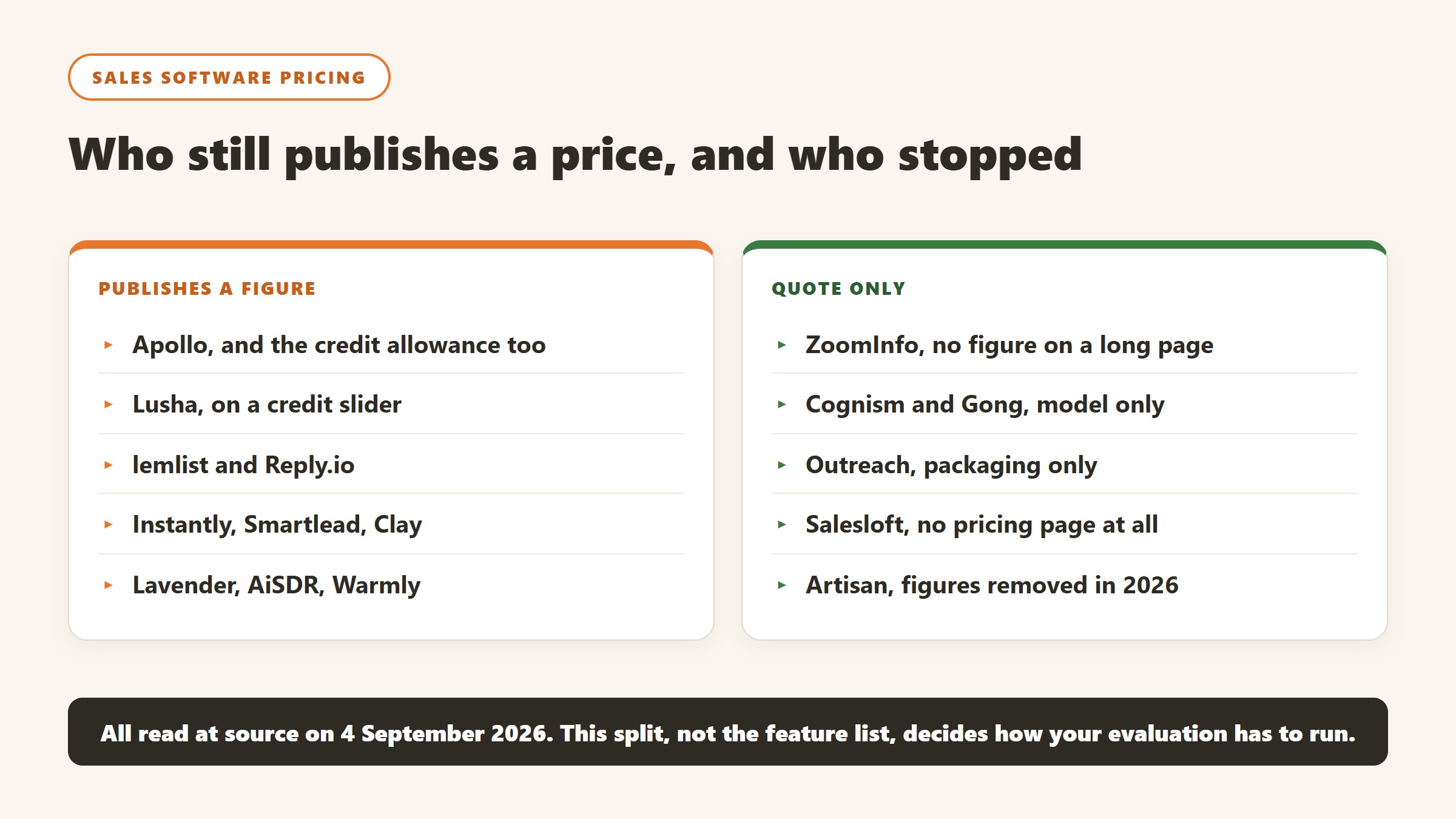
Apollo publishes $49, $79 and $119 per seat per month on annual billing, plus the credit allowance. Lusha publishes $0, $37.45, $52.45 and $299.95 a month billed yearly, tied to a credit volume selector. lemlist publishes $55 and $87 per user per month annually. Reply.io publishes $29 and $69 per month per account. AiSDR publishes from $250 a month. Warmly publishes $10,000 to $30,000 a year. Lavender publishes free to $89 a seat.
The ones that publish nothing
ZoomInfo renders a long pricing page with no figure on it. Cognism and Gong publish packaging and models but no numbers. Outreach publishes packaging only, and note the domain moved from outreach.io. Salesloft’s pricing URL now redirects to a page titled “Talk to Sales”, so it has no pricing page at all. Artisan removed its figures during 2026.
What we do not do
We do not carry a figure we cannot source to the vendor. Where a number circulates and cannot be traced, we say so and withdraw it rather than repeating it with a hedge, and we have withdrawn our own published figures on that basis more than once. Every price here carries the date we read it, because in this market a claim without a date is not checkable.
How credit pricing actually works, and the four questions that decide your bill
Credits are the reason two vendors quoting similar monthly figures can differ threefold in practice. Ask each of these vendors and every competitor the same four questions in writing.
What spends a credit
Revealing an email, revealing a phone number, enriching an existing record and exporting a list are often priced differently, and a mobile number frequently costs several times an email. Ask for the table. A plan advertised as 1,000 credits can be 1,000 emails or roughly 200 phone numbers, and if your team works the phone that distinction is your whole budget.
Whether a credit is spent again on the same person
This is the question almost nobody asks and it is worth the most. Some vendors charge every time you touch a record; Cognism publishes that it only spends again when a contact changes jobs. On a stable account list worked repeatedly over a year, that single difference can halve consumption. Get the answer in the contract rather than from a rep.
Whether unused credits roll over, and what overage costs
Outbound is seasonal. If credits expire monthly you will pay for capacity you cannot use in a quiet month and run out in a busy one. Ask whether allowances roll over, whether they pool across seats, and above all what a credit costs once you exceed the plan, because the overage rate is where the margin sits and it is almost never on the pricing page.
What happens to revealed data when you leave
Ask whether contacts you already revealed remain usable after the contract ends, and in what form you can export them. Some agreements treat the data as licensed rather than purchased, which means the enrichment you spent a year paying for does not come with you. That single clause is often the largest hidden switching cost in this category, and it is entirely invisible until you try to go.
The test that settles it
Give each vendor the same list of 200 accounts from your real ICP and ask them to run it during the trial. Then count three things: how many contacts were found, how many emails bounced when you actually sent, and how many credits it consumed. Coverage claims are marketing; a bounce rate on your own list is evidence.
What the rest of this market charges, vendor by vendor
A table gives you the number. What decides your bill is the meter behind it and the limit that binds first. Here is each comparable vendor to each of these vendors, read from their own pricing page on 4 September 2026.
Apollo.io, from $49 per seat, and it publishes the allowances too
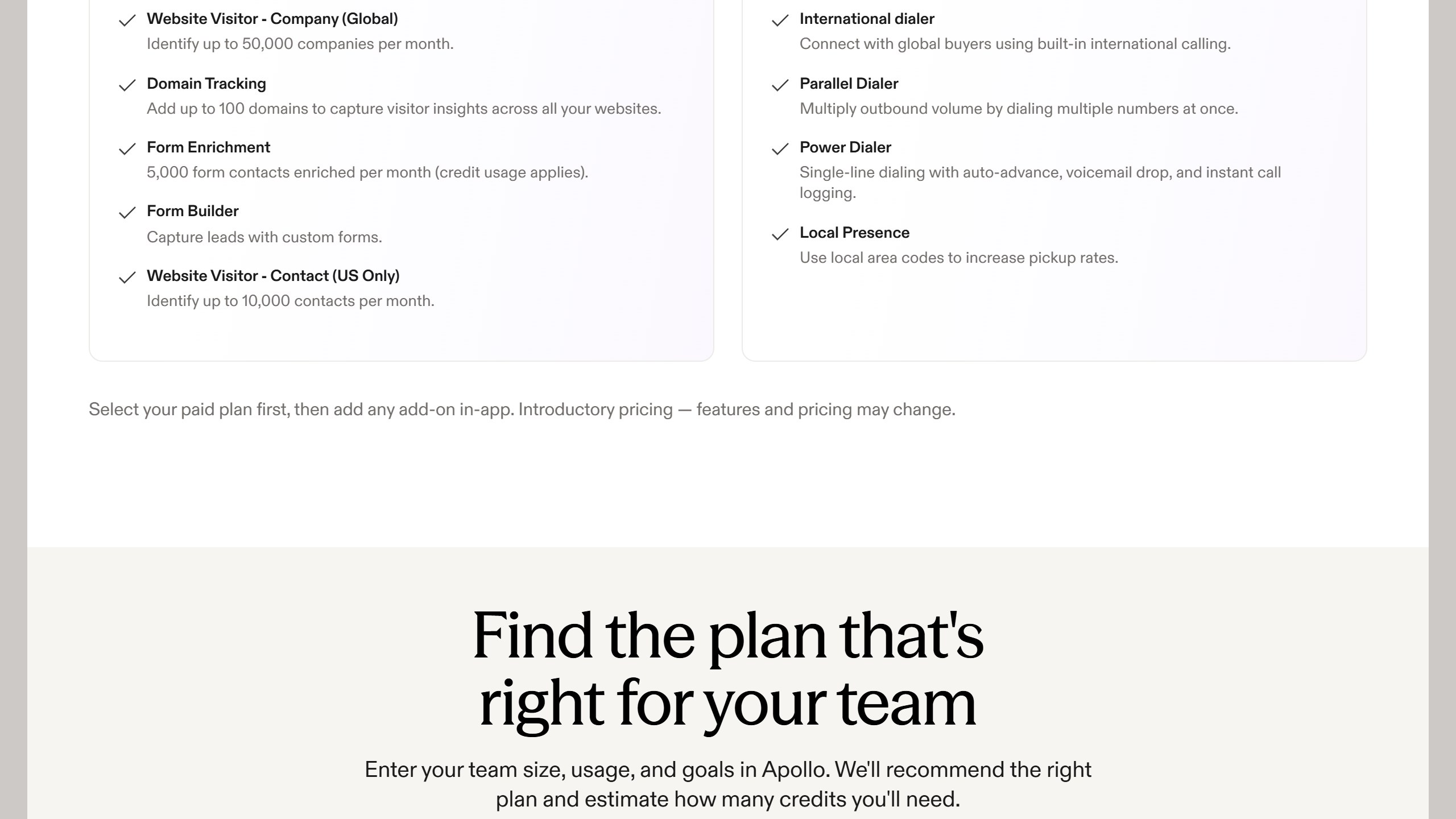
Apollo is the transparency benchmark in this category. Basic is $49 per seat per month billed annually and $65 billed monthly, Professional $79 and $99, Organization $119 and $149 with a three-seat minimum, plus a free tier at $0. Crucially it also publishes the credit allowance, 30,000 per seat per year on Basic, which almost nobody else does. That means you can divide the allowance by your real monthly reveal volume and know whether the plan fits before speaking to anyone.
Lavender, from free to $89 a seat, and free for students and jobseekers
Lavender publishes every tier: Basic free forever but capped at five emails analysed a month, Starter $27, Individual Pro $45 and Team $89 per seat, all billed annually. Note the URL, because lavender.ai/pricing now returns a 404 after the company split into two products. It also gives the Email Coach away free to students, jobseekers and bootstrapped founders, which is unusually generous and worth knowing if you hire from a graduate pipeline.
Instantly and Smartlead, published, and metered on sending
Instantly and Smartlead both publish figures openly. For cold email tooling the binding constraint is usually monthly sending or active-lead volume rather than seats, so a plan can look generous per user and still stop you at the volume your campaign needs. Smartlead runs a working monthly and annual toggle that changes every figure, so check which state you are reading.
Clay, published but on a slider
Clay publishes real numbers, but they sit on a credit slider with a monthly and annual toggle marked “Save 10%”, so the figure changes as you move the credit volume. Any article quoting a single flat Clay price has taken one position on that slider and presented it as the price. Always pair a Clay figure with the credit volume it assumes, or it cannot be compared to anything.
Cognism, no price, but it publishes the packaging
Cognism publishes no figure in any currency. It does publish that Standard and Pro both include five seats, which is a floor worth knowing, and that its credits model only spends a credit again if a contact changes jobs. A two-person team should expect to be quoted for five.
Gong, no price, but it publishes the formula
Gong publishes no figure either, but it does publish the model: licences priced per user plus a separate platform fee based on the number of users supported. Two components, both scaling with headcount, which at least lets you model the shape of the bill.
ZoomInfo, Outreach and Salesloft publish nothing at all
ZoomInfo renders over 12,000 characters of pricing page with no currency figure anywhere. Outreach sets out packaging but no numbers, and note the domain moved from outreach.io. Salesloft has gone furthest: its pricing URL now redirects to a page titled “Talk to Sales”, so there is no pricing page at all. Artisan has also removed its figures, its cards now reading “Pricing scoped on your plan”.
undefined
Verdict
Seven of eleven publish a price, which is better than this category’s reputation suggests, and better than nonprofit CRM, where only one of six does. The problem is not secrecy, it is that the seven who publish are not measuring the same thing, so the tables that put them side by side are quietly wrong.
If you want the shortest honest summary: Smartlead and Instantly compete on cost per email and Smartlead is more transparent about billing, Apollo and Clay compete on cost per data operation and Clay is the more configurable and the more expensive, Salesforce and HubSpot compete on cost per person and both have real costs outside the headline, and Lavender is the only one here priced like a tool for one person rather than a platform for a team.
The four that quote on request are not all the same. Cognism tells you how its meter works in more detail than several vendors who print a price. Salesloft and ZoomInfo tell you nothing at all.
Every figure on this page was read from the vendor’s own page on 26 August 2026, HubSpot excepted and dated. Prices in this category move fast enough that we would not trust these numbers past the end of the year without re-reading them.

Written by
FazFaz is the founder of AIToolsBakery. Some tools here are tested hands on. Others are assessed from vendor documentation and pricing verified on the live page, and every review says which one it is. Sponsors can buy a position in a guide. They cannot buy the score, the criticism, or silence about a better option.
How we test and how we make money →