Quick answer: Gong publishes no price. It does publish its model: licences are priced per user, there is a separate platform fee based on the number of users supported, and integrations are free. The quote form gates by team size in four bands. Checked 12 August 2026.
Gong is not alone in quoting rather than publishing. Of eleven major sales tools read on 26 August 2026, seven publish a price and four do not: Outreach, Salesloft, Cognism and ZoomInfo. Where Gong is unusual is that it publishes its model even though it withholds the number. The full picture is in AI sales tool pricing compared.
How we researched this
We did not run Gong. This is a pricing analysis read directly from gong.io in a browser on 12 August 2026. It is not a hands-on review and we do not score the product here. For what Gong does, see our Gong review.
One methodological note that matters for this page specifically. Gong’s site is a React application, and its raw HTML contains strings that look like currency figures but are not: hydration markers such as $L31 and $Sreact.fragment. Anything that fetches the page and pattern matches for a dollar sign will report prices that do not exist. Every figure and quotation below was read from the rendered page.
Gong does not publish a price, but it does publish the formula
There is no number on the pricing page. What there is, stated in three plain bullets, is more useful than most vendors give you:
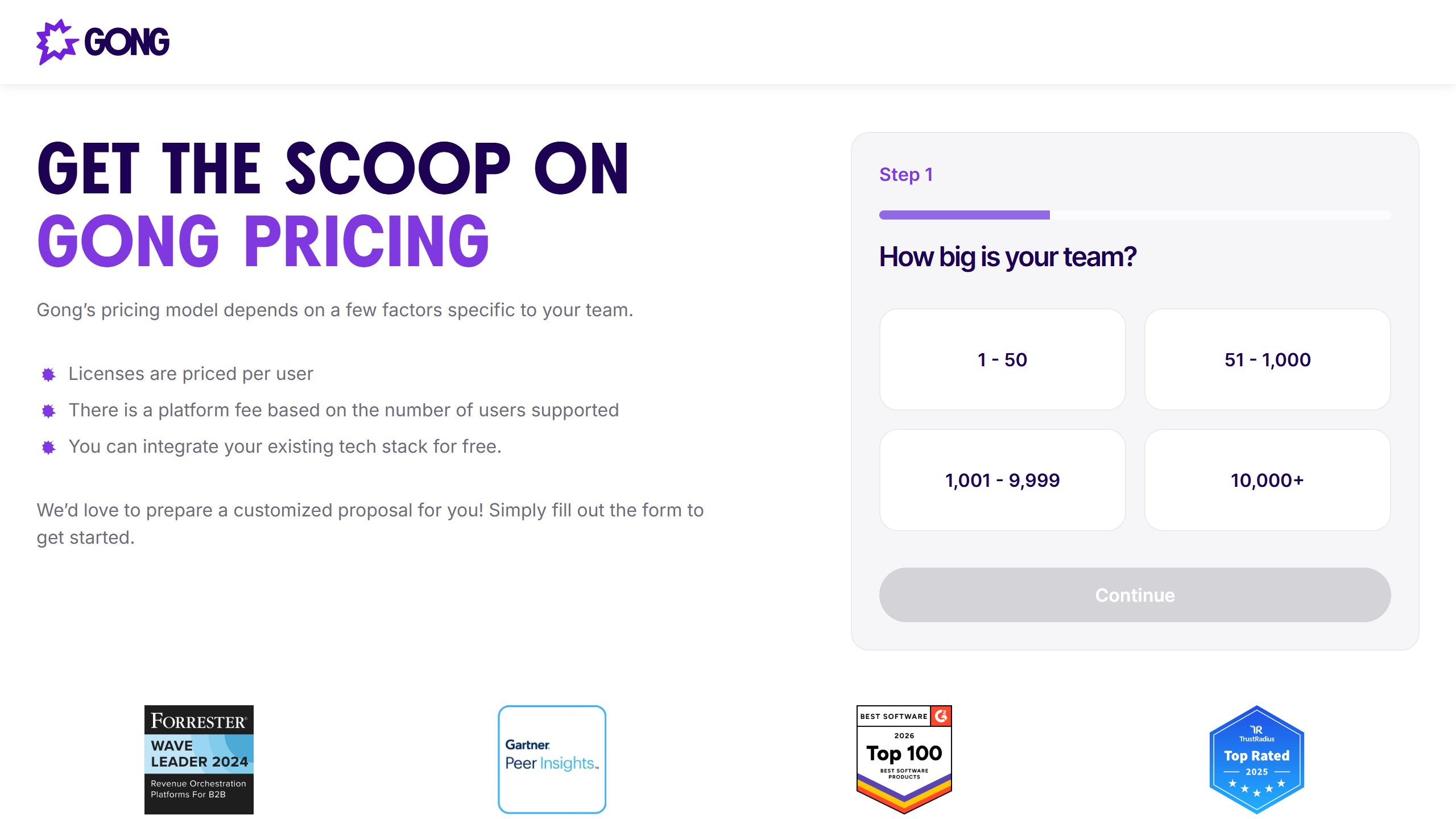
“Licenses are priced per user. There is a platform fee based on the number of users supported. You can integrate your existing tech stack for free.”
Read the middle bullet again, because it is the one that catches people out.
The platform fee is a second line item, not a rounding error
Most comparisons of Gong describe it as priced per seat and stop there. That is half the model. There is a separate platform fee scaled to the number of users supported, and it sits on top of the licences.
Two practical consequences.
Your per seat maths will understate the bill. If you take a per user figure from a forum or an AI answer and multiply by headcount, you have priced the licences and none of the platform. The gap is not disclosed publicly, so we cannot tell you how large it is, only that it exists and that Gong says so itself.
Growth costs more than linearly, or it might not. A fee “based on the number of users supported” could step at thresholds or scale smoothly. Gong does not say which. That is the single most valuable question to ask on the call, because it determines what happens to your bill when you hire.
Free integrations are worth more than they sound
The third bullet is a genuine differentiator and it is easy to skim past. Gong states you can integrate your existing tech stack for free.
In this category that is not universal. Integrations are frequently the thing that sits behind the higher tier. On Hyperbound, for example, CRM and call recorder integrations are not available on the cheaper of its two licences at all: you have to buy Perform to get them. Gong charging nothing for connections into your CRM and dialer is a real cost difference, and it partly offsets the platform fee.
The four bands, and what they tell you
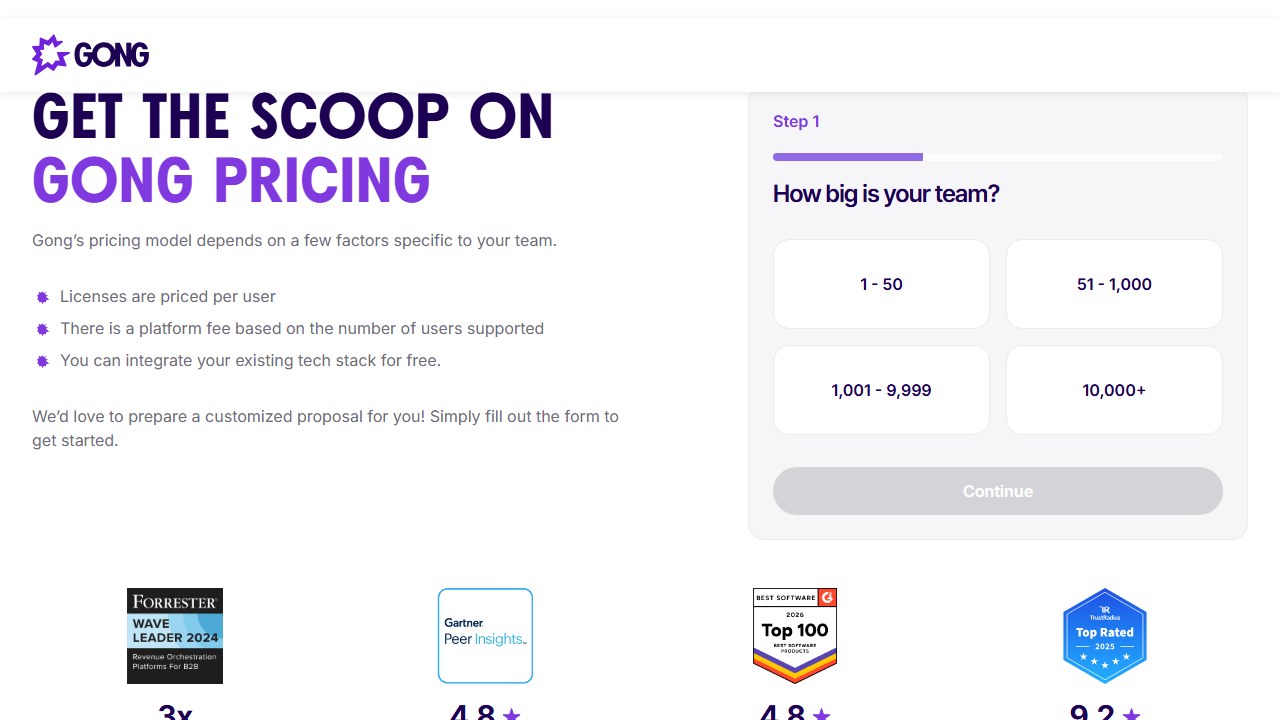
Before Gong will quote you, it asks one question: how big is your team. The options are:
| Band | What it signals |
|---|---|
| 1 to 50 | Self-serve adjacent. The widest band at the small end, which suggests broadly similar treatment across it |
| 51 to 1,000 | The core mid-market band, and by far the widest in absolute terms. A 60 seat team and a 900 seat team are in the same bucket at first contact |
| 1,001 to 9,999 | Enterprise |
| 10,000+ | Strategic accounts |
Bands are not pricing, but they are where a vendor has decided its commercial breaks sit, and that is worth knowing. A team of 48 and a team of 55 are being routed differently before anyone has spoken to them.
What Gong does not tell you
Being clear about the limits of this page. From published material we could not determine:
- Any actual figure, for licences or for the platform fee
- Whether the platform fee steps at thresholds or scales continuously
- Whether manager or reviewer seats cost the same as full seats
- Billing cadence, and whether annual upfront is required
- What happens to seat count mid term when people join or leave
Anyone publishing a specific Gong price is either quoting their own contract, which is one data point from one negotiation, or estimating. Treat both accordingly.
How Gong compares on transparency
Of twelve platforms in this category we checked on the same day, only Yoodli publishes a figure. Gong sits in the middle of the rest: no number, but an unusually clear description of the model. Allego is the other vendor that describes its structure openly, stating it bills annually upfront and charges different rates by user type.
The full picture is in our best AI sales coaching software guide. For the one vendor with public numbers, see our Yoodli pricing guide. Two vendors in the category, Mindtickle and Balto, have no pricing page at all, covered in our Mindtickle pricing guide.
If you are weighing Gong against the ZoomInfo option, note that the standalone Chorus product no longer exists as such. We cover what changed in Gong vs Chorus and our Chorus review.
Where Gong sits against the rest of the market
Gong publishes no figure, which sounds like the bottom of the class until you look at what its peers publish. It is actually in the middle, and for a specific reason worth crediting.
| Vendor | Publishes a figure? | Publishes the model? | Entry price if published |
|---|---|---|---|
| Apollo.io | Yes | Yes | $49 per seat/mo, billed annually |
| Lavender | Yes | Yes | Free, then $27/mo |
| Gong | No | Yes | Quote |
| Cognism | No | Partly, packaging only | Quote, 5 seats included |
| ZoomInfo | No | No | Quote |
| Salesloft | No | No | No pricing page at all |
Gong is the only vendor in this group that publishes a model without publishing a figure. That is a genuine middle position: you cannot get a number, but you can predict how the number behaves as you grow, which is more than ZoomInfo or Salesloft give you.
Modelling the two components before the call
The licence scales with people who use it
Per-user licensing is predictable and you control the input. Decide who genuinely needs a seat: in most deployments the reps whose calls are recorded and the managers who review them, which is a smaller number than “everyone in revenue”.
The platform fee scales with people it supports
This is the line to interrogate, because “users supported” is not the same as “users licensed” and the definition determines the bill. Ask exactly how it is calculated, get the figure at your current headcount and at your hiring plan, and get both in writing before you sign anything.
Neither line is the implementation
Onboarding, CRM integration and any historical data migration sit outside both components. They are also the most negotiable part of a first-year deal, which is precisely why they are often folded into a headline figure that then anchors the renewal.
What a good Gong evaluation looks like
Load your own calls, not their demo set
Vendor demos run on recordings chosen because the product handles them well. Ask to load your own, including a poor-quality line and a call full of your product jargon. Transcription accuracy on your vocabulary decides whether reps trust the output, and it is invisible in a scripted demo.
Name the person who will review calls weekly
Gong creates the conditions for coaching; it does not perform it. Every deployment described as a success has a manager with recurring time booked to review calls. If you cannot name that person and point at the slot in their calendar, the software will not create them, and this becomes an expensive archive.
What to ask on the call
- Split the quote: per user licence cost, and platform fee, as separate lines
- Does the platform fee step at thresholds, and where are they
- Both figures at our current headcount and at plus 30 percent
- Do reviewer or manager only seats cost the same as full seats
- Is it billed annually upfront, and what is the three year total
- Confirm in writing that every integration we need is included at no cost
What the rest of this market charges, vendor by vendor
A table gives you the number. What decides your bill is the meter behind it and the limit that binds first. Here is each comparable vendor to Gong, read from their own pricing page on 4 September 2026.
Apollo.io, from $49 per seat, and it publishes the allowances too
Apollo is the transparency benchmark in this category. Basic is $49 per seat per month billed annually and $65 billed monthly, Professional $79 and $99, Organization $119 and $149 with a three-seat minimum, plus a free tier at $0. Crucially it also publishes the credit allowance, 30,000 per seat per year on Basic, which almost nobody else does. That means you can divide the allowance by your real monthly reveal volume and know whether the plan fits before speaking to anyone.
Lavender, from free to $89 a seat, and free for students and jobseekers
Lavender publishes every tier: Basic free forever but capped at five emails analysed a month, Starter $27, Individual Pro $45 and Team $89 per seat, all billed annually. Note the URL, because lavender.ai/pricing now returns a 404 after the company split into two products. It also gives the Email Coach away free to students, jobseekers and bootstrapped founders, which is unusually generous and worth knowing if you hire from a graduate pipeline.
Instantly and Smartlead, published, and metered on sending
Instantly and Smartlead both publish figures openly. For cold email tooling the binding constraint is usually monthly sending or active-lead volume rather than seats, so a plan can look generous per user and still stop you at the volume your campaign needs. Smartlead runs a working monthly and annual toggle that changes every figure, so check which state you are reading.
Clay, published but on a slider
Clay publishes real numbers, but they sit on a credit slider with a monthly and annual toggle marked “Save 10%”, so the figure changes as you move the credit volume. Any article quoting a single flat Clay price has taken one position on that slider and presented it as the price. Always pair a Clay figure with the credit volume it assumes, or it cannot be compared to anything.
Cognism, no price, but it publishes the packaging
Cognism publishes no figure in any currency. It does publish that Standard and Pro both include five seats, which is a floor worth knowing, and that its credits model only spends a credit again if a contact changes jobs. A two-person team should expect to be quoted for five.
Gong, no price, but it publishes the formula
Gong publishes no figure either, but it does publish the model: licences priced per user plus a separate platform fee based on the number of users supported. Two components, both scaling with headcount, which at least lets you model the shape of the bill.
ZoomInfo, Outreach and Salesloft publish nothing at all
ZoomInfo renders over 12,000 characters of pricing page with no currency figure anywhere. Outreach sets out packaging but no numbers, and note the domain moved from outreach.io. Salesloft has gone furthest: its pricing URL now redirects to a page titled “Talk to Sales”, so there is no pricing page at all. Artisan has also removed its figures, its cards now reading “Pricing scoped on your plan”.
What it costs to leave, which nobody quotes
Switching cost is why teams stay on tools they have outgrown. Three things determine how locked in you are, and all three are answerable during procurement.
Your data, and which parts of it come back
Contact records usually export cleanly. What often does not is the enrichment you paid for, the activity history, custom fields and the sequence performance data that tells you what actually worked. Ask specifically what a full export contains, in what format, and whether revealed contacts remain usable after the contract ends.
Sequences and templates are rebuild work
Cadences, templates, snippets and scoring rules represent months of iteration and rarely transfer between platforms. That is real staff time to rebuild, and it is the cost most often left out of a switching business case.
The integrations multiply the effort
Count every connected system before you sign, not when you leave: CRM, calendar, dialler, enrichment providers, data warehouse. Each one is work to disconnect and reconnect elsewhere, and the count is almost always higher than anyone remembers.
What a stack actually costs at three team sizes
Per-seat figures compound faster than people expect. Here is the annual bill for the vendors that publish, at the sizes teams actually buy, using our arithmetic on their own published rates.
| Team size | Apollo Basic, $49 | Apollo Professional, $79 | Lavender Individual Pro, $45 | Lavender Team, $89 |
|---|---|---|---|---|
| 3 seats | $1,764 | $2,844 | $1,620 | $3,204 |
| 5 seats | $2,940 | $4,740 | $2,700 | $5,340 |
| 10 seats | $5,880 | $9,480 | $5,400 | $10,680 |
| 25 seats | $14,700 | $23,700 | $13,500 | $26,700 |
Use these as the number a quote-only vendor has to beat
None of the enterprise vendors will give you a figure before a call. Walking in with a published alternative priced at your exact seat count changes the conversation, because it puts a real number in the room that you can verify and they cannot dispute. It also gives you a credible walk-away, which is the only leverage that reliably moves an enterprise quote.
Watch the tier jump, not the entry price
The step from Apollo Basic to Professional is $30 per seat per month, which at ten seats is $3,600 a year. Teams get this wrong in both directions: upgrading early for features nobody requested, or staying on the lower tier while several people work around a gap that costs more in time than the upgrade costs in money. Price the workaround before you refuse the upgrade.
Verdict
Gong is quote only, like almost everyone here, but it is more forthcoming than most about how the number is built. The platform fee is the part to take seriously: it is a second line item that per seat comparisons miss entirely, and it is the reason Gong quotes routinely come in above what buyers modelled. Free integrations pull in the other direction and are worth real money.
Go into the conversation asking for the two lines separately and you will get a number you can actually compare.
Checked on gong.io/pricing on 12 August 2026.

Written by
FazFaz is the founder of AIToolsBakery. Some tools here are tested hands on. Others are assessed from vendor documentation and pricing verified on the live page, and every review says which one it is. Sponsors can buy a position in a guide. They cannot buy the score, the criticism, or silence about a better option.
How we test and how we make money →