What Apollo.io costs
Paying per seat or per call? This page covers Apollo’s full price sheet. Our SDR API comparison carries the figure it does not: Apollo works out at about two cents a credit, and unusually that rate stays flat as you move up the tiers.
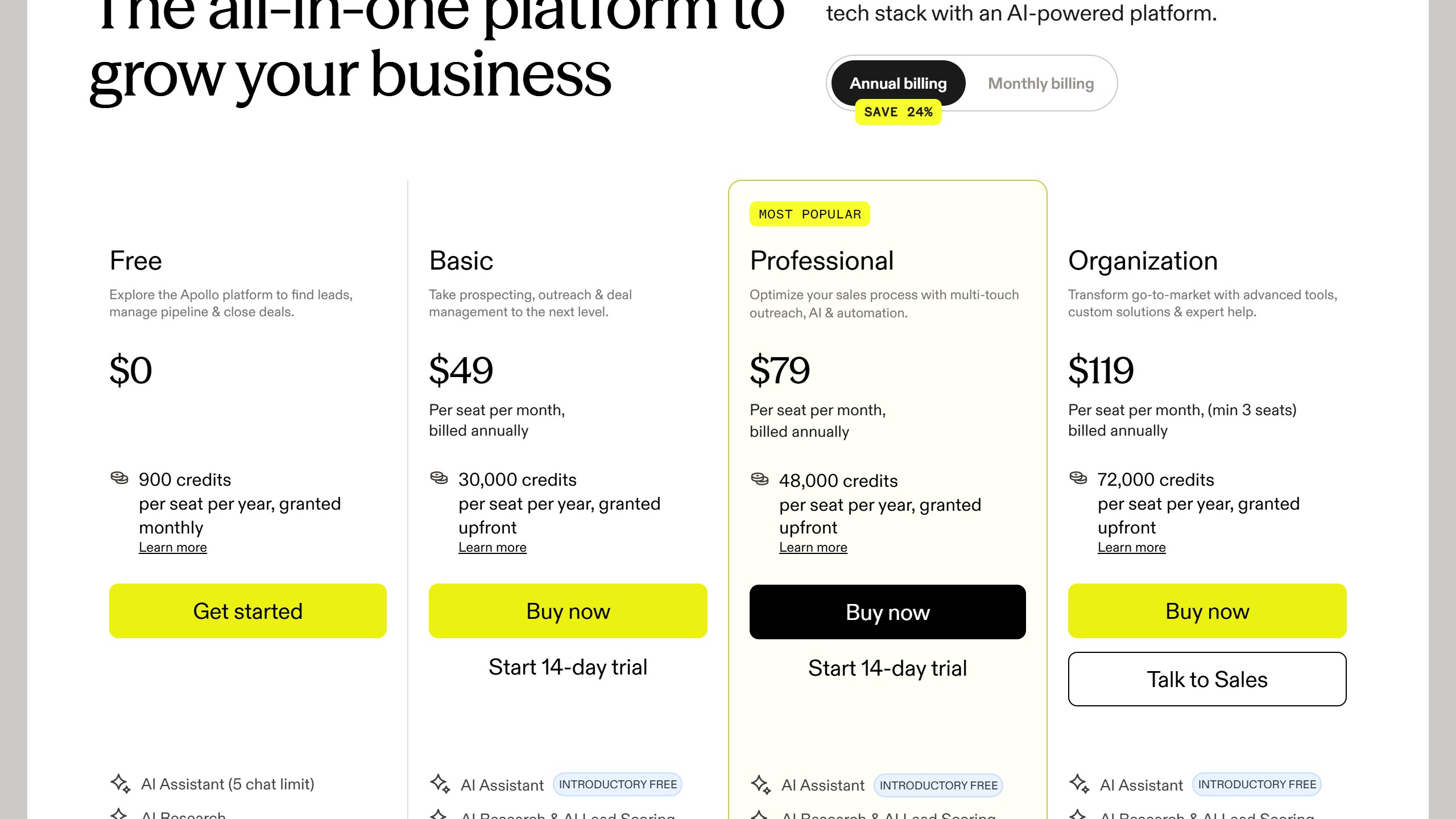
| Plan | Billed annually | Billed monthly | Credits | Annual saving |
|---|---|---|---|---|
| Free | $0 | $0 | 75 per seat per month | n/a |
| Basic | $49/seat/mo | $65/seat/mo | 30,000 per seat per year | 24.6% |
| Professional | $79/seat/mo | $99/seat/mo | 4,000 per seat per month | 20.2% |
| Organization | $119/seat/mo | $149/seat/mo | 6,000 per seat per month | 20.1% |
Read from apollo.io/pricing on 26 August 2026, with both billing states expanded. Organization is annual only and carries a three-seat minimum.
Two add-ons sit outside the tiers, both priced per team rather than per seat: Inbound at $149 a month, which identifies up to 10,000 website-visitor contacts a month, and the Advanced Dialer at $149 a month, or $119 billed annually.
How we researched this
We did not run Apollo for this page. This is a pricing analysis read from apollo.io in a browser on 26 August 2026, with the annual and monthly billing states each expanded and recorded separately. It is not a hands-on review and we do not score the product here. For what Apollo does, see our Apollo.io review.
The billing toggle matters more than usual on this page. A first automated pass captured only the state that happened to be showing and came back with four dollar figures for a vendor that publishes more than a dozen. Reading one state and calling it the price list is how comparisons of Apollo end up 25% out.
The 24% that applies to one tier
Apollo’s pricing page carries a “Save 24%” badge above the billing toggle. Not “up to 24%”. A flat statement, sitting above all three paid tiers.
Do the subtraction on Apollo’s own two columns:
- Basic: $65 to $49 is a saving of 24.6%. The claim holds.
- Professional: $99 to $79 is 20.2%.
- Organization: $149 to $119 is 20.1%.
So the badge is accurate on the cheapest paid plan and overstates the saving by about four points on the other two. For 24% to hold on Professional, the annual price would need to be about $75 a month rather than $79.
Organization does not cost $119
The Organization tier is listed at $119 per seat per month, which reads as the price of the plan. It is not the price of anything you can buy.
Two conditions are printed alongside it. It is annual only, so the monthly $149 figure is not purchasable either. And it has a minimum of three seats.
That makes the real entry cost of Apollo Organization $357 a month, or $4,284 for the year, before either add-on. A two-person team cannot buy it at all.
This is worth stating plainly because $119 is the figure that gets quoted in comparisons, and it is three times smaller than the smallest cheque Apollo will accept for that plan.
The credit grant changes shape when you switch billing
Most vendors give you the same allowance whichever way you pay. Apollo does not, quite.
On monthly billing, Basic gives 2,500 credits per seat per month. On annual billing, Basic gives 30,000 credits per seat per year, granted upfront.
The totals match. Twelve months of 2,500 is 30,000. What changes is when you get them, and that is a real difference for two kinds of team.
If your prospecting is seasonal, annual is much better than the price alone suggests. A team that runs a heavy Q1 and a quiet Q3 can spend 20,000 credits in January on the annual plan. On monthly billing, January is capped at 2,500 no matter how much work there is.
If your prospecting is steady, the upfront grant is a discipline problem. There is nothing stopping a new team burning a year of credits in six weeks, and Apollo’s page does not say the grant is topped up if you do.
The free tier is the same shape: 75 credits per seat per month, or 900 per seat per year.
What Apollo does not tell you on the pricing page
What a credit buys. The tiers are quoted in credits and the pricing page does not define what one credit gets you across each data type. That is the number that decides whether 30,000 is generous or thin for your workflow.
What happens when the credits run out. No overage rate is published, and no statement about whether the annual grant can be topped up mid-term.
Whether unused credits roll over. Not addressed on the pricing page in either billing state.
Seat minimums below Organization. Only Organization prints one. Whether Basic and Professional have one is not stated.
How Apollo compares on transparency
Apollo publishes more than most of its direct competitors. Of eleven major sales tools we read on the same day, seven published a price and four quoted on request. ZoomInfo, which Apollo is most often compared against, publishes package names and a Get Pricing button and no figures at all.
Where Apollo sits mid-pack is on the honesty of its discount badge. Smartlead advertises 17% off and delivers between 16.9% and 17.9% on every tier. Apollo advertises a flat 24% and delivers it on one tier of three.
Full cross-vendor comparison in our AI sales tool pricing breakdown, and a direct feature comparison in Clay vs Apollo and Apollo vs ZoomInfo.
What it actually costs at real team sizes
Per-seat figures are easy to underestimate in aggregate. Here is the annual bill at the sizes teams actually buy, using Apollo’s published annual rates.
| Seats | Basic, $49 | Professional, $79 | Organization, $119 |
|---|---|---|---|
| 3 | $1,764 | $2,844 | $4,284 (minimum seats) |
| 5 | $2,940 | $4,740 | $7,140 |
| 10 | $5,880 | $9,480 | $14,280 |
| 25 | $14,700 | $23,700 | $35,700 |
Where the tier jump actually bites
The step from Basic to Professional is $30 per seat per month, which at ten seats is $3,600 a year. That is the decision most teams get wrong in both directions: upgrading early for features nobody has asked for, or staying on Basic while three people work around a missing capability that costs more in time than the upgrade would in money.
Why Organization is a bigger step than it looks
Organization is not simply $119. It carries a three-seat minimum, so the smallest possible Organization deployment is $4,284 a year even if only one person needs the tier. For a small team where a single person needs an Organization-only feature, that constraint often makes the tier uneconomic in a way the headline per-seat figure hides.
The credit economics matter more than the seat price
Apollo publishes its credit allowances, which is genuinely unusual in this category and is the more useful half of the pricing page.
What the allowance buys
Basic carries 30,000 credits per seat per year on annual billing. The free tier carries 900 per seat per year, granted monthly. Before comparing Apollo to anything, divide the allowance by your realistic monthly reveal volume, because a generous seat price with a thin allowance is not a cheap product.
The comparison most competitors will not let you make
This is where transparency has practical value rather than just moral value. Cognism, for instance, publishes that each seat includes an allocation but never says how large it is, so the seat price alone cannot be compared. Our Cognism pricing analysis goes through what that leaves a buyer able to work out, which is very little. Against that, Apollo lets you model the whole thing on a spreadsheet before you speak to anyone.
Credits are not the only meter to check
Allowances and email sending limits are different constraints. A plan can be generous on reveals and restrictive on outbound volume, and teams usually discover the binding limit only after committing annually. Check both against your actual motion.
How Apollo sits against the quote-only end of the market
The comparison worth drawing is not feature by feature, it is what each vendor will tell you before a call.
| Vendor | Publishes figures? | Publishes allowances? |
|---|---|---|
| Apollo.io | Yes, all four tiers, both billing cycles | Yes |
| Cognism | No | No |
| ZoomInfo | No | No |
| Salesloft | No, and no pricing page at all | No |
That transparency is worth real money in procurement time, and it is the strongest argument for Apollo that has nothing to do with its feature set.
What to ask on the call
What does one credit buy, per data type. Get it in writing per action, not as a headline number.
What is the overage rate. And whether hitting it stops work or bills you.
Do unused credits expire. Especially on the annual upfront grant.
Is there a seat minimum on Basic or Professional. Organization’s is published. The others are not.
What is the year two price. Every figure here is year one.
What the rest of this market charges, vendor by vendor
A table gives you the number. What decides your bill is the meter behind it and the limit that binds first. Here is each comparable vendor to Apollo, read from their own pricing page on 4 September 2026.
Apollo.io, from $49 per seat, and it publishes the allowances too
Apollo is the transparency benchmark in this category. Basic is $49 per seat per month billed annually and $65 billed monthly, Professional $79 and $99, Organization $119 and $149 with a three-seat minimum, plus a free tier at $0. Crucially it also publishes the credit allowance, 30,000 per seat per year on Basic, which almost nobody else does. That means you can divide the allowance by your real monthly reveal volume and know whether the plan fits before speaking to anyone.
Lavender, from free to $89 a seat, and free for students and jobseekers
Lavender publishes every tier: Basic free forever but capped at five emails analysed a month, Starter $27, Individual Pro $45 and Team $89 per seat, all billed annually. Note the URL, because lavender.ai/pricing now returns a 404 after the company split into two products. It also gives the Email Coach away free to students, jobseekers and bootstrapped founders, which is unusually generous and worth knowing if you hire from a graduate pipeline.
Instantly and Smartlead, published, and metered on sending
Instantly and Smartlead both publish figures openly. For cold email tooling the binding constraint is usually monthly sending or active-lead volume rather than seats, so a plan can look generous per user and still stop you at the volume your campaign needs. Smartlead runs a working monthly and annual toggle that changes every figure, so check which state you are reading.
Clay, published but on a slider
Clay publishes real numbers, but they sit on a credit slider with a monthly and annual toggle marked “Save 10%”, so the figure changes as you move the credit volume. Any article quoting a single flat Clay price has taken one position on that slider and presented it as the price. Always pair a Clay figure with the credit volume it assumes, or it cannot be compared to anything.
Cognism, no price, but it publishes the packaging
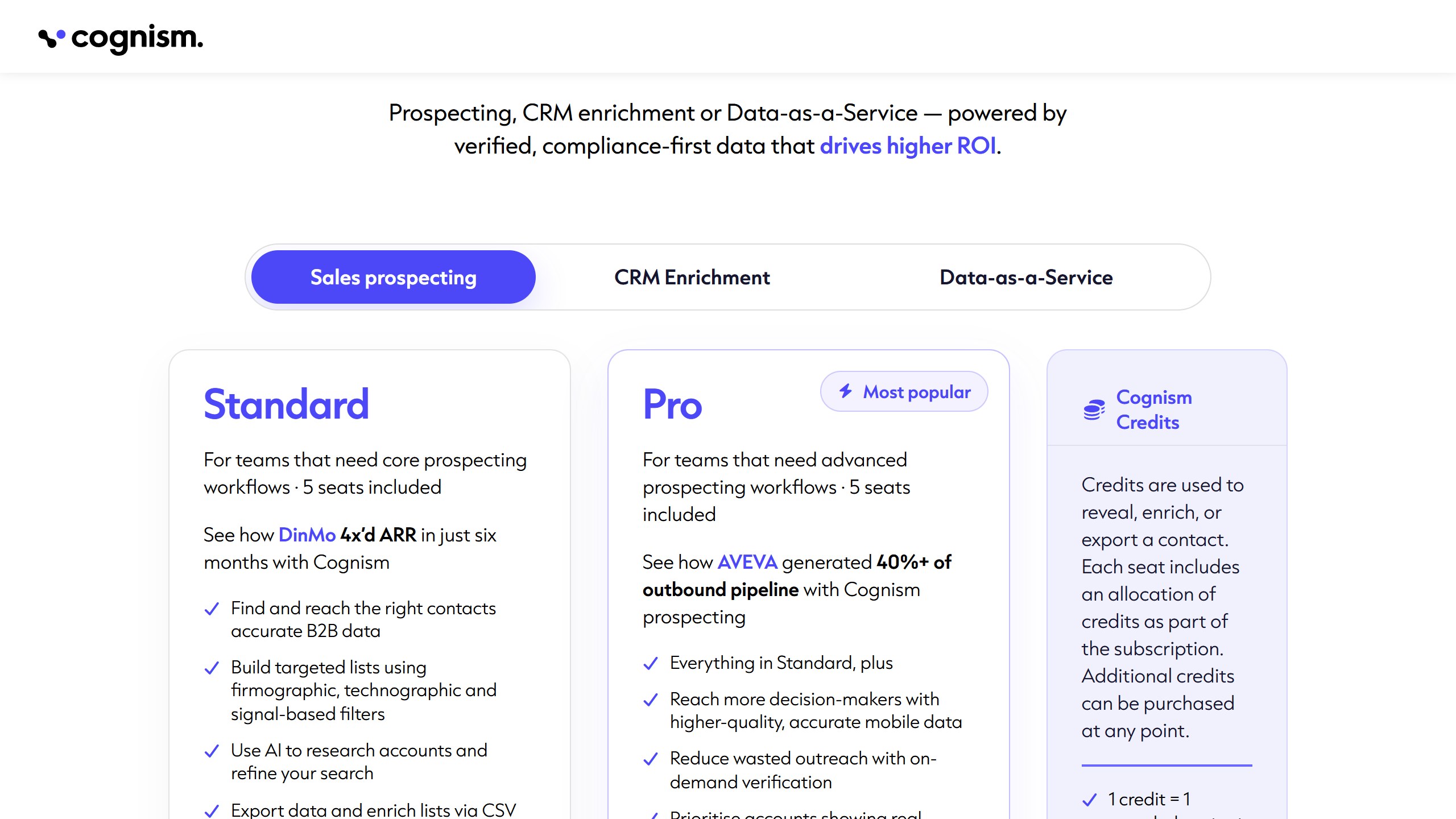
Cognism publishes no figure in any currency. It does publish that Standard and Pro both include five seats, which is a floor worth knowing, and that its credits model only spends a credit again if a contact changes jobs. A two-person team should expect to be quoted for five.
Gong, no price, but it publishes the formula
Gong publishes no figure either, but it does publish the model: licences priced per user plus a separate platform fee based on the number of users supported. Two components, both scaling with headcount, which at least lets you model the shape of the bill.
ZoomInfo, Outreach and Salesloft publish nothing at all
ZoomInfo renders over 12,000 characters of pricing page with no currency figure anywhere. Outreach sets out packaging but no numbers, and note the domain moved from outreach.io. Salesloft has gone furthest: its pricing URL now redirects to a page titled “Talk to Sales”, so there is no pricing page at all. Artisan has also removed its figures, its cards now reading “Pricing scoped on your plan”.
What it costs to leave, which nobody quotes
Switching cost is why teams stay on tools they have outgrown. Three things determine how locked in you are, and all three are answerable during procurement.
Your data, and which parts of it come back
Contact records usually export cleanly. What often does not is the enrichment you paid for, the activity history, custom fields and the sequence performance data that tells you what actually worked. Ask specifically what a full export contains, in what format, and whether revealed contacts remain usable after the contract ends.
Sequences and templates are rebuild work
Cadences, templates, snippets and scoring rules represent months of iteration and rarely transfer between platforms. That is real staff time to rebuild, and it is the cost most often left out of a switching business case.
The integrations multiply the effort
Count every connected system before you sign, not when you leave: CRM, calendar, dialler, enrichment providers, data warehouse. Each one is work to disconnect and reconnect elsewhere, and the count is almost always higher than anyone remembers.
Verdict
Apollo is one of the more transparent vendors in a category where four of eleven publish nothing. All four tiers, both billing cycles, credit allowances and add-on prices are on the page and readable in a browser without a form.
Two things are misleading rather than hidden. The “Save 24%” badge is stated as a fact and is only true on Basic, and the $119 Organization tier cannot be bought for less than $357 a month because of a three-seat minimum printed beside it.
For a single rep or a small team, the shape that makes Apollo good value is the annual credit grant, which lets seasonal work spend against a year of allowance in a single month. For a team of three or more, price Organization at its real floor before comparing it to anything.
Verified from apollo.io on 26 August 2026. Pricing in this category moves, so re-read the page before it moves a decision.

Written by
FazFaz is the founder of AIToolsBakery. Some tools here are tested hands on. Others are assessed from vendor documentation and pricing verified on the live page, and every review says which one it is. Sponsors can buy a position in a guide. They cannot buy the score, the criticism, or silence about a better option.
How we test and how we make money →