Ask a teacher whether you can use AI in your AP class and you will get an answer about that classroom. Ask whether College Board allows it and most people guess. The guessing is understandable, because the actual answer is scattered across three separate pages on two different College Board sites, and it is more permissive in some places and far stricter in others than students expect.
This page collects what College Board has actually published, quotes it, and links every source. It is not legal advice and it is not a substitute for your teacher’s classroom rules, which can be stricter. Everything below was read on 24 September 2026 from College Board’s own pages.
The Short Answer
Three rules cover almost every situation an AP student will meet.
1. Studying with AI is not an AP policy issue. Nothing College Board publishes stops you using an AI tutor, a study app or a chatbot to learn the material, review a concept or quiz yourself. That is preparation, not submitted work.
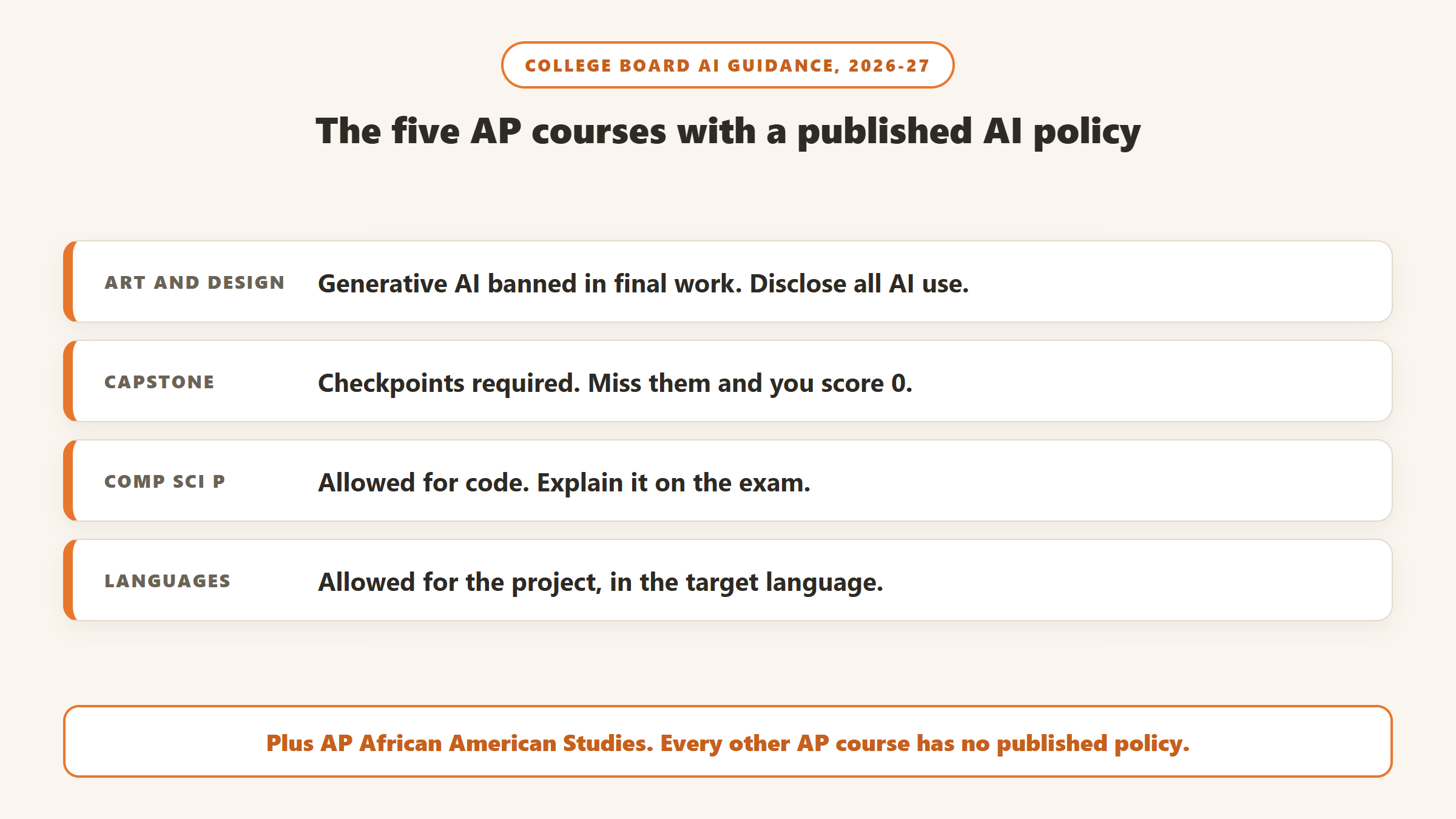
2. Submitted work is governed course by course. College Board’s AI guidance for the 2026-27 academic year covers five course families. In those courses, generative AI is permitted as an optional aid and prohibited from producing the work itself. Courses not on that page have no published AP-level AI policy, which does not mean your teacher or school permits it.
3. Exam content is the real trap. Putting an AP exam question into any tool, AI or otherwise, after you have sat the exam can get your score cancelled automatically. This rule applies to every AP course and it is the one students break by accident.
Which AP Courses Have a Published AI Policy
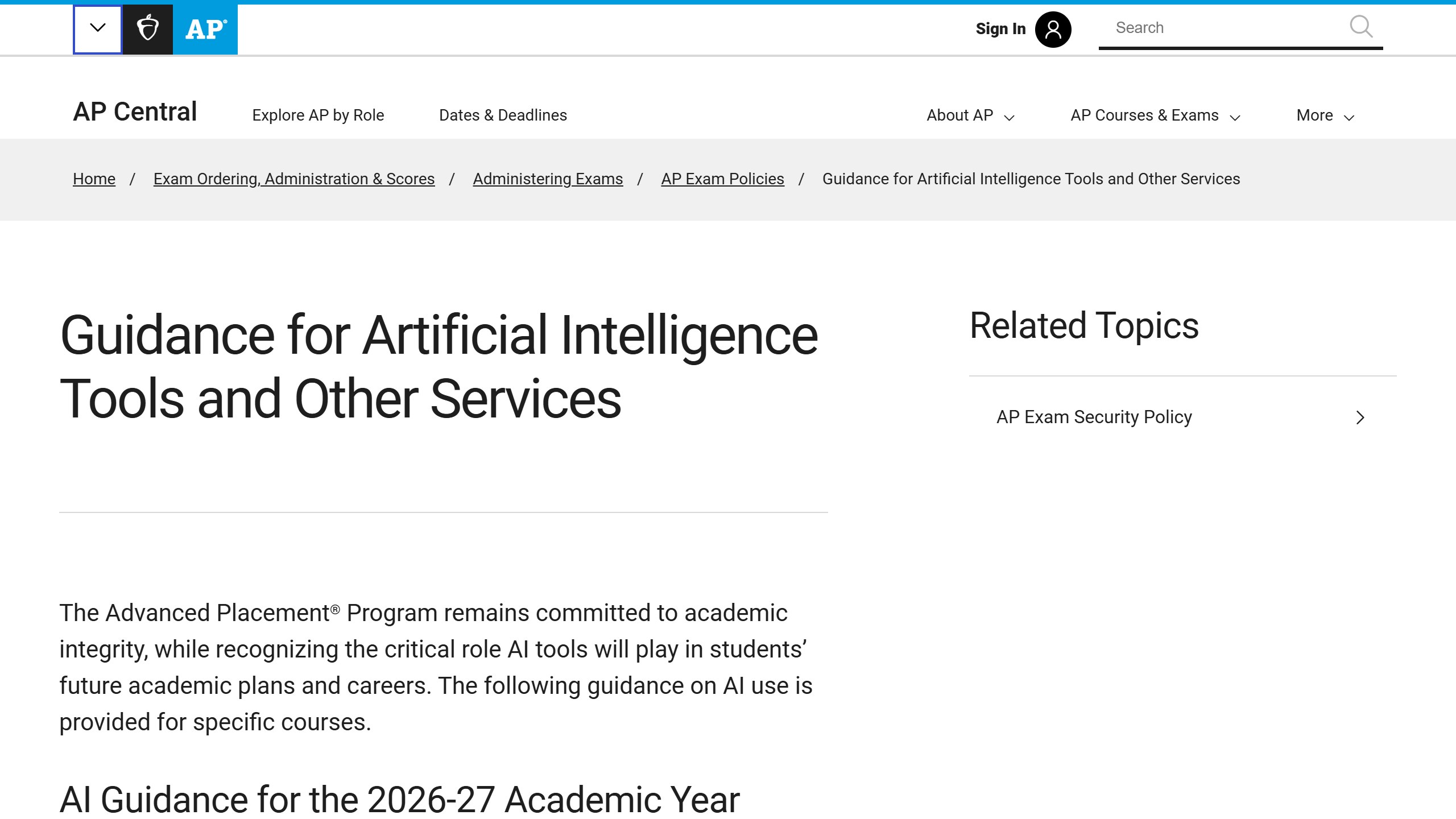
College Board’s guidance page opens by saying it “remains committed to academic integrity, while recognizing the critical role AI tools will play in students’ future academic plans and careers”, then gives guidance “for specific courses”. Those courses are:
- AP African American Studies
- AP Art and Design
- AP Capstone, meaning AP Seminar and AP Research
- AP Computer Science Principles
- AP World Languages and Cultures: French, Italian, German, Spanish, Chinese and Japanese
What these have in common is that they all include work students produce over time and submit outside the exam room: a project, a portfolio, a performance task, a course project. That is the pattern. Where there is no submitted coursework, College Board has published no AI policy, because the exam room already handles it.
The Shared Standard Across Every Course With a Policy
The same paragraph appears, nearly word for word, in African American Studies, Capstone and World Languages. Generative AI tools “must be used ethically, responsibly, and intentionally to support student learning, not to bypass it”, the submitted work “must be the student’s own work”, and AI use is “optional and not mandatory”.
Students may use generative AI as an optional aid for:
- exploring potential topics of inquiry
- initial searches for sources of information
- confirming their understanding of a complex text
- checking their writing for grammar and tone
And students must still read primary and secondary sources directly, perform their own analysis and synthesis of evidence, and make their own choices about how to communicate.
College Board’s help centre sharpens two of those points in a way the course policies do not. It says students may use AI for “checking their writing but not rewriting for grammar and tone”, and states flatly that students may not use AI tools to write or create their assignments for them. If you have ever pasted a paragraph in and asked a model to make it better, that is the line.
AP Art and Design: The Most Detailed Policy
Art and Design has the most worked-out rules, because AI image generation collides directly with a portfolio of original artwork. College Board’s policy splits AI into two kinds.
Generative AI produces new content: text, charts, images, audio, video. Students “can use generative AI tools only during research, ideation, practice, experimentation, and revision”. Using them “to create final submitted artwork is prohibited”. Crucially, that extends inside your editing software: “any AI feature that generates or inserts new content (e.g., object creation, generative fill/expand, background replacement), even when accessed through otherwise permitted software, is treated as generative and not permitted in final submitted artwork”. Generative fill in a photo editor is not a grey area.
Non-generative AI does not create new visual content. Lighting adjustment, selection, cleanup, exposure, contrast, colour correction, cropping. These “may be used at all stages of artmaking, including final submitted artwork”, because the student remains the sole creator of the visual content.
Disclosure is mandatory. Students “must disclose any AI use (generative or non-generative)” in the AP Digital Portfolio, for artwork in both Sustained Investigation and Selected Works, explaining how AI supported research, ideation, practice, experimentation or revision. Note that this includes the permitted, non-generative uses. Cropping with an AI-assisted tool is allowed and still needs disclosing.
College Board even publishes acceptable citation formats on its portfolio policies page, in 200 characters or fewer, naming the tool. Its own examples include an ideation citation for ChatGPT, and reference-image citations for Midjourney and DALL-E marked as used for ideation only. There is a fuller plagiarism and AI policy guide as a PDF.
The consequence is stated on the same page: College Board “may cancel their score” where a student violates the artistic integrity agreement, including by violating the AI policy.
AP Capstone: Checkpoints, and a Score of Zero
AP Seminar and AP Research get the shared standard plus an enforcement mechanism that no other AP course has.
Students must complete interim checkpoints with their teacher to demonstrate genuine engagement. In AP Seminar these are short conversations “during which students make their thinking and decision-making visible (similar to an oral defense)”, occurring during the sources and research phase and, for the Individual Written Argument, the argument outline phase. In AP Research they take the form of in-progress meetings and work in the Process and Reflection Portfolio.
The stakes are explicit: “Failure to complete the checkpoints will result in a score of 0 on the associated task.” Teachers must also affirm, to the best of their knowledge, that the final submission is authentic student work. College Board “reserves the right to investigate submissions where there is evidence of the inappropriate use of generative AI” and to request copies of a student’s interim work.
There is a group provision too. In AP Seminar, a team or a team member who does not follow the AI policy on the Team Multimedia Presentation receives a group score of 0 for that component. One student’s shortcut can cost the whole team.
If you take one thing from this section: in Capstone, the defence against AI misuse is that you have to explain your own thinking out loud, repeatedly, while the work is in progress. A student who outsourced the thinking has nothing to say at the checkpoint.
AP Computer Science Principles: AI Is Explicitly Permitted
This is the course where the policy runs the other way, and students are often surprised. College Board states that AP Computer Science Principles students “are permitted to utilize generative AI tools as supplementary resources for understanding coding principles, assisting in code development, and debugging”, and says this “aligns with current guidelines for peer collaboration on developing code”.
The conditions are practical rather than restrictive. College Board warns that AI tools can produce incomplete code, code that introduces bias, code with errors, inefficiencies, or complexity that makes the code hard to explain. It is the student’s responsibility to review and understand any code co-written with AI and to ensure it works. And then the real constraint: “students must be prepared to explain their code in detail, as required on the end-of-course exam”.
Which is the same enforcement idea as Capstone, applied through the exam instead of checkpoints. You may use the tool. You cannot hide behind it.
AP World Languages: Work in the Target Language
For the course project in AP French, Italian, German, Spanish, Chinese and Japanese, the shared standard applies with one addition specific to language learning. Students may use AI to explore topics and to search for target-language sources or places where sources may be found, and College Board says students “should engage with AI tools in the target language and read sources in the target language”.
Asking a model in English to summarise a Spanish article defeats the purpose of the assessment, which is your Spanish.
The Rule That Catches Students Who Broke No AI Policy
This is the most important section on this page, and it has nothing to do with the five course families above. It applies to every AP exam.
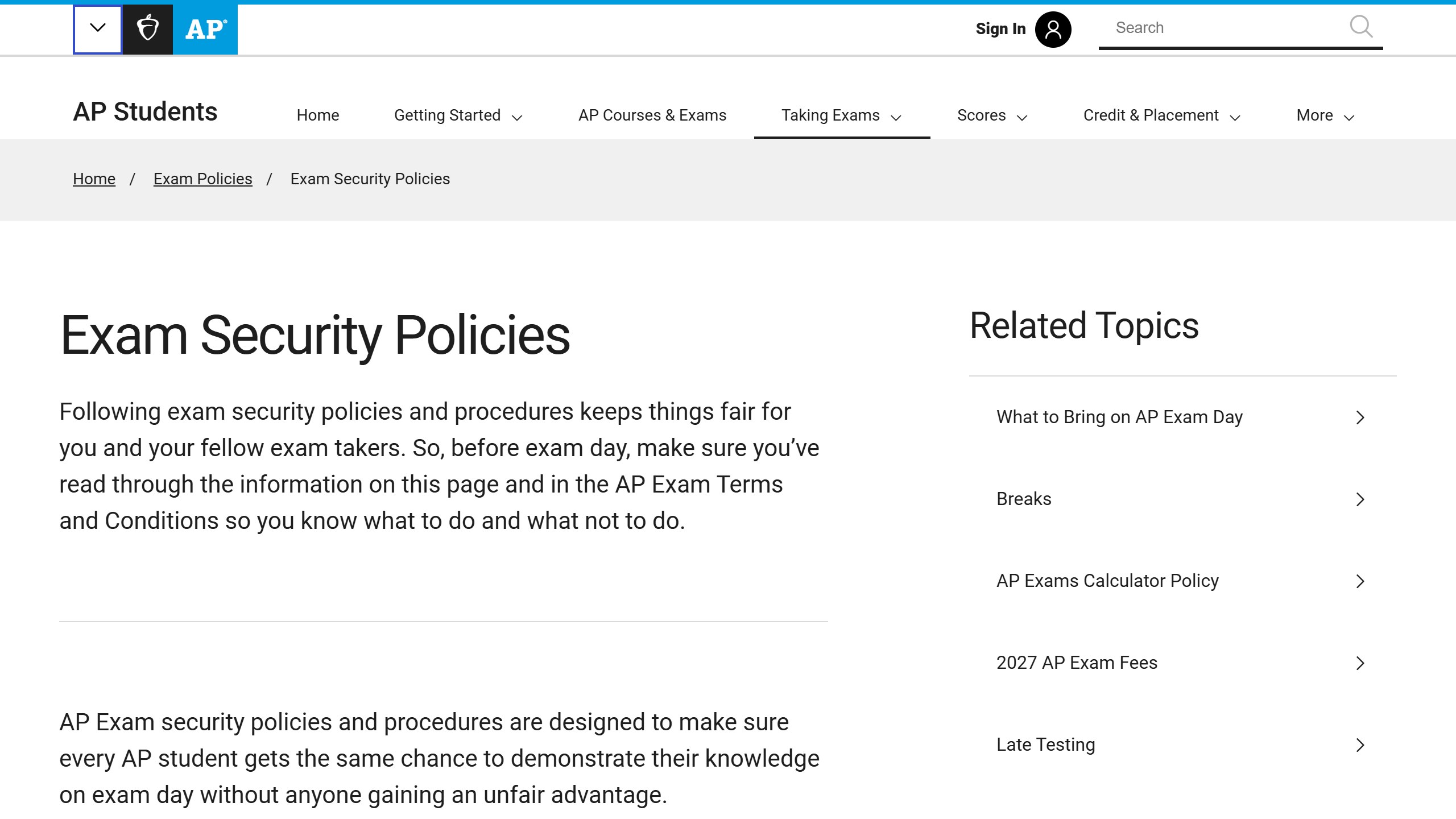
College Board’s exam security policies state that it “will automatically cancel your exam score if you are discovered disclosing through any means” the following:
- multiple-choice content for any exam, which “is never released and may therefore never be discussed”
- free-response content from a regularly scheduled exam if it has not been released on the College Board website
- free-response content from a late-testing exam
And, in College Board’s words: “If you post to any form of social media during the exam or refer to unreleased exam content at any time after the exam, your score will be canceled, no retest will be permitted, and you may be banned from future testing.”
Read that against what students actually do in May. You walk out of the AP US History exam, you are not sure whether your thesis worked, and you paste the prompt into ChatGPT to find out. That is disclosing unreleased free-response content. The AI is incidental. Typing the question into a group chat, a Discord server or a Reddit thread is the same violation by the same rule.
College Board also says something that softens this if you wait: once the free-response content from your regularly scheduled exam is posted on the College Board website, you may discuss it from that point. So the safe version of the same impulse is to wait for the release, then ask the AI anything you like.
The page notes explicitly that “something you may not have intended as a violation, like casually talking about a multiple-choice question with your friends or your teacher during the exam break”, can result in a cancelled score. Multiple-choice content is never released, so it is never discussable.
And During the Exam Itself
Worth stating plainly, because the question gets asked. You cannot use AI during an AP exam, for the same reason you cannot use a phone, a smartwatch or a second browser tab. Exams are taken under supervision, digital exams run inside the Bluebook application, and College Board’s security policies cover taking the exam at the scheduled time, not opening materials before the proctor says so, and not removing exam materials from the room. Violating those policies “could cause your score to be canceled”, and College Board says a student could be banned from future testing. There is no AI-specific clause because none is needed.
What the Policy Does Not Say
Three things students and parents commonly believe, none of which appear anywhere in what College Board publishes.
There is no AP-wide ban on AI. The guidance page addresses specific courses and says so in its own opening line. A student in AP Biology or AP Calculus will not find an AP-level rule about using an AI tutor, because the assessment in those courses is an exam taken under supervision.
There is no published AI detector. College Board does not describe any automated tool that scans AP submissions for AI-generated text. What it describes instead are process checks: interim checkpoints in Capstone, teacher affirmation of authenticity, mandatory disclosure in Art and Design, and the stated right to investigate a submission and request a student’s interim work. That is a deliberate design. Detection software is unreliable, and asking a student to explain their own reasoning is not.
There is no rule against AI study tools. Using an AI tutor, a study app that scores your practice essays, or a chatbot to explain a hard concept is nowhere restricted. If it were, most of the AP prep market would be prohibited.
The Policy Is Dated, So Check It
The guidance page is explicitly headed for the 2026-27 academic year, and the Art and Design policy carries a note that it “has been updated for the 2026-27 school year”. That is a strong hint about how to treat all of this: as a policy that changes annually, in a field that changes faster.
College Board also updates the AP Exam Terms and Conditions each spring and says it will email students when the current version is available. Those terms are what you actually agree to on exam day or when you submit through the Digital Portfolio, and they are the authoritative version for the year you are sitting.
So do two things in the spring. Re-read your course’s paragraph on the guidance page, because it may have changed since September. And read the exam terms when they land, rather than clicking through them, because that is the document that governs a cancelled score.
What This Means in Practice
Use AI to learn, freely. Explaining a concept to you, quizzing you, marking a practice essay you wrote yourself, building a revision schedule. None of this is submitted work and none of it is covered by a policy. Our AP exam prep guide compares the tools that do this, and our SAT prep guide covers the SAT side.
Check your course. If you take Art and Design, Capstone, African American Studies, Computer Science Principles or a world language, read your course’s paragraph on the guidance page directly. It is short. In Art and Design, also work out your disclosure before you submit, not after.
Assume your teacher’s rule is stricter. College Board sets a floor for the AP components. A school can and often does forbid more. The policies above do not override a classroom rule.
Never feed an exam question to anything. Not a chatbot, not a homework app, not a group chat, not a study server, until College Board has published that free-response question. Multiple-choice questions, never.
Be able to explain everything you submit. Both enforcement mechanisms College Board has built, Capstone checkpoints and the CSP exam requirement to explain your code, test the same thing. Whatever route your work took, you have to be able to account for it out loud.
Sources
- Guidance for Artificial Intelligence Tools and Other Services, AP Central, headed “AI Guidance for the 2026-27 Academic Year”, read 24 September 2026.
- What is the acceptable use of AI?, AP Central help centre, read 24 September 2026.
- Exam Security Policies, AP Students, read 24 September 2026.
- AP Art and Design Portfolio Policies and the AP Art and Design Plagiarism and Artificial Intelligence Policy Guide, read 24 September 2026.
- AP Capstone and AP Exam Policies and Guidelines, read 24 September 2026.

Written by
FazFaz is the founder of AIToolsBakery. Some tools here are tested hands on. Others are assessed from vendor documentation and pricing verified on the live page, and every review says which one it is. Sponsors can buy a position in a guide. They cannot buy the score, the criticism, or silence about a better option.
How we test and how we make money →