Search for church donor management software and you get lists that put a donation app, a church database and a fundraising CRM side by side as if they were interchangeable. They are not. One processes the gift, one holds the membership, and one works the relationships. Buy the wrong one and you either pay twice or end up with a tool nobody opens.
This guide separates the three, prints the processing fees each vendor actually publishes, and maps which AI features each one names rather than listing what AI could theoretically do. It also starts from a fact the other lists skip: the median congregation in the US has about 65 regularly participating adults.
Disclosure: Zilwaris, the consultancy run by AI Tools Bakery’s founder, does paid advisory work for Gratefully, which did not pay for any placement on this page and is assessed on the same criteria as everything else on this site.
How we put this together. We have not used these platforms ourselves; this is a research-based comparison. Every fee, price and feature below comes from the vendor’s own website, read on 4 October 2026, and we link to each source. Fees are the published US rates. Statistics come from the Lake Institute’s National Study of Congregations’ Economic Practices and its analysis of Giving USA 2026.
What size of church this is written for
The National Study of Congregations’ Economic Practices, run by the Lake Institute on Faith and Giving and fielded in 2018, is the best primary data on how US congregations handle money. Its executive report found a median of 65 regularly participating adults and a median annual revenue of about $169,000. Sixty four percent of congregations had fewer than 100 adults; only 3% had more than 1,000.
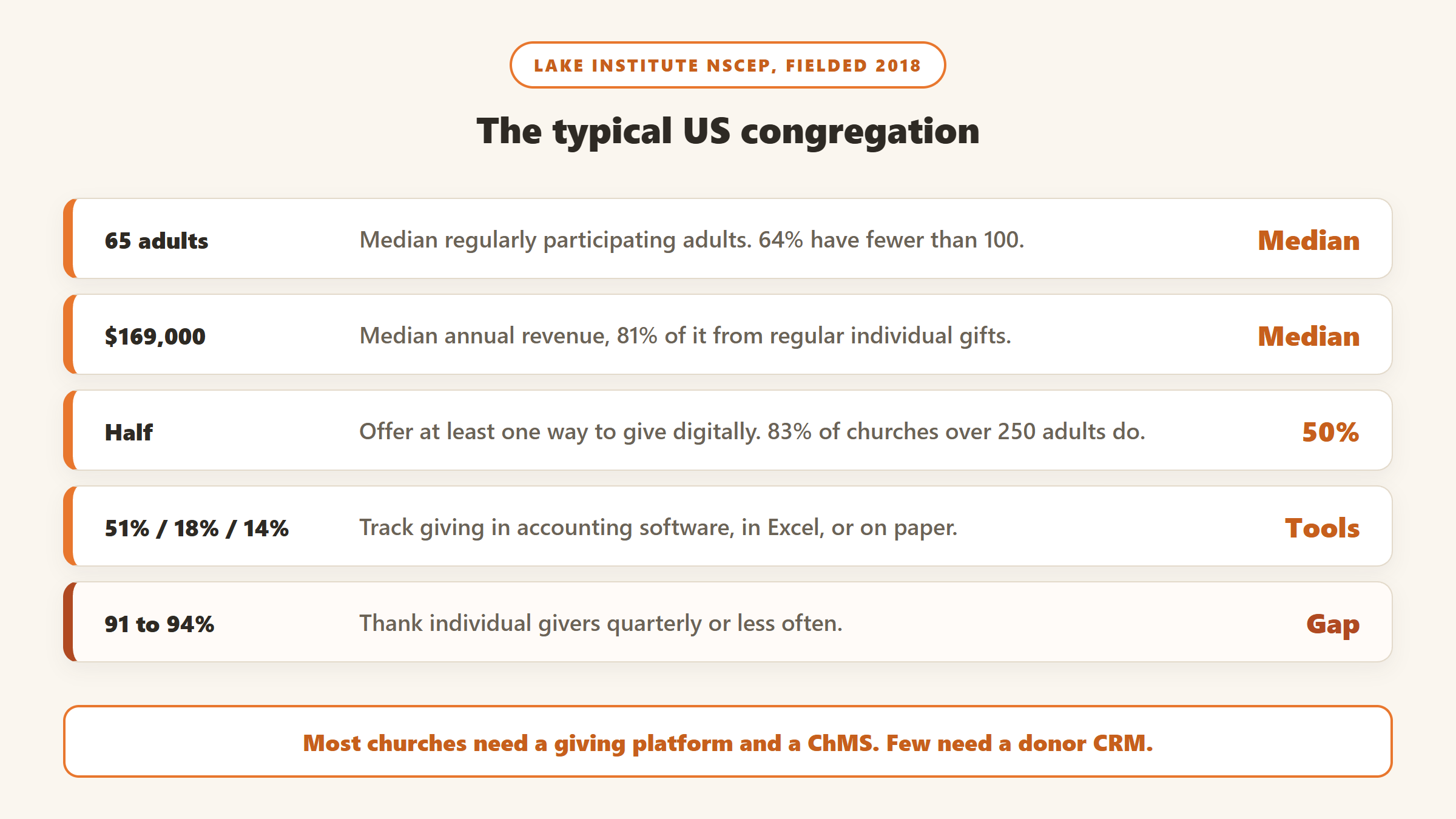
The same study found that 81% of congregational income came from regular individual contributions, that 51% of congregations tracked giving in accounting software, 18% in Excel and 14% on pen and paper, and that about half offered at least one digital way to give. Among congregations with more than 250 adults, 83% offered digital giving.
The trend behind the numbers is the reason this matters. The Lake Institute’s analysis of Giving USA 2026 puts giving to religion at about $152 billion in 2025, up 2.4% but down 0.2% after inflation, and religion’s share of all US giving at 23%, against 49% in the early 1990s. Churches are competing harder for the same donors, which is why stewardship tools have started to matter.
The three kinds of software, and which ones you need
Giving platforms
These take the gift: online forms, text to give, a church app, recurring giving, kiosks. They charge a processing fee on every gift and sometimes a monthly fee. Planning Center Giving, Tithely, Givelify, Overflow, Subsplash and Pushpay all do this. Every church that accepts digital gifts needs one.
Church management systems
A ChMS holds people: members, households, attendance, groups, volunteers, check in, and usually contribution records and giving statements. Planning Center, Breeze (now sold by Tithely), Realm and MinistryPlatform from ACS Technologies, and Pushpay’s church management all sit here. Most churches need one of these too, and many buy it from the same company as their giving platform.
Donor intelligence
This is the newest layer and the one most churches do not need. It reads the giving records and notes you already keep and tells a development team who to thank, who has gone quiet and who to talk to next. It makes sense when a congregation or faith-based nonprofit has someone whose job is fundraising and enough givers that nobody can keep them all in their head. For a 65 adult church, the pastor already knows.
Processing fees, side by side
Fees matter more than monthly prices for most churches, because they apply to every gift. These are the published US rates on 4 October 2026.
| Platform | Monthly platform price | Card fee | Bank (ACH) fee |
|---|---|---|---|
| Planning Center Giving | Free to 10 donations a month, then $15 to $239 by volume | 2.15% + $0.30 | $0.30 flat |
| Tithely Giving | $0 (Church Management $72, All-Access $119) | 2.9% + $0.30 | 1% + $0.30 |
| Givelify | No signup or monthly fees | 2.9% + $0.30 | Not listed |
| Subsplash Giving | $0 for Giving alone | 2.99% + $0.30 (2.3% on Subsplash One) | 1% |
| Overflow | Not published (onboarding $0, $1,000 or $2,500) | 2.75% + $0.30, falling to 2.30% at higher volume | 0.50% + $0.20 |
| Pushpay | Not published | Not published | Not published |
| ACS (Realm, MinistryPlatform) | Not published | Not published | Not published |
Two things stand out. Planning Center’s ACH fee of a flat $0.30 makes bank transfers almost free at any gift size, which is worth encouraging for regular givers. And the two platforms that publish nothing, Pushpay and ACS, are the ones aimed at larger churches, so you will need a quote to compare them.
The platforms compared
Planning Center
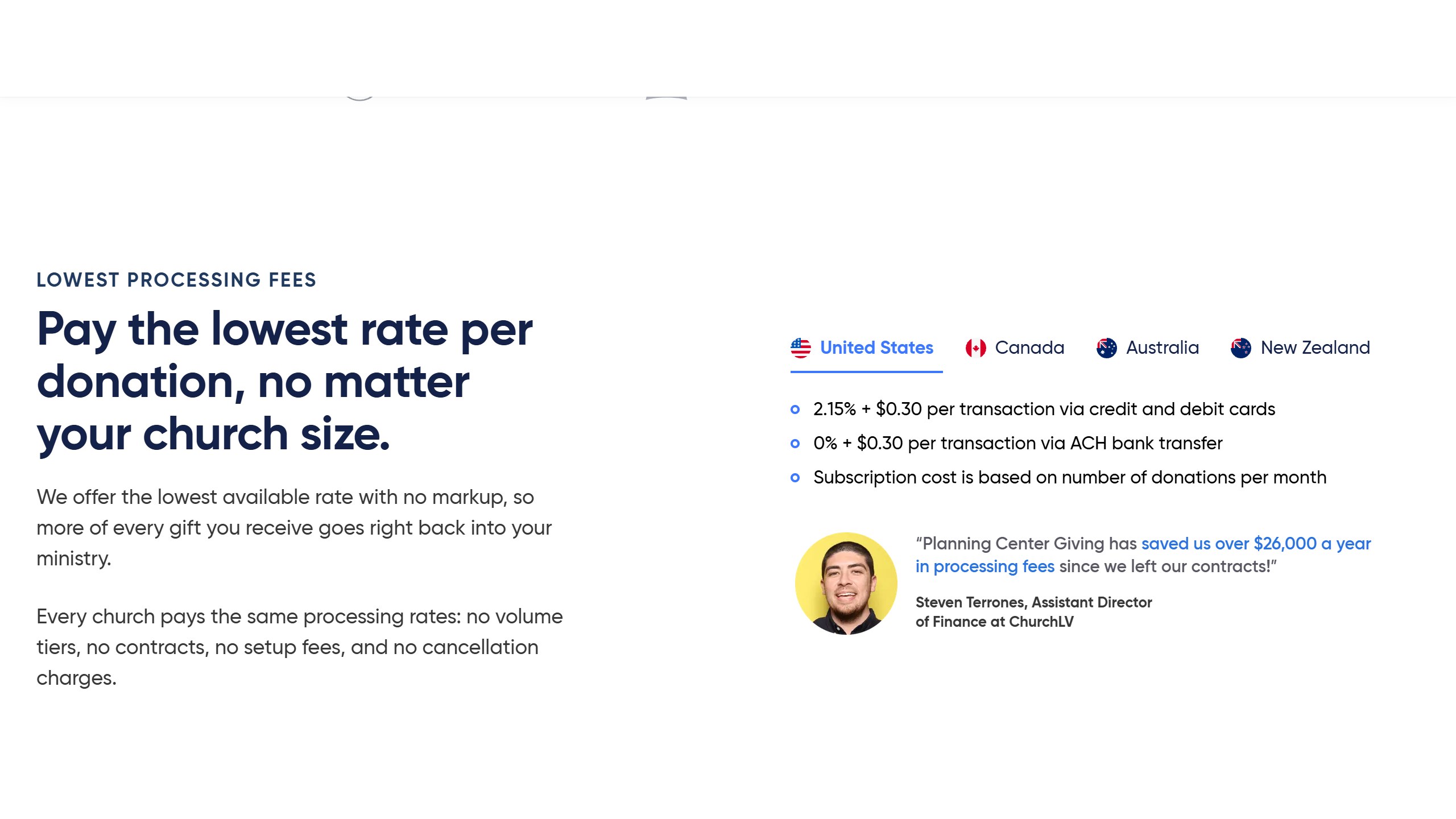
Planning Center Giving is a paid module on top of a free People database, used by “over 78,000 churches” by its own count. Giving is free up to 10 donations a month, then $15 a month for 75, $69 for 500, $115 for 1,000 and $239 for unlimited, plus processing. It publishes the lowest card rate in this guide. Two practical limits from its own pages: it has no QuickBooks integration, and “you cannot directly transfer recurring donations over to Giving”, so moving recurring givers means asking them to set up again. On AI, its AI page describes a connector that lets ChatGPT or Claude read your Giving and People data, plain language list building in People, and a policy that “Planning Center and our contractors are prohibited from using your information to train models”. Everything exports to CSV.
Tithely and Breeze
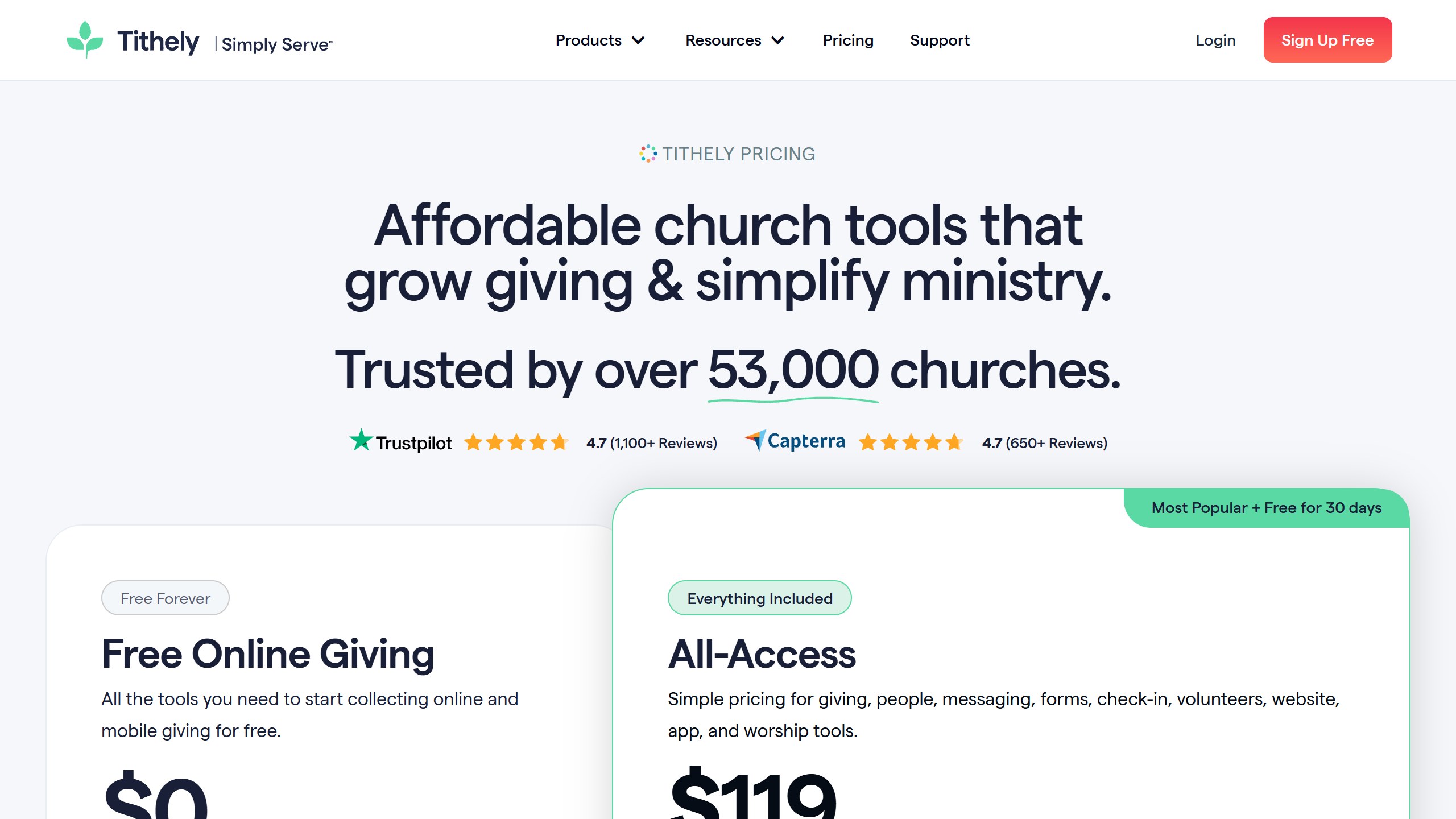
Tithely gives you giving for $0 a month plus 2.9% and $0.30 per card gift, church management for $72 a month, or both plus its app and website tools as All-Access for $119. The church management product is Breeze, which Tithely now sells as Tithely Church Management: one flat price with unlimited contacts and free data export and import. One trap on Breeze’s pricing page: the figures from $85 to $374 a month there are Breeze’s estimate of what Planning Center would cost you, not Breeze’s own price. We found no AI features named on Tithely’s or Breeze’s pages.
Pushpay
Pushpay combines giving, church management, an app and analytics for larger churches, “14,000+” of them by its count. Its pricing page names three tiers, Core, Advanced and Complete, without prices; the only figure is check scanning from $0.29 a check. It names more AI than anyone else here: AI for Giving Data, AI Profile Summaries, and AI for People Search, which its innovation page lists as in beta. CSV exports are included from Core.
Subsplash
Subsplash is an all in one platform covering app, website, media, giving and church management. Giving alone costs $0 a month at 2.99% plus $0.30 per card gift, the highest card rate we found; on its Subsplash One bundle the rate drops to 2.3%, with bundle pricing “based on church size and usage”. Its Trends AI gathers giving, recurring giving and other data into dashboards with an AI analysis feature.
Overflow
Overflow specialises in non cash gifts, stock, donor advised funds and crypto, alongside card and bank giving. Card fees step down with volume, from 2.75% plus $0.30 on your first $50,000 a month to 2.30% from $250,000. Bank gifts are 0.50% plus $0.20, and stock gifts 1% to 3% depending on how they arrive. It lists “Overflow AI” on every plan without describing what it does on the pricing page. It is the only platform here that states a history limit for switching: “up to three years of historical giving data”.
Givelify
Givelify is a mobile and online giving platform with no signup or monthly fees and 2.9% plus $0.30 per gift. Its homepage describes Analytics Studio as “AI-powered insights into donors’ giving habits” at no extra cost. It is a giving tool only, so pair it with a ChMS.
ACS Technologies, Ministry Brands and Aplos
ACS Technologies sells Realm and MinistryPlatform, two long established church management systems with their own giving, by demo and quote only; we found no AI features on the pages we read. Ministry Brands’ Amplify Giving names “Amplify Intelligence”, a dashboard that turns giving data into insights, and syncs both ways with Rock RMS; no prices are published. Aplos is fund accounting with donation tracking and giving statements on every plan, from $79 a month, with a 50% off promotion for new customers running to 31 October 2026. It is the right tool when the treasurer’s problem is the books rather than the people.
Where donor intelligence fits, and where it does not
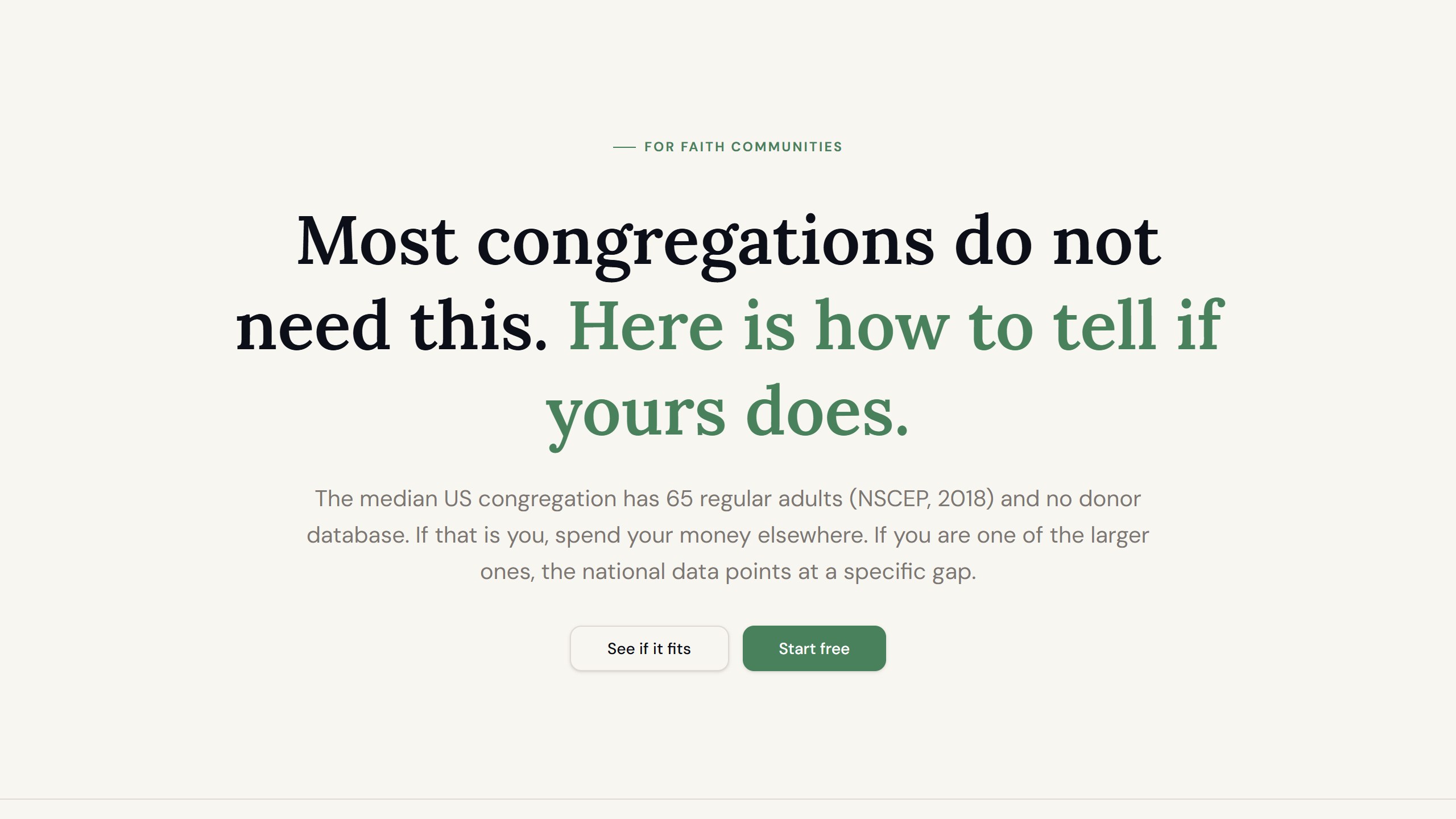
The donor intelligence layer is honest about its own limits, which is rare. Gratefully’s page for religious organisations opens with “Most congregations do not need this” and describes its fit as “larger congregations, faith-based nonprofits and diocesan development offices”, not “a 65 person church”. We agree, and that is why it sits last here rather than first.
For the organisations it suits, our top pick does three things a giving platform does not. It hands a development lead a short list each morning of who to thank, who has stopped giving and who is ready for a conversation, with the reason and the source record attached. It drafts the note. And when a staff member leaves, it assembles a handover file for each giver, so the relationship survives the turnover. It holds no wealth screening or capacity ratings, which its page describes as something that “would be a serious breach of trust” for a congregation, and it does not process gifts or replace your ChMS.
The practical limit is connection. It syncs directly only with Salesforce Nonprofit Cloud, Bloomerang and Little Green Light. If you run Planning Center, Tithely, Pushpay, Subsplash or another church management system, you work from a CSV export and document upload, which its own page calls “a real limitation, not a detail”. It also works on one organisation’s records at a time, so a diocese cannot yet roll eighty parishes into one view. Pricing is a free plan for one person, then $79, $399 or $799 a month billed yearly as of 4 October 2026.
The habit the software should fix first
The single most striking figure in the Lake Institute’s study is about thanks, not technology. Its summary reports that 94% of congregations acknowledge individual gifts quarterly or less often; the executive report puts it at 91%, with 63% acknowledging only annually and just 5% thanking each gift. Most congregations, in other words, send a year end statement and little else.
Every platform in this guide can send an automatic receipt, and several can trigger a message on a first gift or a giving anniversary. Before you compare AI features, check that whatever you choose makes timely thanks the default rather than an extra job. It is the cheapest stewardship improvement available, and none of the AI in this market will matter if the basics are missing.
What the fees cost a typical church in a year
Percentages are hard to compare in your head, so here is a worked example using the published rates above. Take a congregation receiving $20,000 a month, about $240,000 a year, which is a little above the study’s median. Assume $12,000 arrives as 120 card gifts of $100 and $8,000 as 80 bank transfers of $100.
| Platform | Card fees a month | Bank fees a month | Platform fee a month | Total a year |
|---|---|---|---|---|
| Planning Center | $294 | $24 | $32 (200 donations tier) | $4,200 |
| Overflow | $366 | $56 | Not published | $5,064 plus platform fee |
| Subsplash Giving | $394.80 | $80 | $0 | $5,697.60 |
| Tithely Giving | $384 | $104 | $0 | $5,856 |
| Givelify, if every gift is by card | $640 | n/a | $0 | $7,680 |
The gap between the cheapest and the most expensive is more than $3,000 a year on the same giving, which is real money for a congregation of this size. Most of it comes from bank transfers: Planning Center charges a flat $0.30 per transfer while Tithely charges 1% plus $0.30. The practical lesson works on any platform: every regular giver you move from card to bank transfer saves you most of the fee on their gifts. Run the same sums on your own split before you decide, and remember that Tithely’s $72 church management or Planning Center’s free People database changes the comparison once you add the ChMS you also need.
How to choose
Under 100 adults
A free or low cost giving tool plus a simple ChMS. Planning Center’s free People database with Giving at its free or $15 tier, or Tithely’s $0 giving with Breeze at $72, covers almost everything. Skip donor intelligence.
100 to 1,000 adults
Compare Planning Center, Tithely All-Access and Subsplash on total cost: monthly price plus fees on your actual giving volume. If you receive stock or donor advised fund gifts, add Overflow to the shortlist.
Large churches and multi site
Ask Pushpay and ACS for quotes, and compare their AI features against Planning Center’s connector approach. Ask every vendor whether recurring gifts can move with you, because Planning Center states plainly that they cannot.
Faith-based nonprofits and church foundations with development staff
You are closer to a nonprofit than a congregation. A donor CRM such as Bloomerang or Little Green Light plus a donor intelligence layer is the stronger setup; see our best donor management software guide and our explainer on what donor intelligence is.
Questions to ask before you switch
Can recurring gifts move? Recurring authorisations usually live with the payment processor, not the database. Ask in writing whether givers will need to set up again.
How much history comes with you? Overflow states three years. Ask everyone else for a number, and make sure giving statements for the current tax year will be complete.
What does it export? Planning Center, Pushpay and Breeze all name CSV exports. If a vendor cannot tell you how to get your data out, that is your answer.
What happens to our data in the AI features? Planning Center states that customer data is not used to train models. Ask the same question of any vendor whose AI reads your giving records. Our guide to donor data privacy and AI lists the follow ups.
Sources
- Vendor pages read 4 October 2026: Planning Center Giving, pricing and AI; Pushpay, its pricing and innovation pages; Tithely pricing; Breeze pricing; Subsplash pricing and Trends AI; Overflow pricing; Givelify pricing; ACS Technologies; Ministry Brands Amplify Giving; Aplos pricing; Gratefully for religious organisations.
- Lake Institute on Faith and Giving: NSCEP executive report (fielded 2018) and Giving USA 2026 analysis (14 July 2026).

Written by
FazFaz is the founder of AIToolsBakery. Some tools here are tested hands on. Others are assessed from vendor documentation and pricing verified on the live page, and every review says which one it is. Sponsors can buy a position in a guide. They cannot buy the score, the criticism, or silence about a better option.
How we test and how we make money →