Choosing donor management software is one of the biggest technology decisions a nonprofit makes. The system holds every donor, gift and relationship you have, it shapes how your team works every day, and moving off it later is slow and risky. Yet most “best nonprofit CRM” lists are written by a CRM vendor that ranks itself first, and many quote prices that are no longer on the vendors’ own pages.
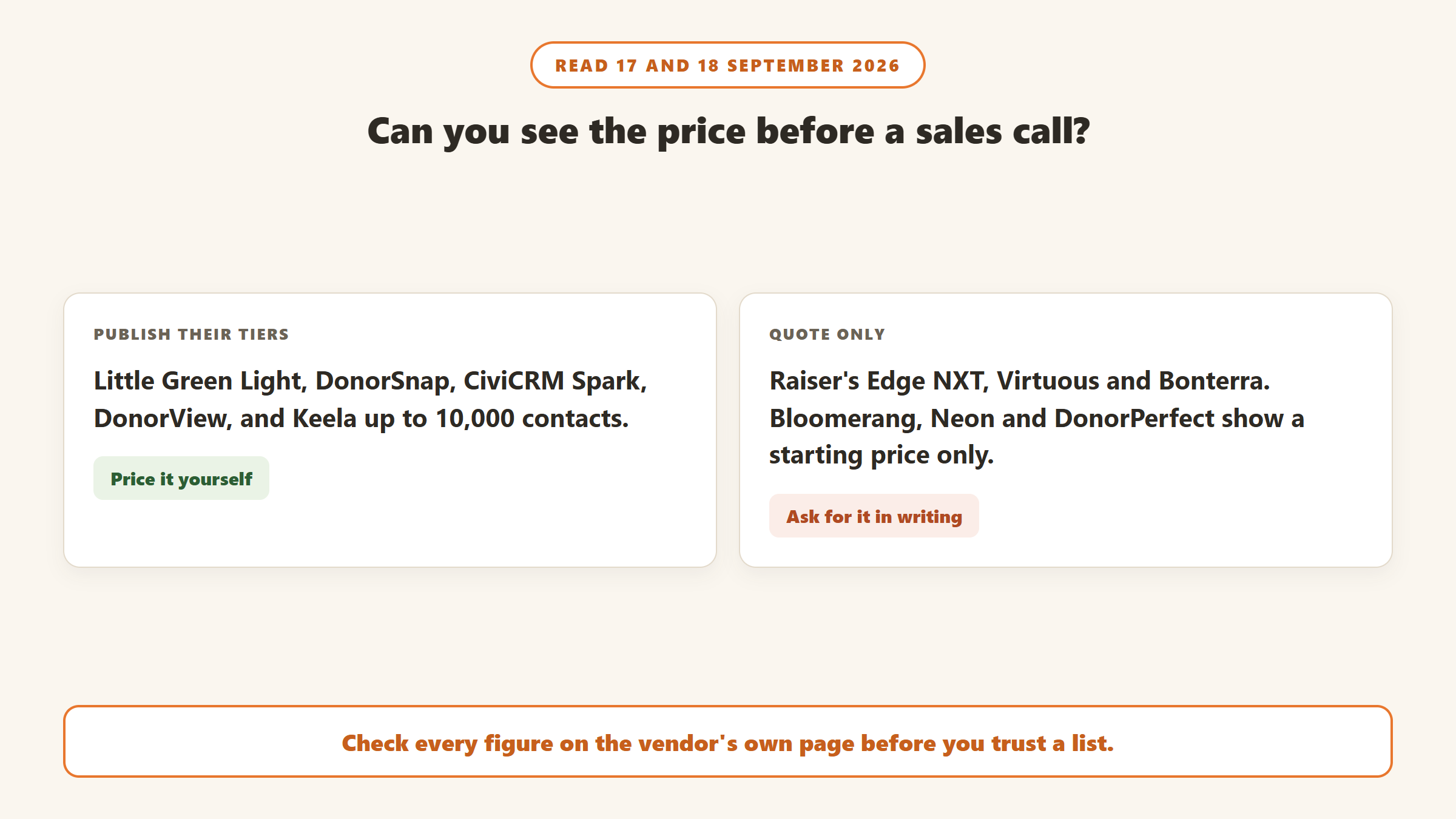
This guide compares fifteen donor management systems on the things that decide the real cost and the exit: the published price, what the price is based on, the contract you sign, what online gifts cost to process, and who each one suits. Every figure was read on the vendor’s own pricing page, terms or help centre on 17 or 18 September 2026. Where a vendor publishes nothing, we say so. And because a CRM stores your relationships but does not tell you which donor needs attention today, we also cover how Gratefully, a donor intelligence layer with a free plan, can sit on top of whichever system you choose.
How we put this together. Prices and terms come from each vendor’s own pages, read from India and shown as displayed, in US dollars unless stated. Ratings are from Capterra and G2 on 18 September 2026. We have not run these systems hands-on; this is a research-based comparison, and each section says where its facts come from.
The best donor management software at a glance
| Software | Best for | Published starting price | Priced by | Default commitment |
|---|---|---|---|---|
| Gratefully (add-on, not a CRM) | Our top pick for donor intelligence, on top of any CRM below | Free plan; paid from $79 a month billed yearly | Plan and seats | Free plan has no end date |
| Little Green Light | Small budgets, full price transparency | $45 a month (up to 2,500 records) | Records | No contract |
| Bloomerang | Small to mid-sized teams wanting support | CRM from $125 a month, billed annually | Constituents | Two years by default |
| Neon CRM | Large lists with modest revenue; memberships and events | From $99 a month | Revenue | 12 months |
| DonorPerfect | Established mid-sized organisations | From $99 a month | Plan, by quote | Subscription; 30 days’ notice |
| Keela | All-in-one with no platform fee | $164 a month billed annually (up to 1,000 contacts) | Contacts | Monthly or annual, auto-renews |
| Salesforce (Agentforce Nonprofit) | Complex organisations with admin capacity | Enterprise $60 per user a month; 10 donated licences | Users | Annual contract |
| Blackbaud Raiser’s Edge NXT | Mid-sized to large, major gifts | Not published | Quote | Quote |
| Virtuous | Mid to large, responsive fundraising | Not published | Fundraising revenue band | Quote |
| Bonterra (EveryAction, Network for Good) | Advocacy organisations; small shops wanting coaching | Not published | Quote | Quote |
| DonorDock | One flat price, easy exit | $500 a month billed annually | Flat | Cancel anytime; 90-day money-back |
| DonorSnap | Low cost with published tiers | $50 a month (up to 1,000 contacts) | Contacts | Monthly or annual |
| DonorView | Organisations able to commit long term | $99 a month on a 60-month commitment; $139 on 12 months | Constituents | 12, 36 or 60 months |
| CiviCRM (Spark) | Open source, lowest cost hosted option | $15 a month (up to 5,000 contacts) | Contacts | No contract |
| Givebutter | Free CRM with online giving | Free; Plus from $29 a month billed annually | Contacts (Plus) | None on free |
| Zeffy | Free, no fees to the nonprofit | $0 | None | None |
What donor management software does
Donor management software, often called a nonprofit CRM, is the system of record for your supporters. At a minimum it holds each person or organisation, every gift with its date, amount and campaign, the relationships between people such as households, and your contact history. Most add donation forms, email, receipts, reporting and tasks. Larger systems add major gift pipelines, memberships, events, volunteers, grants and integrations with accounting.
What it does not do on its own is decide who needs your attention. A CRM tells you what happened; a team, or an intelligence tool on top, decides what to do about it. That distinction matters when you choose: many organisations switch CRMs hoping for better insight, then find the new system holds the same data in the same way. Our guide to CRM versus donor intelligence covers that decision.
Donor relationship management software
You will also see this category called donor relationship management software, donor relations software or a nonprofit CRM. The names describe the same thing: a system that holds each supporter’s gifts, contacts and relationships so your team can thank, report to and ask the right people at the right time. Whatever the label, check the same five things covered below: the pricing unit, the contract, the card fee, migration and support, and who will run it.
Some general business CRMs, such as HubSpot, Salesforce, Microsoft Dynamics 365 and monday CRM, offer nonprofits free seats or discounts and can be configured for donor relationships. They suit organisations that also run programmes and have admin time. Our best CRM for nonprofits guide compares them with the nonprofit-built systems on this page and reads each discount’s terms.
How to choose: five things that decide the real cost
1. What the price is based on
The vendors in this guide use at least six different pricing units, which is why a single price column misleads:
- Records or constituents: Little Green Light, Bloomerang, DonorView. Every person you store counts, so event guests and one-off contacts push you up. Little Green Light counts “any individual or organization for which you’ve created a record”.
- Contacts: Keela, DonorSnap, CiviCRM Spark, Givebutter Plus. Keela counts “anyone your organization interacts with”.
- Revenue: Neon CRM bills on how much you raise, with unlimited contacts. Virtuous uses fundraising revenue bands.
- Users: Salesforce charges per user per month.
- Flat: DonorDock charges one price with unlimited contacts.
- Free with tips: Givebutter and Zeffy are funded by optional donor contributions.
Before comparing quotes, clean your file so the count is real. Our duplicate donor records guide covers how.
2. The contract
| Vendor | Default term and renewal | Source |
|---|---|---|
| Bloomerang | Two-year initial term unless the proposal says otherwise; renews yearly; 45 days’ written notice | Terms and conditions |
| Neon CRM | 12 months where the order does not specify; auto-renews; 30 days’ notice; fees may rise once a calendar year | Terms of service, updated 24 June 2025 |
| DonorPerfect | 30 days’ notice before renewal; prepayments nonrefundable; data deleted on termination | Terms of service, updated 1 April 2026 |
| Keela | Monthly or annual; all subscriptions auto-renew; data access ends when the account closes | Help centre |
| DonorView | 12, 36 or 60 months, billed annually; the page defaults to 60 | Pricing page |
| Salesforce | Annual contracts | Nonprofit pricing page |
| Little Green Light | “No contracts”, no cancellation fees | Pricing page |
| DonorDock | “Cancel anytime”; 90-day money-back guarantee | Pricing page |
| CiviCRM Spark | “Cancel any time. No contracts or penalties.” | Spark page |
3. What online gifts cost
Processing fees can outweigh the subscription. Little Green Light and Keela pass through Stripe’s nonprofit rate of 2.2% + $0.30 with nothing added. Bloomerang’s help centre, in an article dated 20 July 2026, lists 3.95% + $0.30 on cards through Bloomerang Fundraising forms and 3.2% + $0.30 through its CRM forms. DonorDock charges a 2% platform fee on its giving pages. CiviCRM Spark says it adds no percentage on payments. Neon and DonorPerfect do not publish their processing rates on their pricing pages. On a $100 card gift, that is the difference between $2.50 and $4.25 in fees, which across 1,000 gifts a year is $1,750.
4. Migration and support
Ask who moves your data and what it costs. DonorPerfect advertises free data transfers from most CRMs, though its data transfer page says pricing varies. DonorDock includes white-glove migration. DonorSnap’s $200 setup includes four hours of data conversion. Little Green Light provides an importer and a consultant network but does not handle files itself. Recurring gifts need special care: they are authorisations held by the payment processor, not rows in an export. Our nonprofit CRM migration guide covers the checklist.
5. Who will run it
Salesforce and Raiser’s Edge NXT can do almost anything, but they need someone with time to configure and maintain them. Little Green Light, DonorSnap and Givebutter can be run by a part-time development lead. Be honest about your capacity: an under-used powerful system is worse than a well-used simple one.
What each costs at 1,000, 5,000 and 10,000 donors
Only some vendors publish enough to price a real database. Here is a year’s subscription at three sizes, using each vendor’s own published tiers. The arithmetic is ours; processing fees and add-ons are not included.
| Software | 1,000 records | 5,000 records | 10,000 records | Basis |
|---|---|---|---|---|
| CiviCRM Spark | $180 | $180 | $600 | Starter to 5,000 contacts, Pro to 10,000 |
| Little Green Light | $540 | $720 | $900 | Monthly; about 10% less if prepaid for 12 months |
| DonorSnap | $600 | $1,080 | $1,500 | Monthly; $540, $972 and $1,350 on annual billing |
| Givebutter Plus | $948 | By contact tier | By contact tier | Optional; the free CRM has unlimited contacts |
| DonorView Pro, 12-month commitment | $1,668 | $3,792 | $5,448 | 10,000 falls in the up-to-15,000 band; 60-month terms cost less |
| Keela, annual billing | $1,968 | $3,792 | $5,256 | Contact bands to 10,000 |
| DonorDock | $6,000 | $6,000 | $6,000 | Flat, unlimited contacts, 5 users |
| Bloomerang CRM | From $1,500 at the entry band; band size and higher prices not published | Constituents | ||
| Neon CRM | From $1,188; depends on revenue, not records | Revenue | ||
| DonorPerfect | From $1,188 on the vendor’s figure; quote by plan | Plan | ||
Two things stand out. The cheapest published options cost a few hundred dollars a year even at 10,000 records, so price alone rarely justifies a quote-only system for a small organisation. And DonorView’s 12-month figures are the fair comparison with month-to-month vendors; its lower 60-month prices buy a five-year commitment.
The 15 best donor management systems, reviewed
1. Little Green Light: best for small budgets and price transparency
Little Green Light publishes every tier: $45 a month for up to 2,500 records, $60 for 5,000, $75 for 10,000, $90 for 20,000, $105 for 30,000 and $135 for 50,000, adding $15 a month per further 10,000 to 200,000. Users are free, prepaying 12 months takes 10% off, there are no setup or cancellation fees and no contract, and the first 30 days are free. Its forms take donations, event registrations and memberships at the processor’s rate with no fee to LGL, and it covers memberships, events, volunteers and task-based stewardship. It integrates with Mailchimp, Constant Contact, QuickBooks Online, Zapier, Stripe and PayPal, and has an API.
Watch for: no in-house data migration, and it does not market predictive scoring. Capterra 4.8 from 317 reviews; G2 4.4 from 63. Gratefully connects live to Little Green Light, so the pair is a low-cost way to get a ranked list of who to contact. See our Little Green Light review and pricing guide.
2. Bloomerang: best for small to mid-sized teams that want support
Bloomerang’s CRM starts at $125 a month billed annually, Bloomerang Fundraising adds from $40 a month (sold only with the CRM), the combined Giving Platform starts at $242 a month and Bloomerang Volunteer at $119 a month. All plans include unlimited users. The CRM lists predictive giving insights, and the Fundraising product adds forms, events, text giving and donor apps. Qgiv is now Bloomerang Fundraising and Kindful is a Bloomerang product.
Watch for: only starting prices are published; the default agreement is two years with 45 days’ notice; card gifts cost 3.95% + $0.30 on Fundraising forms. Capterra 4.7 from 1,287 reviews; G2 4.6 from 922, with the highest service scores in this group. See our Bloomerang review, Bloomerang vs Little Green Light and Bloomerang vs Neon CRM.
3. Neon CRM: best for large lists with modest revenue
Neon CRM prices on revenue, “not record counts”, from $99 a month, with unlimited records, users, emails and forms. Memberships and Volunteers add 10% of the CRM fee each and Events 20%. The core plan includes grant management, peer-to-peer, recurring gifts, email, texting, stewardship journeys and a donor portal, and support covers free live chat, email and phone.
Watch for: prices above $99 are in a gated guide; Neon Pay’s processing rate is not on the public pricing page; the default term is 12 months with 30 days’ notice and a possible yearly fee increase. Capterra 4.3 from 620; G2 4.2 from 443. See our Neon CRM review and Neon CRM alternatives.
4. DonorPerfect: best for established mid-sized organisations
DonorPerfect publishes one figure, “starting at $99/month”, across Core, Plus and Pro plans; review sites list $119. All plans include built-in Constant Contact, a Mailchimp integration, donation forms, volunteer tracking, grant management and a mobile app. Plus adds QuickBooks, auctions, crowdfunding and moves management; Pro adds phone support and a custom API.
Watch for: phone support only on Pro; 30 days’ notice to stop renewal, nonrefundable prepayments, and data deleted at termination. Capterra 4.5 from 1,480; G2 4.4 from 567. See our DonorPerfect review and DonorPerfect vs Little Green Light.
5. Keela: best all-in-one with no platform fee
Keela starts at $164 a month billed annually, or $190 monthly, for up to 1,000 contacts, rising to $438 or $489 for up to 10,000. Every plan lists unlimited donation forms, email marketing, memberships, automatic receipts and automation, and Keela says it takes nothing on top of Stripe and PayPal’s 2.2% + 30 cents. Keela is now part of the Velora group with Aplos and Raisely.
Watch for: prices rose from $134 to $164 at the entry tier between our readings on 24 August and 4 September 2026; phone support is a paid add-on from $200 a month; access to data ends when the account closes. Capterra 4.3 from 314; G2 4.6 from 103. See our Keela review and Keela vs Bloomerang.
6. Salesforce Nonprofit Cloud (Agentforce Nonprofit): best for complex organisations
Salesforce’s nonprofit pricing page lists Enterprise at $60 and Unlimited at $100 per user per month, billed annually, and its Power of Us programme gives eligible nonprofits 10 licences at no cost. Salesforce renamed Nonprofit Cloud to Agentforce Nonprofit in December 2025, and G2 now lists it under that name. The older Nonprofit Success Pack remains supported, and Salesforce says there is no requirement to migrate.
Watch for: free licences are not free implementation; most organisations need a partner or an in-house admin. Capterra 4.7 from 42; G2 4.1 from 87. See our Salesforce Nonprofit Cloud pricing guide and NPSP vs Nonprofit Cloud.
7. Blackbaud Raiser’s Edge NXT: best for mid-sized to large fundraising teams
Raiser’s Edge NXT is, in Blackbaud’s words, “best for mid-sized to large nonprofits that rely on relationship-based fundraising”, with dedicated development teams managing individual giving, major gifts, campaigns and grants. Its product page lists Prospect Insights for major gift candidates, an AI assistant for donor summaries, workflow sequencing, memberships, planned gifts, grant management and SKY APIs, with generative AI off by default until an admin opts in. Blackbaud publishes no price; its pricing page says pricing depends on “organization’s size, number of users, selected solutions or modules, and the level of support and services desired.”
Watch for: quote-only pricing, and the lowest G2 rating among the major CRMs at 3.9 from 640 reviews; Capterra 4.2 from 418. Blackbaud’s smaller product, eTapestry, is still sold, also by quote. See our Raiser’s Edge NXT pricing guide and Raiser’s Edge alternatives.
8. Virtuous: best for mid-sized to large responsive fundraising
Virtuous sells a Platform plan “for nonprofits with fundraising revenue up to $5 million annually” and an Enterprise plan above that, both “Request Pricing”, with unlimited users. It is built around responsive, relationship-led fundraising and sells several modules separately. Capterra 4.6 from 48; G2 4.3 from 281. See our Virtuous review, Virtuous pricing and Virtuous alternatives.
9. Bonterra EveryAction and Network for Good: best for advocacy, and for small shops wanting coaching
Bonterra sells two fundraising CRMs, both quote-only. EveryAction is “built for growing mid-market, large, and enterprise-scale nonprofits running multi-channel fundraising and advocacy programs”, including organisations with dual 501(c)(3) and (c)(4) structures. Network for Good is “an AI-powered fundraising platform built for small nonprofits” combining coaching with donor management, donation pages, email, events, grants and peer-to-peer. EveryAction scores 4.4 on Capterra from 156 and 4.3 on G2 from 285; Network for Good 4.6 on both, from 938 and 419. See our Bonterra review and Bonterra pricing.
10. DonorDock: best for one flat price and an easy exit
DonorDock sells one plan, DonorDock ONE, at $500 a month billed annually, with unlimited contacts, 5 users (extra users $40 a month), 10,000 emails a month, automations and white-glove data migration included. It offers a 90-day money-back guarantee and says you can cancel anytime; optional premium onboarding costs $3,800 once. Its giving pages carry a 2% platform fee. Capterra 4.8 from 33; G2 4.8 from 153.
11. DonorSnap: best low-cost option with published tiers
DonorSnap publishes its ladder by contacts: $50 a month for up to 1,000, $70 for 2,500, $90 for 5,000, $125 for 10,000, $200 for 20,000 and $250 for 30,000, with 10% off for annual billing. A one-time $200 setup “includes setup, 4 hours of data conversion, and private training.” Some ranking lists still quote an older $39 entry price. Capterra 4.6 from 414; G2 4.2 from 130.
12. DonorView: best for organisations able to commit long term
DonorView prices by constituents and commitment length, and its pricing page defaults to the longest term. The Pro plan for up to 1,000 constituents shows $99 a month on a 60-month commitment, $119 on 36 months and $139 on 12 months, all billed annually, against a list price of $198. At up to 5,000 constituents Pro is $226 on 60 months or $316 on 12. There is no free plan. The headline $99 is real, but it is a five-year price; compare the 12-month figure with other vendors.
13. CiviCRM: best open-source option
CiviCRM is free, open-source software licensed under the GNU AGPL 3, which you can host yourself or through a partner. Its own hosted service, CiviCRM Spark, costs $15 a month for up to 5,000 contacts with unlimited users, $30 with richer email, and $50 for up to 10,000 contacts. Spark says “Cancel any time. No contracts or penalties.” and adds no percentage to payments, while disclosing that its recommended payment processors share revenue with CiviCRM. G2 3.9 from 84. It suits organisations with some technical confidence or a partner.
14. Givebutter: best free CRM with online giving
Givebutter’s free platform includes a CRM with “unlimited users, contacts, email blasts, fundraising campaigns, and more”. It charges no platform fee when donor tips are enabled, or a flat 3% plus processing if tips are off, on its Standard pricing for accounts created from 9 September 2025. Givebutter Plus, from $29 a month billed annually for 250 contacts, adds workflows, texting, custom reports and QuickBooks. Capterra 4.8 from 872; G2 4.7 from 2,218. See our Donorbox vs Givebutter and Givebutter review.
15. Zeffy: best completely free option
Zeffy says “Our price is $0” and that it “covers all transaction & credit card fees”, funded by optional donor contributions. Donations, ticketing and memberships are free, and its donor management page describes no paid contact tier. Capterra 4.8 from 496; G2 4.9 from 2,603. Its CRM is lighter than the paid systems above, so it suits small organisations whose priority is keeping every dollar. Our free donor management software guide compares the free options in detail.
Also worth knowing
LiveImpact starts at $150 a month billed annually with unlimited users and contacts, plus a one-time onboarding fee it does not publish. Raklet is membership-first, with a free plan for 100 contacts and paid plans from $49 a month billed annually plus transaction fees of 1% to 4% + $0.60. Kindsight’s Ascend CRM, built on Salesforce, is quote-only. Kindful and Qgiv now belong to Bloomerang, so ranking lists that price them separately are out of date.
Ratings compared
| Software | Capterra | G2 |
|---|---|---|
| Zeffy | 4.8 (496) | 4.9 (2,603) |
| DonorDock | 4.8 (33) | 4.8 (153) |
| Givebutter | 4.8 (872) | 4.7 (2,218) |
| Little Green Light | 4.8 (317) | 4.4 (63) |
| Bloomerang | 4.7 (1,287) | 4.6 (922) |
| Salesforce (Agentforce Nonprofit) | 4.7 (42) | 4.1 (87) |
| Network for Good | 4.6 (938) | 4.6 (419) |
| Virtuous | 4.6 (48) | 4.3 (281) |
| DonorSnap | 4.6 (414) | 4.2 (130) |
| DonorPerfect | 4.5 (1,480) | 4.4 (567) |
| EveryAction | 4.4 (156) | 4.3 (285) |
| Keela | 4.3 (314) | 4.6 (103) |
| Neon CRM | 4.3 (620) | 4.2 (443) |
| Raiser’s Edge NXT | 4.2 (418) | 3.9 (640) |
| CiviCRM | Not found | 3.9 (84) |
Read small samples carefully: a 4.8 from 33 reviews moves more easily than a 4.5 from 1,480. Free tools also tend to score highly because they are compared against what users paid.
Which donor management software fits your organisation
- Volunteer-run or under 2,500 donors, tight budget: Little Green Light, DonorSnap, CiviCRM Spark, or free with Givebutter or Zeffy. Our guide to the best donor management software for small nonprofits goes deeper.
- One or two fundraisers, growing: Bloomerang for support and retention focus, Keela for all-in-one with no platform fee, DonorPerfect for a vendor-run move.
- Big list, modest revenue, memberships and events: Neon CRM.
- Several fundraisers, major gifts, complex data: Raiser’s Edge NXT, Virtuous or Salesforce, with implementation budget.
- Advocacy with a (c)(4): EveryAction.
- Want certainty on price and an easy exit: DonorDock or Little Green Light.
- Happy with your CRM but not with knowing who to contact: keep it and add the free donor intelligence layer covered below before you think about switching.
Our nonprofit CRM pricing comparison and CRMs with AI features cover those angles in more depth.
Questions to ask every vendor
- What exactly counts toward my price, and what is it at my current size and at twice my size?
- What is the default term, the notice period and the renewal price cap?
- What does processing cost on your forms, and can I use my own processor?
- Who migrates my data, what does it cost, and how do recurring gifts move?
- What support is included, by which channels and in which hours?
- How do I export everything, and how long is my data kept after I leave?
A six-week selection process
- Week 1: write down the problems. List what is not working today and who it affects: slow receipts, no major gift tracking, duplicate records, reports nobody trusts. A new CRM should solve named problems, not general frustration.
- Week 1: count honestly. Deduplicate, then record your real number of records, contacts, users and last year’s revenue, since each vendor prices on a different one.
- Week 2: shortlist three. Use the fit list above. Three is enough to compare; more turns demos into a blur.
- Weeks 3 and 4: run scripted demos. Give each vendor the same three tasks from your problem list and ask them to show, not describe, how their system does them.
- Week 5: get written proposals. Price at your size and at twice your size, term, notice period, renewal cap, processing rates, migration scope and support hours.
- Week 6: check references and decide. Ask each vendor for a customer of your size and speak to them without the vendor present.
Mistakes to avoid
- Choosing on the demo. The most polished demo is not the best fit. Score each system against your own problems.
- Comparing headline prices across different units. A per-user price, a per-record price and a revenue-based price cannot be compared until you apply your own numbers.
- Ignoring the contract. A two-year default or a 60-month discount changes the risk of getting it wrong.
- Underestimating migration. Soft credits, households, pledges and recurring gifts are where moves break. Budget time for a test import.
- Buying for the organisation you hope to be in five years. A system you cannot staff today will be under-used tomorrow.
- Switching to fix a people or process problem. If nobody follows up with lapsed donors now, a new CRM will not change that on its own.
When you should not switch
Switching makes sense when your current system cannot do something you genuinely need, costs far more than alternatives at your size, or is being withdrawn. It makes less sense when the real complaints are that data is messy, reports are hard to build or the team does not know who to contact. Those problems usually move with you. Clean the data first, fix the reports you actually use, and try an intelligence layer on the system you already have. If the problem survives that, you will know exactly what the next CRM has to do. Our guide to new CRM or better intelligence walks through that decision.
Add donor intelligence to whichever CRM you choose
A CRM stores relationships; it does not work them. The question most development teams are really asking when they shop for software is “who should I contact this week, and why?”, and that is a different job. Gratefully is a donor intelligence layer built for it. In its own words it “doesn’t replace your CRM”. Its product page says live connectors cover Salesforce for Nonprofits, both Nonprofit Cloud and NPSP, plus Bloomerang and Little Green Light, “each syncing donor records, gift history and interactions automatically”, with Mailchimp, Constant Contact and HubSpot bringing in email engagement, and anything else arriving through CSV import with smart field mapping. From there it ranks which donors need attention with a reason for each, flags people drifting toward lapse, and drafts outreach from each donor’s history for you to review.
Gratefully’s pricing page, read on 18 September 2026, has a Free plan that “holds your full donor file with no record, contact, or data volume limits”, and every new account starts with a 14-day trial of its Advanced plan with no card required before moving to Free. Paid plans start at $79 a month billed yearly. If you are unsure whether you need a new CRM at all, trying it on your current data is a cheap way to find out. See our Gratefully review and best AI donor intelligence tools.
Disclosure: Zilwaris, the consultancy run by AI Tools Bakery’s founder, does paid advisory work for Gratefully. Gratefully did not pay for this placement, and it is assessed on the same criteria as everything else on this site. It is not ranked in this list because it is not a CRM.
Where the facts on this page come from
- Pricing pages of Little Green Light, Bloomerang, Neon CRM, DonorPerfect, Keela, Salesforce, Virtuous, Bonterra, DonorDock, DonorSnap, DonorView, CiviCRM Spark, Givebutter, Zeffy, LiveImpact, Raklet and Kindsight, read 17 and 18 September 2026.
- Terms of Bloomerang, Neon One and DonorPerfect; help centres of Bloomerang, Keela and Little Green Light.
- Blackbaud Raiser’s Edge NXT product and pricing pages; Salesforce newsroom and help documentation on Agentforce Nonprofit and NPSP.
- Capterra and G2 ratings, 18 September 2026.
- Gratefully: product and pricing pages, 18 September 2026.
The bottom line
There is no single best donor management software, but there is a best fit for your size, budget and capacity. Little Green Light and DonorSnap publish every tier and suit small budgets; Bloomerang, Keela and DonorPerfect suit growing teams; Neon suits big lists; Raiser’s Edge NXT, Virtuous and Salesforce suit complex organisations with implementation budgets; and Givebutter and Zeffy are free. Compare on the pricing unit, the contract and the processing fee, not just the headline price, and check every figure on the vendor’s own page. Then, whichever you choose, remember that storing relationships and working them are different jobs.

Written by
FazFaz is the founder of AIToolsBakery. Some tools here are tested hands on. Others are assessed from vendor documentation and pricing verified on the live page, and every review says which one it is. Sponsors can buy a position in a guide. They cannot buy the score, the criticism, or silence about a better option.
How we test and how we make money →