Arts fundraising has a shape that generic donor software guides miss. A theatre, orchestra or museum usually has one system that sells tickets, memberships and admissions and holds every patron record, and that system is where fundraising lives too. It is the expensive, sticky thing. You do not switch it to get better donor tools; you work with what it gives you and add around it.
The ranking pages for this search are mostly vendor landing pages and vendor written lists, and almost none of them publishes a price or says which AI features have actually shipped. This guide does both, from the vendors’ own pages, and frames the choice the way an arts development office actually faces it.
Disclosure: Zilwaris, the consultancy run by AI Tools Bakery’s founder, does paid advisory work for Gratefully, which did not pay for any placement on this page and is assessed on the same criteria as everything else on this site.
How we put this together. We have not used these platforms ourselves; this is a research-based comparison. Every price and feature comes from the vendor’s own website, read on 4 October 2026, and we link to each source. Sector figures come from SMU DataArts, the American Alliance of Museums and Giving USA 2026.
Why arts fundraising is under pressure
The headline number looks healthy. Giving USA 2026 reports that giving to arts, culture and humanities reached $27.31 billion in 2025, up 7.5%, or 4.7% after inflation.
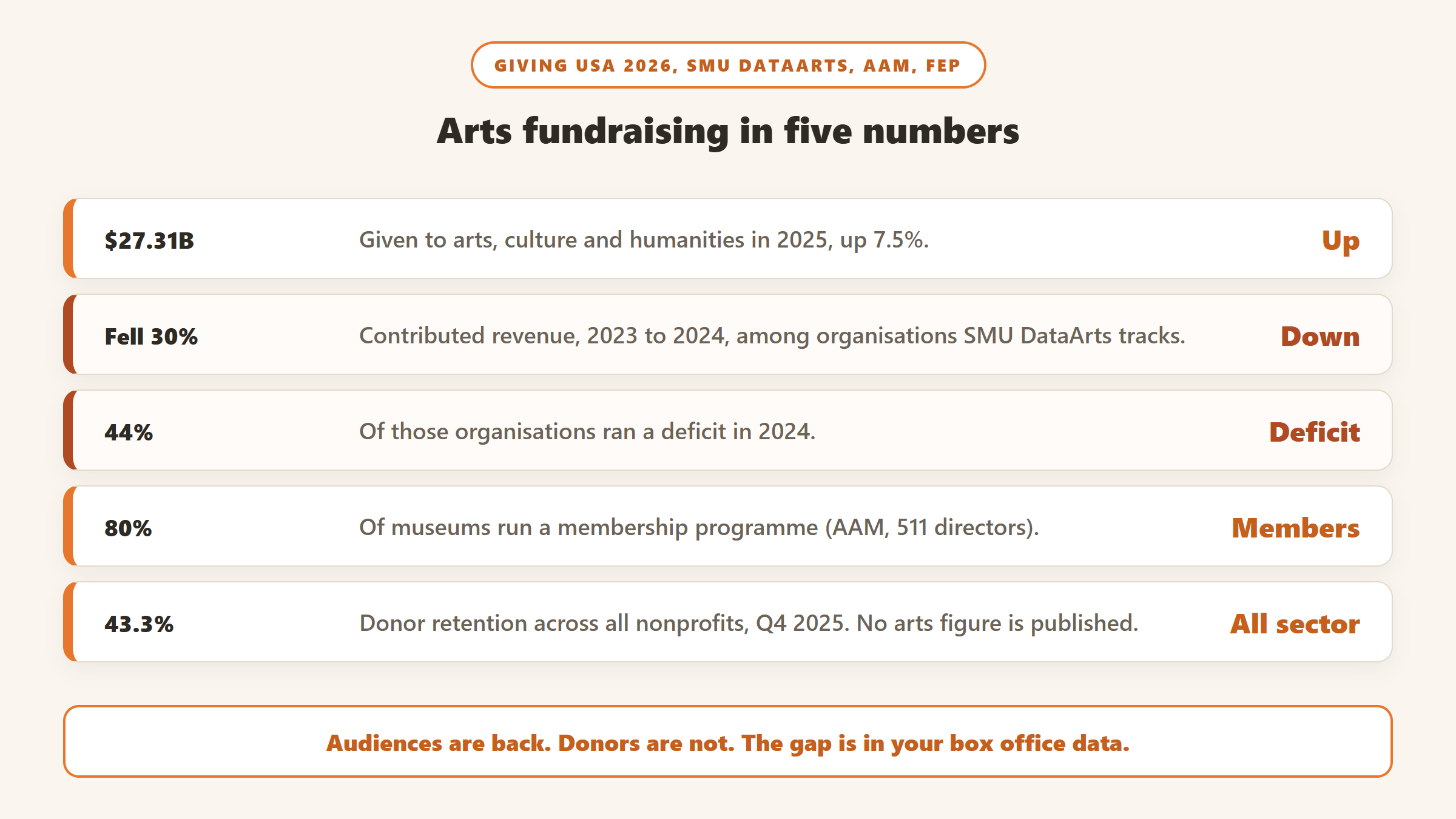
The organisation level picture is harder. SMU DataArts’ National Trends 2025 found that contributed revenue fell 30% from 2023 to 2024 among the organisations it tracks, “with every source declining”, foundation revenue fell 25% and earned revenue fell 18%, while 44% of organisations ran a deficit in 2024. Median working capital fell to 4.25 months, from 6.75 in 2021. Attendance, by contrast, grew.
For museums, the AAM’s 2025 National Snapshot of 511 directors found that 80% run a membership programme; among those, 36% grew membership in the first half of 2025, 35% held steady and 29% declined, and 46% had created or revamped their programme in the previous two years. An AAM post from September 2026 describes the decline in lower level giving, under $500, as the most acute.
We did not find an arts specific donor retention rate from SMU DataArts, the NEA or Americans for the Arts. The best all sector figure is the Fundraising Effectiveness Project, which put overall donor retention at 43.3% in the fourth quarter of 2025. Read together, the message is that arts organisations have audiences but are losing donors, and the people buying tickets are not automatically becoming people who give.
Two architectures, and which one you have
All in one patron systems
Tessitura, Spektrix, PatronManager, Blackbaud Altru, Doubleknot, AudienceView and Arts People combine ticketing or admissions, memberships, a patron CRM and fundraising. The donor is the same record as the ticket buyer, which is the big advantage: you can see who attended five times and never gave. Most mid sized and large arts organisations run one of these.
A ticketing tool plus a separate donor CRM
Smaller organisations often sell tickets through a lighter tool and keep donors in a nonprofit CRM such as Bloomerang, Little Green Light, Neon CRM or Salesforce. That costs less and gives better donor features, but the attendance history lives somewhere else, so the link between buying a ticket and giving a gift has to be built by hand or by integration.
Which architecture you have decides almost everything below, including which outside AI tools can connect to your data.
The patron systems compared
Tessitura
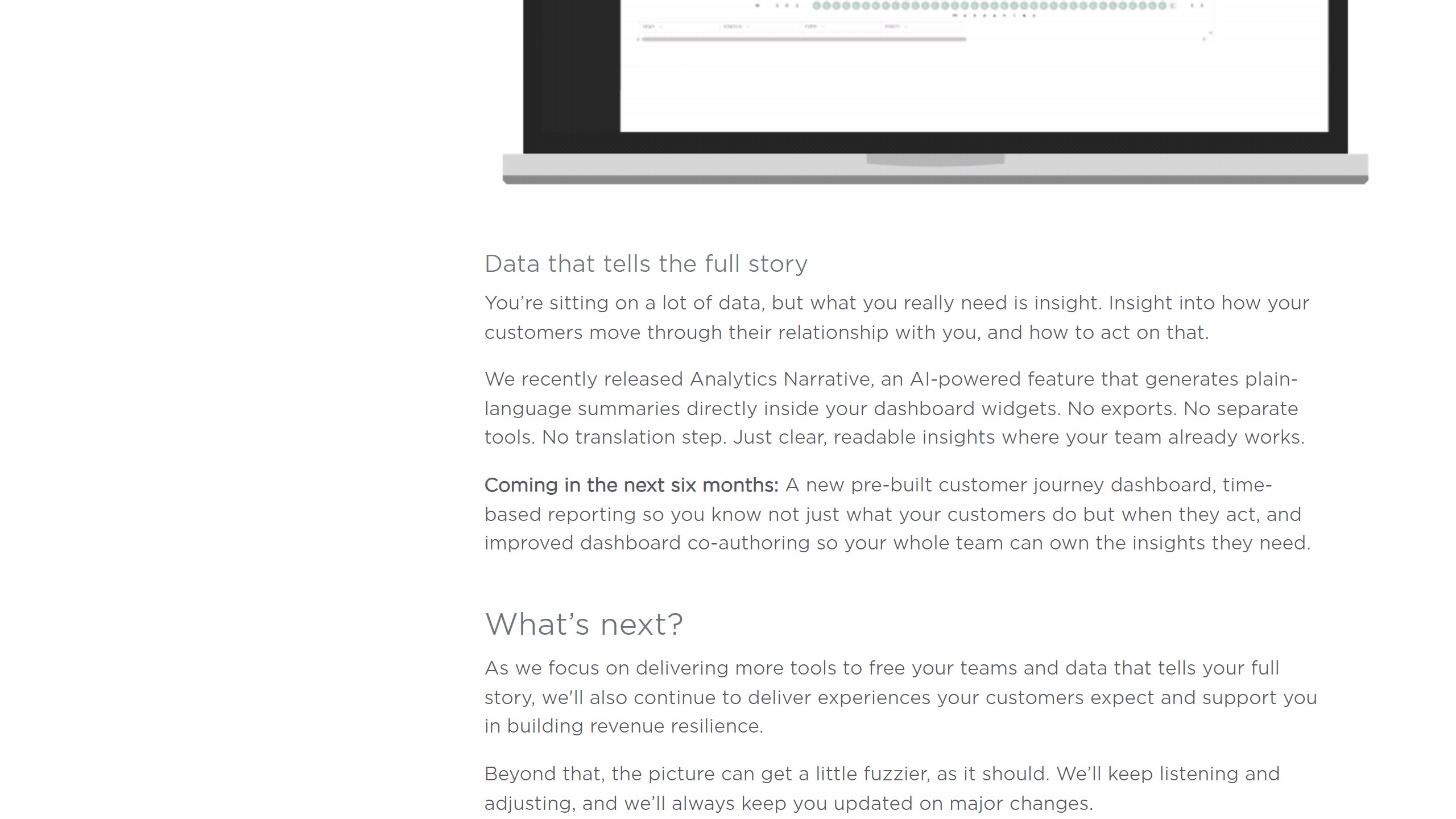
Tessitura calls itself one platform to run a whole arts and culture organisation, and is the standard for large performing arts centres and museums. Its fundraising covers moves management, memberships with renewal rules, pledges, matching, stock and in kind gifts, galas, automated acknowledgements and renewal reminders. Its only released AI is Analytics Narrative, which writes plain language summaries inside dashboard widgets; its 2026 roadmap describes groundwork “for more AI-centered insights”. The AI results in its San Francisco Opera and California Academy of Sciences case study came from partner tools, DonorSearch Ai and Future Demand, not from Tessitura itself. No pricing is published.
Spektrix
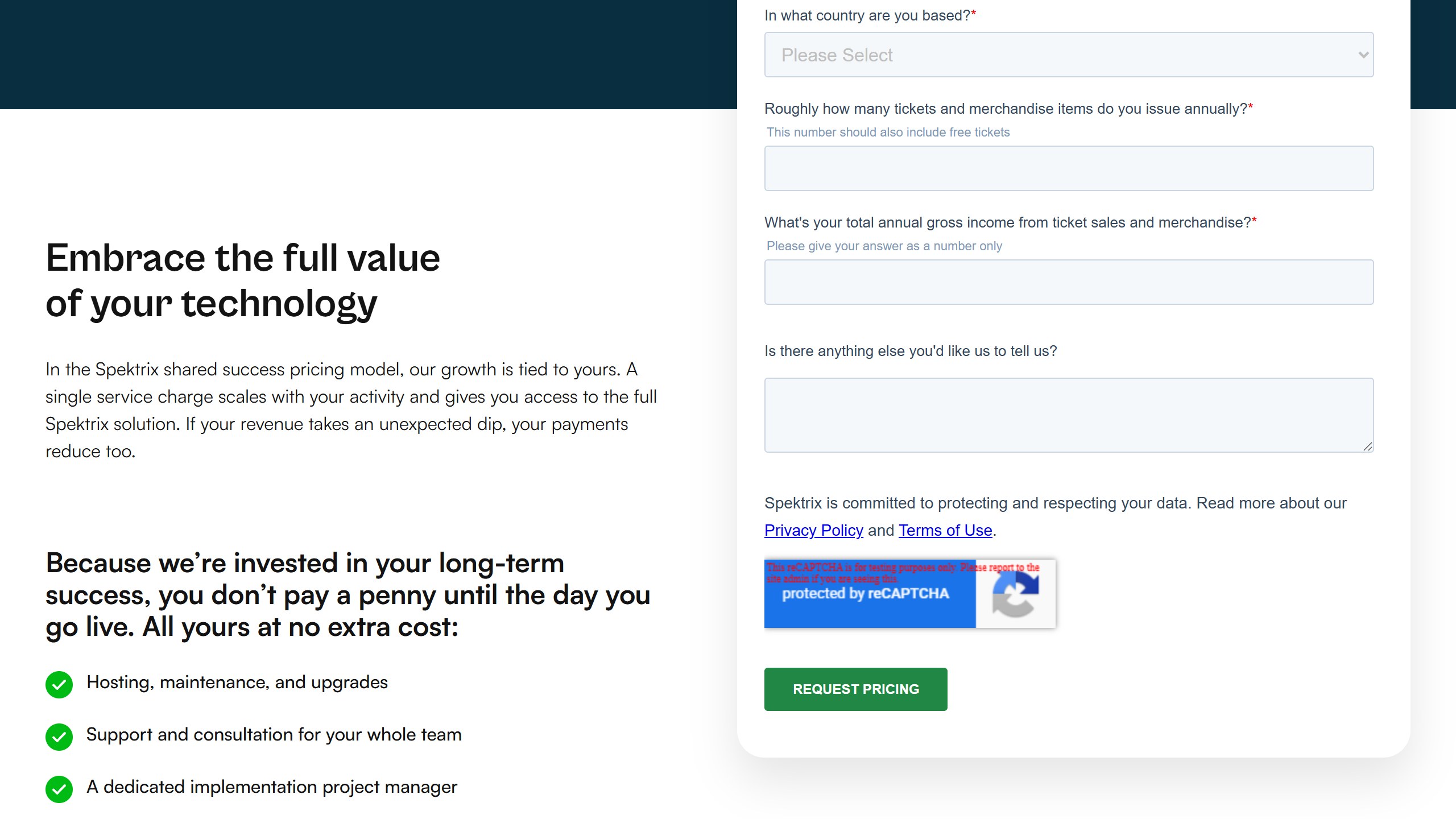
Spektrix combines box office, ticketing, CRM, marketing, fundraising and memberships. Its pricing is a “shared success” service charge that scales with your sales, with card fees added as a percentage of each transaction and unlimited users, implementation, data migration and API access included; no figures are published. Recent additions on its release page include variable recurring giving, appeal automation and an iWave wealth screening integration. Its machine learning today is Dotdigital’s send time optimisation; AI recommendations based on purchase history are listed as expected in 2026.
PatronManager and Ticketure
PatronManager is built on Salesforce, now part of the Ticketure family, and serves more than 500 arts organisations including orchestras, theatres, dance companies and museums by its count. Its site is now a single landing page with no pricing and no named AI. Ticketure handles ticketing, membership and donations for museums, zoos and attractions, but is not a donor CRM.
Blackbaud Altru and Doubleknot
Altru covers ticketing, membership, admissions and fundraising for museums, zoos, aquariums and cultural organisations, with pricing customised by size and no named AI on its page. Doubleknot serves museums, zoos and nature centres with admissions, membership, fundraising such as buy a brick and adoption programmes, and connects both ways with ClearView CRM for donor management, wealth screening and moves management. Neither publishes a price.
Arts People and AudienceView
Arts People, part of Neon One since 2019, is the only patron system here with a published price: “$.99 per ticket + transaction fees”, with no monthly subscription. That makes it easy to budget for a small or seasonal company. AudienceView Professional offers subscription and per ticket options by quote. We found no named AI in either.

Where AI in arts software actually stands
“AI powered” appears on a lot of arts software marketing. This is what each vendor’s own pages said had shipped on 4 October 2026, and what was only promised.
| Platform | Released | Announced or expected |
|---|---|---|
| Tessitura | Analytics Narrative: plain language summaries in dashboards | “Groundwork” for more AI insights in its 2026 roadmap |
| Spektrix | Send time optimisation, using Dotdigital’s machine learning | AI recommendations from purchase history, expected 2026 |
| PatronManager | None found | None found |
| Blackbaud Altru | None named on its page | None found |
| Doubleknot, AudienceView, Arts People | None found | None found |
| Bloomerang | Penny assistant, predictive donor insights, Prospect AI | n/a |
The pattern is clear: the patron systems built for the arts are behind the general nonprofit CRMs on AI. That is not necessarily a problem, because the most valuable arts data, attendance, is already in the patron system and can be queried without AI. But it does mean that if you want predictive scores or a daily action list today, it will usually come from a partner tool or an outside layer reading your exports, not from the platform itself. Tessitura’s own case study makes the point: the AI results it highlights came from DonorSearch Ai and Future Demand.
Ask any vendor that mentions AI on a demo to show the feature working on a real account, and to tell you whether it is included in your contract or priced separately.
An illustration: what the loyal attender list is worth
The numbers in this example are hypothetical, chosen to show the arithmetic; use your own. Take a mid sized theatre with 20,000 unique ticket buyers over two years. Suppose 1,500 of them bought tickets three or more times, and 1,200 of those have never made a gift.
If a personal letter and a follow up email converts 5% of them into donors at an average of $100, that is 60 new donors and $6,000 in the first year. The value is in what happens next: at the all sector retention rate of about 43%, roughly 26 of them give again the following year, and the ones who stay are the people most likely to become members, subscribers and eventually larger donors.
Every patron system in this guide can build that list. The difference between platforms is how easily it can be repeated every month, and whether someone on the development team has time to work it. That second constraint, time, is the one an intelligence layer or an automated stewardship sequence is designed to address.
The donor CRMs arts organisations pair with
| CRM | Published price, 4 October 2026 | Named AI |
|---|---|---|
| Little Green Light | $45 a month to 2,500 records, $135 at 50,000 | None found |
| Neon CRM | From $99 a month, by revenue; memberships and events as add ons | Unnamed “AI-driven insights” |
| Bloomerang | CRM from $125 a month, billed annually | Penny, predictive donor insights, Prospect AI |
| Salesforce Nonprofit Cloud | $70 to $285 per user per month, billed annually; 10 free Core licences | Agentforce for Nonprofit in the $285 editions |
None of these sells tickets, so they suit organisations whose ticketing is light or whose donors are mostly not ticket buyers, such as a gallery, a community arts centre or a heritage trust. Little Green Light is the cheapest full donor CRM. Neon CRM adds memberships and events as modules, which matters for arts organisations. Bloomerang has the most named AI, described on its AI page. Salesforce is the most flexible, and PatronManager runs on it.
Where donor intelligence fits in an arts organisation
The gap the patron systems leave is the one between data and action. Tessitura can tell you who attended five times; it does not, on its own, hand a development officer a list each morning of the ten people to call and why. That is what a donor intelligence layer does.
Our top pick’s page for arts and culture describes a ranked list of who on your own file to contact now, “with a source behind every number”, lapse detection, giving anniversaries and unacknowledged gifts, and handover files when staff leave. It states that your data “never trains anyone’s AI” and that each organisation sits in an isolated tenant. Pricing on 4 October 2026 was a free plan for one person, then $79, $399 and $799 a month billed yearly.
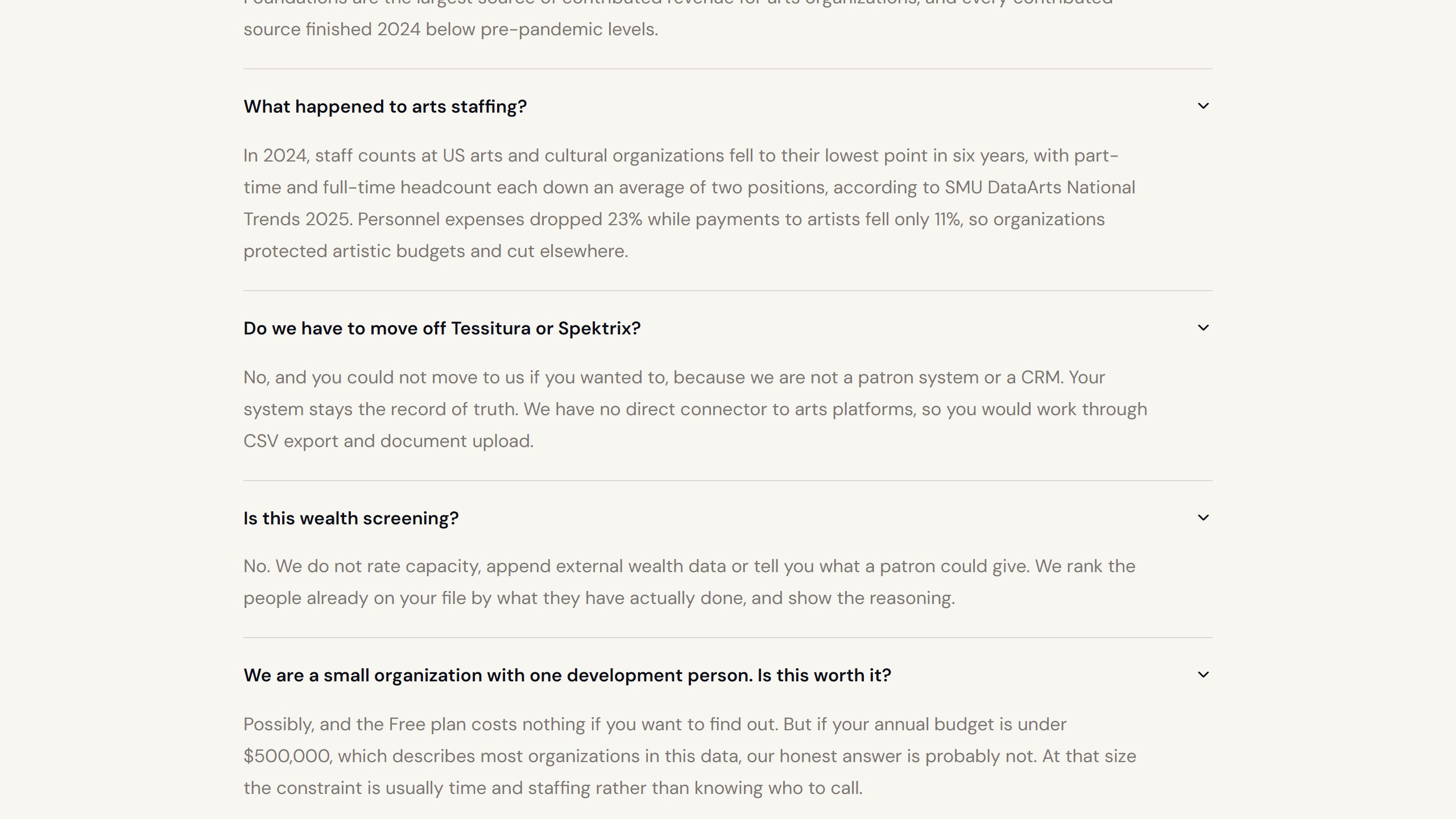
Its limits for arts organisations are significant, and its own page lists them. It has “no direct connector to arts platforms”, so if you run Tessitura, Spektrix or PatronManager you work from a CSV export and document upload; its direct connectors are Salesforce Nonprofit Cloud and NPSP, Bloomerang, Little Green Light and Mailchimp. It has no membership, subscription or renewal features, no event management and no wealth screening. It says it is not designed for organisations under $500,000, and that “before anything else, most arts organizations should not buy software”. We would put it this way: it fits best where the donor file already lives in one of the CRMs above, and for patron system shops it is a monthly export, not a live view.
Turning ticket buyers into donors
Every system above can do the basics of this, and it is where most arts organisations leave money on the table.
Define your loyal attenders. Pick a rule, such as three or more visits or performances in two years, and build it as a saved list. In an all in one patron system this is a query; with a separate CRM it needs attendance data imported.
Ask at the right moment. The days after a visit or performance are when goodwill is highest. Most patron systems can trigger an email after a ticket is used; make one of those emails a thank you with a soft invitation to give or join.
Use membership as the bridge. AAM’s data shows most museums run membership programmes, and many have revamped them recently. Membership turns a transaction into a relationship and is easier to ask for than a donation.
Watch the under $500 donors. AAM’s September 2026 post identifies lower level giving as the area of sharpest decline. These donors are usually not assigned to anyone, which is exactly where a daily list or an automated stewardship sequence earns its place.
How to choose
Large performing arts centres and museums
Tessitura is the default. Add prospect research through a partner such as DonorSearch or iWave rather than expecting it from the platform, and use Analytics Narrative for reporting.
Mid sized theatres and orchestras
Compare Spektrix, PatronManager and AudienceView on total cost at your ticket volume, since all three price by quote or service charge. Ask each which AI features are released today, not on the roadmap.
Museums, zoos and attractions
Altru, Doubleknot and Ticketure are built around admissions and membership. Check how each connects to a donor CRM if your development office uses one.
Small companies, galleries and community arts organisations
Arts People at $0.99 a ticket for ticketing, a low cost donor CRM such as Little Green Light or Neon CRM, and a donor intelligence layer only once you have a development person with more donors than they can track. Our guide to the best donor management software for small nonprofits covers the CRM choice.
Questions to ask a patron system vendor
Which AI features are released, and which are on the roadmap? Spektrix lists AI recommendations as expected in 2026; Tessitura describes its broader AI work as groundwork. Get release status in writing.
How do we get donor data out? Ask about the API, scheduled exports and what an outside tool needs to read your records. Spektrix, for example, includes API access in its service charge; ask whether yours does too. Our page on adding AI without migrating your CRM shows which intelligence tools connect natively and which need a file.
What does it cost at our ticket volume? Service charges and per ticket pricing scale differently from subscriptions. Ask for a quote at last season’s volume and at a 20% higher one.
Sources
- Sector data: SMU DataArts National Trends 2025; AAM 2025 National Snapshot and AAM, 14 September 2026; Giving USA 2026; Fundraising Effectiveness Project Q4 2025.
- Vendor pages read 4 October 2026: Tessitura fundraising, roadmap and AI case study; Spektrix fundraising, pricing and releases; PatronManager; Ticketure; Blackbaud Altru; Doubleknot; Arts People; AudienceView; Bloomerang pricing and AI; Little Green Light pricing; Neon CRM pricing; Salesforce Nonprofit Cloud pricing; Gratefully for arts and culture.

Written by
FazFaz is the founder of AIToolsBakery. Some tools here are tested hands on. Others are assessed from vendor documentation and pricing verified on the live page, and every review says which one it is. Sponsors can buy a position in a guide. They cannot buy the score, the criticism, or silence about a better option.
How we test and how we make money →