Many AI IELTS apps promise a band score. Record an answer, paste an essay, and a number between 0 and 9 comes back in seconds. The question nobody in the top search results asks is how close that number is to what a real IELTS examiner would give you, and the answer is that almost no app says.
That matters more for IELTS than for most exams, because a band score is often the whole point. Universities, employers and visa systems set a minimum, and an app that tells you 7.0 when an examiner would give 6.0 can cost you a test fee and a few months. This guide compares seven AI IELTS prep apps and tools, including what the three organisations that own IELTS offer themselves, and looks hard at what each band score is based on.
How we put this together. We have not used these apps ourselves; this is a research-based comparison. Every price, rating and feature below comes from the vendor’s own website, an official IELTS page, or the app’s US App Store and Google Play listing, read on 18 October 2026, and we link to each source. Where a vendor quotes prices in another currency, or shows a dollar sign with no currency code, we say so and do not convert. Apple often lists several prices for one plan because of trials and promotions, so we give the range it showed. Nothing here is a test result, and none of these vendors paid to appear on this page.
What the people who own IELTS say about AI scoring
IELTS is jointly owned by the British Council, IDP IELTS and Cambridge University Press & Assessment. All three now offer some form of AI practice feedback, and at least one of them has warned candidates about the very thing many apps sell.
The real test is marked by people
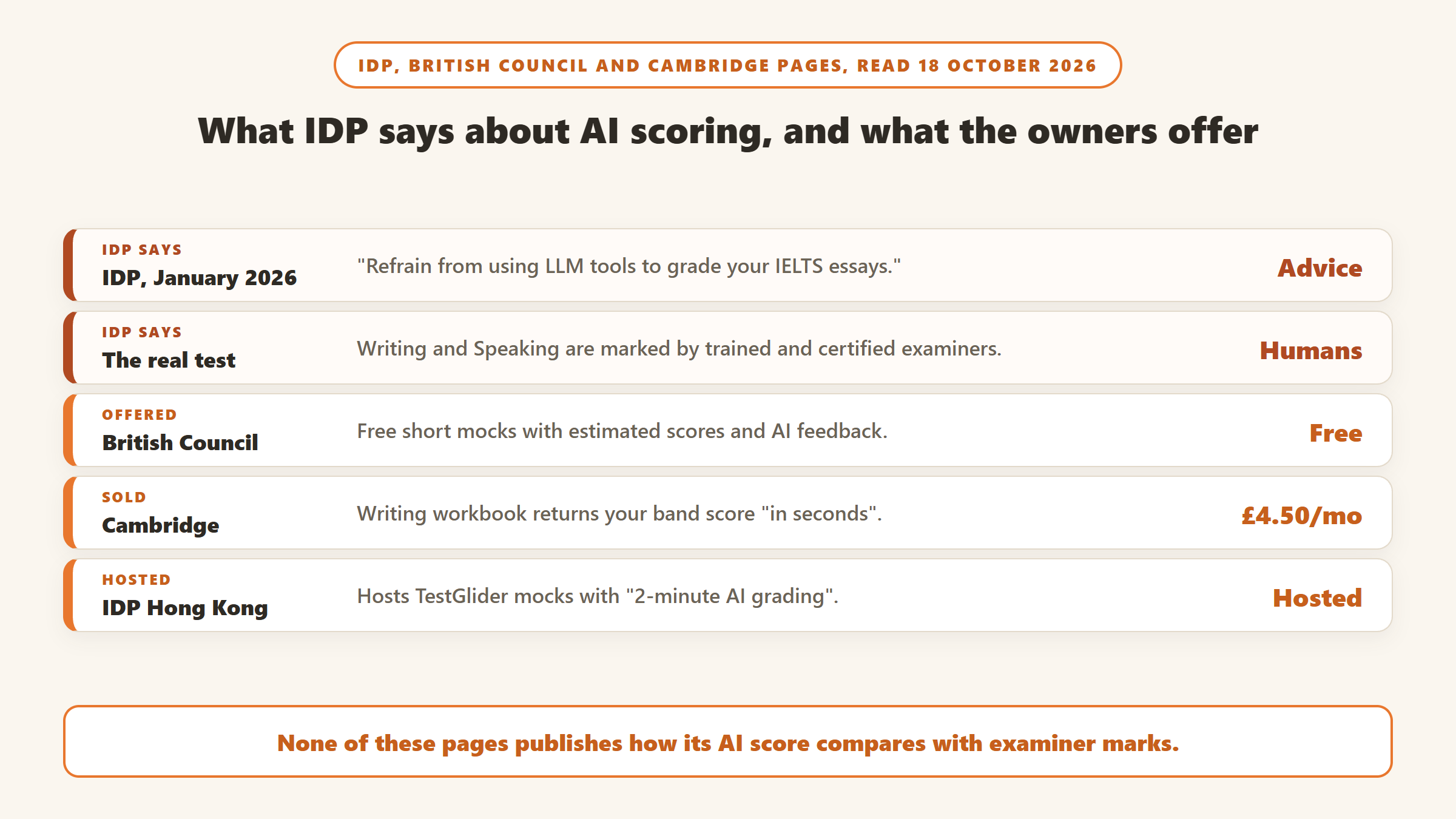
IDP has been clear for years that the scored parts of IELTS that AI apps imitate are human-marked. An IDP article from 2021 states that “the IELTS Writing and Speaking tests are marked by trained and certified examiners”, and that “IELTS markers (not machines) work to clearly defined criteria”. A 2020 IDP article on Speaking puts it more simply: the test “is done face-to-face with a real, human examiner.” Any app that gives you a Writing or Speaking band is predicting what a person would decide, not reproducing how the test is scored.
IDP’s own advice: do not let an LLM grade your essay
IDP’s guide to using AI for IELTS preparation, dated 9 January 2026, recommends AI for finding weak spots, checking grammar and practising speaking questions. On marking, it is blunt: “Refrain from using LLM tools to grade your IELTS essays” and “Always verify against official IELTS band descriptors.” It also warns that AI tends toward “overwhelmingly positive feedback”, and says “there isn’t any right AI tool that specialises in IELTS.” That advice is aimed at general chatbots, but it applies to any band score that has not been checked against examiners.
And yet the owners sell or host AI scoring
The same organisations are now in the AI feedback business. The British Council gives estimated scores and AI feedback on short mock tests for free, and lists Writing and Speaking scores on a single mock test in both its free and Premium packages. Cambridge sells an IELTS writing workbook that returns “your IELTS band score for the task in seconds”. IDP’s Hong Kong site hosts AI mock tests developed by TestGlider, a third-party platform, with “2-minute AI grading for all mock tests”. The IELTS by IDP Android app lists an E2 course that offers to “instantly estimate your IELTS score” with what it calls a “reliable score estimator”. None of these pages, as read on 18 October 2026, publishes how its AI score compares with examiner marks.
None of this makes the tools useless. It means a practice band score is a rough signal, and the most useful thing an app can give you is the feedback around the number, not the number itself.
How accurate are AI IELTS band scores?
We looked for published evidence on the accuracy of every app in this guide. Here is what exists.
One vendor gives two different figures
Cathoven is the only app here that puts a number on its accuracy. Its pricing page FAQ says its “Writing and Speaking scores are within 0.5 band of examiner scores in 98% of cases”, and an older Cathoven blog post repeats the 98% figure. Neither page explains how it was measured, on how many essays, or by which examiners. Cathoven’s own resource page on AI essay checking, published in March 2026, gives a much lower figure for the category: it says leading AI writing tools agree with certified IELTS examiners “within 0.5 bands approximately 75-80% of the time”, citing Cambridge research from 2024 that we could not locate. The same page says AI evaluation “is most reliable for Lexical Resource and Grammatical Range and Accuracy” and weaker at judging whether an argument is convincing.
An open benchmark shows one scorer’s pattern
Some public numbers come from outside the app stores. An open IELTS Task 2 scoring model on Hugging Face publishes its own, self-reported results on 6,000 held-out essays from a public essay dataset whose labels it describes as noisy, not examiner marks: its raw overall band was within half a band of the human label 50.3% of the time and within one band 80.0% of the time. For Task Response, the criterion about answering the question, only 32.8% of predictions landed within half a band. It also reports a pull toward the middle: “Weak essays are scored up, strong ones scored down”, by 0.46 of a band at bands 4 to 5.5 and 0.83 of a band at 8 to 9. That model is not used by any app on this list, as far as their pages say, but it is a published look at how one automated scorer behaves.
What that means for you
If the app you use behaves like that model, it may flatter you around band 5 and undersell you if you are aiming for 8 or above. Treat any AI band as a range of roughly a band either way, look at which criterion it flags, and use full timed mocks to check progress over weeks rather than trusting one essay’s score.
AI IELTS prep apps compared
| Product | Type | Skills scored by AI | Price (18 October 2026) | Platforms | Store rating |
|---|---|---|---|---|---|
| British Council IELTS Ready | Official practice package | Short mocks with AI feedback; Writing and Speaking scores on one mock | Free tier; Premium free when you book IELTS with the British Council | Web | No app |
| Cambridge Write & Improve +Test Zone | Writing checker from the IELTS co-owner | Writing | £4.50/month per workbook; 10 free Academic tasks | Web | No app |
| Stimuler | AI speaking scorer and video mock tests | Speaking | US App Store from $1.99/week; $9.99 or $12.99/month; yearly $18.99 to $99.99 | iPhone, Android | 4.8 iOS (8,446); 4.8 Android (220,709) |
| Cathoven | Full IELTS platform with AI tutor | Writing, Speaking | $21.00/week; $67.50/month; $172.80 for 3 months (dollar sign, no currency code) | Web; Android speaking app | Android app unrated |
| TestGlider | Timed mock tests with AI grading | Writing, Speaking | $5.99 for 5 days; $25.99/month; $98.50 for 6 months (dollar sign, no currency code) | Web for IELTS | No IELTS app |
| ELSA Speak | Pronunciation coach with exam prep | Pronunciation (no band claim) | US App Store $19.99/month; yearly $71.00 to $129.99 | iPhone, Android | 4.8 iOS (113,854); 4.6 Android (1,015,490) |
| IELTSpeaking | Speaking mock tests and question bank | Speaking | US App Store $9.99/week; $29.99/month; $99.99/year or lifetime | iPhone | 4.6 iOS (1,200) |
Prices and ratings read on 18 October 2026. Ratings are rounded to one decimal, with the number of ratings in brackets. Apple’s in-app purchase lists often show several prices for the same plan, so check the store or the vendor’s checkout before you subscribe.
How we chose and ordered these
Every product had to give AI feedback or an AI score on IELTS Speaking or Writing, the two skills that need a human examiner in the real test. We ordered them by how close the tool is to the organisations that write and mark IELTS, how specific the vendor is about what its AI does, how much public evidence there is that the product works at scale (ratings, installs, recent updates), and price. We dropped apps not updated in more than a year on any platform, apps with only a handful of ratings, and products whose websites we could not reach or verify, and we list them at the end.
1. British Council IELTS Ready: the official free option
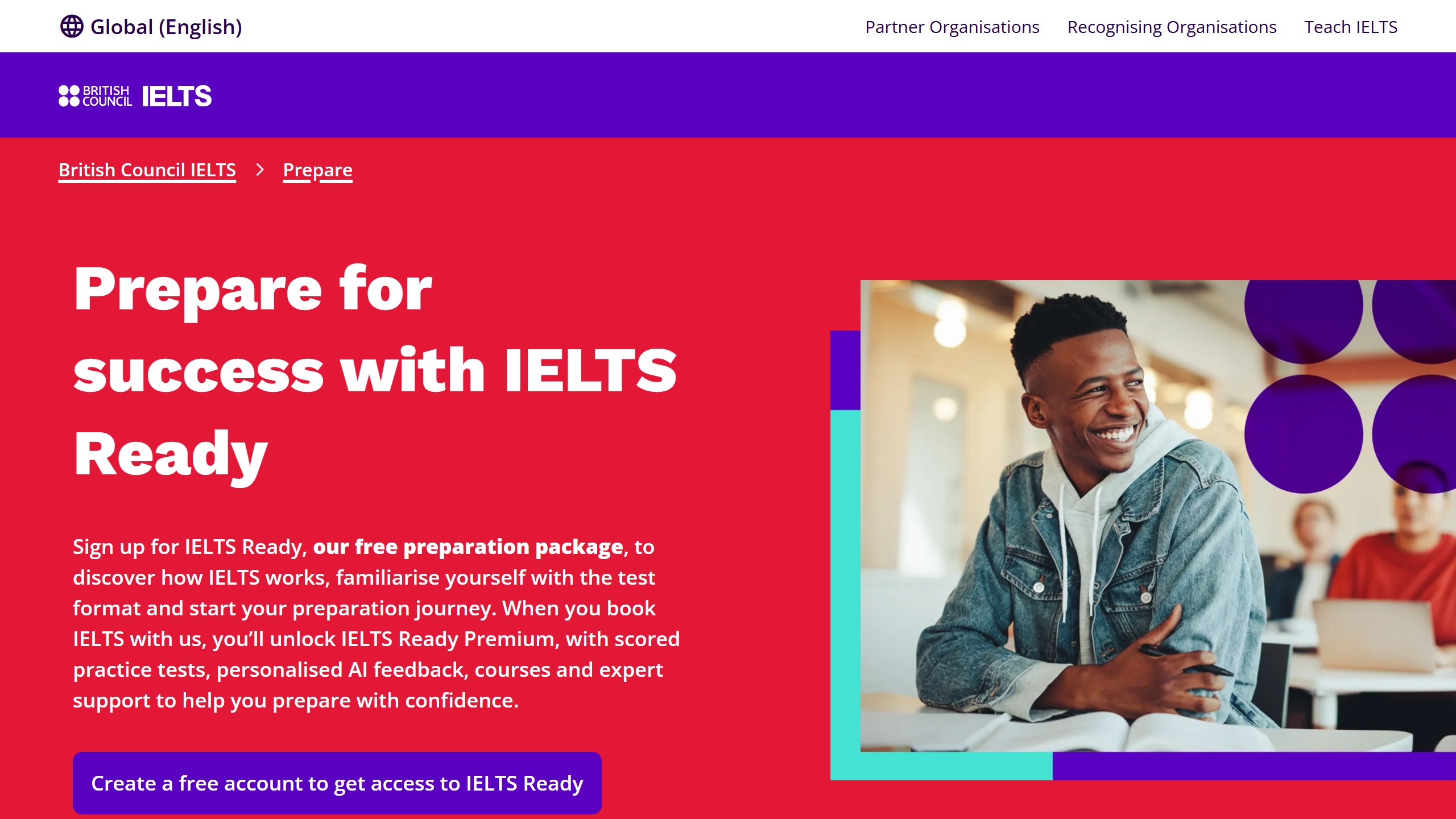
IELTS Ready is the British Council’s own preparation package, and for anyone booking with the British Council it is hard to beat on price. On 18 October its comparison table listed the free tier as “Free forever”, with a 25-minute and a 50-minute mock test that give estimated scores and AI feedback, 2 full mock tests with Reading and Listening scores and model answers, Writing and Speaking scores on a single mock test, short Speaking and Listening courses and live webinars. Book your IELTS test with the British Council and you unlock IELTS Ready Premium, free from registration until 7 days after your test date, with 40 full mock tests, Writing and Speaking scores on a single mock test “and packages”, courses in all four skills and a personalised study guide. We read the global English version of the page; your country’s page may differ.
The limits: it lives on the web, not in an app, and Premium is tied to booking with the British Council rather than IDP. The page we read does not describe how its AI feedback or scores were checked against examiners. Search results for regional British Council pages mention paid AI feedback add-ons in some countries, but those pages did not load for us, so check the page for your country.
Choose it if you will book with the British Council, or want a free official mock with AI feedback. Skip it if you want daily speaking practice on your phone.
2. Cambridge Write & Improve: the IELTS writing checker from the co-owner
Write & Improve +Test Zone for IELTS comes from Cambridge University Press & Assessment, which co-owns IELTS, and its page says it “is developed by the same Cambridge team behind IELTS.” You pick a task from a workbook, set a timer, write under test conditions and “get your IELTS band score for the task in seconds”, then revise using the feedback and track your progress.
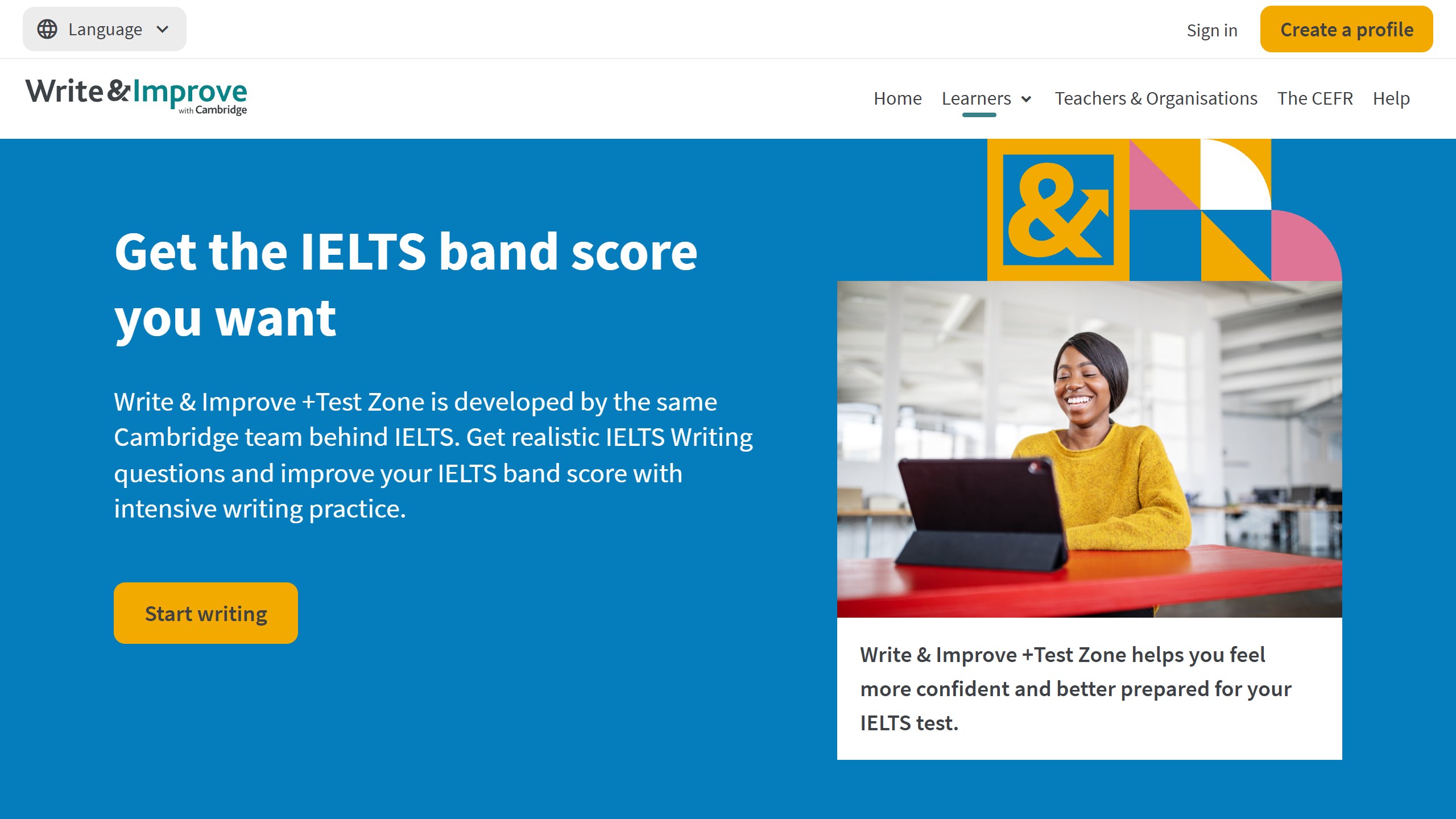
The IELTS Academic workbook has 60 tasks and the General Training workbook has 40. Each costs £4.50 a month, priced in pounds on Cambridge’s site, with 10 free Academic tasks and 2 free General Training tasks to try first. The free version of Write & Improve gives a CEFR level rather than an IELTS band, with “word, sentence-level and motivational feedback and a progress graph”. It covers writing only; Cambridge’s speaking counterpart, Speak & Improve, is described in its help centre as a research project based on a different exam, Linguaskill, not IELTS.
Being from the IELTS co-owner does not mean its score is the official one, and the page does not publish accuracy figures. But it is the one IELTS writing checker here built by the organisation that sets the test.
Choose it if Writing is your weakest skill and you want a cheap, focused band estimate. Skip it if you need speaking feedback.
3. Stimuler: the biggest IELTS-focused speaking app here
Stimuler is a speaking app first and an IELTS app second, and on store numbers it is the largest IELTS-focused app in this guide. Its iPhone app had a 4.8 average from 8,446 US ratings and was updated on 14 October 2026. Its Android app had a 4.8 average from 220,709 ratings and more than 10 million installs. Its website claims more than 13 million downloads.
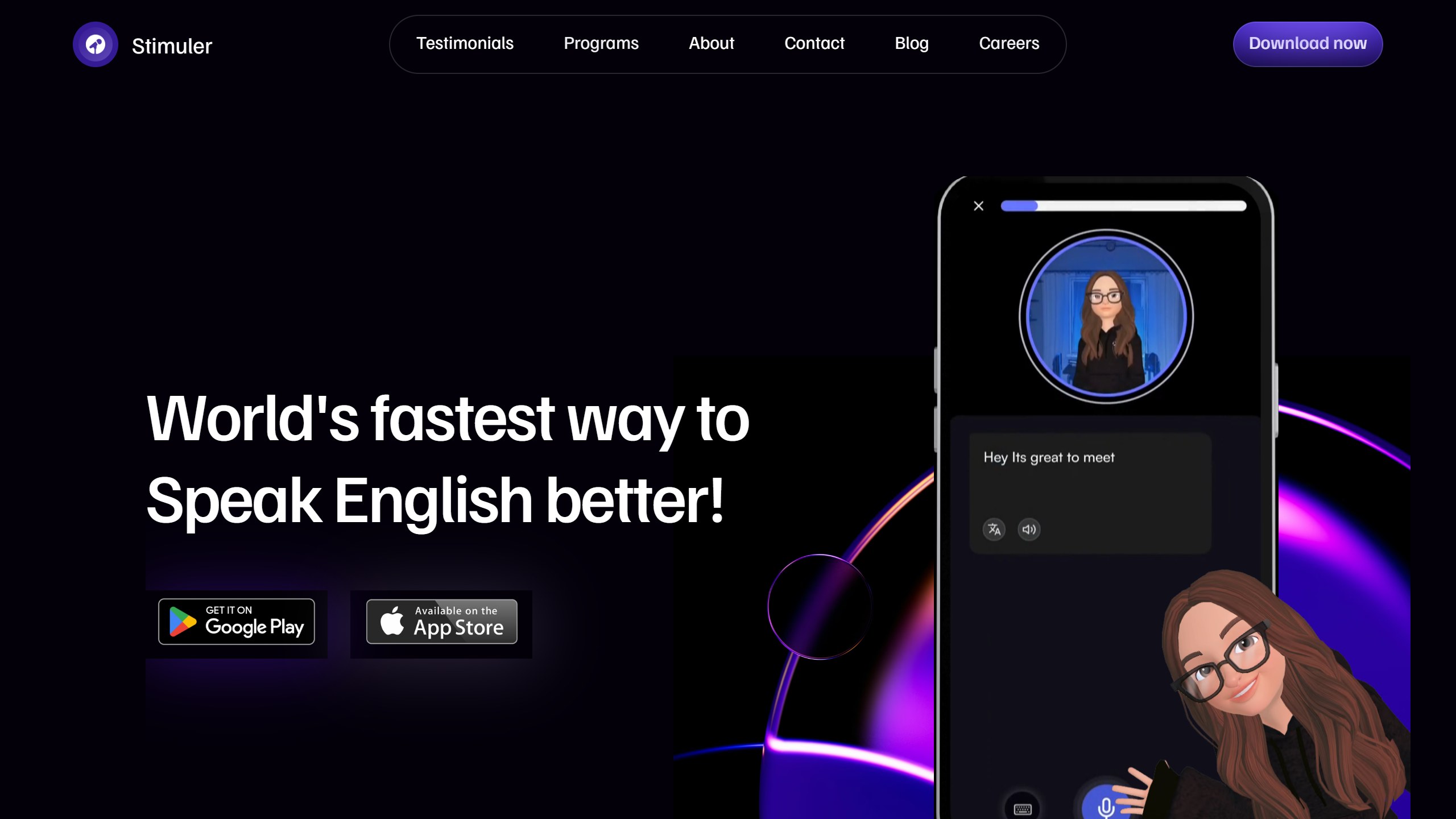
The core loop is simple: speak for 60 seconds on a topic and, according to the App Store listing, get feedback on pronunciation, fluency and vocabulary “in less than 20 seconds”, with “an immediate IELTS band score”. It also offers what it calls “Live Video Mock Tests” with an AI interviewer, and the listing promises more than 15 full-length IELTS Speaking mock tests with Premium. Stimuler says its voice AI was “refined using millions of user speeches”, but publishes no comparison with examiner scores.
Watch the price. The App Store description says Premium costs “less than $5/month”, but the US in-app purchase list on 18 October showed monthly plans at $9.99 and $12.99. The annual plans, listed from $18.99 to $59.99, with a Pro+ annual at $99.99, are where the low monthly figure comes from. There is also a $1.99 weekly option.
Choose it if you want daily speaking practice on your phone with a band estimate. Skip it if you need writing feedback.
4. Cathoven: full platform, one bold accuracy claim
Cathoven covers all four skills on the web, with Task 1 and Task 2 writing for Academic and General Training, all three Speaking parts, and Reading and Listening practice. Premium adds diagnostic tests, a personalised study plan, more than 50 mock tests and an AI tutor called Catbot. Its pricing page says Cathoven is an IELTS registration centre for the British Council, and that more than 1.2 million users have joined.
It is also the most expensive option here by the week. On 18 October its pricing page showed $21.00 a week, $67.50 a month (down from $90.00) and $172.80 for three months as a one-time payment, all with a dollar sign and no currency code, so the figure you see may vary by region. A free set of tools, including a CEFR text analyser and a Writing Reviser, has daily limits. On Android there is a separate Cathoven Speaking app with more than 10,000 installs that gives a CEFR speaking level and conversation feedback.
The accuracy question is covered above: a 98% claim on the pricing page, a 75 to 80% figure for the category on its own resource page, and no published method. To its credit, the resource page is candid that AI is weaker on argument quality and that a trained examiner is still needed for that.
Choose it if you want one web platform for all four skills and can use it intensively for a short period. Skip it if you are on a tight budget or want a phone app.
5. TestGlider: timed mock tests, also hosted by IDP Hong Kong
TestGlider, from South Korean company Databank, is built around full timed mock tests with AI-graded Writing and Speaking. Its IELTS course is the one IDP Hong Kong hosts on its own site, where it lists “8 IELTS mock test sets”, “34 lectures and 780 practice questions” and “2-minute AI grading for all mock tests”. That is a direct link to an IELTS owner, although the IDP page does not say the AI score matches examiner marks.
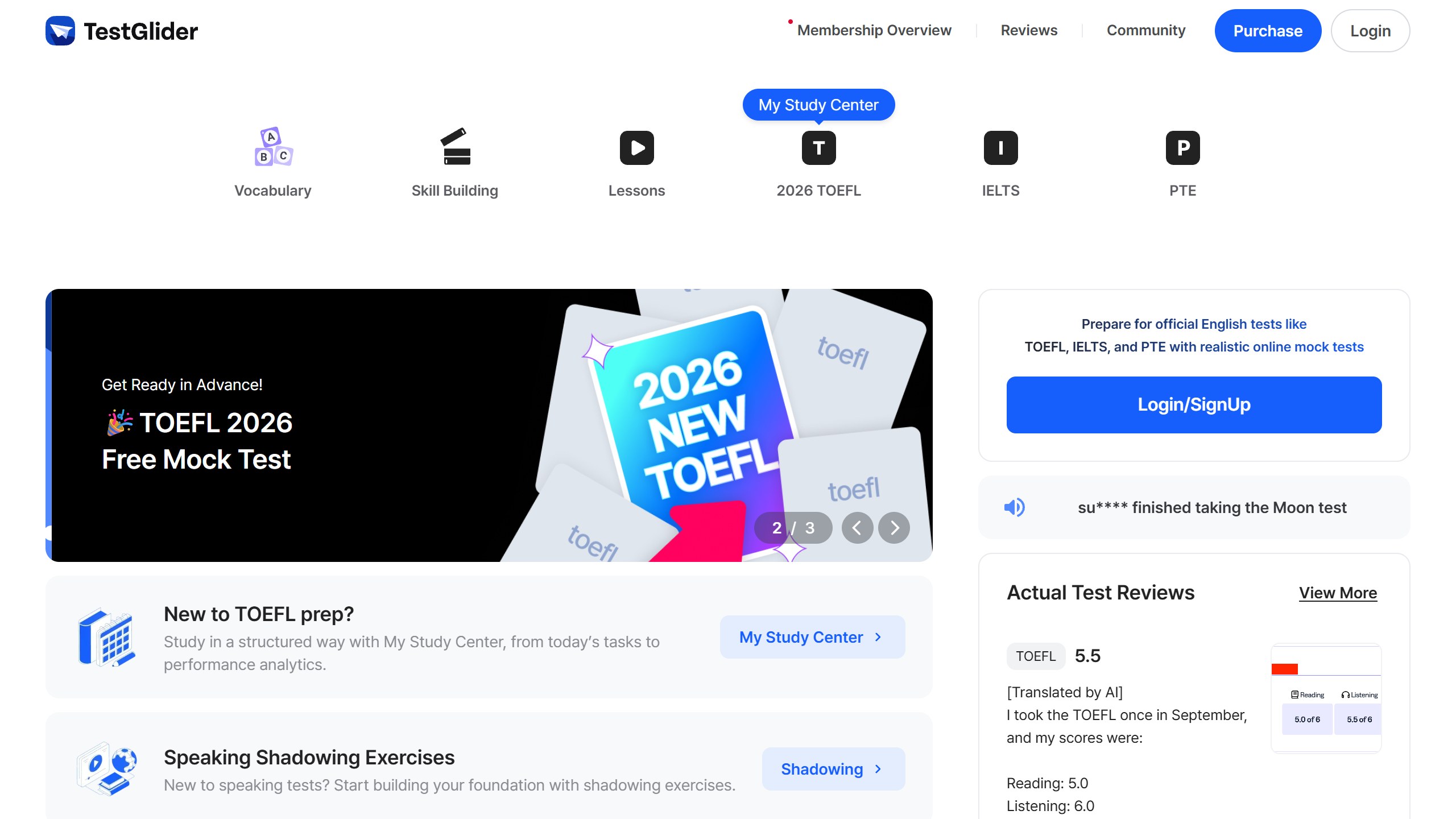
Its pricing page on 18 October listed IELTS plans at $5.99 for 5 days, $25.99 a month (down from $39.99) and $98.50 for 6 months, each with unlimited AI feedback, again with a dollar sign and no currency code. The 5-day plan is a cheap way to sit a couple of full mocks in the week before your test. Note that TestGlider’s iPhone app, released in July 2026, describes TOEFL preparation only, so IELTS practice is on the web.
Choose it if you want realistic full-length mocks with fast AI marks close to test day. Skip it if you want short daily practice on a phone.
6. ELSA Speak: pronunciation, one of four Speaking criteria
ELSA Speak is not an IELTS app, but pronunciation is one of the four criteria IELTS Speaking examiners use, alongside fluency and coherence, vocabulary and grammar. ELSA has the most store ratings of any app in this guide: a 4.8 average from 113,854 US ratings on its iPhone app, updated 6 October 2026, and a 4.6 average from more than a million ratings with over 10 million installs on Android.
Its App Store listing includes exam preparation for IELTS, TOEFL, TOEIC and others with Premium, and a Speech Analyzer for free speaking with “instant detailed feedback”. It does not claim to predict an IELTS band. US App Store prices on 18 October were $19.99 a month, $39.99 to $52.00 for three months and $71.00 to $129.99 a year. We cover it in more depth in our guide to AI pronunciation apps.
Choose it if examiners or teachers say your pronunciation is what holds your Speaking band down. Skip it if you want IELTS-format mock tests.
7. IELTSpeaking: long-running speaking app with a confusing price list
IELTSpeaking, from Gravity Technology Beijing, has been on the App Store since 2014 and was updated on 13 October 2026. Its iPhone app had a 4.6 average from 1,200 US ratings. It offers full Speaking mock tests with what it calls “1-on-1 AI examiner feedback, and precise band scoring”, practice by Part 1, 2 or 3, and a question bank that it says is updated hourly during topic-change seasons. Its website links only to the iPhone app.
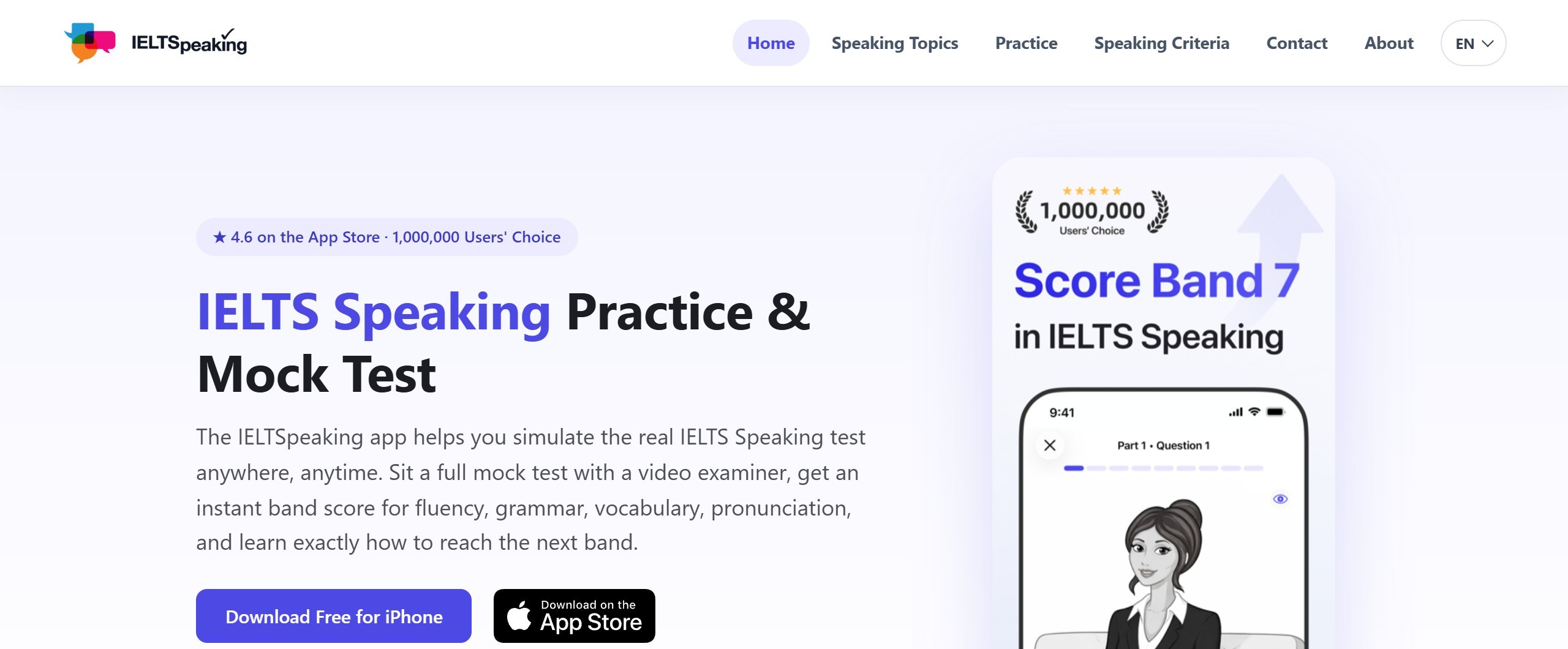
The price list needs care. On 18 October the US App Store showed Pro Weekly at $9.99, Premium Pro Monthly at $29.99, and both Premium Pro Yearly and Premium Lifetime at $99.99, alongside a “One-Time Exam Marking” purchase at $149.99 that the description does not explain. If you buy it, check what the yearly and lifetime plans include before paying. The same company makes TalkFace, which we left out below.
Choose it if you are on iPhone and want a large, frequently updated Speaking question bank. Skip it if you are on Android.
The official IDP app: useful, but not an AI scorer
IDP’s own app, IELTS by IDP, is built for booking your test, getting results and preparing with articles, videos and quizzes. Its Google Play listing had a 4.9 average from 2,634 reviews and more than a million installs, updated 6 October 2026. It hosts partner courses: a Macquarie University course free for 14 days, Cambridge preparation with “auto-marked, AI-enabled features” for Listening and Reading that the listing says is “available in India only”, and an E2 course with a score estimator. When we checked on 18 October, the app was not available in the US App Store, though it is listed in other App Store regions. Use it to book and to check results, and look elsewhere for AI Speaking and Writing practice.
What we left out, and why
TalkFace, also from Gravity Technology Beijing, ranks well in search but had only 34 US App Store ratings. Its App Store description gives example prices of $14.99 a month and $89.99 a year, while the in-app purchase list on 18 October showed a 1-year Premium Max plan at $229.99 and a month at $29.99. The Android app linked from its website was last updated in August 2024. IELTS Pulse publishes its own ranking of IELTS apps but had 3 US App Store ratings, with Premium listed at $59.99 a month and $499.99 a year.
ai-ielts.app, the second result in our search, returned a Cloudflare error when we checked on 18 October, so we could not research it. We could not find an official website or store app for Speechful or LexiBot, which both appear in search results. Magoosh’s IELTS app has not been updated since August 2019, and the general IELTS practice apps we found without an AI scoring claim, such as IELTS Prep App, belong in a different guide.
Speaking app or writing checker: which do you need?
AI speaking apps
Stimuler, IELTSpeaking and the speaking parts of Cathoven and TestGlider record your answer, transcribe it and score it against the four Speaking criteria. They are good for volume: you can answer dozens of Part 2 cue cards in the time it takes to book one lesson. Their weak point is the one IDP raises: a real examiner reacts to you, follows up and judges coherence in context, and a recording scored afterwards cannot fully copy that. For delivery skills beyond the exam, our guide to AI public speaking coach apps covers pace, filler words and confidence.
AI writing checkers
Write & Improve, Cathoven and TestGlider score essays. AI is strongest on the criteria it can count, vocabulary range and grammatical accuracy, and weakest on Task Response, whether you actually answered the question with a convincing argument. That pattern shows up in both Cathoven’s own resource page and the open benchmark above. Use the checker to clean up language, and ask a teacher or a strong peer whether your argument works.
Full mock tests
British Council IELTS Ready and TestGlider both offer full mock tests. Take one early to set a baseline, practise skills in between, and take another a week or two before your test.
How to choose an AI IELTS app
Start with the free official tools
Take the British Council’s free mock with AI feedback and try Cambridge’s 10 free Academic writing tasks before you pay anyone. If you book with the British Council, Premium is included.
Pay for your weakest skill
If Writing is the problem, a writing checker is enough. If Speaking is the problem, a speaking app with daily practice will help more than a full platform. Only pay for an all-in-one plan if more than one skill is below your target.
Treat the band as a range
No app here publishes a method showing how its band compares with examiners. Read every AI band as roughly one band either way, and pay more attention to which criterion is flagged and whether it improves over several weeks.
Check the price in the app
Stimuler, TalkFace and IELTSpeaking all showed in-app prices that differ from the figures in their own descriptions. Look at the plan length and the renewal terms before you confirm, and prefer short plans if your test date is close.
Get a human opinion at least once
IDP’s own guide recommends combining AI with human feedback, and it is good advice. One marked essay or a mock Speaking test with a teacher will tell you whether the app’s score is in the right range.
Teaching IELTS rather than taking it? Our guide to AI tools for ESL teachers covers marking and lesson planning tools for the classroom.
Sources
- IDP: How to Effectively Use AI to Prepare for IELTS (9 January 2026), article on human marking (10 June 2021), IELTS Speaking: AI vs face-to-face (30 April 2020), IDP Hong Kong AI mock test page, IELTS by IDP on Google Play.
- British Council: IELTS Ready and IELTS Ready Premium comparison.
- Cambridge: Write & Improve +Test Zone IELTS, Write & Improve Free, About Speak & Improve.
- Stimuler: website, US App Store listing, Google Play listing.
- Cathoven: website, pricing and FAQ, AI essay checker resource page (20 March 2026), blog post (updated 1 August 2025), Cathoven Speaking on Google Play.
- TestGlider: website, pricing, US App Store listing.
- ELSA Speak: website, US App Store listing, Google Play listing.
- IELTSpeaking: website, US App Store listing. TalkFace: US App Store listing, Google Play listing. IELTS Pulse: US App Store listing. Magoosh IELTS: US App Store listing.
- Open scoring benchmark: tolmachv1.0 model card on Hugging Face.
- All store listings and web pages read 18 October 2026.

Written by
FazFaz is the founder of AIToolsBakery. Some tools here are tested hands on. Others are assessed from vendor documentation and pricing verified on the live page, and every review says which one it is. Sponsors can buy a position in a guide. They cannot buy the score, the criticism, or silence about a better option.
How we test and how we make money →