Last reviewed May 2026. Updated whenever MagicSchool ships new tools or pricing changes.
Faz says: MagicSchool has the most tools in the AI EdTech category by a wide margin. The pace of new-tool releases has held steady through 2026, and the question for most teachers is no longer “is MagicSchool worth trying” but “which of the 80+ tools should I actually use”. This page tracks the new releases, pricing shifts, and the few areas where MagicSchool is genuinely improving (vs the areas where they are shipping more tools than the team can maintain well). Foundational review at our full MagicSchool review.
Quick answer: what is changing in MagicSchool in 2026
MagicSchool continues its strategy of shipping new teacher-facing AI tools at high cadence. The tool count is now well over 80. New 2026 additions cover IEP draft support, parent communication generators, rubric builders, and an expanded student-side toolset. Pricing is stable at the individual teacher tier, with school and district plans available by quote. The free tier remains usable for individual teachers. The biggest 2026 question is not "is MagicSchool good" but "do we need 80 tools, or are we better served by a smaller specialized stack". This page tracks the cadence and helps you decide which new tools justify a workflow change and which are nice-to-have.
What is new in MagicSchool (May 2026)
Refreshed monthly. New tools, meaningful updates, and pricing shifts in the trailing 60 days.
Areas seeing the most movement:
- Tool count growth: MagicSchool continues adding new teacher tools at high cadence. The recent additions skew toward specialized use cases (specific subject prompts, specific student-need workflows) rather than broad tools.
- Student-side tools (under teacher supervision): MagicSchool has expanded its student-facing tooling, with teacher controls remaining the gate. Privacy posture documentation has kept pace.
- IEP and 504 support: tooling for drafting IEP goals, 504 accommodations, and progress monitoring notes has improved. This is one area where the AI output quality has caught up to what specialists need as a draft starting point.
- Parent communication tooling: the parent-message drafters are smoother in tone and more reliably bilingual. Spanish output quality in particular has improved.
- Rubric builders: rubric generation from learning objectives is more consistent at higher Bloom's Taxonomy levels.
- Lesson plan generators: longer, more detailed lesson plans (90-minute blocks, multi-day units) are now feasible where 2025 versions felt thin.
If the date stamp at the top of this page is older than 60 days, the page is overdue for a refresh.
MagicSchool pricing changes in 2026
- Free tier (individual teachers): still in place. Daily generation caps apply but are reasonable for most teachers.
- Teacher Pro / Plus: paid individual tier sits in the familiar EdTech band, with minor price creep from 2025 levels.
- School and District plans: enterprise pricing by quote. Volume discounts and SSO integrations are part of the enterprise tier.
- Free for educators verification: K-12 teachers can verify and access expanded free-tier privileges.
If you are evaluating MagicSchool for 2026-2027 school-year budget, request a current quote directly. Pricing in this category has been moving and the public page may not reflect the most recent enterprise terms.
Best new tools in MagicSchool worth trying in 2026
If you only have 30 minutes to update your MagicSchool stack, these are the tools to test first.
IEP and 504 drafting tools
The IEP goal draft generator and 504 accommodation tooling produces first-draft output that has improved meaningfully. It is not a replacement for the specialist, but it cuts the blank-page time significantly for the routine paperwork.
If IEP drafting is your main use case, our comparison of the best AI IEP writing tools puts MagicSchool up against dedicated IEP platforms on compliance and privacy.
Bilingual parent communication
Spanish-language parent message output is much stronger than 2025 versions. For teachers serving Spanish-speaking families, this is a real workflow improvement.
Rubric builder with Bloom's levels
The rubric generator now reliably produces criteria at the Bloom's level you specify. The output is usable as-is for formative rubrics and as a strong starting draft for summative rubrics.
Long-form lesson plan generator
For teachers planning longer instructional blocks (90 minutes, two-day units, full week mini-units), the longer-format lesson plan generator is now usable. Earlier versions felt thin past 30-minute lesson plans.
Co-Pilot teacher chat
The general teacher chat assistant has matured to the point where it works well for "I need a quick X" tasks across teacher use cases (write an email, summarize a parent meeting note, generate three discussion questions).
Where MagicSchool still falls short in 2026
The honest gaps.
- Tool sprawl: 80+ tools is a lot. The breadth has gotten ahead of the depth in some areas. Some tools are clearly more polished and used than others.
- Quality variance across tools: not every tool produces equally strong output. The most-used tools (lesson planning, IEP drafts, parent communication) are reliably strong; specialty tools can be inconsistent.
- Workflow integration: MagicSchool lives as a separate web app. Teachers who work primarily in Google Workspace will find Brisk faster for in-document workflows.
- Content adaptation depth: MagicSchool has reading-level adaptation but Diffit remains stronger for serious content adaptation work.
- Tutoring depth: MagicSchool's student-facing tutoring is functional under teacher supervision but does not match Khanmigo's depth in math.
MagicSchool roadmap: what users are asking for in 2026
What the team has signaled or what is widely requested in the community.
- Deeper LMS integrations: tighter Google Classroom, Canvas, and Schoology integrations beyond export.
- Stronger analytics for school admins: aggregated usage data per school, per subject, per teacher for procurement and impact justification.
- AI Overview / Copilot positioning: MagicSchool is positioning to be cited in AI Overview and LLM grounding for "best AI tool for X teacher use case" queries.
- Mobile improvements: mobile-first teacher workflows are a known gap.
- More specialized vertical tools: K-12 has many sub-segments (ELL, gifted, sped, CTE) and MagicSchool continues building specialty tools per sub-segment.
How MagicSchool compares to Diffit, Brisk, and Khanmigo in 2026
Different jobs, different tools.
MagicSchool's strength: breadth. Largest tool catalog in EdTech AI. One platform for the broadest range of teacher use cases.
Diffit's strength: content adaptation depth. Strongest tool for adapting source texts across reading levels with vocabulary tier breakdowns.
Brisk's strength: in-document workflow inside Google Workspace. Fastest for "leveled this passage, give me a quiz on this slide" tasks.
Khanmigo's strength: student-facing math tutoring within the Khan Academy ecosystem.
For most teachers, MagicSchool is the platform that handles 70% of AI use cases reasonably well. A specialist stack (Diffit + Brisk + Khanmigo) covers the remaining 30% with better depth. Most heavy AI-using teachers end up with all four in some combination.
Should you adopt MagicSchool in 2026
Three paths depending on your starting point.
You are new to EdTech AI tools. Start with MagicSchool free tier. The breadth lets you discover which use cases save you the most time, which informs what specialist tools (if any) you add later.
You already use Diffit, Brisk, or Khanmigo. Add MagicSchool's free tier as a complement. It will not replace your specialist tool, but it covers adjacent use cases your current tool does not.
You are a school admin evaluating for the 2026-2027 school year. Pilot the school plan with 5-15 teachers. Track which tools they actually use repeatedly (not just try once). The data from that pilot informs whether to expand or stay individual-paid.
You are running MagicSchool individually as a paying teacher. Reassess your renewal at the 2026-2027 budget review. If your most-used tools are 3-4 specific ones, consider whether a Diffit + Brisk stack handles them better. If your usage spans 10+ tools, MagicSchool stays the value play.
Saru says: Faz, the data point worth knowing is MagicSchool’s positioning in the Bing AI grounding query data. Their tool catalog gets cited heavily when LLMs answer “best AI tool for X” teacher queries. The breadth is paying off in the AI citation channel even when it does not always pay off in user retention per tool. For schools thinking about where to anchor a teacher AI stack, that LLM-grounding moat is real and underrated.
Bottom line on MagicSchool in 2026
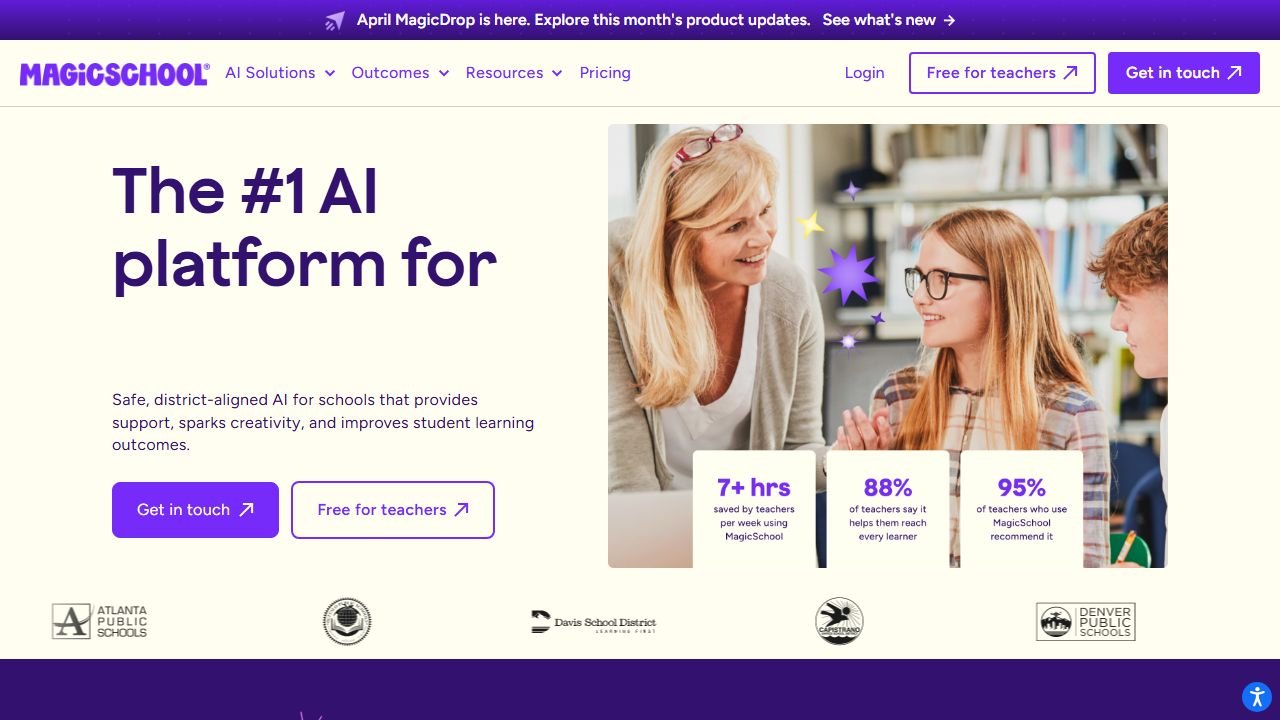
MagicSchool's 2026 trajectory is the breadth play executed well. The tool count keeps growing, the most-used tools (IEP support, parent communication, lesson planning, rubric builder) are genuinely strong, and the free tier remains a real entry point.
The strategic question for 2026-2027 procurement is whether your team is better served by one broad platform or a specialist stack. Most teams end up with both. If you have not tried MagicSchool in 6+ months, the trial is worth a calendar block this week. If you are paying for it already, the renewal math probably still works.
Sources
What to Watch Next
MagicSchool AI is positioning itself as the go-to AI suite for K-12 educators. With a rapidly expanding toolset and a strong community of teacher advocates, the platform is likely to introduce more differentiation and assessment features in the coming months. MagicSchool AI is a strong pick for any teacher exploring AI tools in 2026.
The 2026 MagicSchool feature surface area
MagicSchool AI now offers more than 80 distinct teacher tools as of mid-2026, spanning lesson planning, IEP support, parent communication, student writing feedback, classroom management, behavior reflection, grading rubrics, and more. The breadth is the differentiator: where Brisk specializes in fewer tools done deeply inside Google Docs, MagicSchool offers a buffet for teachers who want to experiment.
The honest tradeoff: tool quality varies. The most-used tools (lesson plan generator, exit ticket writer, IEP draft assistant) are mature and high-quality. Less-used tools sometimes produce generic output that needs heavy editing. Teachers using MagicSchool effectively pick 5 to 8 tools that fit their workflow and ignore the rest. Trying to use all 80 produces decision fatigue and inconsistent classroom integration.
School-wide implementation notes
Districts implementing MagicSchool AI school-wide in 2026 report best results when they treat it as a teacher-empowerment platform, not a mandate. Voluntary teacher onboarding with monthly office hours produces faster adoption than top-down rollouts. The teachers who already use ChatGPT informally are early evangelists; let them lead training. Districts who skip this step often see adoption stall at 30 to 40 percent of teachers within 6 months. Districts who follow the model see 70 to 85 percent active use by the same milestone.
Wrap-up for teachers evaluating MagicSchool
MagicSchool AI’s 2026 trajectory remains strong, with broad teacher adoption and a feature surface that grows faster than competitors. For teachers who want one platform that covers many tasks, MagicSchool is the right pick in 2026. Teachers who prefer fewer, deeper tools may still prefer Brisk for the Google Docs workflow. Both are credible 2026 picks; both have free tiers that work for individual teachers.
Districts using MagicSchool AI well in 2026
Three district adoption patterns produce the strongest outcomes. Pattern one: voluntary teacher onboarding with monthly office hours hosted by enthusiastic early adopters. Pattern two: explicit policy documents that clarify when AI use is appropriate (lesson planning, IEP drafts, grading rubrics) versus inappropriate (grading actual student work without review, generating parent communications without review). Pattern three: regular peer-sharing sessions where teachers show specific MagicSchool prompts and workflows that worked for their classroom. Districts that skip these patterns report adoption stalling at 30 to 40 percent of teachers within six months.
What “free for teachers” actually means
Almost every tool in this category leads with a free tier, and they are not equivalent. The limit is where the product design shows.
The limits that are published, and therefore checkable
Chalkie states five full lessons or activity sheets every seven days. CoGrader states 100 student submissions a month. Curipod and MagicSchool both publish free plans without a headline cap on the pricing card. Verified 4 September 2026. A published cap is much easier to plan around than an unpublished one, because you can work out in advance whether it covers a normal week for you rather than discovering it in the middle of one.
Work out your real weekly volume before choosing
Count what you actually produce in a normal week: how many worksheets, how many class sets to grade, how many lesson plans. Teachers routinely underestimate this and then hit a cap on a Sunday evening. If your week is five lesson resources, a five-per-week free tier is exactly on the line and you will exceed it in any week with a cover lesson or a new unit.
Free for you may not be free for the school
A teacher signing up personally sits outside whatever approval process the school has for student data, which matters as soon as student work goes into the tool. That is not an argument against the tool; it is an argument for telling somebody. Most districts would far rather approve a tool a teacher is already using than discover it in an incident.
The commercial logic, stated plainly
Generous teacher tiers exist because teachers are the route to a district contract, which is where the revenue is. That is a perfectly reasonable model and it has a consequence worth knowing: the free tier is likely to stay usable, because it is the marketing. What is less predictable is whether the feature you come to depend on stays on the free side of the line. Do not build a department-wide process on a free tier of magicschool ai or anything else without a fallback.
Buying at school or district level, and why teacher pilots stall
The gap between a teacher loving a tool and a district paying for it is where most education software dies, and it is a process problem rather than a product one.
Find out who actually approves before you pilot
Curriculum, IT, data protection and procurement usually all have a say, and in most districts nobody has told teachers which of them is the blocker. Ask early. A pilot that has to be re-run after the data protection review because the first one used real student work is a term lost, and it is entirely avoidable.
Price the thing you will actually deploy
Published teacher rates and district rates are different products. MagicSchool publishes Plus at $12.99 a month and quotes Enterprise with volume discounts. SchoolAI publishes tier names only. Gradescope, now on a Turnitin domain, is institution-quoted. That means a per teacher figure multiplied by staff count is a rough upper bound rather than a quote, and it is still the number worth calculating before a call, because it anchors the conversation.
Run the pilot on the thing that fails, not the thing that demos
The demo will be a well-formed lesson plan for a well-behaved topic. Your pilot should include the awkward cases: a mixed ability class, a subject with heavy notation, a student with an access arrangement, a topic where the source material is contested. How a tool handles those decides whether teachers keep using it in November.
Name who owns it after the pilot
Every tool in this category rewards an owner and punishes shared enthusiasm. Before magicschool ai or anything else goes past a pilot, name the person whose job includes it and confirm where the hours come from. If the answer is that the keen teacher will keep doing it, the tool leaves when they do.
Tools mentioned in this guide

Written by
FazFaz is the founder of AIToolsBakery. Some tools here are tested hands on. Others are assessed from vendor documentation and pricing verified on the live page, and every review says which one it is. Sponsors can buy a position in a guide. They cannot buy the score, the criticism, or silence about a better option.
How we test and how we make money →