Search for agentic sales tools for early stage startups and the results are mostly vendors grading themselves. Origami’s guide puts Origami first, and Fin’s top 10 puts Fin for Sales first. Neither explains what the agent sends without asking you, and neither says what happens to your domain if the campaign goes badly.
Those are the questions that matter when you are a founder or a first sales hire with no RevOps team. This page is about that decision: whether to buy an agent at all, what you are really committing to, and what you remain responsible for once it starts sending. If you already know you want a dedicated AI SDR and want a wider comparison, see our AI SDR tools guide. For the whole sales stack, including coaching and call recording, see our AI sales tools guide. New to the term? Start with what an AI SDR is.
How we put this together. We have not used these tools ourselves; this is a research-based comparison. We created no accounts, started no trials and booked no demos. Every price and quote below comes from the vendor’s own pricing, product or legal page, reached through its own site navigation and read on 2 November 2026, and each source is linked. The exceptions are labelled: a Vendr price estimate for 11x, and a TechCrunch report about Artisan. All prices were shown in US dollars, except HubSpot’s seat prices, which were served to us in rupees, so we do not quote them. None of these companies paid to appear on this page. Nothing here is legal advice.
When a startup should not buy an agent yet
An agent automates a message. It does not find one. The checks below are our judgement rather than sourced statistics, but each one comes from how these products are built and priced.
You have not closed deals from cold outreach yourself
Every agent here asks you for the same inputs: who to target, what you sell and why it matters to them. Instantly’s agent reads your website to work that out, and Artisan and 11x let you coach or supply positioning. If you cannot yet write the email that gets a reply, the agent will send a confident version of your best guess to far more people than you could reach by hand. Send the first few hundred yourself, read every reply, and only then write down what worked.
Your list is small
Volume is the hidden cost for a startup with a narrow market. Artisan’s Intern plan is sized at about 500 leads contacted a month, and its Employee plan at about 1,250. At the lower figure, a market of 3,000 reachable buyers has heard from you within six months. You rarely get a clean second first impression, so if your market is small, a slower human process protects the list you have.
You cannot read what comes back
Early replies are the cheapest customer research you will get. Objections tell you about pricing, positioning and who the real buyer is. When 11x says of its replies that “Nothing sits in an inbox waiting for a human”, that is a benefit for a team with a proven script and a loss for a founder still learning why people say no.
Inbound is your real problem
If people already fill in your form and you are slow to answer, an outbound agent is the wrong purchase. Fix that first, even with a simple alert to your phone. The section on inbound and outbound below covers where agents fit.
Autopilot on the sales page, you as the sender in the terms
This is the gap nobody in the search results covers. The marketing and the contract describe different products.
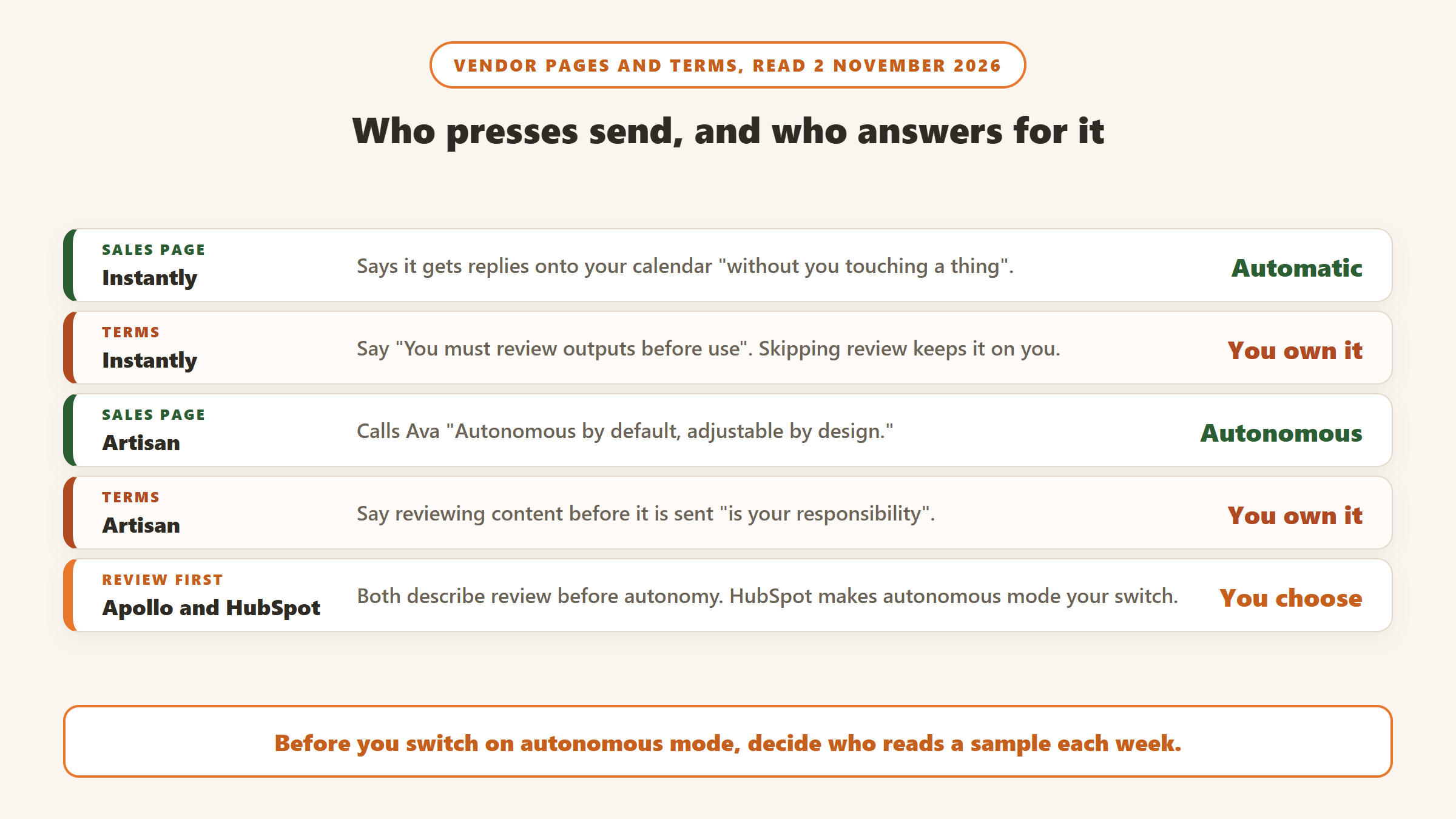
Instantly’s AI Sales Agent page says it “handles every follow-up sequence and gets replies onto your calendar, automatically, without you touching a thing.” Its AI Agent Terms, last updated 5 August 2026, say: “You must review outputs before use.” You may switch on autonomous sending, but “you are deemed to have reviewed and approved the resulting messages and campaigns”. The next sentence reads: “Your election not to review any message or campaign does not transfer any responsibility or liability to Instantly.” The same terms name you as the sender of every message, and ask you to defend and indemnify Instantly against claims from your campaigns.
Artisan works the same way. Its pricing page calls Ava “Autonomous by default, adjustable by design.” Its terms say “It is your responsibility to review and approve the content generated by Artisan agents before it is sent to any recipient, where technically feasible”, and that Artisan “does not authorize, direct, or initiate any outbound communication on Customer’s behalf.” Ava also sends in your reps’ names, from your own sending domains, so a mistake carries your name.
We do not read that as a scandal. Software vendors allocate risk this way, and a tool provider cannot check your list. The practical point: “autonomous” tells you who presses send, and you still answer for what goes out. Before you switch on any autonomous mode, assume you own every message, and decide who at your company reads a sample each week.
Which tools ask first
The approval defaults differ, and the difference matters more than any feature list:
- The vendor describes review first: Apollo says “Stay in control at every step and approve the actions that count”, with “Autonomy levels that expand as your confidence builds”. HubSpot offers review and edit when you enrol contacts, and says that once you are comfortable “you can switch to fully autonomous mode, which sends emails without requiring review first.” lemlist’s lemAgent says “You review it, you send it.”
- The vendor describes autonomy first: Artisan describes itself that way, with approval available as a setting. On its startup plans, “Full self-driving Ava” is marked “Soon” on the Employee plan, while “Autonomous campaigns and replies” are already listed on Intern. 11x describes replies being handled with no human step.
- You choose when you set it up: Instantly lets you configure either, with the terms above. AiSDR says its agent, Ami, “builds your campaign, runs it, and sharpens it as replies come in”; the clearest approval promise on its pricing page, “You review and approve before anything sends”, is attached to the $149 per campaign managed service. Ask how approval works on the self-serve plan.
The real minimums
Headline prices hide the commitment. The table shows the least you can spend to try each tool’s agent features, and what a full year costs if you take the annual discount. Annual figures are our multiplication of the listed monthly rate.
| Tool and plan | Try it for a month | Year, on annual billing | What to check |
|---|---|---|---|
| Apollo Basic | $65 per seat | $588 per seat | Unused credits expire each cycle |
| Instantly Starter bundle | $94 | $1,020 | All fees non-refundable; 21-day wait to rejoin the same monthly plan |
| Unify Base | $20 per seat | Monthly billing below Business | Warmup is Business only |
| HubSpot Prospecting Agent | $1 per recommended lead, plus a Starter seat or above | Seat price varies by region | Autonomous mode is your switch |
| Attio Pro | $99 per user | $948 per user | Sequences start on Pro |
| AiSDR pay as you go | $1.50 per person, no monthly fee | Not applicable; Team plans use quarterly contracts | Customer data used for machine learning unless you opt out |
| Clay Launch | $185 | $2,004 | Two meters; actions do not roll over |
| Artisan Intern | $280, plus mailboxes | $3,000, credits upfront | Unused annual credits are lost at term end |
| Artisan Employee | $660, plus mailboxes | $7,200, credits upfront | Same |
| Amplemarket Startup | Not offered; “annual term” | $7,200 for 2 users | The plan is named for startups but has no monthly option listed |
| 11x | Not published | Vendr shows a median of $65,100 | Non-cancelable terms; credits non-refundable |
Two units are worth comparing directly. Artisan’s Intern at $280 for about 500 leads contacted works out at roughly 56 cents a lead, before mailboxes, which it bills separately. AiSDR charges $1.50 per person prospected and says research, lists and writing cost nothing extra. Those are vendor estimates on different definitions, so treat them as a starting question for each vendor rather than a like for like result.
Startup discounts change the sums
Several vendors run programmes that the comparison pages rarely mention, and they can matter more than the list price:
- HubSpot for Startups advertises 90% off the first year for seed and Series A founders.
- Attio offers 80% off the annual Pro plan and credits in year one and 30% off in year two. You must be VC-backed, have signed up within the last 90 days and be incorporated less than 10 years ago, and it covers workspaces of up to 10 seats.
- Apollo for Startups offers 50% off Basic or Professional for one year, up to 5 seats, if you have fewer than 20 employees, no existing subscription and an affiliation with one of its partners.
- Clay runs Wedge, a two-week programme where venture-backed startups at Series A and below can earn credits, and a partner programme through VC firms.
Ask your investor or accelerator which partner lists they sit on. Notice the catch: most of these require venture backing or a partner, and they expire. Check the year two price before you build on it.
Agentic sales tools for startups compared
| Tool | Best fit | What the AI does | Entry price (2 November 2026) | Default on sending |
|---|---|---|---|---|
| Apollo | Founder doing outbound with a data need | AI Assistant, AI Research, agents with tiered autonomy | Free; Basic $65 monthly or $49 annual per seat | Approve first, more autonomy later |
| Instantly | Founder wanting one cheap bundle | AI Sales Agent finds, writes, follows up, books | $94 monthly, $85 yearly bundle | Your setting; you carry the risk |
| Unify | First rep paying per seat | Agents build and qualify lists, AI copy | Free; $20 and $60 per seat monthly | Review stressed; no autonomous claim found |
| HubSpot Prospecting Agent | Team already on HubSpot | Watches signals, researches, drafts | $1 per recommended lead plus seat | Review option; autonomous switch |
| Attio | VC-backed team choosing a CRM | CRM agents, Ask Attio, web research | Free; Plus $44 or $35; Pro $99 or $79 per user | Examples draft; no autonomous claim found |
| AiSDR | Testing an agent with no commitment | Ami builds and runs campaigns, handles replies | $1.50 per person prospected | Runs it; ask about approval |
| Clay | Technical founder who builds workflows | Claygent research, waterfall enrichment | Free; Launch $185 or $167 | You build what sends |
| Artisan | Proven message, ready to scale | Ava finds leads, writes, replies, books | Free without campaigns; Intern $280 or $250 | Autonomous, approval optional |
| 11x | Later stage, with budget | Alice outbound, Julian inbound voice and chat | Quote only | Replies handled automatically |
The nine tools, from least to most commitment
We ordered these by how little a founder with no RevOps has to commit before finding out whether it works. That is an editorial order, not a quality score, and we give no scores because we have not run these products.
1. Apollo: start here if you also need the data
Apollo combines a contact database, listed at 240M contacts and 30M companies, with sequencing and an AI layer it calls the GTM Harness. It says “agents start with guided recommendations and can execute more independently as your confidence builds”, which is the order a startup should want.
The pricing page lists Free at $0 with 900 credits per seat per year, two sequences and a five chat limit on the AI Assistant, with Gmail as the only mailbox option on free plans. Basic is $65 per seat monthly or $49 billed annually, and it lists unlimited sequences, a deliverability suite and email warmup. Professional, $99 or $79, adds AI Lead Scoring and call recording insights. Organization at $149 or $119 is annual only with a three seat minimum.
Read the credit rules. Unused credits expire at the end of each cycle, and that includes add-ons, which also “renew automatically each billing cycle until removed.” Mid-cycle downgrades on annual plans are not permitted. Choose it if you need contacts and sending in one place and want to stay in the loop. Skip it if you want an agent running by itself from day one.
2. Instantly: a flat monthly bundle with sharp terms
Instantly sells email sending and warmup with agents on top. The pricing page lists a Starter bundle at $94 monthly or $85 yearly, with 5,000 emails, 1,000 uploaded contacts, 1,500 credits and the AI Sales Agent. Scale, at $194 or $175, raises that to 100,000 emails and 25,000 contacts. If you do not want the agent, the outreach plan alone starts at $47 or $37.60 with unlimited email accounts and warmup.
One thing to confirm: the bundle page lists “AI Reply Agent, Unibox replies” under Scale, while the agent page talks about getting replies onto your calendar. Check which plan handles replies before you budget on Starter.
Setup is advertised as 30 seconds from a URL, with “No forms, no configuration, no onboarding calls.” That speed is exactly the risk for a young company, because the agent is working from what your website says. The general terms state “ALL FEES PAID UNDER THIS AGREEMENT ARE NON-REFUNDABLE AND NON-CANCELLABLE”, and you may not rejoin the same paid monthly plan within 21 days. Choose it if you want one flat monthly price with an agent included and you will read the output. Skip it if you hoped autopilot meant someone else was responsible.
3. Unify: per seat, with a hard spending cap
Unify works through a chat prompt. Its agents page says “Describe your ideal buyer in plain English and Unify gets to work. Our agents find accounts, pull contacts, research fit, and qualify lists.” The same page says “Spend your time reviewing, not writing”, and we found no claim of a fully autonomous sending mode on the pages we read, which is not the same as none existing.
The pricing page is friendly to a first hire: Free for up to three seats with limited credits, Base at $20 per seat with 800 credits, and Pro at $60 with 2,400 credits, a 14-day trial with no card, and read-only HubSpot and Salesforce sync. It also states a hard cap: when credits run out, “credit-consuming actions pause rather than charge.” That is a useful protection when nobody is watching spend.
The trap is in the comparison table. Mailbox warmup and rotation, bounce prevention, deliverability analytics and managed mailboxes are all marked for Business only, which is custom and billed annually. So on Free, Base and Pro you handle mailbox health elsewhere. Choose it if you are one or two reps who want cheap research and copy. Skip it if you need one tool to look after your sending reputation at a low price.
4. HubSpot Prospecting Agent: sensible if you already run HubSpot
HubSpot’s Prospecting Agent “researches accounts, finds the right contacts, and drafts personalized outreach.” It is available on Starter, Professional and Enterprise, runs on HubSpot Credits, and connects to third-party contact providers including ZoomInfo and Apollo. The Sales Hub pricing page lists the agent and 500 credits on Starter; the seat price was served to us in rupees, so check your own region.
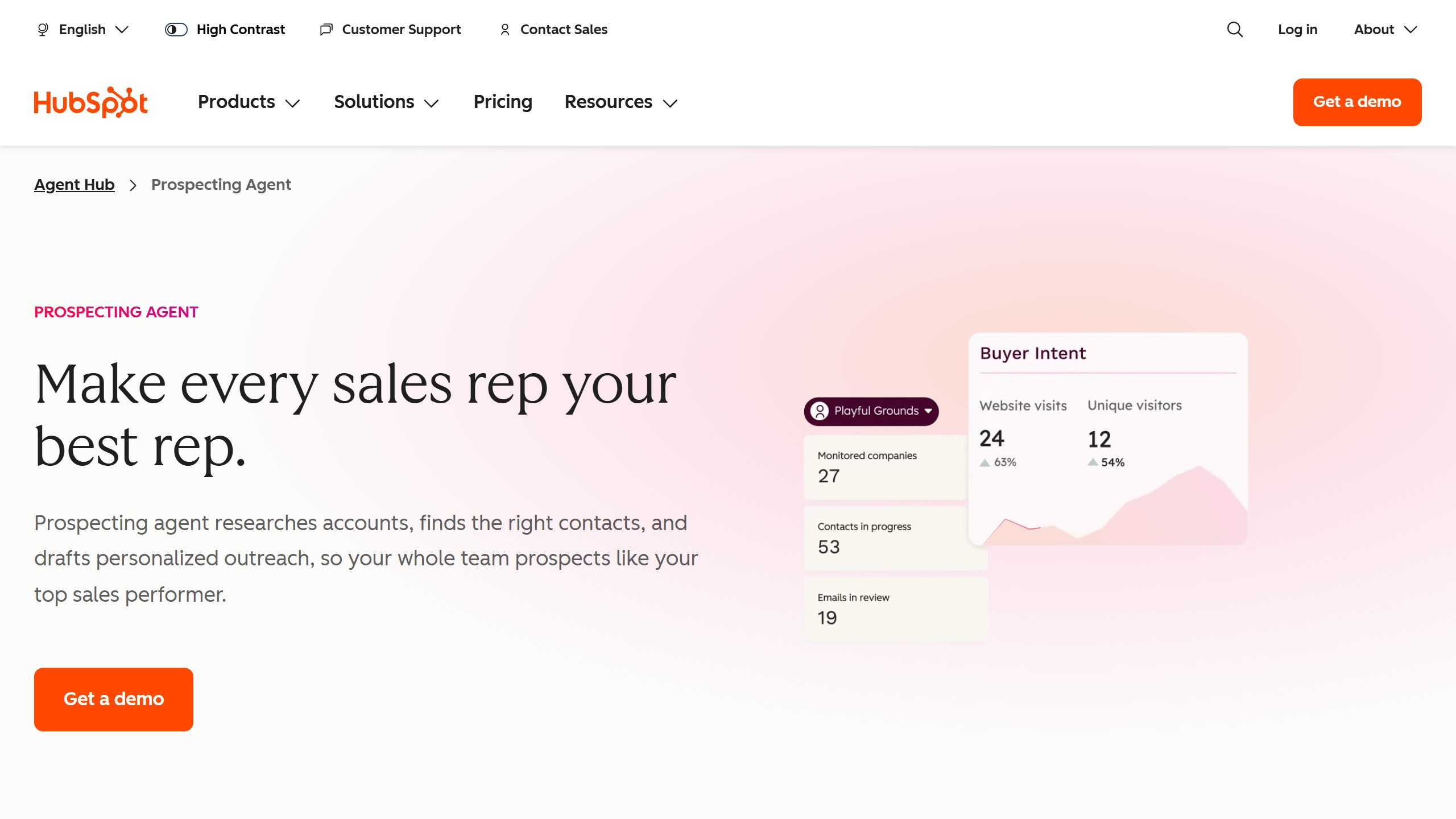
Read the price carefully. The product page says “You pay $1 for each lead prospecting agent recommends outreach for.” The startups page shortens this to “$1 per qualified lead” and says you pay when agents deliver. A recommendation is not a meeting, so model it as $1 per lead the agent acts on, not per result you can bank. Choose it if HubSpot is already your CRM, especially with the startup discount. Skip it if you would be adopting HubSpot just to get the agent.
5. Attio: the CRM first, agents second
Attio calls itself an agentic CRM, meaning AI “that researches and enriches records, surfaces signals, automates outreach”. Its custom agents are written in plain language and its examples end in a draft, such as an agent that “Reads the usage, decides if it’s an upsell, drafts the note.” For a seed team this is a different purchase: a system of record you need anyway, with agents added, rather than an outbound machine.
The pricing page lists Free at $0 for up to three seats and 200 emails a month, Plus at $44 or $35 with 1,000 emails, and Pro at $99 or $79 with unlimited email. Its comparison table marks AI agents on every plan, but sequences begin at Pro, and the credits that power agents and workflows grow sharply by plan: 250 workspace credits on Free, 1,500 on Plus and 10,000 on Pro. Choose it if you do not yet have a CRM and qualify for the startup programme. Skip it if you need volume outbound now.
6. AiSDR: a pay as you go way to test a full agent
AiSDR now leads with usage pricing. Its pricing page offers pay as you go: $1.50 per person prospected, charged daily, “Stop anytime”, with no monthly fee, and you can build a campaign before paying. That includes lists, research and writing, multichannel sequences and “AI reply classification and handling”. A warmed-up mailbox is listed at $33. So a test on 200 people costs $300 plus mailboxes, and you can then stop.
Above 1,000 people a month it points you to Team plans, which are “billed monthly with quarterly contracts”, a line the same page follows with “Cancel anytime”, so get that clarified in writing. There is also a done-for-you service at $149 per campaign or $2,500 a month.
The term to read is on data. The terms say “We may use Customer Data for machine learning to support and develop features and functionality within the Service and similar products and services”, and that you may opt out by email. Compare that with 11x below, whose terms rule out training on customer data, and Artisan, whose data agreement and terms limit it to the model serving you, apart from anonymised or aggregated data. Choose it if you have a proven message and want to test an agent for a few hundred dollars. Skip it if you want your data kept out of model training by default.
7. Clay: powerful, but you are the RevOps team
Clay sells access to more than 150 data partners and a research agent called Claygent, and it is at heart a workflow builder. Its own startups page suggests you “Consider hiring a Clay Expert to implement Clay at your startup”, which tells you the likely effort.
The pricing page lists Free with 500 actions, 100 data credits and 200 rows per table, including Claygent and Clay Sequencer. Launch is $185 monthly or $167 on annual billing; Growth is $495 or $446. Each plan is two meters: actions, which reset every cycle, and data credits, which can roll over up to twice your monthly amount. Token-heavy AI models are billed on actual usage, so a research-heavy prompt can cost noticeably more. Choose it if someone on your team enjoys building systems and your edge is unusual targeting. Skip it if nobody will own it. See our cold email tools guide for the sending layer you would pair with it.
8. Artisan: real public prices, on a tab most people miss
Artisan’s pricing page has two tabs. “Businesses & Enterprises” shows plans with “Pricing scoped on your plan”, so anyone reading that tab alone would conclude there is no public price. “Startups” shows real prices: Free with 300 credits and no campaigns, Intern at $280 monthly or $250 billed annually for about 500 leads a month, and Employee at $660 or $600 for about 1,250. A trial gives 10K credits for 30 days with no card.
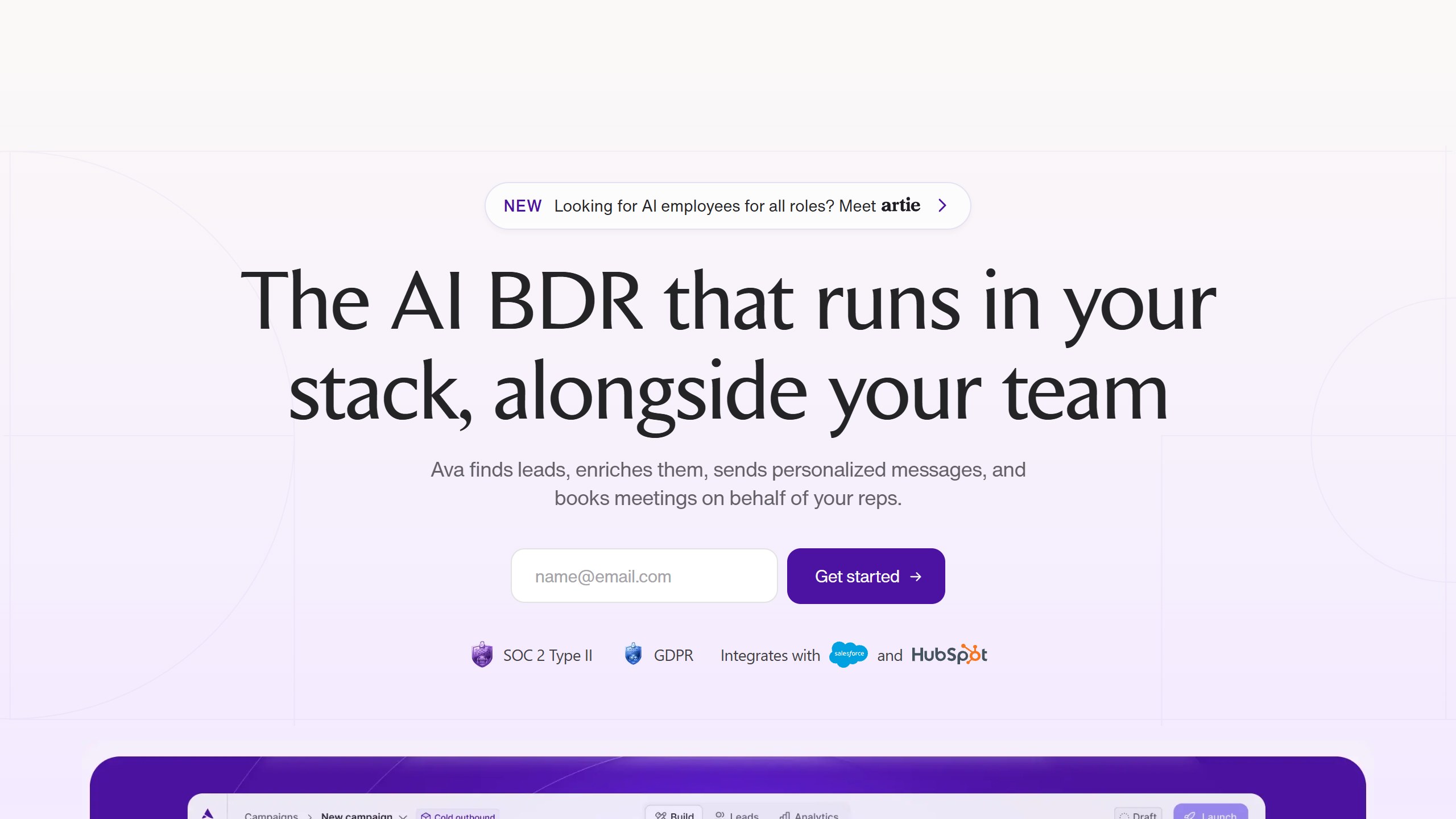
A typical end-to-end campaign uses around 20 credits per person. Mailboxes and phone numbers are billed separately in dollars, and the dialer is an extra $75 or $67 per seat. Annual plans take the credits upfront, and “any unused credits at the end of your term do not roll over.” The terms say purchases are “non-refundable and non-cancellable for convenience”, and renew unless you give 30 days’ notice.
One event to know about: TechCrunch reported on 7 January 2026 that LinkedIn had banned Artisan’s company page and profiles, and that it was being reinstated after about two weeks of work with LinkedIn. Its CEO said the issue was use of LinkedIn’s name and data brokers alleged to have scraped the site, not agents spamming people. LinkedIn had not commented at the time. Choose it if you have a proven message and a large market and want email and replies handled. Start monthly. Skip it if you are still working out who buys.
9. 11x: built for a later stage
11x runs Alice for outbound and Julian for inbound, across voice, chat, email, SMS and WhatsApp. It addresses “frontier revenue teams” and has no pricing link in its site navigation or footer, so it is quote only behind a demo. Vendr, which brokers software contracts, shows a median contract of $65,100 a year within a range of $38,250 to $83,100, with annual or quarterly payment. That is third-party data with no sample size shown, on a page still titled 2025.
Its Smart Replies page says an agent reads each reply and “Handles objections without escalating”. The terms make payment obligations “non-cancelable” and credit purchases non-refundable, with the term set in your order form, so read that document before signing. On data, the terms are clear: “11x shall not use any Customer Data to train any artificial intelligence or machine learning models.” Choose it if you are past Series A with a sales team, real inbound volume and legal review available. Skip it if you are a seed founder; that spend is a salary.
Outbound agents and inbound agents are different purchases
Most of the search results mix these together. An outbound agent contacts people who did not ask to hear from you, so its risks are reputation and law. An inbound agent answers people who raised their hand, so its risks are wrong answers and a bad first impression.
For a startup, inbound agents are safer but often premature: if you get ten demo requests a week, answer them yourself, because each one is a learning conversation. As volume grows, HubSpot has a Customer Agent on the service side and 11x says its voice and chat agents can “Respond in under 60 seconds”. Attio’s workflows can route and draft in your CRM.
Voice needs extra care. Instantly’s terms for its AI Voice Agent state: “Cold calling, and calling any number obtained from a purchased, rented, scraped, or third-party-enriched list, is prohibited.” 11x’s menu lists “Consented Outbound Calling”. Take AI cold calling to a lawyer before you switch it on.
Domain, deliverability and the rules that apply to you
The damage from a bad campaign lands on your company’s domain, and for a startup that is also where customers and investors email you. Three primary sources are worth reading before anything sends:
- Google. Gmail’s sender guidelines tell senders to “Keep spam rates reported in Postmaster Tools below 0.3%”, and warn that “Over time, user spam reports can lower your domain’s reputation.” Above 5,000 messages a day to Gmail accounts, DMARC is required and marketing mail must support one-click unsubscribe.
- The FTC. Its CAN-SPAM guide says “The law makes no exception for business-to-business email”, requires a valid physical postal address and honouring opt-outs within 10 business days, and says each violating email can carry penalties of up to $53,088. Other countries have their own rules, and some are stricter about cold email. Instantly’s terms name GDPR, UK GDPR, PECR and CASL among the laws you must check yourself.
- LinkedIn. Some sequencers list LinkedIn steps, including AiSDR and lemlist. LinkedIn’s help page says it does not permit third-party software that can “automate activity on LinkedIn’s website”, and that members using such tools “risk having their accounts restricted or shut down.” If the account is yours, the risk is yours.
What we left out, and why
lemlist ($69 monthly or $55 yearly for email; Multichannel $109 or $87 per user) is a sequencer whose lemAgent hands the campaign back to you for approval, and we cover it on the cold email guide. Smartlead ($39 monthly or $32 yearly) is a sender rather than an agent. Amplemarket has a plan actually named Startup, at $600 a month on an annual term with two users, and says of its Duo Copilot that “Reps stay in control at every step”; but $7,200 over the term is a lot to commit before proof. Origami ($99, $199 and $399 a month, with a 7-day trial that requires a card) ranks well through its own guide, but that guide still mentioned a $29 price and a free plan that its pricing page did not show on 2 November 2026. Fin for Sales, Qualified, Chili Piper and Salesforce Agentforce lean towards inbound or larger teams, so they do not fit a reader with no RevOps. Reply.io, Salesforge and Warmly are covered in our AI SDR guide.
How to choose an agentic sales tool for your startup
Pre-seed or seed, no repeatable sale yet
Buy no agent. Use Apollo Free or Basic, send by hand or with light sequencing, keep every reply and write the playbook. Attio Free or a discounted HubSpot gives you somewhere to record it.
Seed, some wins from cold outreach
Run a capped test. AiSDR’s pay as you go, Instantly’s Starter bundle or Unify’s Base all let you try this within a month or a small budget. Start on a separate domain with a small slice of your list, read every message for the first two weeks, and compare the results with what you achieved by hand.
Series A, first sales hire
Give the agent to the rep rather than replacing them. Apollo with tiered autonomy, HubSpot’s agent if you already use HubSpot, or Artisan on a monthly plan fit here. Make the rep the named owner of the output and the domain health.
Ask these questions before you sign
- What can it send without approval, and is that the default?
- Is there a monthly option, and what is the notice period for non-renewal?
- Who pays for mailboxes, domains and warmup?
- What happens to unused credits, and does a top-up auto-renew?
- Is our data used to train models, and how do we opt out?
- What result at the end of the first term means we stop?
That last question is the one founders skip. Write the answer down before you start, or the renewal will decide for you.
Sources
- Apollo: pricing, Intelligence and GTM Harness, Apollo for Startups.
- Instantly: pricing, AI Sales Agent, AI Agent Terms, terms of service.
- Unify: pricing, agents. HubSpot: Prospecting Agent, Sales Hub pricing, HubSpot for Startups.
- Attio: pricing, startup programme, custom agents. AiSDR: pricing, terms.
- Clay: pricing, Clay for Startups. Artisan: pricing, terms of use, data processing agreement.
- 11x: homepage, Smart Replies, terms; Vendr 11x page for the third-party price estimate.
- Rules: Google email sender guidelines, FTC CAN-SPAM compliance guide, LinkedIn prohibited software. Reporting: TechCrunch on Artisan and LinkedIn.
- Left out: lemlist, Smartlead, Amplemarket, Origami.
- All pages read 2 November 2026.

Written by
FazFaz is the founder of AIToolsBakery. Some tools here are tested hands on. Others are assessed from vendor documentation and pricing verified on the live page, and every review says which one it is. Sponsors can buy a position in a guide. They cannot buy the score, the criticism, or silence about a better option.
How we test and how we make money →