Pick the wrong B2B data platform and you either overpay by five figures for accuracy you will never use, or you save money and watch your reps burn hours on bounced emails and dead phone numbers. Apollo and ZoomInfo sit at opposite ends of that trade-off. One is a self-serve, all-in-one prospecting platform you can start using this afternoon for the price of a couple of lunches. The other is an enterprise data engine with deeper coverage, better phone accuracy, and a sales-led contract that starts in the tens of thousands.
The verdict in 30 seconds: Pick Apollo if you are an SMB, startup, or lean revenue team that wants database, sequencing, and dialer in one cheap tool you can buy without a procurement cycle. Pick ZoomInfo if you are an enterprise that lives or dies on phone accuracy, intent data, and ABM signal, and you have the budget to match. For most readers on a budget, Apollo wins on price-performance.
This is not really a “which tool is better” question. It is a “which problem are you solving” question. Apollo is trying to be the one platform a small team needs to find, enrich, and email prospects without buying three separate products. ZoomInfo is trying to be the most accurate, most complete B2B dataset on the market, and it charges accordingly. The right answer depends almost entirely on your team size, your budget, and whether your reps cold-call or cold-email.
Below we break down the data quality, coverage, pricing, and ease of use of both platforms, with a head-to-head benchmark table, so you can match the tool to your actual motion instead of the marketing.
Quick answer: Apollo is the better value all-in-one for startups and SMBs, bundling database, sequencing, and dialer cheaply. ZoomInfo wins for enterprises that need the deepest, most accurate data and intent signals and can pay for it. Pick Apollo for budget and breadth, ZoomInfo for depth.
At a glance
| Dimension | Apollo | ZoomInfo |
|---|---|---|
| Best for | SMB, startups, all-in-one teams | Enterprise, ABM, phone-heavy teams |
| Pricing model | Self-serve, monthly or annual | Sales-led, annual contract |
| Entry price | ~$49 to $119/user/mo | ~$15,000/yr floor |
| Built-in sequencing | Yes | Yes (add-on tier) |
| Built-in dialer | Yes | Yes (add-on) |
| Email bounce rate | ~13.3% | ~15.3% |
| Mobile match rate | ~41% | ~67% |
| Direct-dial accuracy | ~43% | ~61% |
| Intent and ABM data | Basic | Deep |
| Free tier | Yes | No |
Data quality and accuracy
This is the category buyers care about most, and the benchmarks tell a more nuanced story than the price tags suggest. ZoomInfo wins on phone data by a wide margin, while Apollo holds its own on email and even edges ahead on downstream reply rate.
| Benchmark | Apollo | ZoomInfo |
|---|---|---|
| Email bounce rate | ~13.3% | ~15.3% |
| Mobile match rate | ~41% | ~67% |
| Direct-dial accuracy | ~43% | ~61% |
| Reply rate | ~5.1% | ~4.7% |
The pattern is clear. On email, Apollo is roughly comparable to ZoomInfo and actually posts a slightly lower bounce rate, which means fewer wasted sends and a healthier sender reputation. On phone data, ZoomInfo is in a different league: it matched mobile numbers at around 67 percent versus Apollo’s 41 percent, and its direct-dial accuracy of about 61 percent towers over Apollo’s 43 percent. If your reps spend their day dialing, that gap is the whole ballgame.
The reply-rate figure is the interesting wrinkle. Apollo’s reply rate of about 5.1 percent slightly beats ZoomInfo’s 4.7 percent. Reply rate depends on more than raw data accuracy, sequencing, copy, and timing all matter, but it suggests that for email-led teams, Apollo’s data is good enough to drive results that hold up against the premium product. The cheaper tool is not the obviously worse tool here. For more on why accuracy varies so much between providers, see our best AI lead enrichment tools guide.
It is worth being honest about what these numbers do and do not capture. Bounce rate and reply rate are downstream of email data, so they reward Apollo’s strengths. Mobile match and direct dial are pure phone metrics, so they reward ZoomInfo’s. A team that runs a balanced motion of calls and emails will feel both sides of this split. The practical takeaway is to weight the benchmark that matches your dominant channel: if 80 percent of your touches are emails, the email numbers should drive your decision, and if your reps live on the dialer, the phone numbers should. Buyers who average all four metrics into one “accuracy score” end up choosing the wrong tool for their actual workflow.
Coverage and database depth
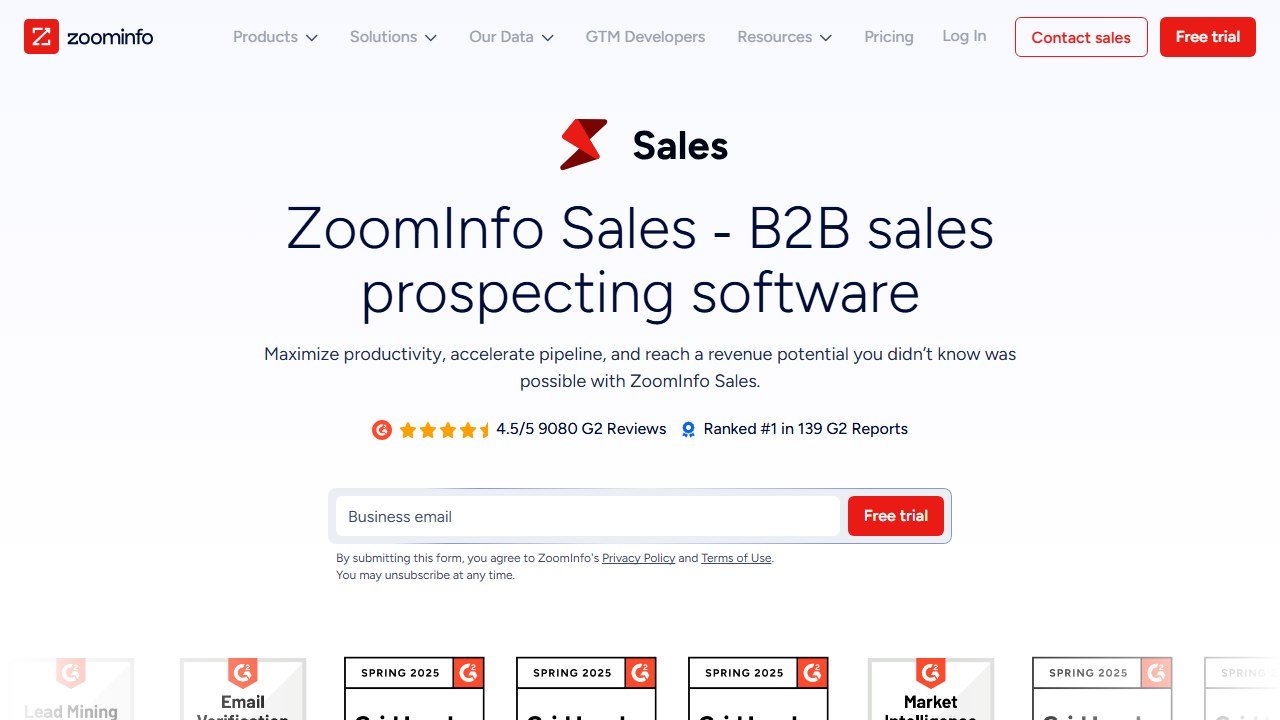
ZoomInfo’s reputation rests on depth. Its database is enormous, its company profiles are richer, and it layers in firmographics, technographics, org charts, and scoops (real-time company events) that Apollo simply does not match at the same fidelity. For enterprise sellers building account plans across large, complex organizations, that depth is the product.
Apollo’s database is large too, well over 200 million contacts by its own count, and for the vast majority of SMB and mid-market prospecting it is more than enough. Where Apollo pulls ahead is that the database is wired directly into sequencing and dialing, so you go from “found the contact” to “emailed the contact” without exporting a CSV. ZoomInfo can do this too, but often through add-on modules that inflate the contract.
Intent data is the other coverage axis. ZoomInfo’s intent and ABM signals are deep and a core reason enterprises pay the premium. Apollo offers intent data, but it is more basic. If buying-signal-driven outbound is central to your strategy, that is a point for ZoomInfo. If you are still building a repeatable outbound motion, Apollo’s coverage is plenty.
One thing buyers underestimate is data freshness versus data volume. A huge database is only useful if the contacts in it still hold the roles the records claim. ZoomInfo invests heavily in refresh cycles and real-time scoops, which is part of what the premium buys, and it shows up as fewer “this person left two years ago” surprises in enterprise account lists. Apollo’s database is large and regularly updated, but at the SMB and mid-market segments most readers prospect, the decay you encounter is rarely the dealbreaker that it can become at the very top of the enterprise. Match the freshness you pay for to the seniority and stability of the titles you sell to.
The asymmetry to keep in mind: Apollo publishes every tier and both billing cycles, and ZoomInfo publishes no figures at all, only package names with a Get Pricing button on each. Any number you have seen for ZoomInfo came from somewhere other than ZoomInfo. Apollo’s current list is in Apollo.io pricing, and where both sit across the category is in AI sales tool pricing compared.
Pricing
This is where the two products stop being comparable. Apollo is self-serve and transparent: a free tier to start, then paid plans roughly in the $49 to $119 per user per month range depending on tier and billing. You can sign up with a credit card, onboard your team, and be sending sequences the same day. No sales call required.
| Pricing factor | Apollo | ZoomInfo |
|---|---|---|
| Starting cost | ~$49 to $119/user/mo | ~$15,000/yr floor |
| Billing | Monthly or annual | Annual only |
| Buying process | Self-serve | Sales-led |
| Add-on stacking | Minimal | Common (intent, dialer, enrich) |
| Free tier | Yes | No |
ZoomInfo is sales-led and annual, with a practical floor around $15,000 per year and real costs that climb fast once you add intent, the dialer, enrichment credits, and seats. Pricing is opaque, negotiated, and bundled, which means two companies can pay wildly different amounts for similar configurations. The total cost of ownership is almost always multiples of Apollo’s. For a budget-conscious team, this single line item often decides the whole comparison. Cognism is worth a look as a third option if ZoomInfo’s price is the sticking point but you still need phone accuracy.
Ease of use and setup
Apollo wins on time-to-value. Because it is self-serve and combines database, sequencer, and dialer in one interface, a new user can find prospects, build a sequence, and start sending in well under an hour. There is a learning curve to the more advanced features, but the basics are genuinely fast.
ZoomInfo is more powerful and correspondingly heavier. Implementation typically involves onboarding, CRM integration, and admin configuration, and full value often requires connecting the add-on modules you paid for. For a large org with a RevOps team, that overhead is normal and worth it. For a five-person startup, it is friction that Apollo avoids entirely. Our full Apollo review and ZoomInfo review go deeper on each platform’s workflow.
Where each tool wins
Apollo wins on price, speed, and all-in-one simplicity. You get a credible database plus the tools to act on it in one cheap subscription, with no procurement cycle. For SMBs, startups, and lean teams, the price-performance is hard to beat, and the email and reply-rate numbers prove the data is good enough to drive real pipeline.
ZoomInfo wins on phone accuracy, database depth, and intent. If your reps cold-call, the mobile match and direct-dial gaps are decisive. If you run ABM and need intent signal to prioritize accounts, ZoomInfo’s data is the deepest in the category. The premium is real, but so is what you get for it.
Who should pick Apollo
Pick Apollo if you are an SMB, startup, or lean revenue team that wants one affordable tool covering data, sequencing, and dialing. Pick it if your motion is email-led, where Apollo’s data is competitive and its reply rate actually edges ahead. Pick it if you want to buy without a sales call and start the same day. And pick it if budget is a hard constraint, because nothing else in this comparison gets you this much capability for this little money. If you are weighing Apollo against a data-enrichment specialist, our Clay vs Apollo comparison is the next read.
Who should pick ZoomInfo
Pick ZoomInfo if you are an enterprise or scaling mid-market team whose reps cold-call heavily and need the best phone accuracy available. Pick it if intent and ABM data drive your prioritization. Pick it if you need deep firmographics, technographics, and org charts for complex account planning. And pick it if you have the budget and a RevOps function to run a sales-led, add-on-heavy platform. The price is steep, but for the right team the data depth pays for itself.
What every B2B data vendor charges, read from their own pages
Contact data is the one category where the sticker price tells you least, because the meter is credits and a credit does not mean the same thing at any two vendors. Here is each alternative to both vendors as published on 4 September 2026.
Apollo, from $49 a seat, and it publishes the allowance too
Apollo is the transparency benchmark here. Basic is $49 per seat per month billed annually and $65 billed monthly, Professional $79 and $99, Organization $119 and $149 with a three seat minimum, plus a genuine free tier. What matters more is that it publishes the allowance, 30,000 credits per seat per year on Basic, which almost nobody else does. Divide that by your real monthly reveal volume and you know whether the plan fits before you speak to anyone.
Lusha, from $37.45 a month, but the figure moves with the slider
Lusha publishes a free tier at $0 and paid plans at $37.45, $52.45 and $299.95 per month billed yearly. Read that with care: the figures are tied to a credit volume selector that defaulted to 40,800 credits a year when we read it, so the price you see is one position on a slider. Any article quoting a flat Lusha price has taken a position and presented it as the price. Always pair the figure with the credit volume it assumes.
Cognism, no figure, but it publishes the packaging
Cognism shows no price in any currency. It does publish that Standard and Pro both include five seats, which is a floor worth knowing before you ask about two, and that its credit model only spends again when a contact changes jobs. That second point is a real structural difference and it favours teams working a stable account list.
Seamless.AI, where we could not read a figure
We read seamless.ai/pricing twice on 4 September 2026 and could not extract a currency figure from its Free, Pro and Enterprise cards, even though the page itself states that “the prices shown on this page reflect this annual discount”. We are not going to claim it publishes nothing on that basis, because absence in a scrape is not absence in fact. Treat any Seamless figure you find elsewhere as unverified until the vendor confirms it.
ZoomInfo, the largest and the least forthcoming
ZoomInfo renders over 12,000 characters of pricing page with no currency figure anywhere on it. That is a deliberate commercial choice rather than an oversight, and it means your only leverage is a published alternative priced at your exact seat count. Walk in with Apollo costed for your team and you have a number in the room that both sides can check.
Clay, published, but on a credit slider
Clay publishes real figures that sit on a credit slider with a monthly and annual toggle marked “Save 10%”, so the number changes as you move the volume. Clay is also a different shape of product: it orchestrates other vendors’ data rather than owning a database, so its credits buy enrichment runs across providers. Compare it on cost per enriched record you actually use, not on headline price.
How credit pricing actually works, and the four questions that decide your bill
Credits are the reason two vendors quoting similar monthly figures can differ threefold in practice. Ask both vendors and every competitor the same four questions in writing.
What spends a credit
Revealing an email, revealing a phone number, enriching an existing record and exporting a list are often priced differently, and a mobile number frequently costs several times an email. Ask for the table. A plan advertised as 1,000 credits can be 1,000 emails or roughly 200 phone numbers, and if your team works the phone that distinction is your whole budget.
Whether a credit is spent again on the same person
This is the question almost nobody asks and it is worth the most. Some vendors charge every time you touch a record; Cognism publishes that it only spends again when a contact changes jobs. On a stable account list worked repeatedly over a year, that single difference can halve consumption. Get the answer in the contract rather than from a rep.
Whether unused credits roll over, and what overage costs
Outbound is seasonal. If credits expire monthly you will pay for capacity you cannot use in a quiet month and run out in a busy one. Ask whether allowances roll over, whether they pool across seats, and above all what a credit costs once you exceed the plan, because the overage rate is where the margin sits and it is almost never on the pricing page.
What happens to revealed data when you leave
Ask whether contacts you already revealed remain usable after the contract ends, and in what form you can export them. Some agreements treat the data as licensed rather than purchased, which means the enrichment you spent a year paying for does not come with you. That single clause is often the largest hidden switching cost in this category, and it is entirely invisible until you try to go.
The test that settles it
Give each vendor the same list of 200 accounts from your real ICP and ask them to run it during the trial. Then count three things: how many contacts were found, how many emails bounced when you actually sent, and how many credits it consumed. Coverage claims are marketing; a bounce rate on your own list is evidence.
undefined
The verdict
Apollo and ZoomInfo are not really competing for the same buyer. Apollo is the price-performance champion for SMBs and lean teams that want everything in one cheap tool, and its email and reply-rate benchmarks prove the data is good enough to win deals. ZoomInfo is the enterprise data depth play, justified when phone accuracy, intent, and coverage are mission-critical and the budget exists to match.
For most readers, especially budget-conscious SMBs and startups, the default lean is Apollo. You get a competitive database and the full prospecting stack for a fraction of ZoomInfo’s cost. Step up to ZoomInfo when your reps live on the phone or your strategy runs on intent data, and the accuracy gap on mobile and direct dials becomes worth five figures a year.
For deeper context on building your stack, see our roundup of the best AI lead enrichment tools for 2026.

Written by
FazFaz is the founder of AIToolsBakery. Some tools here are tested hands on. Others are assessed from vendor documentation and pricing verified on the live page, and every review says which one it is. Sponsors can buy a position in a guide. They cannot buy the score, the criticism, or silence about a better option.
How we test and how we make money →