
Quick Answer: JuggernautAI is an AI-powered strength training app that auto-regulates your programme based on daily readiness and bar speed data. $35/mo. Best for intermediate-to-advanced powerlifters and Olympic lifters who want periodised programming without a coach. Not a coaching platform. purely an athlete-facing training tool.
Quick comparison at a glance. Full breakdown for each option below.
JuggernautAI vs the alternatives
Last updated: April 22, 2026.
| JuggernautAI | Fitbod | Dr. Muscle | Hire a powerlifting coach | |
|---|---|---|---|---|
| Monthly cost | $34.99 | $15.99 | $49 | $200-500+/mo |
| Best for | Competitive powerlifters | General fitness / recreational | Hypertrophy / DUP | Anyone who wants fully bespoke coaching |
| Periodization | Full blocks with competition peaking | None | DUP (daily undulating) | Fully customised |
| RPE-based | Yes | No | No | Yes |
| Big three focus | Yes (exclusively) | No | No | Depends on coach |
| Community / coaching | Yes | No | No | Direct access |
| Free trial | 2 weeks | Yes | No info | n/a |
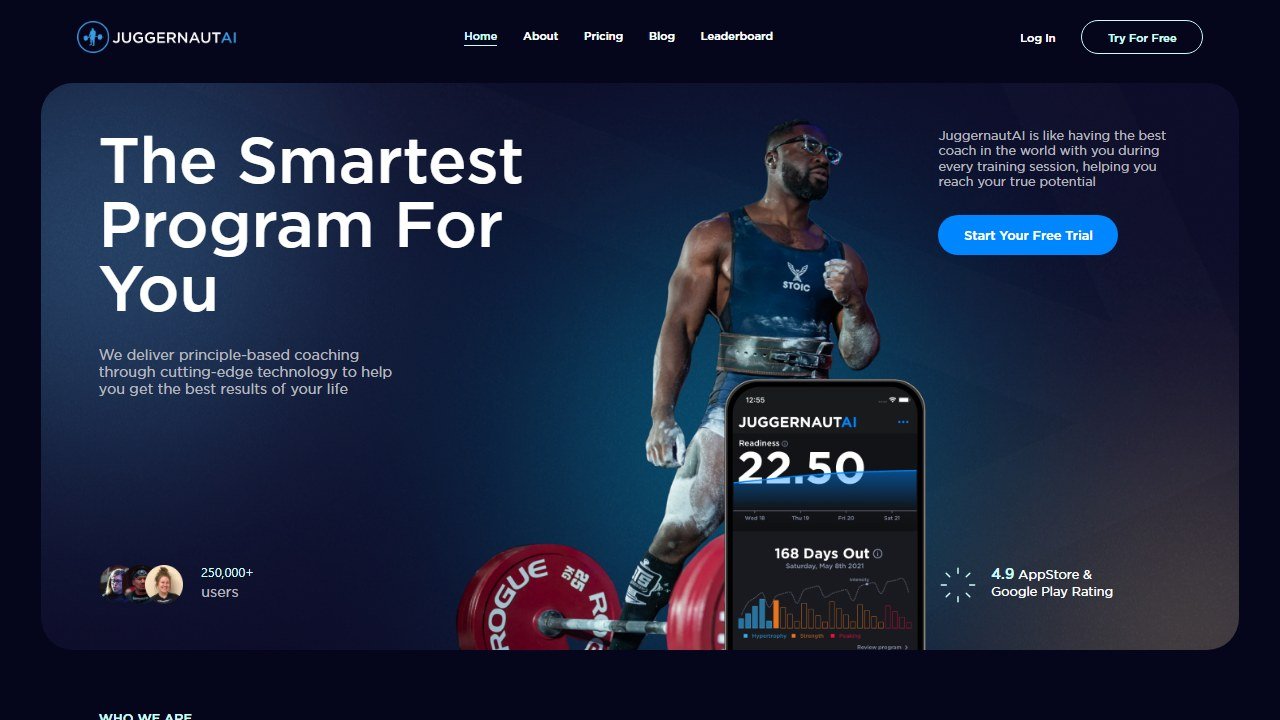
Website: JuggernautAI
Related: See also: Best AI workout apps 2026 | Fitbod vs JuggernautAI | Fitbod review
What JuggernautAI actually is
There’s a reason JuggernautAI is expensive: it was built by someone who actually knows what they’re doing.
Chad Wesley Smith is not an influencer who got into powerlifting. He held the world record in the squat, has coached multiple world champions, and spent years developing the Juggernaut Method. a periodized strength system that has produced elite-level results across thousands of athletes. The app is his methodology, coded into an AI that adjusts your training based on your feedback every session.
This matters because most AI workout apps are built by software developers who consulted a fitness influencer. JuggernautAI was built by an elite strength coach who then got developers to build what he needed. The difference shows in the programming structure.
Pricing
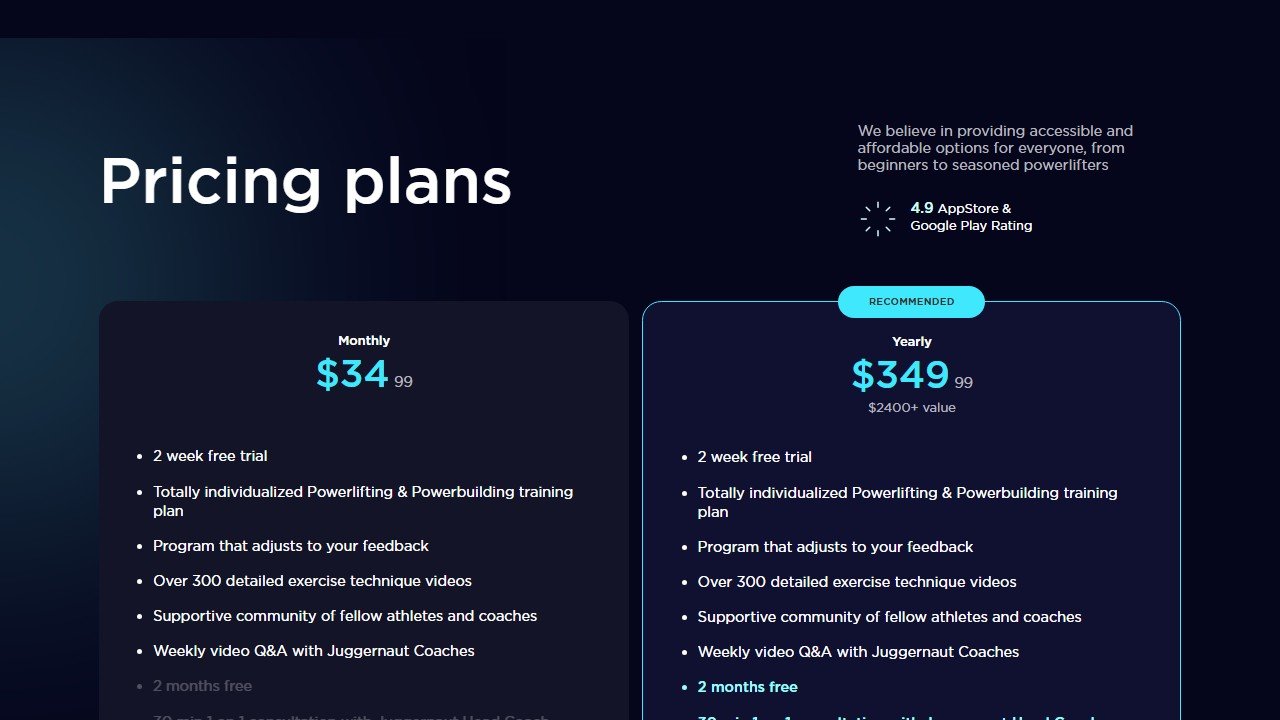
- Monthly: $34.99/mo (2-week free trial included)
- Annual: $349.99/yr (2-week free trial included)
- Note: Using a coupon code disqualifies you from the trial
The annual plan works out to $29.17/mo. about $70 cheaper over a year than monthly. At $349.99/yr, you’re paying more annually than most gym memberships.
What’s included:
- Personalized powerlifting and powerbuilding programs
- 300+ technique videos
- Community access
- Weekly video Q&As with Juggernaut coaches
- 30-minute 1-on-1 consultation with Chad Wesley Smith on the annual plan ($150 listed value)
- Three e-books: Squat, Bench, and Deadlift Manuals
The extras matter. A 30-minute consultation with a coach of Smith’s caliber would cost $150+ standalone. The weekly Q&A sessions mean you’re not just getting an app. you’re getting access to ongoing coaching education. For serious competitors, this context around the programming is genuinely valuable.
How the programming actually works
JuggernautAI uses RPE (Rate of Perceived Exertion) and RIR (Reps in Reserve) as its primary training feedback mechanism. After every set, you log how hard it felt relative to how hard it should have felt. The AI adjusts subsequent sessions. and future cycles. based on that data.
The methodology uses MRV (Maximum Recoverable Volume) to determine how much work you can absorb before recovery breaks down, then structures training blocks around building into and then peaking from that ceiling. This is how elite powerlifters actually train. Most apps ignore it entirely.
Training frequency is 2-6 days per week. You can set a competition date and the app will structure your training to peak at the right time. For competitive lifters, that feature alone is worth significant money.
The RPE system requires honesty. Users who game their RPEs. reporting sets as easier than they were to avoid harder sessions. get programming that doesn’t serve them. The app is only as good as your self-awareness and honesty when logging. This isn’t a weakness of the app; it’s just how RPE-based programming works.
What JuggernautAI does well
The programming quality is elite. The periodization structure, the way volume builds and tapers across a training cycle, and the integration of competition peaking are legitimately sophisticated. You’re not getting an app-generated random workout. you’re getting a structured coaching philosophy expressed through software.
It adapts meaningfully. Unlike apps that just swap exercises based on muscle fatigue, JuggernautAI adjusts your actual training loads, volume, and intensity across weeks based on your cumulative feedback. A bad week of sessions gets reflected in a slightly reduced next week. A week where everything moves fast gets followed by more challenge.
The community and coaching access are underrated. Weekly Q&As with actual Juggernaut coaches means you can ask questions about your programming, technique, or competition strategy and get real answers. For a $35/mo app, that’s unusual.
Technique videos are high quality. 300+ videos covering squat, bench, and deadlift variations, with real coaching cues. Not placeholder stock exercise videos. properly coached technique content from coaches who compete at the highest levels.
What frustrates users
The volume can feel excessive or unpredictable. This is the most common complaint from both powerlifters and powerbuilders. Some users report being prescribed more volume than their recovery can handle regardless of what parameters they set. The MRV model works well for lifters who’ve spent time calibrating their RPEs honestly. for lifters who haven’t done that work, the volume recommendations can overshoot.
No Apple Health or Garmin integration. For multi-sport athletes who also run, cycle, or play sports, there’s no way for JuggernautAI to account for that additional fatigue in your programming. You’re manually adjusting RPEs to compensate, which works but requires awareness.
No rack calculator, no built-in workout timer. Small things, but they get flagged repeatedly. Having to use a separate plate calculator app when you’re mid-warmup is friction that the development team has been asked about for years.
It’s narrowly focused. The app trains squat, bench, and deadlift with accessory work. If you want upper/lower splits, push/pull/legs, or any non-powerlifting structure, this isn’t your app. This is not a flaw. it’s the product design. but lifters who want more variety will find it limiting.
The powerbuilding program has volume calibration issues. The powerbuilding variant (which adds more hypertrophy work alongside strength) receives more criticism than the pure powerlifting program. Specifically, some users report that MEV (Minimum Effective Volume) for hypertrophy and strength are treated the same way in the algorithm when they shouldn’t be.
Who should use JuggernautAI
It’s the right call if:
- You compete in powerlifting or plan to. even at a local level
- You train squat, bench, and deadlift as your primary movements, 3-5 days per week
- You understand RPE and are willing to log it honestly after every set
- You’ve outgrown generic programs and want periodized coaching without paying $150/hr for a human coach
- You want to learn the Juggernaut methodology, not just follow a plan
It’s the wrong call if:
- You train primarily for aesthetics, general fitness, or athletic performance outside of powerlifting
- You want exercise variety. this program is narrow by design
- You’re a beginner who hasn’t yet learned RPE. you’ll need a few months of training with defined weights first before the feedback system helps you
- You’re on a tight budget. $35/mo is hard to justify without serious training goals
Final verdict
JuggernautAI is excellent at exactly one thing: giving competitive and serious powerlifters the best AI-coached periodized program available without hiring a human coach. It does that thing at a level no other app in the market currently matches.
The price is only defensible if you’re that person. At $35/mo, you’re paying for methodology, coaching depth, and community access. not just a workout generator. If you train squat, bench, and deadlift seriously and want to get stronger in a structured way, the investment pays off fast. If you’re after general fitness or bodybuilding, Fitbod or Dr. Muscle will serve you better for less money.
Related personal trainer & fitness AI guides
Other tools and comparisons we have reviewed in this category:
- best AI workout apps. where JuggernautAI ranks for serious lifters
- Fitbod vs JuggernautAI. why these are not actually competitors
- Dr. Muscle review. DUP hypertrophy app comparison
References & further reading
For deeper context on programming, periodization, and training science behind the tools we evaluate:
- NSCA: peer-reviewed strength and conditioning research. evidence-backed programming principles from the National Strength and Conditioning Association
- ACSM physical activity guidelines. official exercise prescription standards from the American College of Sports Medicine
- PubMed sports science database. searchable archive of peer-reviewed studies on resistance training, hypertrophy, and recovery
What JuggernautAI brings to competitive lifters in 2026
JuggernautAI is a strength training app built around competitive powerlifting and serious strength athletes. The 2026 product covers four core jobs: AI-generated programming periodized for competitive meet prep, RPE-based autoregulation that adjusts daily load and volume, technical video review with form analysis, and meet day attempt selection based on training data. The differentiator versus generic strength apps: JuggernautAI is built by Chad Wesley Smith and Max Aita, whose coaching credentials in competitive powerlifting are substantial.
The strongest use case: serious lifters preparing for competitive meets where small percentage points of programming optimization translate to real performance. The less strong use case: general fitness lifters who do not compete and would do fine with simpler apps like Fitbod or Strong.
JuggernautAI pricing and competitive positioning
JuggernautAI prices around $30 to $45 a month in 2026, with annual plans saving around 20 percent. This is at the high end of the strength app category, reflecting the specialist focus on competitive lifters. The free trial covers an introductory program period for evaluation. Most lifters who commit pay annually.
The decision framework. Pick JuggernautAI if you compete in powerlifting or strongman and want AI-augmented programming. Pick Fitbod if you train recreationally and want adaptive workout selection. Pick traditional coaches (Barbell Medicine, Stronger By Science, RP Strength) if you want human coaching with weekly check-ins. Pick free programs in Strong app if you do not want subscription costs and prefer to follow established programs.
Final 2026 verdict
JuggernautAI is the right pick for competitive strength athletes in 2026 wanting AI-assisted periodization. The credentials behind the app are real, the programming is sophisticated, and the price is fair for what serious lifters need. The case against: it is overkill for recreational lifters and the subscription cost exceeds what general fitness users would justify.
How to tell whether the tool was worth it
Fitness software is easy to evaluate honestly because the numbers are countable and small. The reason most coaches cannot say whether a platform helped is that nobody wrote down where they started.
Pick the metric the tool is supposed to move
For a coaching platform it is clients per coach and hours spent on programming and admin per client per week. For a consumer app it is sessions completed per week and adherence over eight weeks. For form checking it is whether you are still filming in month three. Each of those is countable and each needs a figure from before.
Record the time cost this month, before anything changes
Ask yourself or your coaches to log how long programming, check-ins and admin take across one normal week. It takes minutes and it is the only way the time saving is ever provable. Most of the honest value in this category is hours rather than revenue, and hours are measurable in advance and unprovable afterwards.
Give it two client cycles
Retention and adherence move slowly and seasonally. A four week read tells you about novelty rather than value. Judge a coaching platform over at least two full client cycles, and say so at the outset so an unremarkable first month is understood as expected.
Name the result that would end it
Write down before you subscribe what twelve months would have to look like for you not to renew. It converts renewal from a default into a decision, which matters more in a category where the monthly figure is small enough to stop noticing.
Where the figures on this page come from
Every price here was read from the vendor’s own pricing page on 4 September 2026 and carries that date, because pricing in this category moves and a claim without a date is not checkable.
The pages we read
PT Distinction publishes $19.90, $59.90 and $89.90 a month with its marginal per client rates. Everfit publishes a rung for every client count from $19 to $290 monthly. TrueCoach publishes $26.34, $57.99 and $136.99 a month billed annually. My PT Hub publishes $25 and $59. FitBudd publishes $15, $79 and $149 with per client add-ons. Trainerize publishes a free tier and plans from $9. JuggernautAI publishes $34.99 a month or $349.99 a year.
The ones we could not read
Fitbod, Dr. Muscle, Hevy, Whoop and Oura did not yield a figure to the same method that read every vendor above, largely because consumer subscriptions are sold inside the app stores rather than on the web. That is not evidence they publish nothing, and we do not present it as such. Check the store listing on your own device, in your own country, before relying on any figure for those five.
One page worth reading twice
Wodify displayed $199 struck through and $99 a month per location, conditional on booking a demo by 31 August. We read it on 4 September 2026, after that deadline, and the discounted price was still shown. Ask which figure actually applies before budgeting on it.
What coaching platforms actually charge, vendor by vendor
Personal training software is metered on active clients almost everywhere, which makes it one of the few categories where you can calculate your exact bill from the pricing page. Here is each alternative to juggernautai review, read at source on 4 September 2026.
PT Distinction, the clearest per client arithmetic in the category
PT Distinction publishes Basic at $19.90 a month including 3 clients, Pro at $59.90 including 25, and Master at $89.90 including 50. Crucially it also publishes the marginal rate: extra clients cost $6.00 a month on Basic, $2.40 on Pro and $1.60 on Master. That means you can work out your own crossover exactly. At 25 clients Basic would be $151.90 against Pro at $59.90, so the upgrade pays for itself long before you reach the included allowance.
Everfit, which publishes the whole client ladder
Everfit goes further than anyone here and publishes a rung for every client count. Billed monthly: 5 clients $19, 10 $29, 20 $49, 35 $75, 50 $95, 100 $140, 200 $220, 300 $290. Billed annually those become $16, $24, $41, $63, $79, $117, $183 and $242. The per client cost falls from $3.80 to under a dollar as you scale. Its add-ons are priced separately: Autoflow automation from $29 a month, meal plans at $39, on-demand collections at $25 and payments at $9.
TrueCoach, three tiers, annual billing only on the headline
TrueCoach publishes Starter at $26.34 a month billed annually, Standard at $57.99 and Pro at $136.99, with one month free on Starter and two months free on the higher tiers. Note that every published figure assumes annual billing, and the page carries a monthly toggle that changes them. Check which state a quoted TrueCoach price is in before comparing it with a monthly figure from a rival.
My PT Hub and FitBudd, where the add-ons matter
My PT Hub publishes Starter at $25 a month and Premium at $59, currently shown at $29.50 for the first two months, with additional trainers at $10 a month, a custom branded app at $95 one-time and a white label app at $145 a month. FitBudd publishes $15 for 2 clients plus $4 per additional client, $79 for 20 clients plus $2 per additional, and $149 for 20 with your own app, alongside one-time setup fees of $75 and $100. On both, the add-ons can exceed the plan.
Trainerize and Wodify, the two to read carefully
Trainerize publishes a genuinely free tier for a single client seat and paid plans from $9 a month, with additional locations at $248 a month, but its page presents several different figure sets depending on the seat count you select, so quote a Trainerize price only alongside the client count it assumes. Wodify shows $199 struck through and $99 a month per location, conditional on booking a demo by 31 August. We read that page on 4 September 2026, four days after the stated deadline, and the discounted figure was still displayed. Ask them which price actually applies before budgeting on it.
Tools mentioned in this guide

Written by
FazFaz is the founder of AIToolsBakery. Some tools here are tested hands on. Others are assessed from vendor documentation and pricing verified on the live page, and every review says which one it is. Sponsors can buy a position in a guide. They cannot buy the score, the criticism, or silence about a better option.
How we test and how we make money →