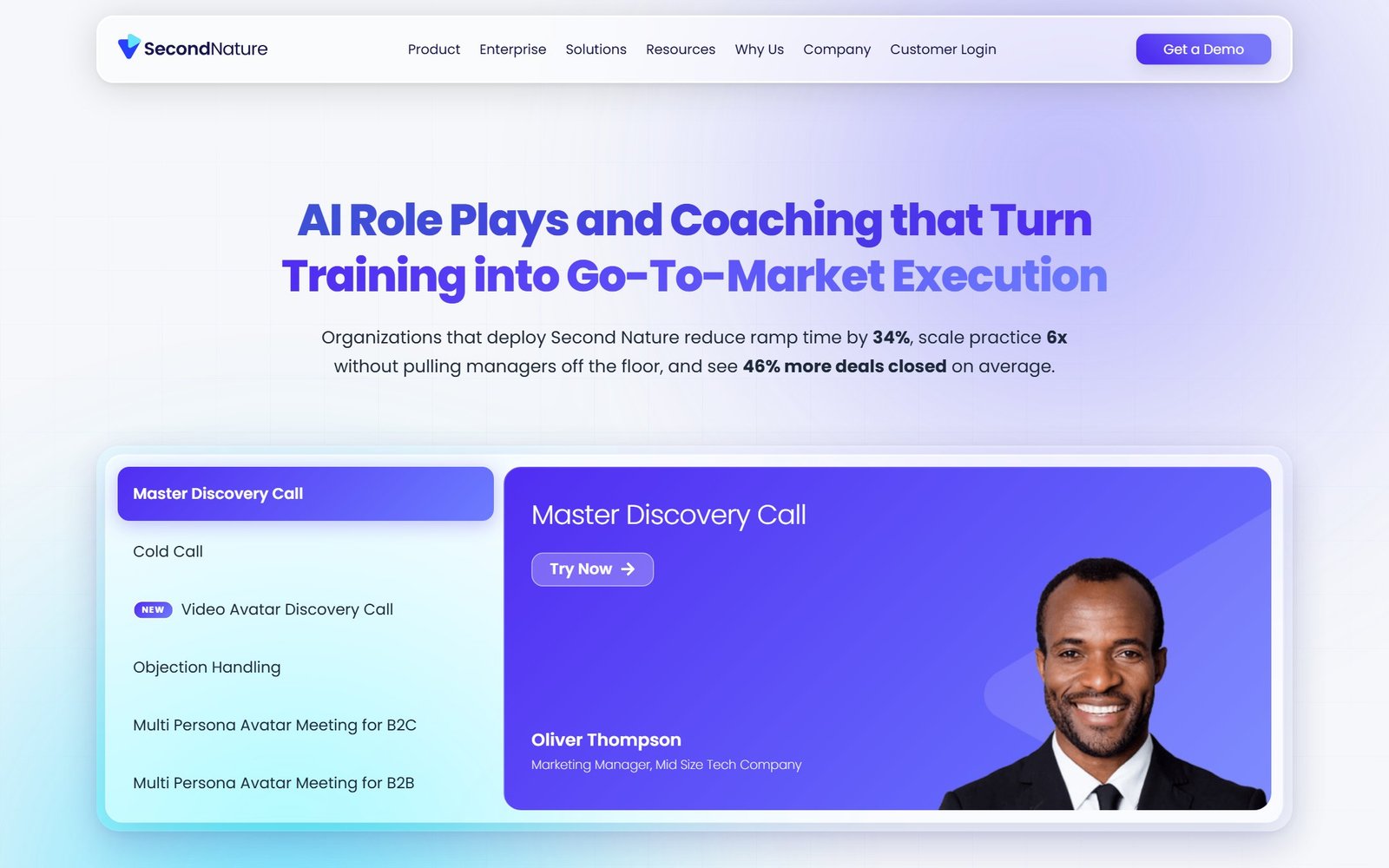
Most AI roleplay tools give you a text box that plays the role of a customer. Second Nature gives you a 3D avatar with facial expressions, body language, and emotional reactions that shift based on how you handle the conversation. It is the G2 number 1 rated AI Role Play Training platform and it is used by Oracle NetSuite, SAP, and dozens of global enterprise sales organisations.
Website: Second Nature AI
Last updated: July 27, 2026.
Related: Yoodli vs Second Nature | Best AI roleplay tools for corporate training | Yoodli review | Best AI corporate training tools
Faz says: The classic failure mode in sales enablement is reps practising on each other and forgetting it by Friday. Second Nature attacks that at enterprise scale, and its differentiator is avatar quality: a 3D persona whose posture shifts when you skip discovery lands differently than a chatbot printing “the customer seems unimpressed.” We cannot tell you the price, because Second Nature publishes none. What we can tell you is that the Oracle NetSuite case study is documented, and the G2 reviews are detailed and consistent across hundreds of entries.
What Second Nature AI Actually Is
Second Nature AI is a dedicated enterprise sales training platform built around AI-powered roleplay simulations. Founded in Israel, it has grown to serve global enterprise sales organisations including Oracle NetSuite, SAP, and Autodesk.
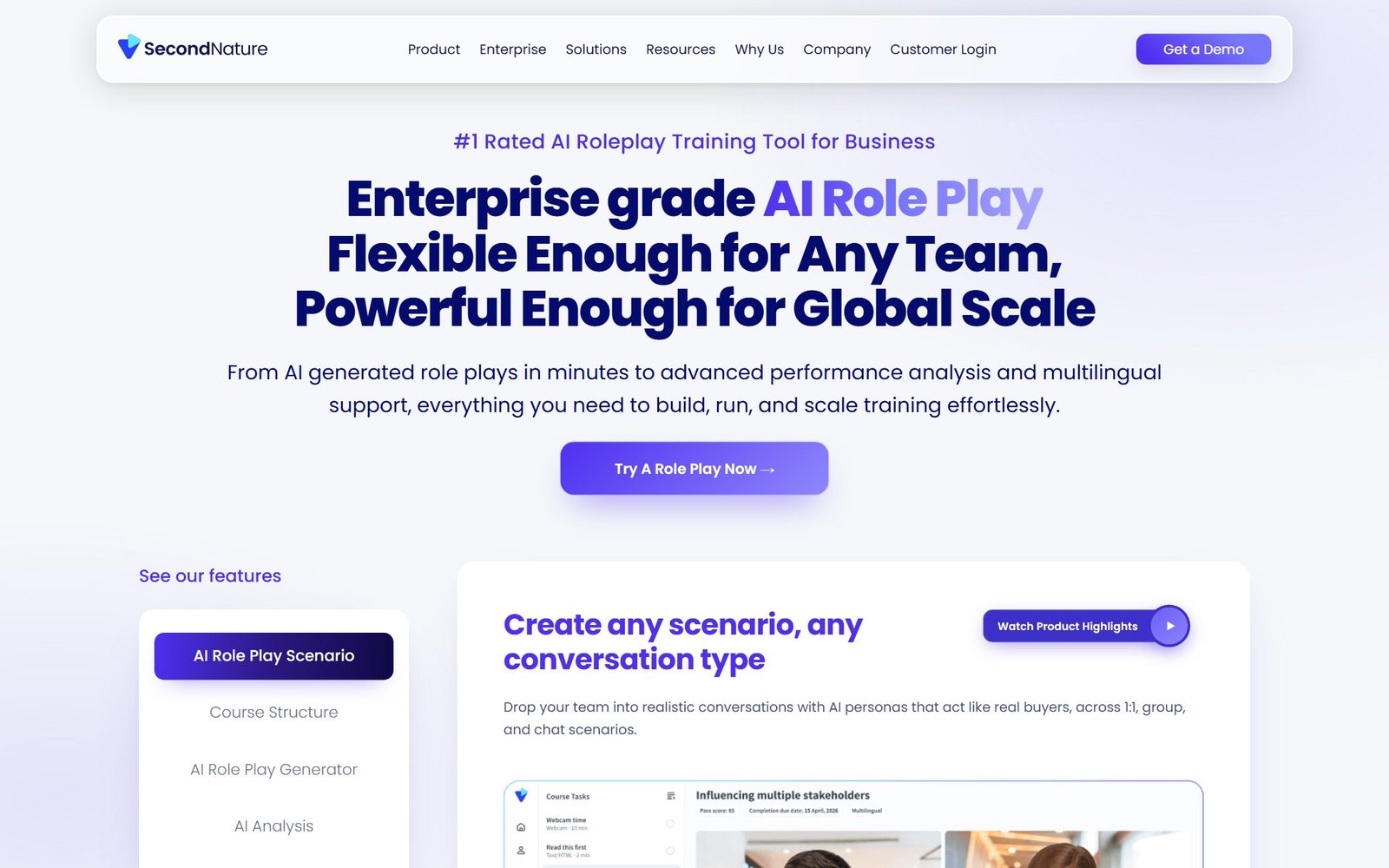
The core product: a sales rep opens a roleplay scenario, starts a conversation with a 3D AI avatar representing a specific customer persona, and practices a specific sales situation: cold call, discovery call, pricing objection, closing. The avatar responds dynamically to what the rep says, adjusts tone and body language based on how the conversation goes, and scores performance against a pre-defined ideal response framework.
Second Nature does not sell to individuals or SMBs. Every customer goes through an enterprise sales process with custom pricing based on team size, scenario complexity, language requirements, and integration scope.
Pricing
Second Nature publishes no pricing at all. There is no pricing page, no public tiers, and no self-serve signup: every route on the site ends at “Get a Demo”. All deals are custom enterprise contracts negotiated directly, and buyers consistently report enterprise minimums that put the platform out of reach for small teams. We are not going to invent a per-seat number for a vendor that publishes none. What we can tell you is what to ask for in the quote: seat count and minimum, contract length, how many custom scenarios are included in onboarding, which languages are covered, and whether the Salesforce integration is in the base tier or an add-on.
For comparison, Yoodli offers a functional free plan and paid plans from around $8 to $28/mo per user. Second Nature is not competing for that market.
Core Features
3D Avatar Conversations
Second Nature’s primary differentiator. AI avatars are rendered in 3D with facial expressions, body language, and emotional cues that respond to the conversation. When a rep handles an objection well, the avatar’s posture opens. When a rep talks price too early, the avatar’s expression shifts. Sales training research consistently shows that reps who practice reading non-verbal cues retain more than those who practice text-only scenarios.
Dynamic Branching Conversations
Conversations branch based on what the rep says. A strong discovery question leads to a different conversation path than jumping straight to product features. The branching logic is configured by L&D teams when building scenarios. They define the ideal path, common objection routes, and evaluation criteria, then Second Nature handles the dynamic execution at scale.
24+ Language Support
Second Nature supports 24+ languages including English, Spanish, French, German, Portuguese, Japanese, Mandarin, Italian, and Dutch. For global enterprise sales teams, this is one of the most consequential differences from competitors. Yoodli is English-only. Most AI coaching tools are built around English. Second Nature’s multilingual depth is a genuine differentiator for organisations running sales training across multiple regions.
Voice-First Practice and Multi-Persona Meetings
The 2026 product leans on voice rather than typing, and the scenario library now includes video-avatar discovery calls and multi-persona meetings where a rep faces several stakeholders at once rather than a single buyer. For teams selling into committees, practising the group dynamic is closer to the real thing than a one-to-one roleplay.
Salesforce Integration
Second Nature connects directly to Salesforce via the AppExchange. Training data, readiness scores, and completion tracking push into the CRM alongside pipeline data. The Oracle NetSuite case study documents 32% more pipeline opportunities and a 21% increase in closed revenue attributed to Second Nature implementation.
Manager Dashboards
L&D managers see dashboards showing scenario completion rates, AI scoring on each defined competency, session recordings, readiness scores, and progress trends. The value at scale is that managers do not have to review every recording manually. The platform surfaces who needs attention.
What Users Say
Second Nature holds 300+ G2 reviews with a 4.6/5 rating and the number 1 position in G2’s AI Role Play Training category.
Consistent praise: Avatar realism compared to text-only alternatives, multilingual support for global teams, customisable scenarios, time savings for managers who previously ran every roleplay manually.
Consistent criticism: AI scoring inconsistency (some users report the same response getting different scores across sessions), setup time for building quality scenarios, pricing and procurement complexity, no real-time live call coaching.
Saru says: The G2 score distribution is heavily weighted toward 4s and 5s, which is typical for enterprise software where buyers who invested in deployment want to validate their decision. The most credible negative signals are the scoring inconsistency reports and setup complexity feedback. Both point to the same truth: Second Nature delivers its value proportionally to how much time your L&D team invests in scenario design. Buy it with minimal scenario customisation and you get average results. Invest in building realistic scenarios for your specific products and personas, and the results match the case studies.
Second Nature vs Alternatives
Second Nature vs Yoodli: Second Nature has better avatar realism and multilingual support for enterprise teams. Yoodli has a free plan, real-time live meeting coaching during actual calls, and a much lower price point for individuals and SMBs. Full comparison: Yoodli vs Second Nature.
Second Nature vs Mindtickle: Mindtickle packages roleplay as part of a broader revenue enablement suite. Second Nature is more focused on roleplay quality specifically. Organisations wanting a full sales enablement stack lean toward Mindtickle; organisations wanting best-in-class roleplay lean toward Second Nature.
Is Second Nature Worth It?
For the right buyer, yes. The right buyer is an enterprise sales organisation with 50+ sales reps who need consistent practice at scale, multilingual teams, a Salesforce-centric operation, an L&D function willing to invest in scenario design, and budget for an enterprise contract.
For anyone outside that profile, such as solo reps, startup teams, SMBs without L&D functions, Second Nature is not the right tool. The enterprise-only model is a deliberate product decision, not a phase they will grow out of.
Bottom line on Second Nature
Second Nature is worth its enterprise price for a narrow, well-defined buyer: sales organisations of roughly 50 reps and up, running multilingual teams, operating on Salesforce, with an L&D function willing to invest real time in scenario design. That last condition is the one buyers underestimate. The platform returns value in proportion to the quality of the scenarios you build in it.
Everyone else should look elsewhere, and not reluctantly. There is no self-serve tier to grow into and no published price to budget against, so a small team cannot start cheap and scale up. Second Nature has deliberately chosen the enterprise market, and it is not a phase the company is going to grow out of. If you want to feel the product before talking to sales, the free simulations on their site are the only no-commitment way in.
Sources
- ATD: Association for Talent Development research
- Brandon Hall Group: corporate L&D benchmarks
- Harvard Business Review on sales coaching
Related AI training and people-ops tools
Related training and HR guides:
- Free AI Recruiting Tools: 7 picks with ATS fit notes.
- AI Leadership Development Tools: what Actually Develops Leaders.
- How to Build an AI-Powered Training Program for Your Team.
- Best AI Tools for Instructional Designers: 10 picks by ADDIE stage.
- Synthesia vs Colossyan: which AI Training Video Tool Is Better?.
More AI tool guides worth reading: Best AI Workforce Planning Tools, Best AI Negotiation Training Tools for Sales Teams and Best AI Tools for Manufacturing Safety Training.
Rolling this out so people actually use it
The failure mode in corporate training software is not a bad product, it is a deployment that reaches week six with impressive licence numbers and no behaviour change.
Pick one team and one behaviour, not one platform
The instinct is to roll out to everyone because the licence covers it. The better move is one team, one measurable behaviour, and a fixed period. A discovery call structure, an objection, a specific product pitch. Narrow scope means you can tell whether it worked, and a result from one team persuades the rest far more effectively than a mandate.
Managers have to use it before reps do
Roleplay and coaching platforms live or die on whether managers review the output. If a rep completes a scenario and nobody ever mentions it, completion becomes a compliance task within a fortnight. Before launch, agree which existing meeting will use the output, ideally the one-to-one that already happens, and make somebody responsible for opening it there.
Mandatory completion produces completion, not skill
If the only metric is completion percentage, you will get a high completion percentage and learn nothing. Pair it with something qualitative from the start: a manager rating on a rubric, a before-and-after recording, or a call outcome. Otherwise the dashboard will look excellent while the sales floor is unchanged.
Plan for the second wave, which is where it usually dies
The first cohort is volunteers and enthusiasts and it always goes well. The second is everyone else, and their experience decides whether second nature becomes part of how the team works. Budget real time for the second wave, expect more resistance, and do not read the first cohort’s enthusiasm as evidence the rollout is done.
Name the owner and the stop condition
One person whose job includes this, with the hours to do it, and a written statement of what twelve months would have to look like for you not to renew. Both are unglamorous and both are the difference between a platform that survives a budget review and one that quietly does not.
Measuring training, honestly
Training is the discipline most prone to measuring the wrong thing well. Four levels of rigour are available and most organisations stop at the first.
Reaction is easy and nearly worthless
Satisfaction scores at the end of a session tell you whether people enjoyed it, which correlates weakly with whether they can now do anything differently. Collect it if you like, and do not report it as evidence the training worked.
Completion is an activity metric
Completion percentage measures compliance with an instruction. It is genuinely necessary for regulated training, where the record is the point, and it is not evidence of capability anywhere else. Report it as what it is.
Behaviour change is where the real evidence starts
Pick one observable behaviour and measure it before and after: the proportion of discovery calls that reach a defined qualification step, the share of tickets resolved without escalation, the number of safety observations logged. It needs a baseline from before the training, which is why this gets skipped, and it is the first level that would survive a hostile question.
Business outcome, with the caveat stated out loud
Attributing revenue or incident rates to a training programme inside one year is genuinely hard, because everything else moved too. If you report an outcome, report what else changed in the same period. The most credible thing a training team can do is claim the behaviour change it can evidence and be openly cautious about the outcome it cannot.
Take the baseline in the week before launch
Whatever you choose, capture it before anything is switched on, from a source the project did not touch. It takes an hour and it is unrecoverable afterwards, which is the single reason most training investments can never be evaluated.
Why the price you see may not be the price we saw
This deserves its own section because it affects several tools in this category and almost no comparison article accounts for it.
What we actually observed
When we read Synthesia’s pricing page on 4 September 2026, every plan figure was in rupees, because our captures run from an Indian IP address and the site served local pricing automatically. HeyGen went further: a request to heygen.com/pricing redirected to its /en-in/ locale even when we sent a United States language header, meaning the routing is by IP rather than by browser preference.
Why this breaks most price comparisons
An article quoting a single global figure for a geo-priced tool is describing one country’s rate card and presenting it as the price. Regional pricing is not usually a straight currency conversion either; vendors set local rates deliberately, so the ratio between two markets can differ considerably from the exchange rate. That means you cannot fix the problem by converting, and we do not attempt to.
How to check your own number in thirty seconds
Open the vendor’s pricing page yourself, from the country where the contract will sit, and look at the currency symbol before you look at the number. If the URL contains a locale segment such as /en-in/ or /en-gb/, you are on a regional page. Where a vendor offers a currency selector, note that changing it sometimes changes the plan structure and not merely the symbol.
What to ask when the contract is cross-border
If your company is registered in one country and the team is in another, ask which entity is billed, in which currency, and whether the rate is fixed for the term or moves with a published exchange rate. Ask whether taxes are included, because several vendors here publish figures excluding tax. These questions are dull and they are the difference between a budget that holds and one that drifts by a fifth.
Where the figures on this page come from
Every price here was read from the vendor’s own pricing page on 4 September 2026 and carries that date. Where a page served us regional pricing we say so rather than converting it, because regional rates are set deliberately and are not a currency conversion.
The pages we read
Yoodli publishes $8 and $20 a month billed annually plus a free tier. Colossyan publishes a free plan and Professional at $59 a month annually with $30 per additional member. HeyGen publishes $0, $29, $49 and $149 a month with team seats at $20. iSpring publishes $970, $1,290 and $720 USD per author per year. Deputy publishes $5, $6.50 and $9 per user per month excluding tax. Synthesia served us rupee pricing, reported as such above.
The ones that publish no figure
Second Nature, Hyperbound, Mindtickle, Highspot and Visier all declined to show us a price, and Allego publishes a pricing page with no currency figure on it at all. Articulate publishes only a limited-time offer, currently $1,198 per user per year against a struck-through $1,749. Treat any other figure for those seven as unverified.
What we do not do
We do not convert currencies, and we do not carry a figure we cannot source to the vendor. Where a number circulates and cannot be traced, we say so and withdraw it rather than repeating it with a hedge.
Tools mentioned in this guide

Written by
FazFaz is the founder of AIToolsBakery. Some tools here are tested hands on. Others are assessed from vendor documentation and pricing verified on the live page, and every review says which one it is. Sponsors can buy a position in a guide. They cannot buy the score, the criticism, or silence about a better option.
How we test and how we make money →